
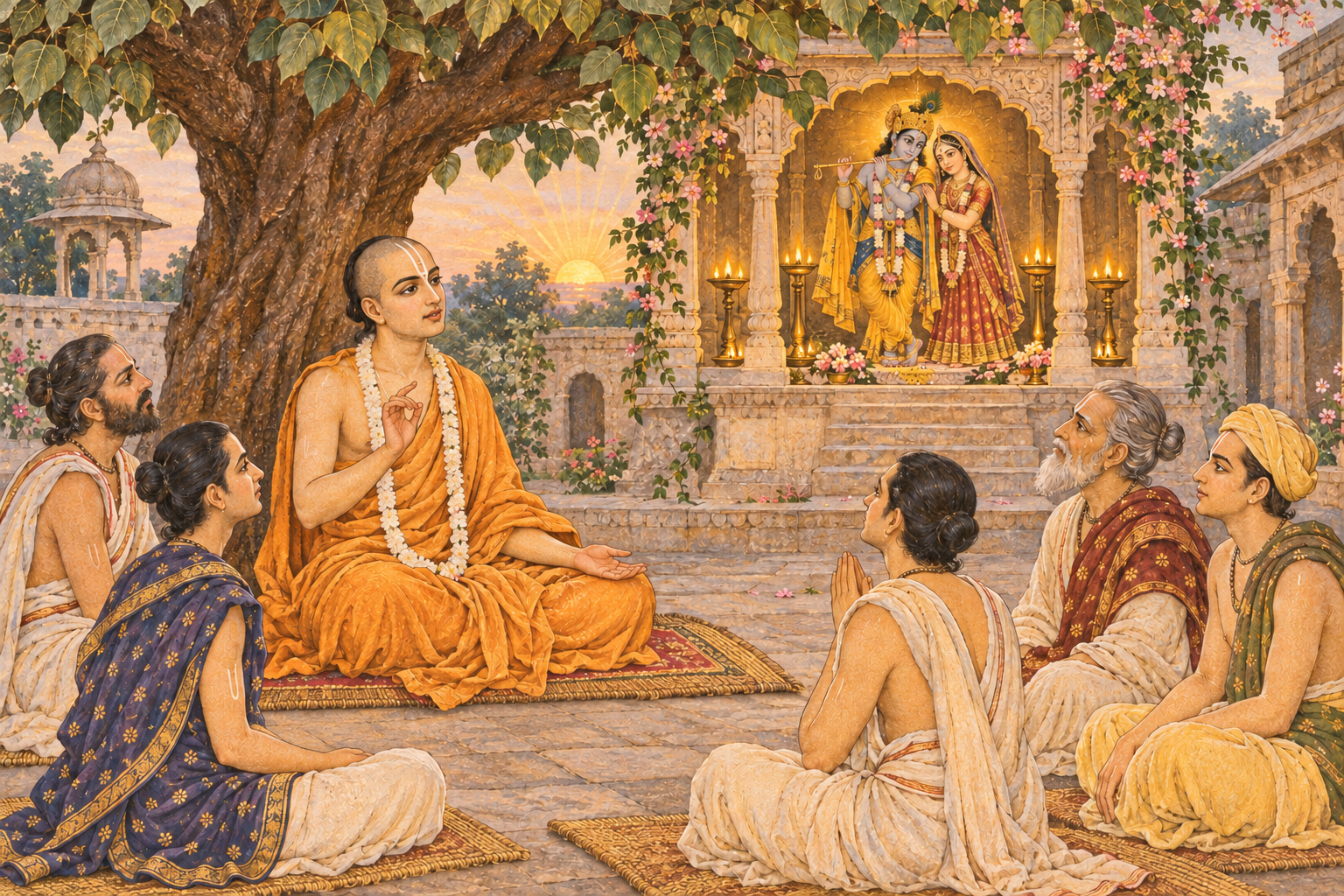
If you have encountered Sri Nimbarkacharya only as a name in a Vaishnava lineage, you probably have three questions: What did he teach, why does the tradition worship Radha and Krishna together, and how can you approach it without mistaking devotional legend for philosophy?
The clearest answer begins by keeping three things connected but distinct: the acharya, the doctrine of Dvaitadvaita, and the living discipline of bhakti. Once you see how they fit together, the Nimbarka tradition stops looking like one more sectarian label. It becomes a precise account of how the soul can belong wholly to Bhagavan without ceasing to be a real soul capable of love, responsibility, and service.
Begin with what an acharya actually transmits
Sri Nimbarkacharya is remembered as a great Vaishnava acharya of Radha-Krishna devotion. That description carries more meaning than a modern label such as philosopher, saint, or religious founder can hold by itself.
An acharya does not merely propose ideas. He gives a coherent interpretation of reality, embodies its disciplines, and transmits a way of learning through a lineage. Philosophy, worship, conduct, and the relationship between guru and disciple therefore belong to one structure. If you isolate any one of them, you get a distorted picture.
This is why a biography alone cannot tell you what the Nimbarka tradition is. Stories about an acharya may preserve a lineage’s sacred memory, but the tradition’s durable identity lies in what it teaches about Bhagavan, the individual soul, the world, bondage, liberation, and devotion. Begin there. Biographical accounts become easier to understand once you know the theological purpose they serve.
You may also encounter different chronologies for Sri Nimbarkacharya. Devotional lineages and modern historical reconstructions do not always use the same methods or arrive at the same dating. Do not force a false choice between contempt and credulity. Mark a claim as traditional chronology, lineage memory, or externally corroborated history according to the kind of claim it is. A precise century should not become a substitute for understanding Dvaitadvaita.
A useful test is simple: after reading an account of Nimbarkacharya, can you explain the relationship between Bhagavan, the jiva, and the world? Can you say why Radha-Krishna worship follows from that understanding? If not, you have collected information about the acharya without yet entering his teaching.
Dvaitadvaita holds difference and non-difference together

The philosophical key to the Nimbarka tradition is Dvaitadvaita, commonly rendered as dualistic non-dualism or difference and non-difference. The phrase is easy to repeat and easy to misunderstand. It does not mean that reality is dual on some days and non-dual on others. It is not a hesitant compromise placed halfway between two rival opinions. Difference and non-difference describe two real aspects of the same relationship.
Start with three realities:
- Brahman, or Bhagavan, is the independent divine reality on whom everything else depends.
- The jivas are conscious selves. They are real, finite, morally responsible, and capable of knowledge, devotion, and liberation.
- The material world is also real. It is not made irrelevant simply because it depends on Bhagavan.
The jiva is different from Bhagavan because it is finite and dependent. Bhagavan is not one finite being among other finite beings. The jiva cannot claim divine independence, and its limitations cannot be transferred to Bhagavan. This difference gives devotion its meaning: there is a devotee who loves, a Bhagavan who is loved, and a real relationship between them.
Yet the jiva is also non-different from Bhagavan in the crucial sense that it has no independent existence or power apart from its divine ground. The same applies to the world. Souls and nature are real, but they are not self-sufficient rivals standing outside Bhagavan. Their being is inseparably dependent upon him.
A simple analogy can help, provided you do not force it too far. A ray is distinguishable from the sun whose light it carries, but it is not an independent source of sunlight. If you erase the distinction, the ray has no identity of its own. If you sever the connection, it is no longer a ray. Dvaitadvaita asks you to hold distinction and dependence together without sacrificing either.
This gives you three checks for evaluating any explanation of Nimbarka’s teaching:
- Does it preserve the reality of Bhagavan, the individual souls, and the world?
- Does it preserve enough difference for love, moral agency, worship, grace, and service to be meaningful?
- Does it preserve complete dependence on Bhagavan rather than turning souls and matter into separate, self-governing powers?
If an explanation treats the world as sheer nothing, it has lost one side of the teaching. If it makes the soul independent of Bhagavan, it has lost the other. If it says that difference is merely an error that disappears with knowledge, it cannot explain why devotion should remain a real relationship rather than a temporary exercise.
This also changes how liberation is understood. Liberation is not permission for the ego to declare itself supreme. Nor does spiritual freedom require loving relationship to become meaningless. Within the logic of Dvaitadvaita, freedom releases the jiva from bondage so that its dependence on Bhagavan can be lived knowingly and without obstruction. Individuality becomes the basis of service rather than the basis of separation.
Radha-Krishna worship is the centre, not an ornament
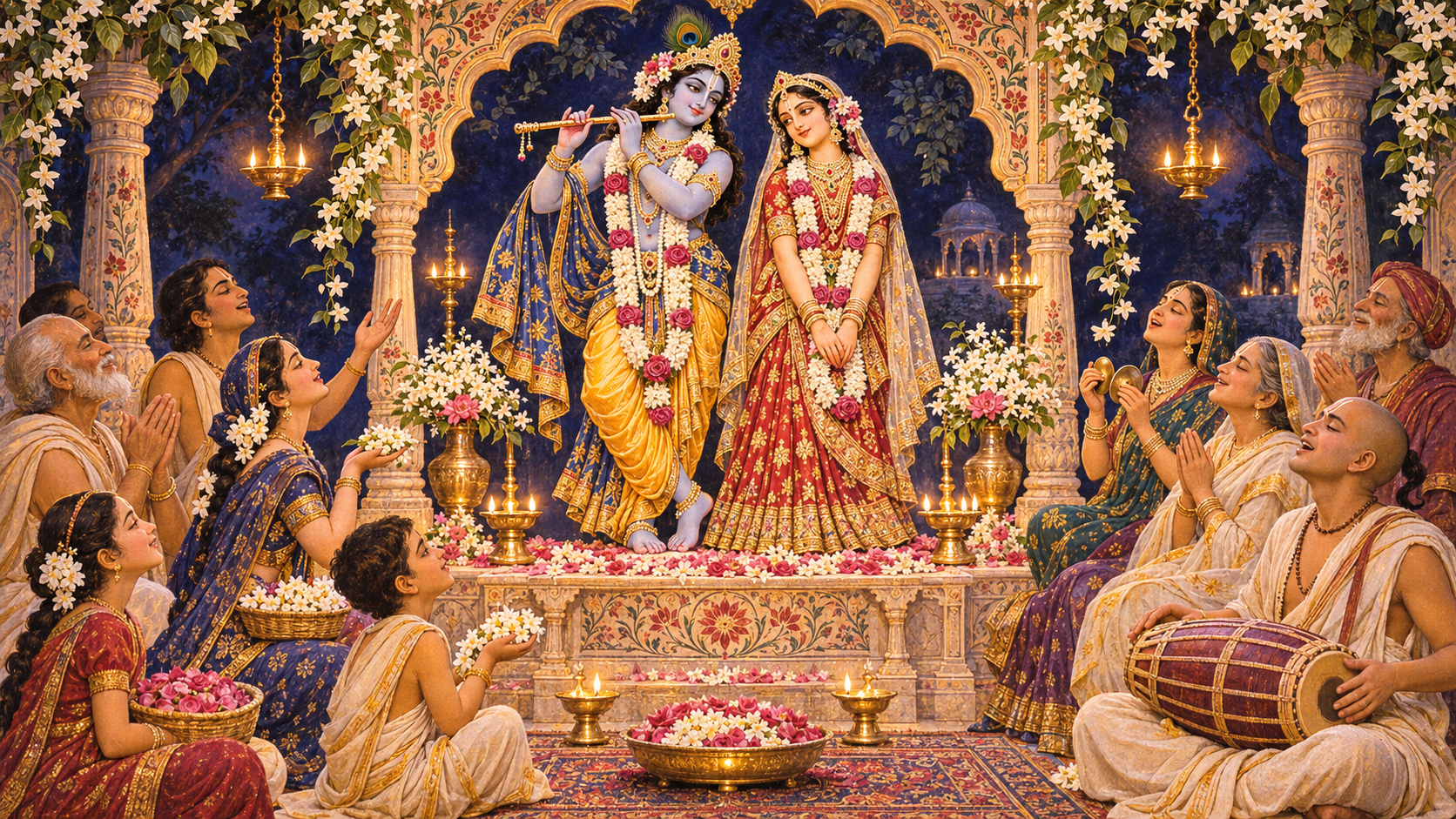
The Nimbarka tradition is not adequately described as abstract Vedanta followed by optional Krishna devotion. Its philosophical vision and its Radha-Krishna bhakti illuminate one another. Dvaitadvaita explains how a real relationship with the divine is possible; Radha-Krishna devotion shows what the fullness of divine relationship means for the devotee.
Radha should therefore not be treated as a decorative addition to an otherwise complete Krishna theology. The worship of Radha and Krishna together places divine love at the centre of the path. The devotee does not approach an impersonal principle and then add emotion for psychological comfort. Love, grace, nearness, remembrance, and seva become intelligible because the divine is approached personally and relationally.
This protects bhakti from two opposite reductions. The first reduces devotion to sentiment: beautiful images, music, festivals, and intense language without disciplined transformation. The second reduces Vedanta to an intellectual contest in which mastering terminology matters more than becoming fit for service. The Nimbarka orientation requires both clarity and devotion. Philosophy keeps emotion from becoming arbitrary; devotion keeps philosophy from becoming sterile.
You can use four practical signs to judge whether your understanding of Radha-Krishna bhakti is maturing:
- Your sense of dependence deepens instead of feeding spiritual self-importance.
- Remembrance becomes steadier rather than appearing only during emotionally charged occasions.
- Seva becomes concrete in conduct, attention, and responsibility rather than remaining a poetic word.
- Respect for guru, fellow devotees, sacred practice, and the divine names grows together.
Emotional intensity by itself proves none of these things. A person can speak constantly about exalted devotion while remaining careless, vain, or exploitative. Bhakti should make the distinction between Bhagavan and the dependent self clearer, not turn religious feeling into a claim of personal grandeur.
The same point applies to sacred art and temple worship. When you see Radha and Krishna together, do not stop at visual appreciation. Notice the theology being enacted: reality is relational; love does not erase identity; and nearness to Bhagavan does not abolish the devotee’s posture of service.
Approach the living tradition with devotion and discernment
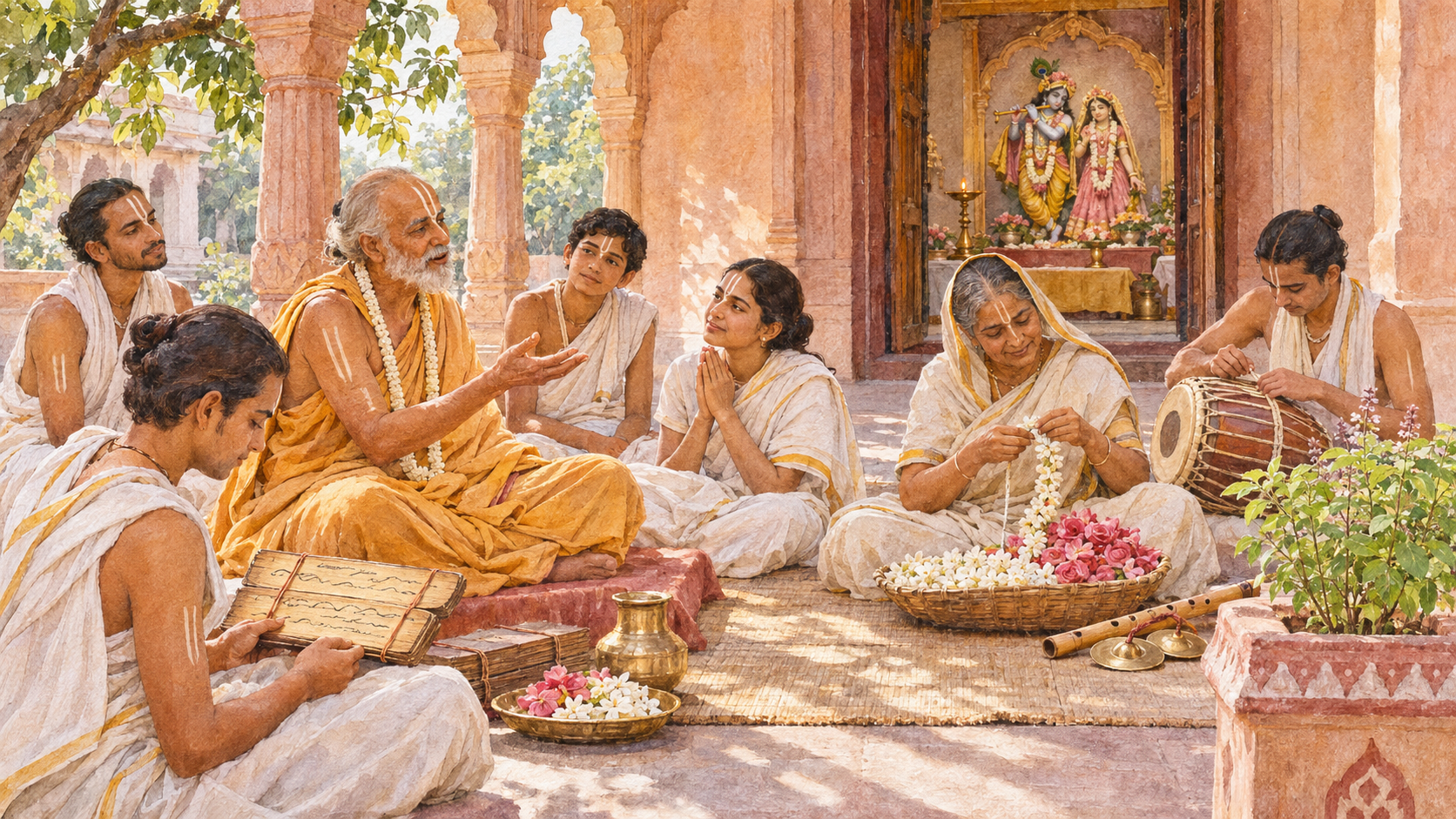
A sampradaya is a transmission, not a brand name. Reading can give you vocabulary and prevent basic confusion, but a living lineage also carries methods of worship, interpretation, discipline, and initiation. If you want more than general knowledge, your next task is to identify a trustworthy channel of transmission.
Use the following sequence rather than collecting mantras, images, and lineage claims at random:
- Learn the doctrinal map first. Be able to define Bhagavan, jiva, jagat, difference, non-difference, bhakti, and seva in plain language. If you cannot explain a term without hiding behind more Sanskrit, keep studying it.
- Ask a teacher how the teaching was received. A serious representative should be able to identify the guru relationship or institution through which the tradition was learned. A prestigious label without an intelligible line of accountability is not enough.
- Distinguish public devotion from initiated discipline. Public remembrance of Radha-Krishna, respectful temple attendance, and study do not authorize you to extract a lineage-specific mantra from the internet and initiate yourself. If a practice is tied to diksha, learn it from an authorized teacher and understand its commitments before accepting it.
- Ask what daily practice actually requires. Find out what is done regularly, what ethical expectations accompany it, what role temple or home worship has, and how guidance is given when questions arise. Vague promises of rapid spiritual status are less useful than a modest discipline that can be explained and sustained.
- Observe conduct before making commitments. Knowledge, eloquence, robes, titles, and online popularity do not cancel the need for honesty, restraint, consistency, and respect. A teacher who invokes surrender to prevent reasonable questions is asking for submission to personality, not demonstrating the logic of sampradaya.
- Decide what you are seeking. General education, occasional satsanga, regular practice, and formal initiation are different levels of involvement. Do not accept obligations meant for one level while imagining that you have chosen another.
These checks do not place the ego above the guru. They help you approach the guru principle seriously. Trust in a spiritual lineage should be grounded in recognizable transmission, coherent teaching, appropriate conduct, and informed consent about the discipline being undertaken.
Apply the same discernment when you read about Nimbarkacharya online. Separate doctrine from miracle narrative, and separate lineage chronology from modern historical dating. Ask whether a page teaches anything distinctively Nimbarka or merely attaches the acharya’s name to generic religious material. Look for a coherent account of Dvaitadvaita and Radha-Krishna bhakti rather than treating every use of the name as equally authoritative.
If you already belong to another sampradaya, study without turning the encounter into a contest. Learn Nimbarka’s categories on their own terms before comparing them with another system. Similar devotional vocabulary can conceal important philosophical differences, while different terminology can conceal substantial shared ground. Fair comparison begins only after accurate understanding.
Key takeaways for your next step
- Sri Nimbarkacharya should be understood through the union of acharya, doctrine, discipline, and transmission – not through biography alone.
- Dvaitadvaita teaches real difference and real non-difference: Bhagavan, souls, and the world are real, while souls and the world remain wholly dependent on Bhagavan.
- Difference makes devotion and responsibility meaningful; non-difference prevents the soul or world from being imagined as independent of the divine.
- Radha-Krishna bhakti is the theological centre of the tradition, not an emotional addition to an otherwise abstract philosophy.
- Before pursuing initiation, verify the channel of transmission, distinguish public practices from initiated ones, learn the obligations involved, and observe the teacher’s conduct.
For your next study session, write one sentence each defining Bhagavan, jiva, jagat, difference, and non-difference. Then explain why those five ideas make Radha-Krishna bhakti possible. When you can do that without collapsing the soul into Bhagavan or separating it from him, you will have moved beyond remembering Nimbarkacharya’s name and begun to understand his tradition.
References

Leave a Reply
You must be logged in to post a comment.