

If you are an Indian-origin scientist working abroad, the hard question is not whether returning to Bharat would feel meaningful. It is whether a move would give your research the people, facilities, autonomy and institutional continuity it needs. For everyone funding or hosting that return, the test is equally practical: will a celebrated appointment become a functioning laboratory?
The PM Research Chair has brought that decision into focus. More than 3,600 scientists abroad have applied, while the programme is intended to support 120 researchers over five years. That gap is both an opportunity and a warning. Bharat has found a large pool of interest; it must now build a reliable system for selecting, receiving and retaining the people behind those applications.
Key takeaways
- The application surge demonstrates serious interest in returning, but an application is not yet a relocation, an operational lab or a reversal of brain drain.
- With 120 planned places over five years, the PM Research Chair should be treated as a measured first phase whose operating lessons determine how quickly it can expand.
- The funding packages matter only when host institutions can convert money into usable space, equipment, research staff and timely decisions.
- Returning scientists should obtain a written implementation plan from the host institution before making an irreversible career or family move.
- Public evaluation should track laboratory activation, recruitment, retention and institutional capacity, not merely appointments, expenditure or announcements.
The applicant surge is an opening, not an outcome

More than 3,600 applications tell us something important: a substantial number of overseas scientists are willing to consider Bharat as a serious base for research. Uncertainty in American science funding has made choices that once looked settled less certain. The PM Research Chair has offered a timely alternative rather than waiting for individual researchers to find their own way home.
But it is too early to declare that brain drain has been reversed. A scientist may apply to preserve an option while comparing institutions, funding conditions and family implications. Some applicants may not meet the final criteria; some selected candidates may decline; and some who accept may encounter delays before their laboratories can begin work. The meaningful numbers will be accepted offers, completed moves, activated labs and researchers who remain after the initial appointment.
At the stated scale, there is roughly one planned place for every 30 applications. That is not an acceptance rate, because the eligibility and quality of the full applicant pool have not been reported. It does show how narrow the funnel is. Selection therefore needs to distinguish reputation from the ability to build a programme in Bharat.
- Scientific merit: Is the proposed work strong enough to advance its field, rather than merely fitting a fashionable label?
- Mission fit: Does it build capability in one of the programme’s 13 priority sectors without allowing strategic language to replace peer judgement?
- Institutional fit: Can the proposed host support this particular laboratory, including its facilities, staffing and regulatory needs?
- Additional capacity: Will the appointment create a team, methods and infrastructure that remain useful beyond one prominent individual?
Host interest is also substantial: more than 400 Indian institutions applied to receive researchers. Yet a host application is no more conclusive than a scientist’s application. Institutions should be assessed on operational readiness, not the warmth of their invitation or the prestige of their name.
The competitive window will not remain open indefinitely. Europe and China are also pursuing globally mobile scientific talent. Bharat therefore needs a published decision calendar and prompt communication, while preserving rigorous review. Speed should remove administrative uncertainty, not shorten scientific scrutiny.
A research chair must become an operating laboratory
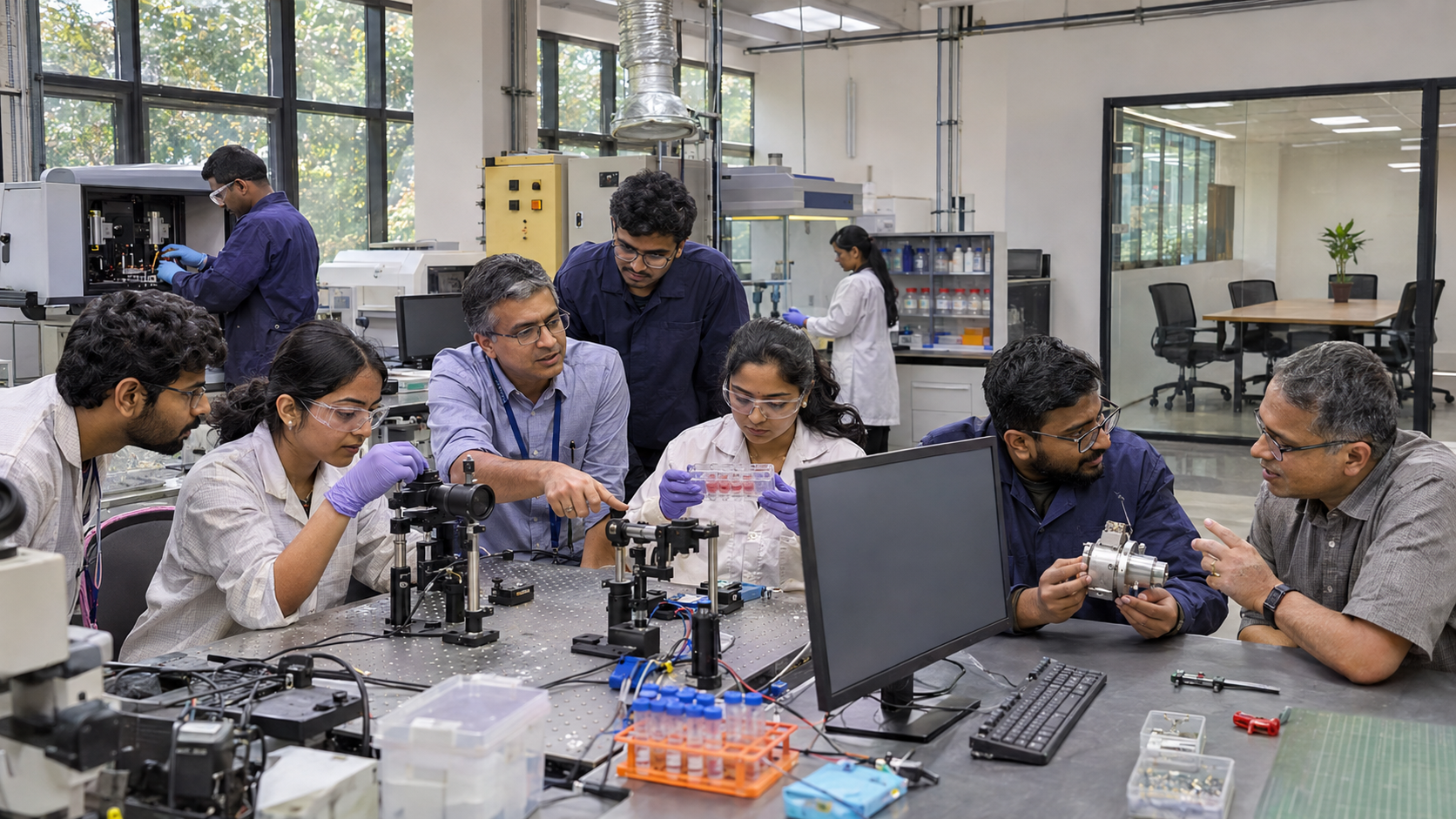
The programme was opened with Rs 200 crore budgeted for 2026-27. Its funding levels are described as approximately Rs 4 crore, Rs 6.5 crore and, at the upper end, as much as Rs 14 crore for running laboratories. These figures should not be casually presented as personal compensation. Their national value lies in the research capacity they can create.
Money becomes science only through a conversion chain: an award reaches an institutional account; the institution releases usable space; equipment is acquired or made accessible; researchers are hired; and the team receives the approvals needed to begin work. A break anywhere in that chain can leave a well-funded chair scientifically idle.
Before resigning from an overseas position, closing a laboratory or moving a family, a selected scientist should ask the host for a signed implementation note covering six points:
<!– wp:list {
Leave a Reply
You must be logged in to post a comment.