

If you found a Saraswati mantra in a video, image, or secondary retelling and want to know whether it represents the Prapanchasara Tantra, do not begin by choosing a repetition count. Begin by verifying the wording, setting, and authority of the instruction.
Chapter 7 belongs to a larger tantric framework. Its parts should therefore be read in relation to one another, not mined for an isolated formula. The method below will help you study the chapter, identify what you can practice honestly, and recognize where a textual edition or lineage teacher must supply what the internet cannot.
First decide whether you want study, devotion, or sadhana
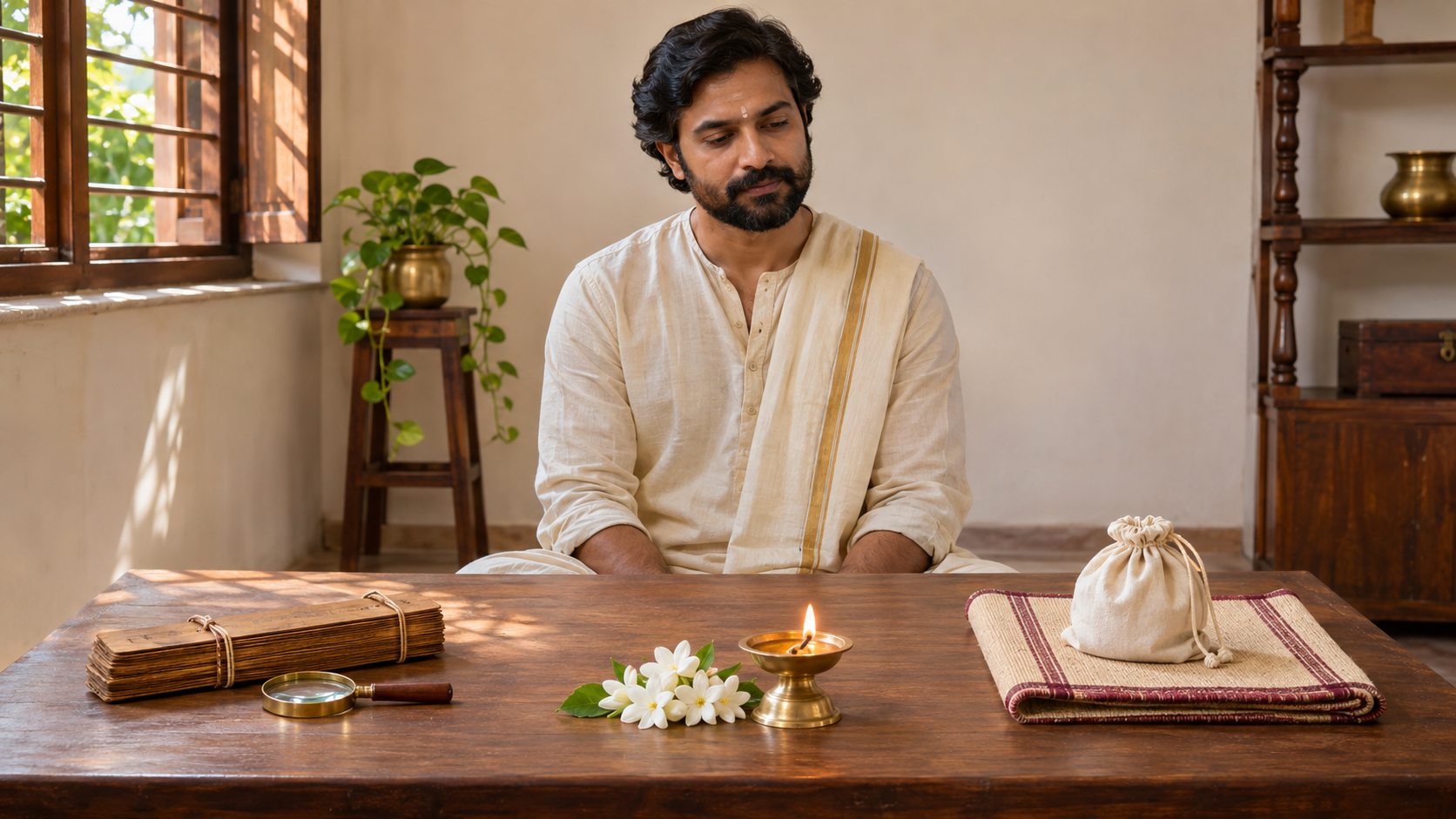
Three different activities are often bundled together under the word practice. Separating them prevents an act of devotion from being misrepresented as a tantric rite.
- Textual study asks what Chapter 7 actually says. Your tools are a named edition, its Sanskrit text where available, a translation, and careful notes.
- Devotional practice directs reverence toward Saraswati through prayer, study, music, disciplined speech, or another form already established in your family or sampradaya. It need not claim to reproduce the Prapanchasara method.
- Formal tantric sadhana follows an exact mantra, contemplation, diagram, sequence, and set of conditions where these are prescribed. It also respects whatever requirements the relevant lineage places on instruction and initiation.
You may move from one level to another, but do not collapse them. Reading a mantra is not automatically permission to deploy it ritually. Loving Saraswati does not require you to pretend that an improvised ceremony came from Chapter 7.
Your immediate aim should determine your next step. If you want a better understanding of Saraswati, begin with study. If you want a daily devotional relationship, use a practice whose provenance you already know. If you want the chapter’s formal sadhana, verify its complete method before attempting to perform it.
Read Chapter 7 as a connected practice system

The seventh chapter centers on the sacred science of Saraswati within a work traditionally attributed to Adi Shankaracharya and concerned with mantra, yantra, and tantric practice. Traditional attribution should be stated as traditional attribution; it is not the same thing as demonstrating historical authorship.
The wider context changes how you read an individual instruction. A mantra is not merely an affirmation. A yantra is not merely devotional decoration. A ritual sequence is not a collection of interchangeable gestures. Their relationship has to be established by the text or by the lineage interpreting it.
| Practice layer | Question to answer | Assumption to avoid |
|---|---|---|
| Mantra | What exact verbal form appears, and what does the surrounding passage ask the practitioner to do with it? | That a similar Saraswati mantra remembered from elsewhere is equivalent. |
| Yantra | Is a diagram actually prescribed, and how are its geometry, letters, orientation, or use connected to the practice? | That any image marketed as a Saraswati yantra belongs to Chapter 7. |
| Contemplation | Which qualities or form of the deity does the passage direct the practitioner to hold in awareness? | That a familiar modern image can replace the specified contemplation without changing the method. |
| Procedure | What sequence, conditions, materials, and limits are explicitly given? | That customary worship steps may be inserted and then attributed to the text. |
| Aim | What fruit or transformation is actually connected with the instruction? | That modern promises about grades, fame, memory, or eloquence reproduce the chapter’s teaching. |
If you cannot fill one of these cells from the passage in front of you, write unknown. An honest blank is more useful than a confident invention because it tells you exactly what to ask next.
Build a working record of the chapter
Use the following process with one edition at a time. It turns vague spiritual curiosity into questions that can be checked.
- Record the edition, translator or editor, language, publisher, and the page, verse, or section identifier that the edition actually supplies. A screenshot without this information is not a dependable practice manual.
- Copy the relevant wording exactly. Keep the Sanskrit text, transliteration, and translation in separate fields rather than silently blending them.
- Mark every imperative. Distinguish what the passage commands from what it praises, describes, or promises. Do not convert praise into a ritual instruction.
- List every stated dependency. If one action is introduced only after another, preserve that order instead of extracting the more attractive step.
- Label each note as textual, lineaged, interpretive, or personal. This prevents a teacher’s explanation, a translator’s choice, and your own reflection from being mistaken for the same kind of authority.
- Turn every uncertainty into a precise question: Is this exact mantra open for devotional recitation in this lineage? Is the diagram required or optional? Does this instruction apply independently or only inside a larger rite?
A simple three-column page works well: what the text explicitly states, what a lineage or teacher adds, and what you have added for personal devotion. Do not erase the boundaries between the columns even when all three additions are meaningful.
What you can practice before formal instruction is clear
You do not need to choose between reckless experimentation and doing nothing. Until the formal method is verified, undertake a preparatory practice of reverence and study. Be explicit that it is preparation, not a transmission of the Prapanchasara rite.
- Prepare a clean, undistracted place and keep your chosen edition or verified passage in front of you.
- Begin with a Saraswati prayer already established in your tradition. If you do not have one, offer a respectful salutation in your own language rather than inventing Sanskrit or borrowing an unverified formula.
- Read a manageable passage slowly. If you have both the original and a translation, notice where the translation explains and where it merely approximates.
- Write answers to three prompts: What is described? What is commanded? What remains unresolved?
- Close with gratitude. Do not append seed syllables, ritual counts, diagram construction, or other technical elements remembered from unrelated practices.
This routine develops attention, textual honesty, and disciplined speech, all of which are appropriate foundations for approaching Saraswati. It makes no claim to confer a mantra, reproduce an initiation, or deliver a promised siddhi.
Leave technical elements unresolved rather than guessing
Pause when you encounter an exact mantra form, seed syllable, body-placement practice, ritual diagram, prescribed sequence, repetition requirement, or condition of eligibility that you cannot verify. Small alterations are not automatically harmless in a method built around precise relationships between sound, form, and action.
Lineages do not always draw the boundary in the same place. One may distinguish an open devotional prayer from a formal tantric application of related words; another may place additional conditions on instruction. Ask what is permitted in the lineage you intend to follow instead of turning one community’s rule into a universal declaration.
How to assess a teacher or online instruction

A recognizable title above a mantra is not provenance. Before adopting a practice presented as Prapanchasara Tantra, ask questions that can receive checkable answers.
- Which edition and exact location contain the instruction?
- Which parts are explicit in Chapter 7, and which come through the teacher’s lineage?
- Is the wording stable in the edition being used, or are there variants that affect pronunciation or interpretation?
- Is initiation required for this particular use in this particular lineage, or is an open devotional form being taught?
- Does the proposed yantra genuinely belong to the cited method, and can its elements be explained?
- What aim does the instruction state, and what basis is there for any additional promise being made?
The work’s traditional association with Adi Shankaracharya does not authenticate every circulating graphic, recording, or ritual carrying his name. Prestige cannot substitute for a traceable passage and a coherent explanation of practice.
Be cautious when someone guarantees examination marks, instant eloquence, artistic fame, or rapid mastery; supplies only a cropped image; combines elements from several traditions without labeling the additions; or treats questions about textual location as disrespect. A trustworthy instructor can distinguish certainty from interpretation and can leave a question open when the basis for an answer is unclear.
Key takeaways
- Choose whether you are pursuing textual study, ordinary devotion, or formal tantric sadhana before selecting a practice.
- Read mantra, yantra, contemplation, procedure, and aim as related parts, but connect them only where the text or lineage does so.
- Keep textual wording, lineaged explanation, translation, and personal addition visibly separate.
- Use reverent study as preparation when the formal method is incomplete; do not relabel that preparation as the Chapter 7 rite.
- Verify the edition, exact passage, pronunciation, practice conditions, and lineage requirements before using technical elements.
Your next step is concrete: select one identifiable edition, open Chapter 7, and make the three-column record before adopting anything new. When you can show what the text states, what your tradition supplies, and what remains uncertain, you are approaching Saraswati with the precision that a goddess of knowledge deserves.
References

Leave a Reply
You must be logged in to post a comment.