
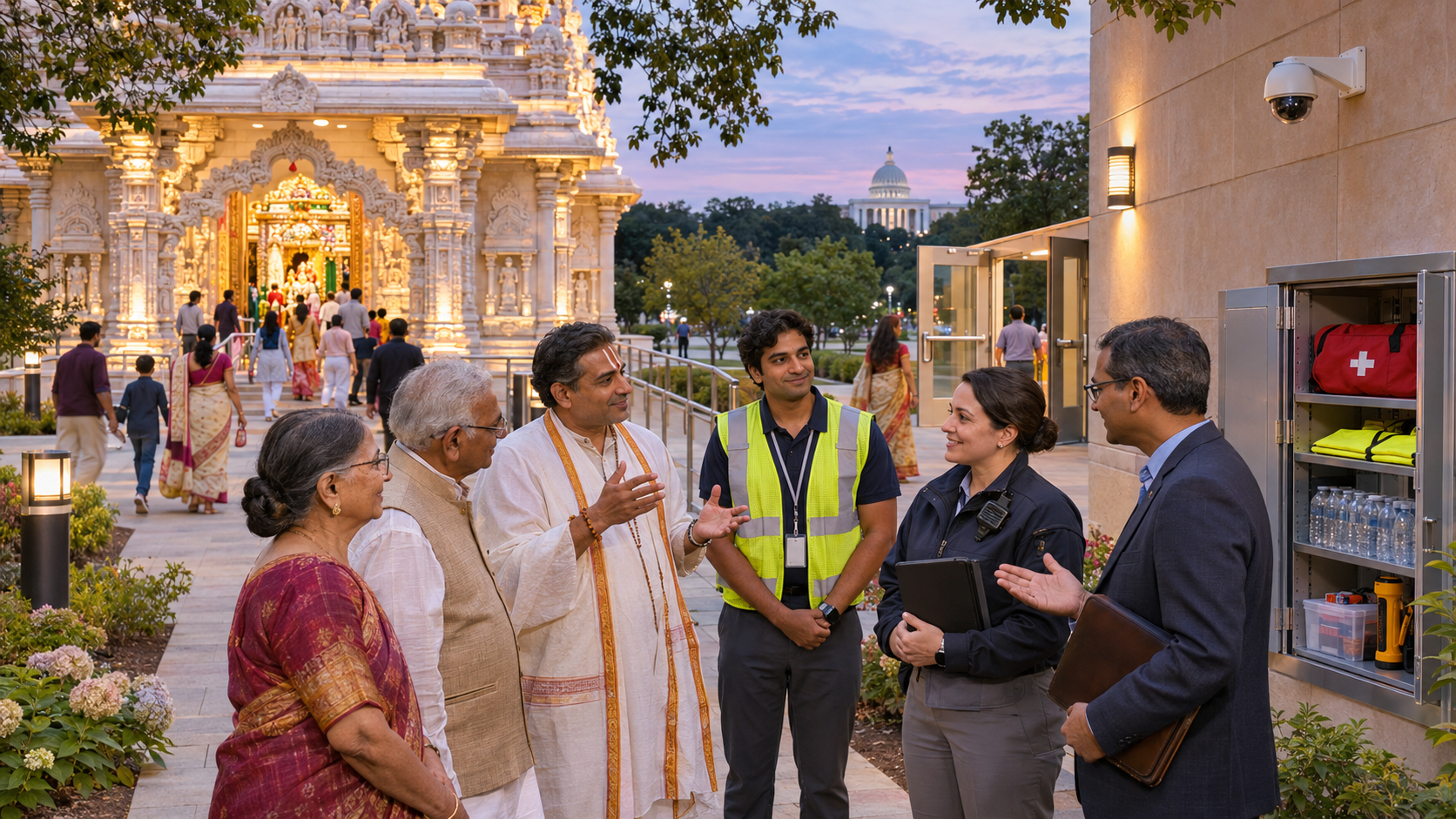
If you help run a mandir in the United States, you do not have to choose between a welcoming temple and a secure one. You need a system that can recognize risk early, protect people without profiling worshippers, and explain the community’s needs to public officials in a form that can produce a decision.
Temple security and federal representation are often discussed as separate concerns. In practice, they depend on each other. Security without civic access stays reactive. Representation without disciplined evidence becomes a general appeal that officials can acknowledge without acting on.
Security and representation are parts of the same civic problem
Pro-Hindu organizations have raised concerns they describe as Hinduphobia, called for stronger temple security, and sought greater Hindu-American participation in federal policy discussions during a Washington meeting with White House Faith Director Jennifer Korn and State Department officials. That engagement establishes that organized Hindu concerns have reached senior officials. It does not, by itself, establish the national frequency of anti-Hindu incidents or confirm that any requested policy has been adopted.
That distinction matters when you speak for a temple. Label confirmed incidents, reported concerns, perceived patterns, and verified threats separately. A careful record is not weaker advocacy. It makes your case harder to dismiss and protects the community from exaggeration that could later damage its credibility.
The work has two tracks. Operational security asks what happens at the mandir before, during, and after a threatening event. Civic representation asks whether Hindu-American experience reaches the officials who shape religious-freedom, community-safety, and public-engagement policy. Your temple may lead the first track directly. The second usually requires coordination across temples and organizations.
Make temple safety legible before asking for help

Start with a written picture of risk, not an equipment purchase. Cameras, access controls, and professional guards may be appropriate for a particular site, but none can replace clear responsibility, incident records, and a practiced emergency plan.
- Assign responsibility. The temple board should designate a security coordinator and a backup. Their job is to maintain the plan, keep contacts current, and bring unresolved risks to the board. It is not a license to confront suspicious people.
- Use the same incident record every time. Capture the date, time, exact location, what was directly observed, the precise words used in a threat, witnesses, photographs or screenshots, any official report reference, operational effects, and pending follow-up. Separate firsthand facts from interpretation.
- Classify without overclaiming. Distinguish an uncomfortable interaction, harassment, vandalism, disruption, suspicious activity, and a direct threat. Do not casually label every hostile comment a hate crime. A hostile event can still require attention even when its legal classification is uncertain.
- Map how the mandir actually operates. Review entrances, gathering points, festival congestion, isolated areas, access to keys or credentials, evacuation routes, and arrangements for children, elders, and people who need assistance.
- Give every role a named owner. Decide who contacts emergency services, pauses a program, guides worshippers, meets responders, communicates with families, preserves evidence, and speaks publicly. Volunteers should not have to invent these decisions during an emergency.
- Seek qualified review. Ask appropriate local emergency personnel, law enforcement, the temple’s insurer, and a qualified security professional to review the plan for the building and local conditions. Seek legal counsel where reporting, privacy, employment, or public accusations create legal questions.
Keep original evidence intact and restrict access to the full incident file. A public update can describe verified trends without publishing sensitive security details or unverified identifying information. Posting a person’s face, name, or vehicle details before verification can expose an innocent person, complicate an investigation, and create additional safety or legal risk.
If danger is immediate, protect life and contact emergency services. Do not ask an untrained sevak to investigate, pursue, restrain, or confront someone. The temple’s detailed response procedures should come from trained local professionals who understand the site.
Ask federal officials for decisions, not expressions of sympathy

A meeting is access; it is not an adopted policy. Do not announce a policy victory unless an official action, written commitment, or implemented change supports that description. Instead, arrive with a concise brief that makes it possible for an official to answer, assign, or redirect each request.
- Define the situation. Identify the temple or community affected and the precise problem you want addressed.
- Present verified evidence. Summarize documented incidents and clearly mark reports that remain unverified. Retain the underlying records so that a responsible official can request them through a secure channel.
- State the consequence. Explain documented effects such as altered access, disrupted worship, canceled activity, additional security measures, or fear reported by community members. Do not claim an effect you have not recorded.
- Show what has already been attempted. Identify the local authority, professional, or institution contacted and the unresolved issue that remains.
- Make a decision-sized request. Ask for a designated point of contact, a defined consultation process, clarification of relevant program eligibility, a secure route for submitting incident information, or referral to the office that actually has jurisdiction.
- Record the follow-through. Note what was requested, what the official acknowledged, who accepted responsibility, what remains open, and what written response is expected.
Route each problem to the right level. An immediate threat belongs with emergency responders. Building procedures belong with local professionals and the people responsible for the property. Legal classification belongs with the appropriate authorities and qualified counsel. Federal engagement is most useful for national policy consultation, interagency coordination, access to relevant public programs, and a durable channel through which Hindu-American concerns can be heard.
Do not assume that a particular federal office controls a local response or administers a particular resource. Ask the office to confirm its role and, when necessary, identify the correct destination in writing. That turns an unproductive referral into a traceable next step.
Make Hindu-American representation accountable to Hindus
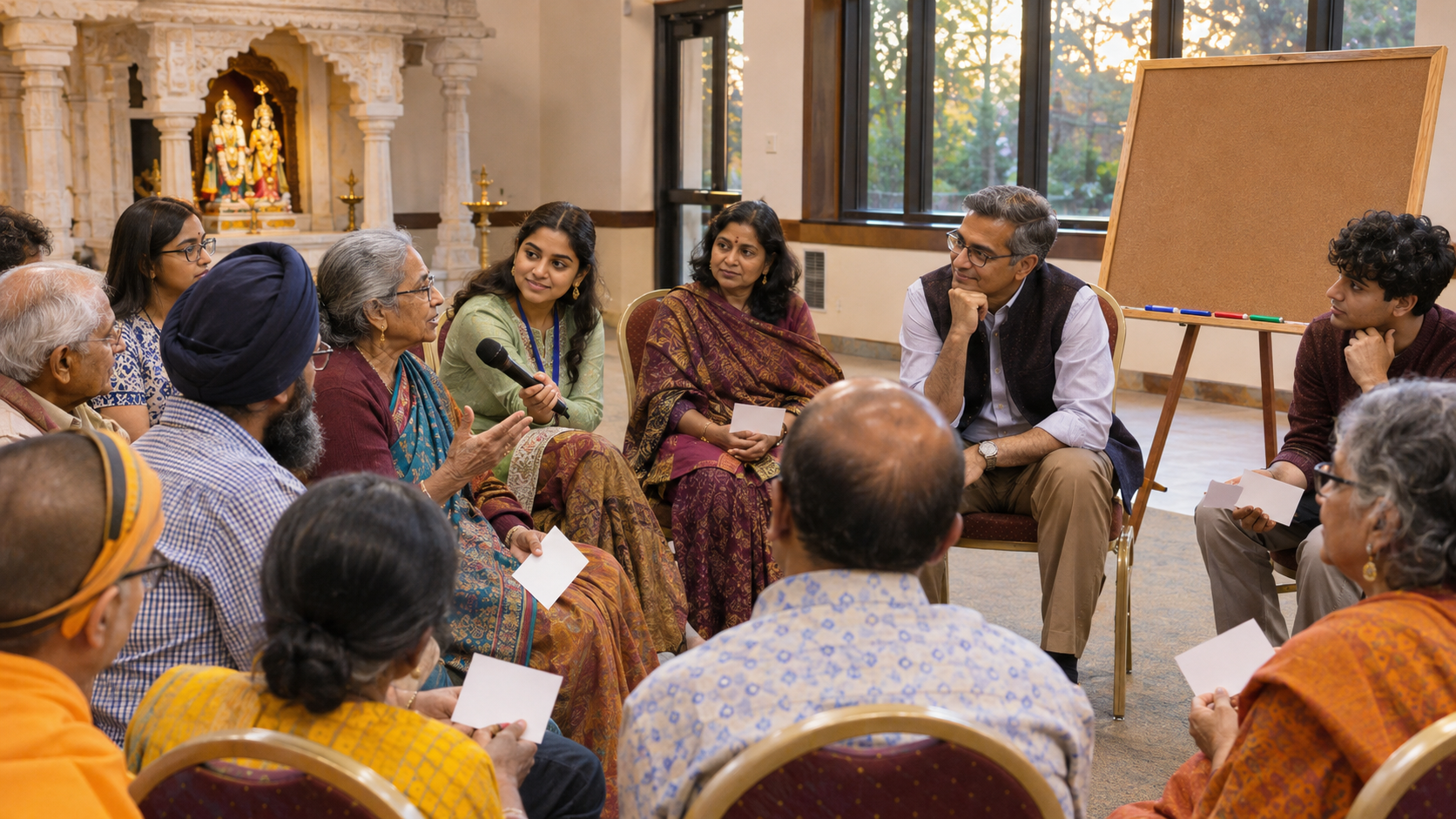
Representation is not achieved merely because a Hindu name appears on a meeting list. A representative needs a mandate before the meeting and a return path afterward. Otherwise, officials may hear an organizational position while believing they have heard a community consensus.
- State the mandate. Say who authorized the delegation and which temples, organizations, regions, or constituencies were consulted. Do not claim to speak for all Hindu Americans unless the mandate genuinely supports that claim.
- Consult across community differences. Temple traditions, languages, generations, and regional experiences are not interchangeable. A coalition does not need agreement on every issue, but it should disclose the breadth and limits of its consultation.
- Circulate the agenda beforehand. Participating organizations should know the intended requests and have an opportunity to correct factual errors before officials receive them.
- Disclose relevant conflicts. A participant who represents an organization, political interest, business, or other institution should make that role clear.
- Publish a safe after-action note. Record who attended, what was requested, what response was given, which matters remain open, and who owns the next step. Omit personal data, threat details, and operational information that could weaken temple security.
- Use disciplined language. Distinguish the delegation’s position from broad community agreement, official acknowledgment from official endorsement, and a promise to consider from an implemented result.
Different Hindu organizations may disagree on politics, terminology, or who should lead. They can still cooperate around a minimum civic agenda: equal treatment, safe worship, access to relevant policy discussions, clear government contacts, and transparent follow-up. A narrow common mandate is more credible than an unsupported claim of complete unity.
Key takeaways
- Document direct observations, interpretations, reported concerns, and confirmed threats as different kinds of information.
- Build temple security around assigned roles, repeatable records, trained review, and practiced communication rather than equipment alone.
- Keep sensitive operational details private while sharing verified, de-identified patterns with the community.
- Treat access to federal officials as the beginning of a process, not proof of a policy result.
- Ask officials for an answerable decision, a responsible contact, a referral, or a written next step.
- Give every delegation a defined mandate and require an accurate, security-conscious report back to the community.
Before your temple’s next major gathering, approve a responsible coordinator, a standard incident record, a professionally reviewed response plan, and a concise set of civic requests. The practical test is simple: if danger appears, people know what to do; if an official agrees to meet, the delegation knows what decision to request; and if a commitment is made, the community can determine whether it was fulfilled.
References

Leave a Reply
You must be logged in to post a comment.