

If you are trying to decide whether Bharat has a strategic development vision, do not start by counting new projects. Ask a harder question: do its infrastructure, industry, education, technology and diplomacy reinforce the same national purpose?
You need that test because spectacle can resemble strategy. A futuristic district, a successful platform or a diplomatic slogan may be impressive on its own. It becomes strategically important only when it builds a capability Bharat can retain, an institution that can reproduce the result, and an international proposition that other countries can use without surrendering their agency.
A strategic vision must close the whole chain

A national vision is not a collection of ambitions. It is a chain of choices connecting civilisational purpose to visible public outcomes. You should be able to take any flagship initiative and trace that chain without filling the gaps with patriotic language.
- Civilisational purpose: What kind of society is Bharat trying to sustain, and which principles constrain the use of power?
- Public outcome: What will become more reliable, accessible or dignified in the life of a citizen?
- Sovereign capability: What knowledge, productive capacity, critical infrastructure or decision-making freedom will Bharat possess that it cannot dependably exercise now?
- Durable institution: Who will train people, preserve knowledge, maintain systems, finance repetition and correct failure after the original political champion has gone?
- International offer: What can another society adopt, adapt or learn from without simply becoming dependent on Bharat?
- Accountability: What evidence would show that the initiative worked, and which institution must explain itself if it did not?
Missing links reveal the difference between a project and a strategy. A project that imports nearly all of its decisive knowledge may produce an asset without producing sovereignty. A pocket of technical excellence without a training system remains an exception. A capable domestic institution with no outward-facing model may improve life inside Bharat but will not shape international norms. An international slogan without a working institution is diplomacy unsupported by delivery.
This also gives self-reliance a disciplined meaning. Aatmanirbhar Bharat need not mean manufacturing every component within national borders or refusing useful partnerships. It should mean retaining enough knowledge, productive depth and institutional authority to make consequential choices under pressure. The relevant question is not whether an input is foreign. It is whether dependence on that input can veto Bharat’s policy choices.
When you hear a grand announcement, therefore, ask what remains after the construction is complete. Look for trained people, domestic design competence, maintenance capacity, an accountable institutional owner and a method that can be repeated elsewhere. Concrete is visible immediately. Strategic capacity often appears only when the original project encounters stress.
Why a city can carry more strategic weight than a communique

At the Global Governance Forum in Xiong’an from 23 to 25 October 2026, political leaders, diplomats and scholars met inside a city presented as Xi Jinping’s vision of China’s future. The setting converted an argument about development and governance into something visitors could enter, inspect and remember.
That is the strategic value of a demonstrator. It does more than display wealth. It makes coordination visible. Transport, technology, administration, research, housing and public space can be presented as parts of one governing idea. The physical environment then becomes evidence for the political message.
Bharat should learn from that method without racing to produce an Indian copy of Xiong’an. Imitation would confuse another country’s instrument with our own objective. Bharat is a federal, multilingual and religiously plural civilisation-state. Its demonstrator must prove that large-scale execution can coexist with local agency, public contestation and more than one legitimate way of life.
Choose a demonstrator by the problem it resolves, not by the skyline it promises. A district could integrate water, mobility, public health, education, skills and local enterprise under an accountable operating model. A knowledge-manufacturing corridor could connect research, vocational training, component production and export support. The exact form matters less than the institutional discipline behind it.
- Start with an Indian coordination failure. Identify a problem that several departments or levels of government currently handle in fragments.
- Design for replication. Publish the operating method, technical standards, training requirements, costs and failures so that another state or district can adapt it.
- Give it a permanent institutional owner. A showcase managed only by a temporary task force will decay when attention moves elsewhere.
- Make trade-offs inspectable. Visitors should be able to see who benefits, who bears the cost, how complaints are handled and how decisions are corrected.
- Build an outward-facing school around it. Officials, researchers and practitioners from partner countries should be able to study the model rather than merely tour the site.
A brochure can claim inclusion, sustainability and efficiency simultaneously. A functioning place exposes whether those claims survive contact with budgets, maintenance, institutional rivalry and ordinary citizens. That is why Bharat needs demonstrators that teach, not monuments that merely impress.
The decisive shift is from assets to institutions
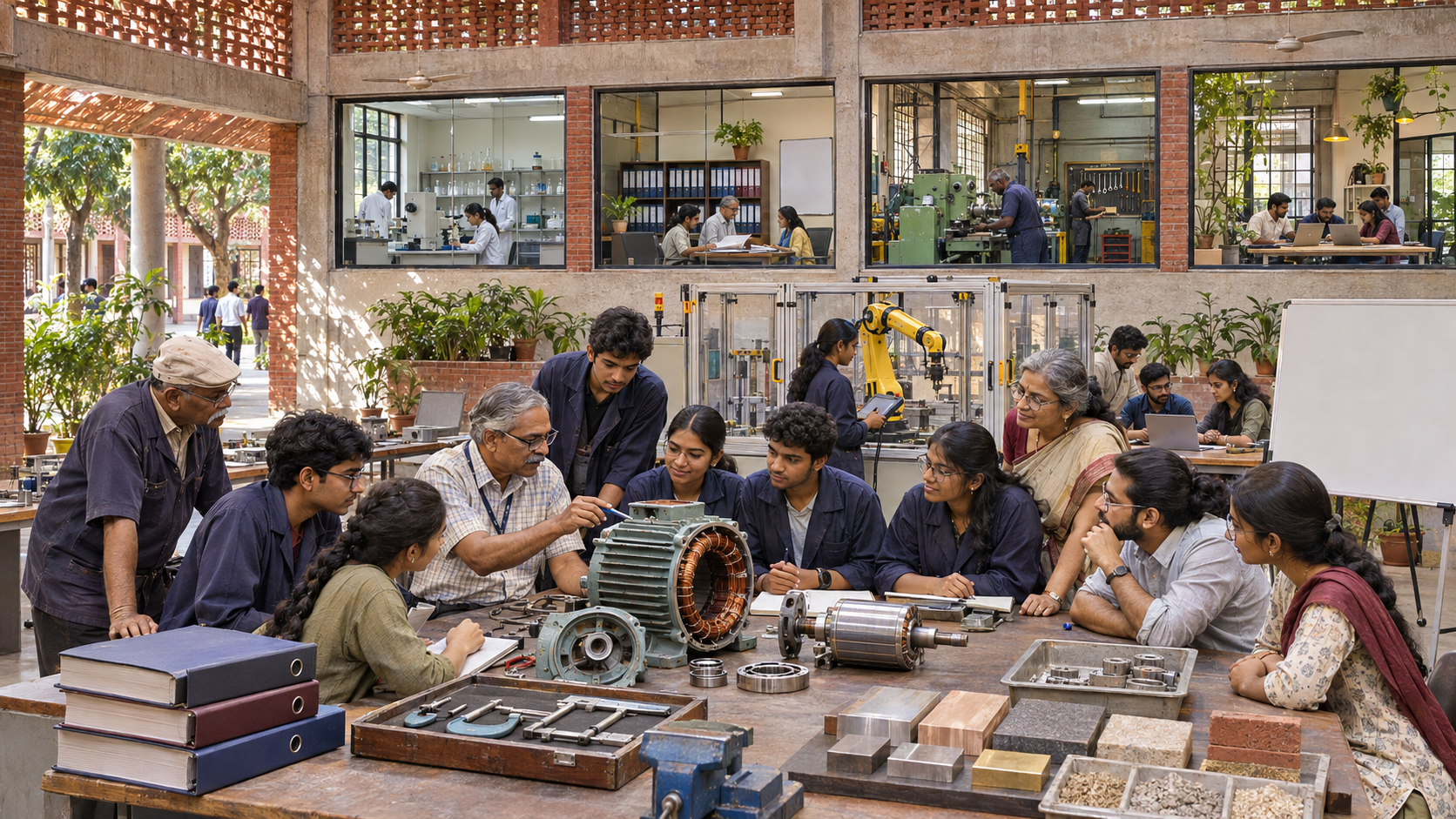
China’s ambition is no longer confined to factories, advanced technology or military capacity. Beijing is also seeking influence over how international rules are made and whose interests those rules serve. Bharat cannot answer that ambition with construction alone. It needs institutions that turn domestic competence into proposals, standards, partnerships and durable coalitions.
The progression is straightforward but demanding. An asset is something Bharat has built. A capability is something Bharat can do reliably. An institution makes that capability repeatable across time and place. An international offer lets a partner use or adapt it. Rule-making influence begins when countries coordinate around principles, standards or procedures that Bharat helped formulate.
| Layer | Question to ask | Proof to demand |
|---|---|---|
| Public purpose | Which concrete problem is being solved, and for whom? | A named outcome and an accountable owner |
| Sovereign capability | What can Bharat now do reliably for itself? | Retained expertise, operating capacity and resilient supply relationships |
| Institution | Can the result survive a change of leadership? | A durable mandate, training system, maintenance process, budget and audit |
| International offer | Can a partner adopt the model without losing agency? | Adaptable standards, finance, training and long-term support |
| Rule-making influence | Does the initiative change how others coordinate? | Written proposals, working coalitions and voluntary adoption |
This framework corrects a common strategic error. Export success is not automatically rule-making power. A country may sell equipment while another country supplies the standard, the financing architecture, the accreditation system, the dispute forum and the language through which the sector is understood. The manufacturer earns a contract; the institutional architect shapes the field.
Bharat should therefore pair every strategically important capability with an institutional package. That package can include a precise problem definition, a technical or professional standard, a training pathway, a financing method, a maintenance model, a dispute process and a forum in which partners can modify the system. Without those components, cooperation remains a series of transactions. With them, it can become a community of practice in which Bharat has earned intellectual and institutional weight.
The same principle applies to the Global South. Bharat can share many concerns about an unequal international order without allowing Beijing to become the sole interpreter of those concerns. But independence requires more than rejecting somebody else’s vocabulary. Bharat must provide language that describes the problem fairly, institutions that countries can enter voluntarily, and working alternatives that respect their sovereignty.
Leadership begins before the summit photograph. Scholars clarify the concept. Engineers and administrators prove the method. Training institutions make it transferable. Diplomats assemble a coalition. Political leaders then give the effort direction and legitimacy. If those stages are reversed, the declaration arrives before the capability and soon becomes ceremonial.
Make Dharma a design discipline, not a decorative label

A Bharatiya vision cannot become distinct merely by placing ancient vocabulary on a borrowed development model. For public strategy, Dharma should operate as a discipline of duty, right relationship and restraint. It should change how an institution distributes power, defines prosperity and treats the people affected by its decisions.
Hindu, Buddhist, Jain and Sikh traditions are not interchangeable. They differ in metaphysics, practice and historical experience, and a serious civilisation-state should not flatten them into a convenient state creed. A modern Bharatiya doctrine can nevertheless draw public principles from this Dharmic inheritance: power is bound by obligation; material gain is a means rather than the highest end; disciplined self-restraint matters; plurality need not be treated as disorder; and knowledge should serve human flourishing rather than domination.
Those principles become useful when expressed as audit questions:
- Duty: Which office or institution owes a defined obligation to the citizen, and what remedy exists when it fails?
- Plurality: Can the program accommodate local languages, customs and institutions, or does efficiency require cultural uniformity?
- Restraint: Are ecological and social costs examined before an irreversible commitment, or treated as problems for a later government?
- Dignity: Does the initiative enlarge people’s agency and competence, or leave them permanently dependent on a remote authority?
- Knowledge: Does it deepen Bharat’s capacity to research, debate, design and teach, or merely purchase a finished system?
- Reciprocity: When offered abroad, does the model strengthen the partner’s own institutions and sovereignty?
The test of a Dharmic program is not the prominence of Sanskrit terms in its branding. It is whether obligations are explicit and whether power is answerable to something beyond its own expansion. A system cannot credibly invoke Dharma while hiding costs, silencing scrutiny or converting citizens into passive subjects.
This is not an argument against wealth, technology, state capacity or strategic power. Bharat needs all of them. It is an argument about ends and limits. Civilisational confidence should help Bharat use modern power without accepting the premise that accumulation, centralisation and control are sufficient measures of success.
That distinction protects the country from opposite errors. Nostalgia celebrates inheritance but leaves institutions weak. Technocracy builds efficient machinery but cannot explain what the machinery is for. Strategic development requires memory and competence together: a civilisational purpose translated into rules, budgets, training, maintenance and public accountability.
A confident China strategy starts with selective strength
Bharat does not need to choose between reflexive hostility and passive admiration. A serious China strategy studies what Beijing executes well, identifies where Chinese leadership would narrow Bharat’s choices, cooperates where interests genuinely align and builds independent strength where dependence would be dangerous.
Use a consistent set of questions when evaluating any proposed response to China:
- What method or institutional habit is worth learning?
- Which part depends on political conditions that Bharat neither has nor should want?
- Where can cooperation produce a clear reciprocal benefit?
- Where would reliance give Beijing leverage over a consequential Bharatiya choice?
- What credible alternative can Bharat offer instead of merely objecting?
- Which domestic capability gap must close before diplomatic language can be believed?
Not every Chinese initiative requires a symmetrical Indian answer. Building a matching city, fund, forum or slogan can waste attention if the instrument does not suit Bharat’s circumstances. The better response may be asymmetric: a model that works through federal institutions, accommodates multilingual public life, invites scrutiny and gives partner countries more room to adapt it.
That model must still deliver. Pluralism cannot become an excuse for drift, and democracy cannot become a euphemism for unfinished work. Bharat’s distinctive proposition will be persuasive only if institutions coordinate, infrastructure functions, expertise compounds and the public can identify who is responsible for failure.
Key takeaways
- Judge a national vision by the complete chain from civilisational purpose to public outcome, sovereign capability, durable institution, international offer and accountability.
- Build demonstrators that solve Bharatiya problems and publish replicable methods; do not copy another country’s prestige project for its visual effect.
- Pair infrastructure and technology with training, standards, finance, maintenance and forums that can turn domestic competence into international influence.
- Use Dharma as an operational constraint on power: duty, plurality, restraint, dignity, knowledge and reciprocity should alter institutional design.
- Engage China through selective learning, reciprocal cooperation and independent capability, while retaining Bharat’s authority to define its own interests.
- Offer the Global South working institutions and adaptable alternatives, not merely criticism of the existing order or somebody else’s proposed replacement.
The next time you encounter a major national announcement, write the strategic chain beside it. Ask what public problem it solves, which capability remains in Bharat, which institution will reproduce it, what partners can adopt, and how failure will be exposed. If those answers are missing, the proposal may still be worthwhile, but it is not yet a strategic development vision. Demand the missing links. That is how civilisational aspiration becomes national power without losing its Dharmic purpose.
References

Leave a Reply
You must be logged in to post a comment.