
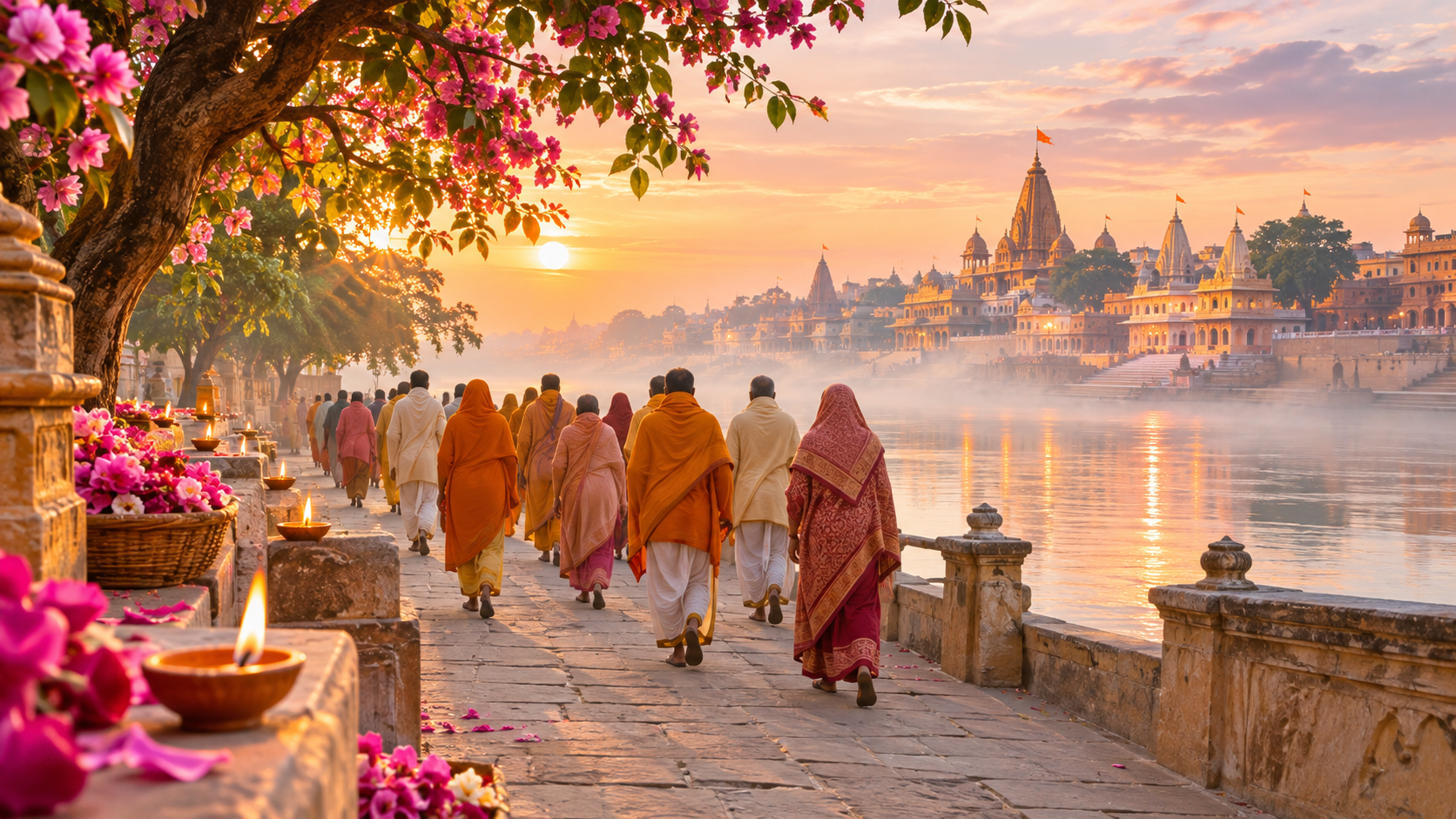
You may have found Day 5 of Radhanath Swami’s Ayodhya journey and wanted more than a passing impression. What actually happened? What can you safely share? And how can someone who was not physically present receive the pilgrimage as more than religious content?
Start on firm ground: Day 5 of the 2026 Ayodhya Dham Yatra is identified with HH Radhanath Swami. That is a meaningful anchor, but it is not permission to invent an itinerary, reconstruct a discourse, or attach quotations that have not been verified. The same restraint that protects accuracy can also deepen your devotion.
Begin with the one verified anchor
You can safely carry forward four details: the pilgrimage concerned Ayodhya Dham; it took place in 2026; Radhanath Swami was named; and the available entry belongs to Day 5 of the journey. Because it is marked Day 5, you are looking at one point within a sequence rather than a complete account of the yatra.
- Repeat the name, place, year, and sequence marker as established facts.
- Verify any claimed temple stop, route, ceremony, companion, crowd estimate, or timetable before sharing it.
- Do not place devotional reflections inside quotation marks unless you have the speaker’s exact words.
- If you cannot establish a detail, omit it or label it plainly as your own reflection.
This is not mere editorial caution. In a Dharmic setting, accuracy is a form of respect. A dham does not become more sacred when plausible details are added to its story, and a teacher is not honoured by words being attributed to him without evidence.
A faithful sentence is enough: Radhanath Swami was associated with Day 5 of the 2026 Ayodhya Dham Yatra. If more information becomes available, add it only after checking it. Devotional enthusiasm and disciplined speech belong together.
What Ayodhya asks you to notice
The dham is a place of moral remembrance
Ayodhya is inseparable from Sri Rama in Hindu sacred memory. To approach it as a dham is therefore to encounter more than geography. The place recalls maryada: the discipline of acting rightly within one’s duties, relationships, promises, and limits.
As you follow the yatra, ask a concrete question: where has your own conduct become careless? It may be in a promise repeatedly postponed, speech that has become needlessly harsh, a family duty treated as an inconvenience, or a responsibility performed only when somebody is watching. Choose the point that is genuinely yours. Ayodhya becomes relevant when remembrance of Sri Rama corrects conduct outside Ayodhya.
The teacher’s presence should direct attention toward the dham
A respected spiritual teacher can easily become the sole focus of pilgrimage coverage. People look for proximity, access, photographs, crowds, and memorable moments. Those things may document an occasion, but they do not by themselves disclose its spiritual purpose.
Watch instead for the direction of attention. Does a teaching illuminate Sri Rama, service, humility, sacred memory, or the responsibilities of a pilgrim? When verified words are available, preserve their wording and context. When they are not, resist the urge to manufacture a message that merely sounds suitable. Silence is more honourable than false attribution.
Your response is part of what the pilgrimage means
You do not need to pretend that reading about a yatra is identical to walking through a dham. Physical pilgrimage includes travel, waiting, bodily effort, shared space, service, and encounters that a screen cannot reproduce. Distance should make you honest about what you have not experienced.
Yet you can still receive a spiritual instruction from the occasion. Select one quality associated with Rama’s example—truthfulness, steadiness in duty, restraint, loyalty, courage, or compassion—and identify one situation in which you will practise it. Keep the choice small enough to perform, but concrete enough that you will know whether you did it.
A disciplined way to follow the yatra

The easiest way to prevent devotion, inference, and fact from becoming tangled is to give each one its own place. Use the following method whenever you encounter further coverage of the pilgrimage.
- Write the verified anchor first: HH Radhanath Swami, Ayodhya Dham Yatra, 2026, Day 5.
- Create three separate lines labelled Fact, Interpretation, and Application. A fact is what can be established directly. An interpretation is what you think it means. An application is what you intend to do.
- Check every quotation for exact wording, speaker, and context. If those are missing, write “My reflection is…” rather than “Radhanath Swami taught…”
- When sharing the yatra, attach the link and use a short, faithful description. Do not fill an information gap with a likely temple name, guessed chronology, or devotional embellishment.
- End by choosing one practice or duty. Close the page, then perform that action before consuming more pilgrimage material.
The distinction between interpretation and application is especially important. “Ayodhya makes me think about keeping my promises” is an honest personal response. “The purpose of Day 5 was to teach everyone about keeping promises” is a claim about the event and requires evidence. The first can guide your life; the second may unintentionally misrepresent the pilgrimage.
Apply the same discipline to images. Describe what is visibly present before drawing conclusions about its meaning. A solemn expression does not prove a particular emotion. A gathered crowd does not establish its size. A sacred setting does not tell you which words were spoken there. Clear description leaves room for reverence without turning imagination into testimony.
Participate from home without pretending to be present

If you could not join the Ayodhya yatra, set aside a short, fixed period for devotional engagement rather than checking it casually between unrelated tasks. Silence notifications. Begin with remembrance of Sri Rama or the form of prayer already established in your own practice. Then engage the available material once, attentively.
Afterward, write three sentences. The first records what you know. The second records what it awakened in you. The third names what you will do. This keeps the external pilgrimage, your inward response, and your practical commitment connected without confusing them.
Your action need not be ceremonial. You might complete a neglected duty, correct an untruth, keep a difficult promise, speak with restraint, offer practical service, or give undivided attention to someone you routinely hurry past. Choose the action that addresses an actual weakness rather than the one that produces the most devotional appearance.
Do not claim that this home practice is equivalent to tirtha-yatra. It is better understood as a disciplined response to the pilgrimage. The physical journey belongs to those who undertook it; the moral invitation can still reach you. A useful test is simple: if your engagement ended without any change in attention, speech, service, or duty, you consumed pilgrimage content but did not yet allow the pilgrimage to work upon you.
Key takeaways
- The firm factual anchor is Day 5 of the 2026 Ayodhya Dham Yatra with HH Radhanath Swami.
- Do not infer an itinerary, discourse, quotation, attendance figure, or ceremony from that anchor alone.
- Approach Ayodhya through Sri Rama’s example by examining one real duty, promise, relationship, or habit.
- Keep fact, interpretation, and personal application on separate lines when taking notes or sharing the yatra.
- If you are following from home, turn attention into one concrete act rather than treating digital access as a substitute for physical pilgrimage.
Open the Day 5 record with a notebook beside you. Copy only the verified anchor, write your reflection in your own name, and choose one duty to perform with greater maryada. That is a modest response, but it gives the yatra somewhere real to continue: in the way you live after you have finished reading.
References

Leave a Reply
You must be logged in to post a comment.