
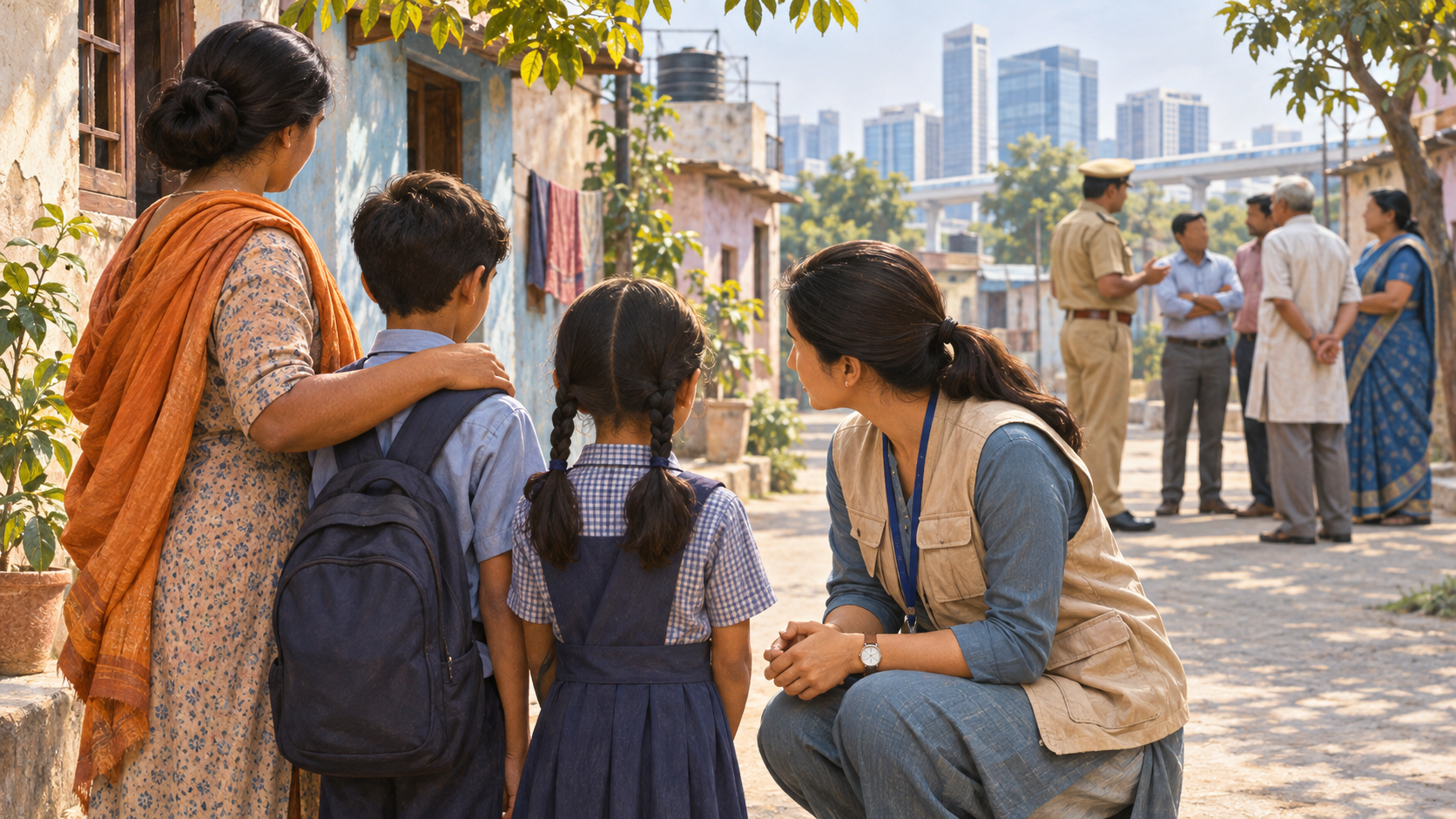
If you encountered the Gurugram conversion claim and want to know what it actually establishes, keep two truths together. The allegations are serious because they concern children, material assistance and religious influence. They are still allegations, not convictions.
Your most useful response is neither denial nor outrage-first sharing. Protect the children, insist on transparent parental consent, preserve verifiable evidence and allow a lawful investigation to determine responsibility. A pro-Dharma response should be firm, but it must also be anchored in satya.
What police have alleged in Ghata village
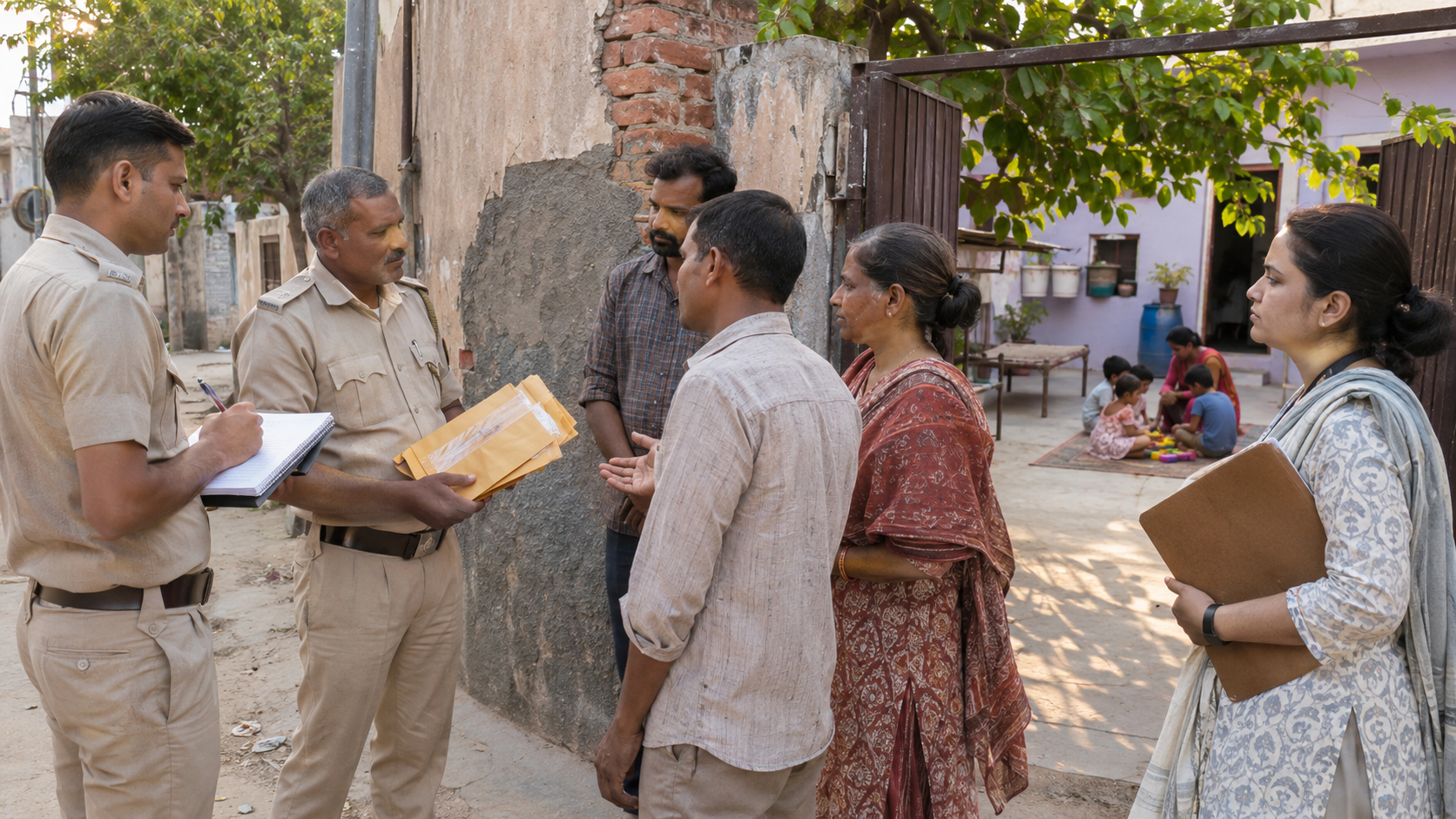
Four women were arrested in Gurugram’s Ghata village after police alleged that they had travelled from Delhi every Saturday for about a year to teach children living in a local informal settlement. Police claim that books and food were distributed while the children were encouraged to adopt Christianity.
Two of the accused were described as employees of private companies, while police said that an alleged Christian couple connected to the activity was being sought. These details describe the police case. They do not establish the intent of every participant or prove guilt.
An arrest answers one narrow question: whether the authorities have acted. It does not answer whether the allegation has been proved. Until evidence is tested, careful language matters: say that police allege religious persuasion under the cover of teaching, not that a conversion racket has been judicially established.
Before you forward a definitive claim, look for the next layer of evidence: the exact complaint, the conduct attributed to each accused person, statements from parents or guardians, the materials allegedly shown to children, any response from the accused and any subsequent court order. A screenshot of an arrest headline cannot answer those questions.
The proper test is consent and conduct, not religious identity

Teaching children, distributing books or providing food does not by itself prove coercion. Religious discussion does not by itself establish a concealed conversion programme either. The concern becomes sharper when several features coincide: the religious purpose is hidden, parents are bypassed, material help appears linked to belief, children face repeated pressure or adults ask them to keep activities secret.
A child cannot negotiate adult influence on equal terms. Material need can also blur the difference between a gift and an expectation. A child receiving food or educational help may believe that agreement is required even when no adult states an explicit condition. That possibility is not proof that coercion occurred in Ghata; it is the reason every child-facing programme needs safeguards before a dispute arises.
- Was the programme’s academic or religious purpose disclosed before the child attended?
- Did a parent or guardian knowingly consent to religious instruction?
- Could the child decline prayer, worship or religious discussion without losing food, books or teaching?
- Were the organisers’ identities, affiliations and contact details available to families?
- Did the actual sessions match what parents had been told?
- Was any child asked to conceal an activity or conversation from the family?
These standards should apply to Christian, Hindu, Sikh, Buddhist, Jain, Muslim and secular organisations alike. Criticising concealed pressure is not hostility toward every Christian act of service. Conversely, charitable language should not shield any organisation that uses a child’s dependence as leverage.
The Dharmic principle of seva offers a clear standard. Food, learning and care should be given for the recipient’s welfare, not treated as bargaining tools for religious compliance. If assistance stops when a family declines a belief or ritual, the arrangement deserves scrutiny regardless of who runs it.
A six-point check for parents and neighbourhood volunteers

If an unfamiliar group begins tutoring or distributing supplies in your neighbourhood, do not wait for a controversy to ask basic questions. Complete this check before enrolling children or referring other families.
- Identify the organiser. Obtain the names of the people responsible, the organisation they represent, a local contact and the address from which the programme operates. A social-media profile is not a substitute for an accountable contact.
- Ask for a plain description of every activity. The description should distinguish academic teaching, meals, games, prayer, scripture instruction and worship. A programme presented as tuition should not quietly become religious formation.
- Make consent specific. Permission to attend a class is not automatically permission for prayer or religious persuasion. Parents should know what is optional, what is routine and whether photographs or personal information will be collected.
- Separate assistance from belief. Ask directly whether food, books, tuition or other benefits remain available if the family declines religious participation. Watch what happens in practice, not only what the organiser promises.
- Inspect the materials and setting. Review worksheets, books, videos and messages sent to children. Confirm that sessions occur in an observable setting with responsible adults present rather than through undisclosed one-to-one contact.
- Create a complaint route. Families should know whom to contact if the programme departs from its stated purpose. Record concerns promptly instead of allowing rumours to accumulate for weeks.
When you speak to a child, use open questions: “What did you do in the class?”, “What happened before and after the food was given?” and “Did anyone ask you to keep something secret?” Avoid starting with “Were they trying to convert you?” A leading question can shape the child’s answer and make a later inquiry less reliable.
Write down the child’s words accurately, but do not repeatedly question or rehearse the child. Preserve leaflets, schedules, messages and unedited recordings in their original form. Note the date, place and people present. A factual record is more useful than a dramatic label.
How to act without harming the child or the investigation

Your response should match the seriousness of what you can verify. If the issue is an unclear programme description, seek written clarification from the organiser and inform parents. If there is evidence of threats, secrecy, unwanted contact, conditional aid or sustained pressure on a child, remove the child from the situation and report the facts promptly to the appropriate police or child-welfare authority. Seek qualified legal advice for questions about individual liability or the applicable law.
- Describe conduct, not conclusions. Record the exact words, materials, dates and conditions attached to assistance. Let investigators determine which legal description applies.
- Protect the child’s identity. Do not publish a minor’s name, face, address, school, medical information or unedited statement. Once copied online, that exposure is difficult to reverse.
- Do not organise a confrontation. A crowd at a classroom or home can frighten children, destroy evidence, escalate violence and expose uninvolved people to harm.
- Do not pronounce guilt online. Share confirmed procedural developments and preserve the distinction between an accused person and a convicted person.
- Keep an evidence trail. Retain original files and messages rather than cropped or captioned versions. Record when and how the concern was reported.
- Check the follow-through. Ask whether the complaint was formally received and whether child-safety arrangements have changed while the facts are examined.
Publicly identifying children or declaring suspects guilty may injure innocent people, compromise a child’s privacy and create legal exposure for the person posting. It can also turn a safeguarding concern into a communal spectacle. Restraint is not indifference; it protects the integrity of the case.
The durable community response is reliable local seva. If families depend on questionable programmes because no other tuition or meal support exists, build an alternative that is present every week: named volunteers, visible teaching materials, explicit parental consent, open sessions, an accessible complaint contact and no test of belief. That gives families a real choice instead of merely telling them what to avoid.
Key takeaways
- Four women were arrested in Ghata village, but an arrest does not prove the police allegation or establish guilt.
- The relevant safeguarding questions concern disclosure, parental consent, secrecy, repeated pressure and whether aid depends on religious participation.
- Ask children open questions and preserve their exact words; do not coach them toward a preferred conclusion.
- Report verifiable conduct through lawful channels while protecting minors from identification and publicity.
- Apply the same transparency standard to every religious and secular organisation serving children.
- Strengthen trustworthy, unconditional tutoring and food support so vulnerable families are not forced to choose between material help and freedom of belief.
The next useful move is concrete: seek verifiable case documents, keep the children out of public spectacle and make transparent educational support available without religious conditions. Precision does not weaken a pro-Dharma response. It gives that response credibility and keeps the children, rather than communal outrage, at its centre.
References

Leave a Reply
You must be logged in to post a comment.