
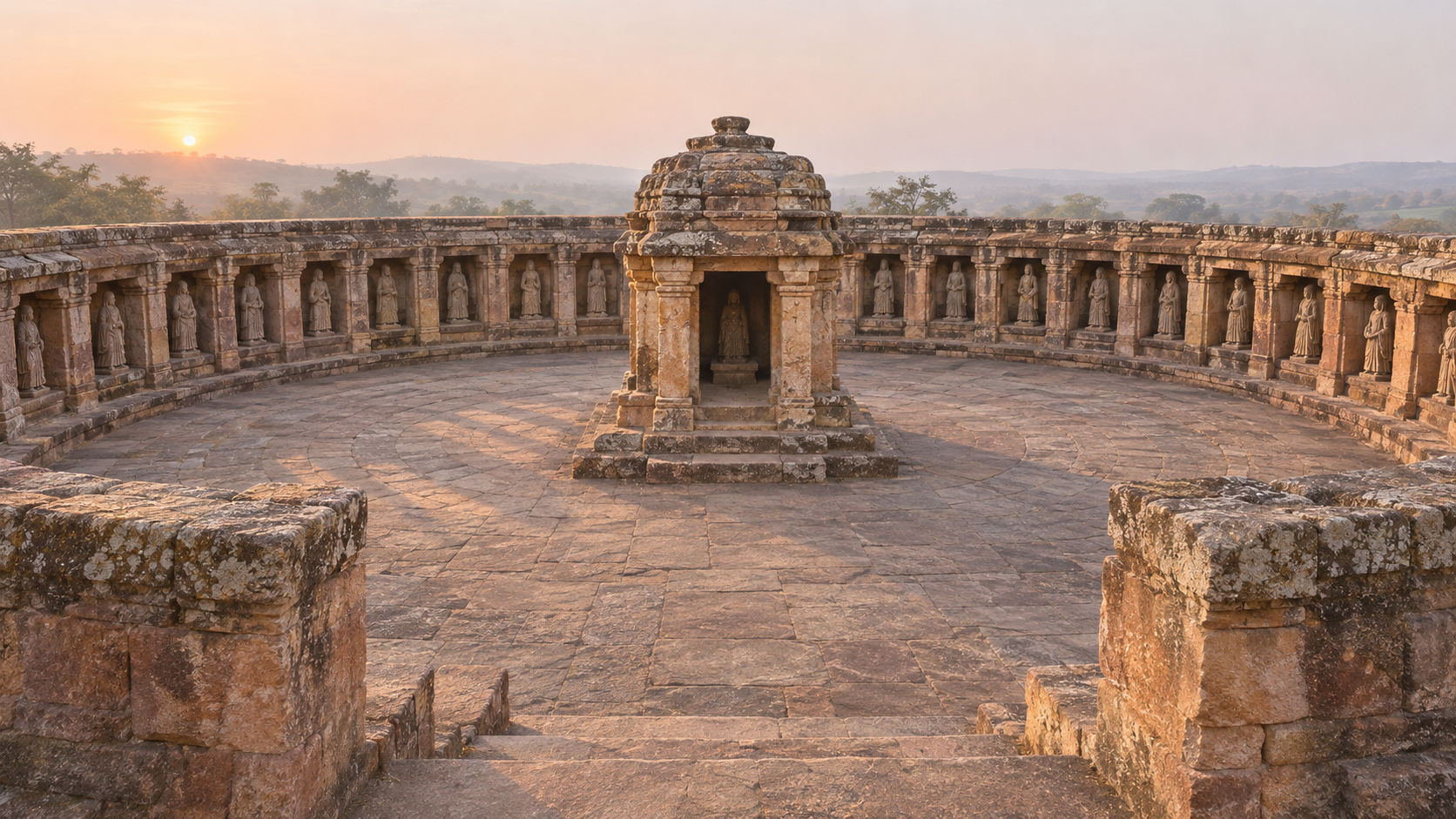
You arrive expecting a temple to guide you toward a doorway, an enclosed sanctum and a rising tower. A circular Yogini temple unsettles that expectation. Its sacred space is not understood simply by looking straight ahead; you have to notice what surrounds you, what occupies the centre and what remains open above.
The circle is therefore more than an unusual ground plan. It changes how you stand, move and distribute your attention. Read those effects carefully and the architecture begins to disclose a theology of plurality, relation and sacred presence without requiring a speculative story for every stone.
Begin with the architectural reversal
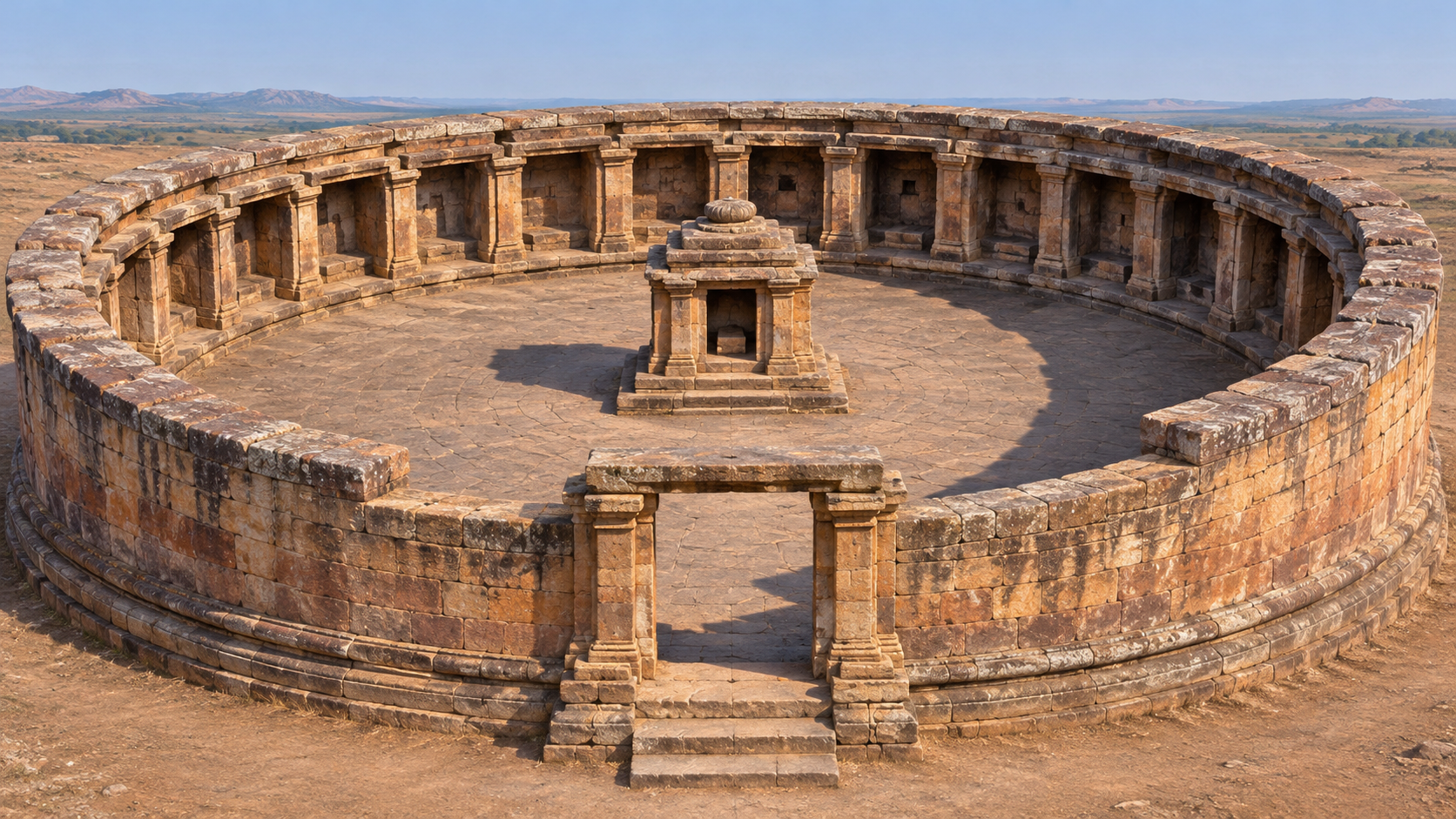
The easiest mistake is to treat a Yogini temple as an incomplete version of a more familiar Hindu temple. If you expect a dominant shikhara, a sealed inner chamber and a roof that separates sacred interior from the world outside, their absence can look like loss. But shrines dedicated to the sixty-four Yoginis form an architectural category of their own. Their circular arrangement changes the basic grammar of the encounter.
A conventional axial plan tends to pull your eye forward, inward or upward. A circle redirects attention sideways and around. Instead of treating one frontal view as sufficient, it makes the surrounding field important. The devotee or visitor is not merely facing a sacred object; the person is placed within a structured relationship among centre, circumference and multiple presences.
This contrast gives you the first rule for reading the temple: do not begin by asking what is missing. Ask what the circular form makes possible. That shift prevents you from measuring a distinctive sacred architecture against the wrong model.
The circle holds unity without erasing plurality
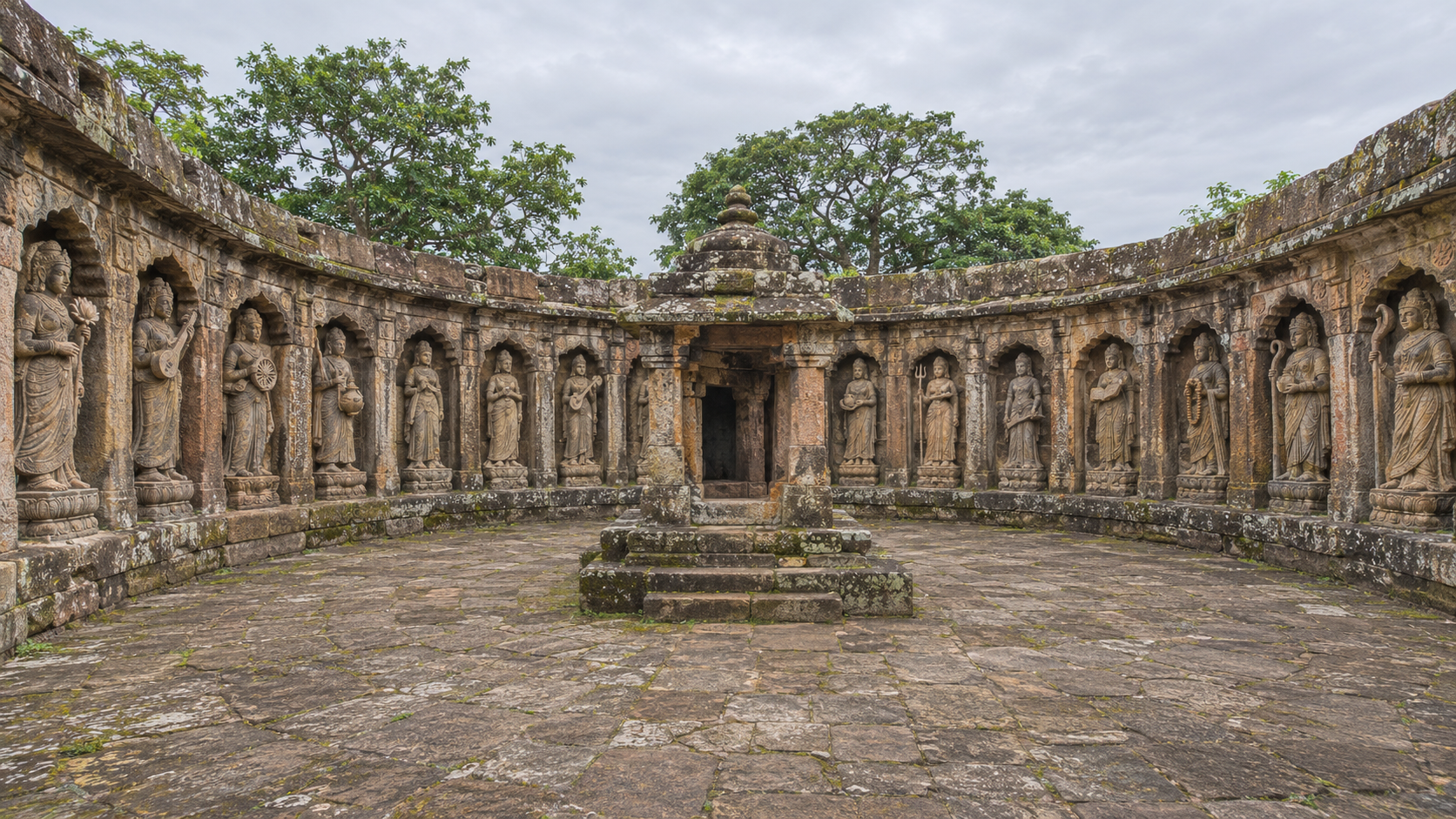
A circle has no inherent first point or final point. Every place on its circumference participates in the same continuous boundary, while every point on that boundary stands in relation to a common centre. Those simple geometric properties support three useful symbolic readings.
- No privileged beginning: the eye can enter the sequence anywhere. This weakens the assumption that sacred meaning must unfold along one straight route.
- A living relation between centre and rim: the centre organises the space, but it cannot make a circle without the circumference. Likewise, the surrounding forms acquire an architectural unity without becoming interchangeable.
- Multiplicity inside one boundary: the ring can hold many distinct presences while presenting them as parts of one sacred field.
This does not prove that every figure in the ring has identical status. Equal distance, visual rhythm and theological equality are different claims. Architecture can suggest relationship without abolishing distinction. When you look at the arrangement, notice both repetition and difference: repeated placement creates coherence, while individual forms preserve plurality.
The number sixty-four matters first at this practical level. You are dealing with a collective sacred presence rather than a solitary image. Do not rush to turn the number into a secret code unless a reliable textual, inscriptional or local tradition supports that reading. Begin with the visible consequence: attention has to expand from one form to the whole assembly.
That changes the question worth asking. Instead of asking only, “Which image is supreme?” ask, “How does the arrangement teach me to perceive the many in relation to the whole?” The second question arises from the building itself and remains useful even when the history of an individual image is uncertain.
Open sky and circular movement complete the experience
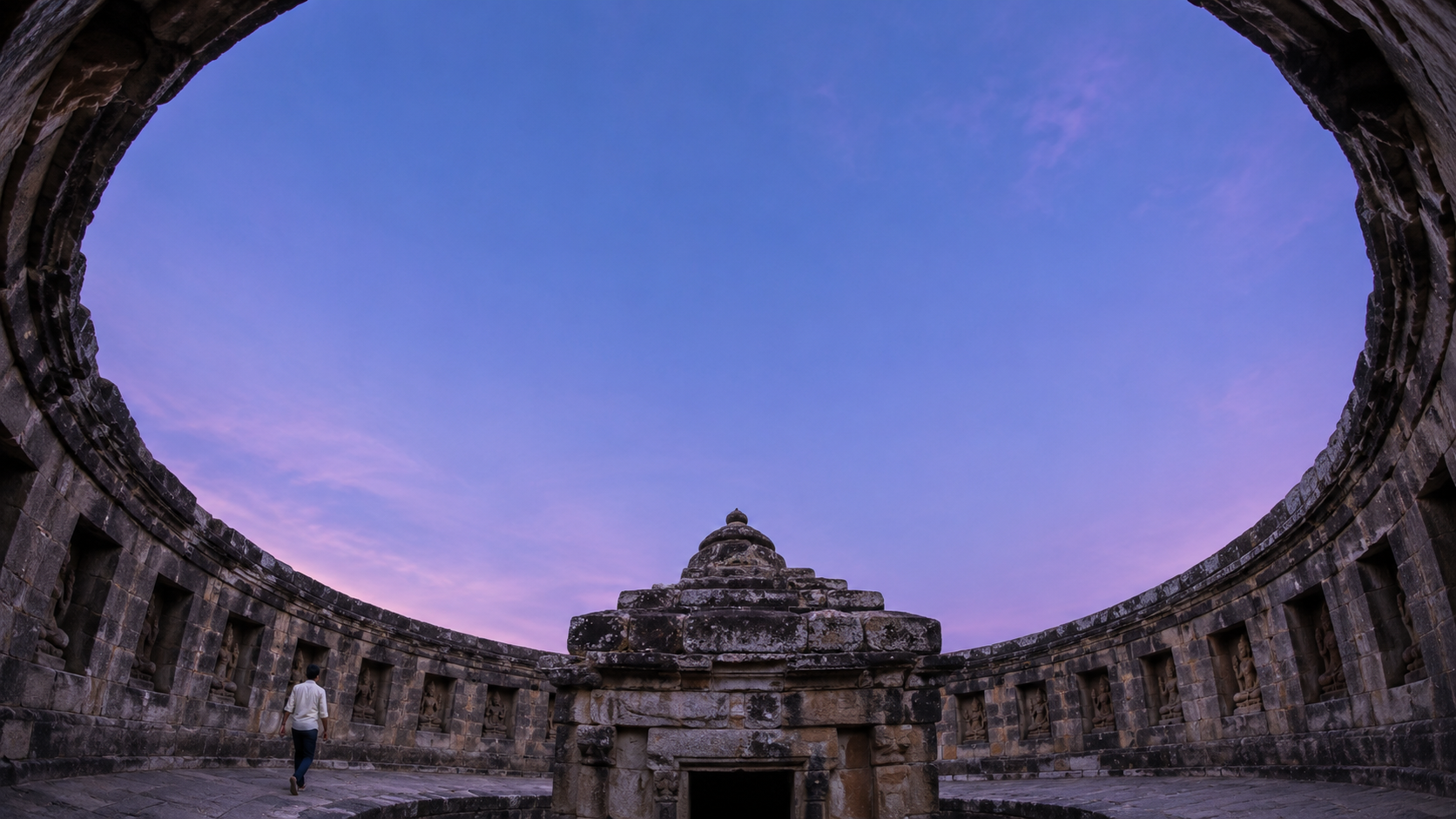
Where a Yogini enclosure is open above, the sky is not merely background. The boundary is firm in the horizontal direction but open vertically. Light crosses the court, shadows move, weather enters and the visible heavens prevent sacred space from becoming a completely sealed interior.
You do not need to attach one exclusive mythic explanation to that openness. The observable effect is already significant: the temple distinguishes sacred ground without isolating it from the larger world. Enclosure and openness operate together. The wall creates a defined field; the uncovered space keeps that field in contact with what exceeds it.
Movement also matters. From a fixed position, a circular temple can look like a symmetrical object. Once you walk along the permitted path, the experience becomes sequential. One form comes into view as another recedes. Relationships change with your position. The architecture cannot be understood fully from a single photograph because the visitor’s moving body participates in the reading.
That is why circularity should not be reduced to the vague statement that “the circle means eternity.” The phrase may sound elevated, but it tells you little about this particular temple. A stronger interpretation connects geometry to experience: the continuous boundary gathers many forms, movement reveals them successively and the centre keeps the changing views within one ordered whole.
How to read a Yogini temple without overclaiming
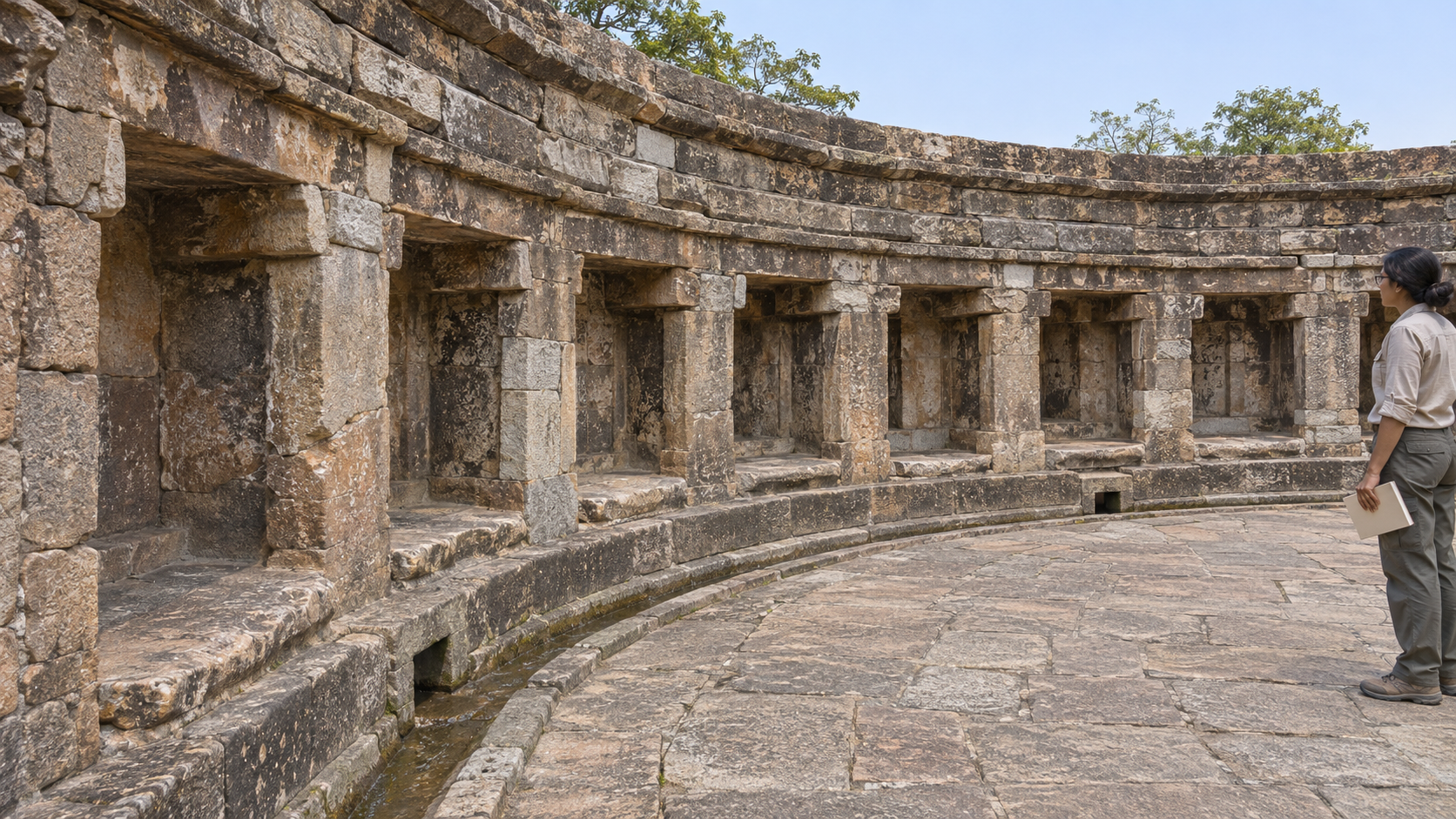
You can use the following method at a temple, in a museum display or while examining a plan. It keeps observation separate from interpretation while still allowing the architecture to speak.
- Pause at the threshold. Before searching for individual deities, notice where the building directs your eyes. Does it offer a dominant forward axis, or does attention spread around the enclosure?
- Trace the boundary. Follow the ring visually. Notice whether it feels continuous, segmented or interrupted by an entrance. Ask how the boundary gathers the interior into one field.
- Locate the centre. If the centre is occupied, examine how it relates to the surrounding forms. If it is open, do not dismiss it as unused space; notice how an apparently empty centre still organises the circumference. Do not assign a historical meaning without evidence.
- Walk only where access and local custom permit. Move slowly enough to notice how figures appear, disappear and align. If worship is taking place, local practice takes precedence over an architectural exercise.
- Compare the figures relationally. Look for repetition, variation, orientation and lines of sight. Do not collapse distinct Yoginis into a generic idea of feminine divinity merely because they share one enclosure.
- Test your conclusion. Separate what you observed, what the geometry permits you to infer and what historical evidence actually establishes. “The open court exposes the visitor to the sky” is an observation. A claim about exactly why particular builders intended that effect requires further evidence.
This method also corrects two common misreadings. The absence of a familiar tower or closed roof does not automatically make the temple unfinished, and the circle does not automatically prove that hierarchy has disappeared. Read the positive work performed by the form, but do not force the form to prove more than it can.
Respect for the site is part of correct interpretation. Do not touch images, enter restricted areas or imitate rites for the sake of an immersive experience. A sacred building is not a puzzle supplied for the visitor’s consumption. Where it remains a place of worship, conduct reveals understanding more convincingly than an elaborate symbolic theory.
Key takeaways
- Read the circular plan as a deliberate reorganisation of sacred attention, not as a deficient version of an enclosed temple.
- The circumference creates unity, but it does not erase the individuality or possible differences among the Yoginis.
- The centre and rim must be read together: each gives spatial meaning to the other.
- Where the temple is open to the sky, vertical openness works alongside horizontal enclosure.
- Walking changes what you can see, making bodily movement part of the architectural experience.
- Keep observation, symbolic interpretation and historically proven intention in separate categories.
On your next encounter with a Yogini temple, give the plan time before trying to decode its iconography. Stand at the threshold, find the centre, follow the circumference and notice where the building makes your attention move. The circle will give you a more disciplined question than “What does this symbol mean?”: “What kind of awareness is this space asking me to practise?”
References

Leave a Reply
You must be logged in to post a comment.