

If you came looking for Day 3 because you could not be in Ayodhya, do not reduce the session to another video in your queue. Give it enough attention to leave you with one clearer understanding, one honest self-examination, and one practice you can carry into ordinary life.
The session is publicly identified as Ayodhya Dham Yatra 2026 | Day 3 | HH Radhanath Swami, and it appears in the November 15, 2026 archive. That establishes the event, day, and speaker. Receiving its spiritual value requires something more from you: deliberate listening rather than passive consumption.
Decide whether you need a record or a practice

Before pressing play, decide what you are actually seeking. You may need an accurate record of Day 3, or you may want to use the session as part of your sadhana. Both are legitimate, but they require different habits.
For a factual caption or catalogue entry, the verified baseline is compact:
- Event: Ayodhya Dham Yatra 2026.
- Programme: Day 3.
- Named speaker: HH Radhanath Swami.
- Archive date: November 15, 2026.
Temple stops, routes, rituals, audience details, exact teachings, and quotations require confirmation from the session itself. Spiritual enthusiasm is not a licence to fill gaps. If you need a recap, watch with a notebook and record only what you can actually see or hear.
If you are approaching the session as sadhana, ask a different question: what should become more truthful in your remembrance, conduct, speech, or service after listening? That question turns a recording about pilgrimage into an occasion for inward pilgrimage.
Receive the session as yatra, not background media

For a pilgrim, Ayodhya is not merely scenery. It is dham, sacred geography approached through reverence, remembrance, and disciplined conduct. Watching from elsewhere is not the same as being physically present, and there is no need to pretend otherwise. You can still receive the session respectfully if you stop treating it like background entertainment.
- Protect the listening period. Silence notifications, close unrelated tabs, and choose a place where you will not keep getting up. The purpose is not ceremonial perfection; it is undivided attention.
- State a sankalpa. Write one sentence before you begin: May this listening deepen my remembrance and improve my conduct. If your sampradaya has its own customary invocation, use that rather than inventing one.
- Prepare a small note page. Divide it into three parts: what was taught, where you resisted it, and what you will do. This prevents note-taking from becoming mere transcription.
- Leave a quiet interval at the end. Do not move immediately to another clip or discussion. Read your notes and choose the line that places a demand on your life, not merely the line that sounded impressive.
While listening, distinguish four layers that are easily blurred:
- The statement: What did the speaker actually teach or ask?
- The support: Was the point developed through a sacred narrative, a verse, an example, or an appeal to conduct?
- Your response: Did you feel conviction, comfort, resistance, confusion, or the urge to apply the point to someone else?
- The practice: What observable action follows if you accept the teaching?
This distinction protects you from a common mistake: remembering your reaction more clearly than the teaching that caused it. When exact wording matters, replay the relevant passage. If you cannot verify the words, write a paraphrase without quotation marks.
Convert one teaching into a lived practice
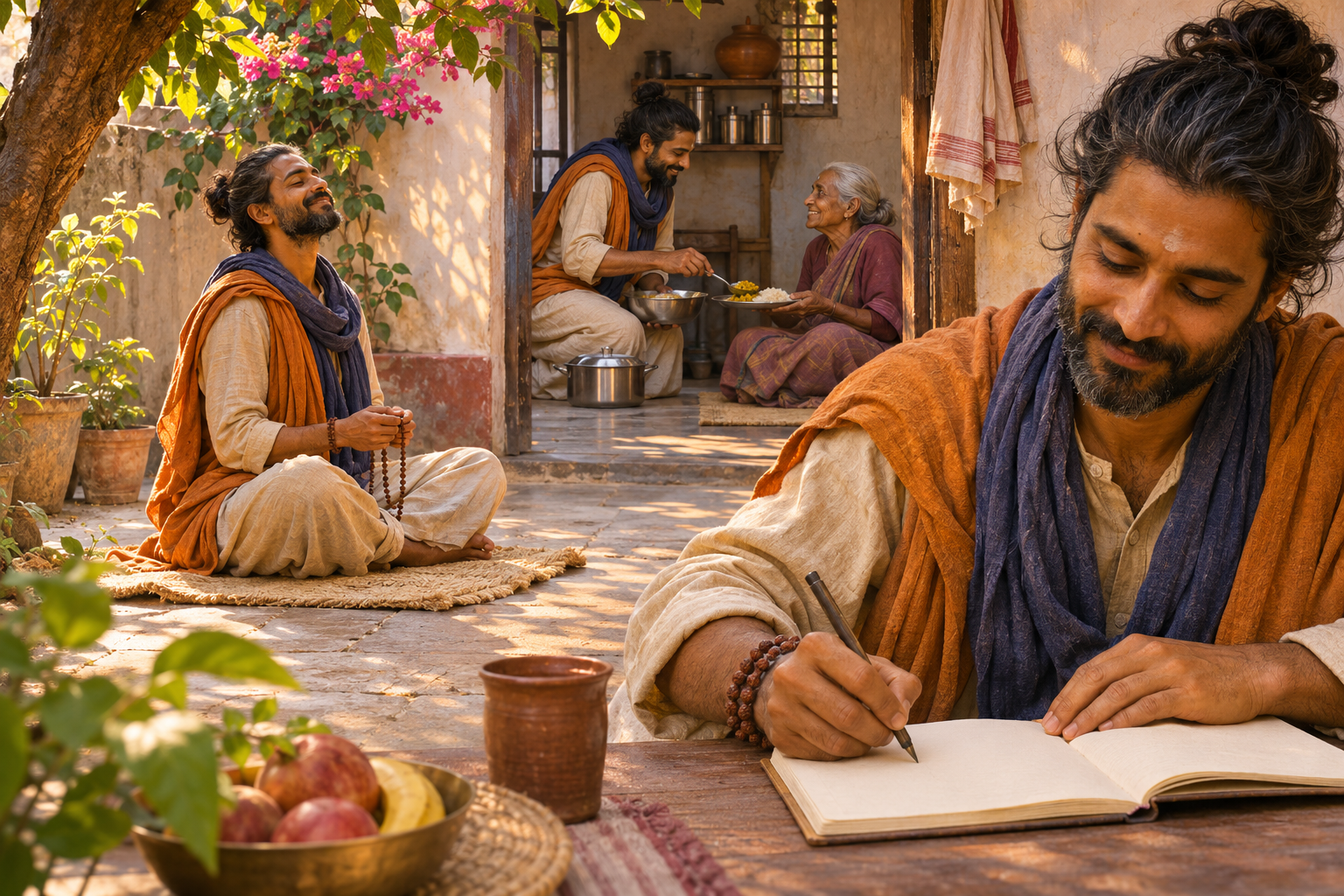
A dham-yatra session can produce many notes and no change. The remedy is not a larger notebook. Choose one teaching and translate it into an action that is visible, repeatable, proportionate, and connected to something you already do.
- If the teaching calls you toward remembrance, attach a brief period of nama-smarana or prayer to an established daily cue. Use the name and practice received in your own tradition.
- If it calls you toward restraint in speech, make your next difficult conversation the test. Before replying, state the other person’s concern accurately enough that they would recognise it.
- If it calls you toward seva, complete one useful act that does not depend on praise, publicity, or recognition.
- If it deepens reverence for dham, prepare your home puja space before your next listening period and keep the phone outside it.
These are models for translating instruction into conduct, not claims about the themes of Day 3. Select only an action that genuinely follows from what you heard.
Keep the commitment modest enough to perform but clear enough to evaluate. At your next review, ask: Did I actually do it? What interrupted it? Did the practice alter my attention or behaviour? Continue what is bearing fruit; revise what was vague or inflated. Bhakti is not strengthened by making dramatic promises that disappear when ordinary life resumes.
Share Day 3 without adding what you cannot verify
If you send the session to family, a satsanga group, or social media followers, keep three kinds of language separate: fact, quotation, and reflection.
- Fact: Use the verified identity of the programme: Ayodhya Dham Yatra 2026, Day 3, with HH Radhanath Swami.
- Quotation: Copy only words you have replayed and confirmed. Add a timestamp when the platform makes one available. Never put quotation marks around a remembered paraphrase.
- Reflection: Mark your interpretation as your own. Say that a teaching led you to reflect on a matter; do not turn your inference into words attributed to the speaker.
Do not infer a temple location, sequence of visits, ritual, central theme, or audience response from the title alone. A short clip also may not preserve the reasoning that came before or after it, so check the surrounding passage before circulating a forceful statement.
Be equally careful with claims about Hinduism as a whole. A speaker may teach from a particular Vaishnava vocabulary, lineage, and pastoral context. Preserve that context instead of presenting every formulation as the sole position of all Hindu traditions. Accurate sharing is itself a form of respect.
Key takeaways
- The secure identifying facts are the yatra name, year, programme day, named speaker, and archive date; further details must be checked in the session.
- Approach the recording with a sankalpa, protected attention, and a simple note page rather than playing it in the background.
- Separate the teaching, its supporting context, your personal reaction, and the action that follows.
- Carry one proportionate practice into daily life, then evaluate whether you performed it before taking on another.
- When sharing Day 3, distinguish verified fact, exact quotation, and personal reflection.
When you are ready, open Day 3, write your sankalpa, and keep one page beside you. When the session ends, choose the action before opening another recording. That small act of follow-through is how remote listening remains oriented toward yatra rather than becoming another item consumed and forgotten.
References
- Dandavats – Weekly Feed Archive – November 15, 2026
- Dandavats108 – Ayodhya Dham Yatra 2026 | Day 3 | HH Radhanath Swami

Leave a Reply
You must be logged in to post a comment.