
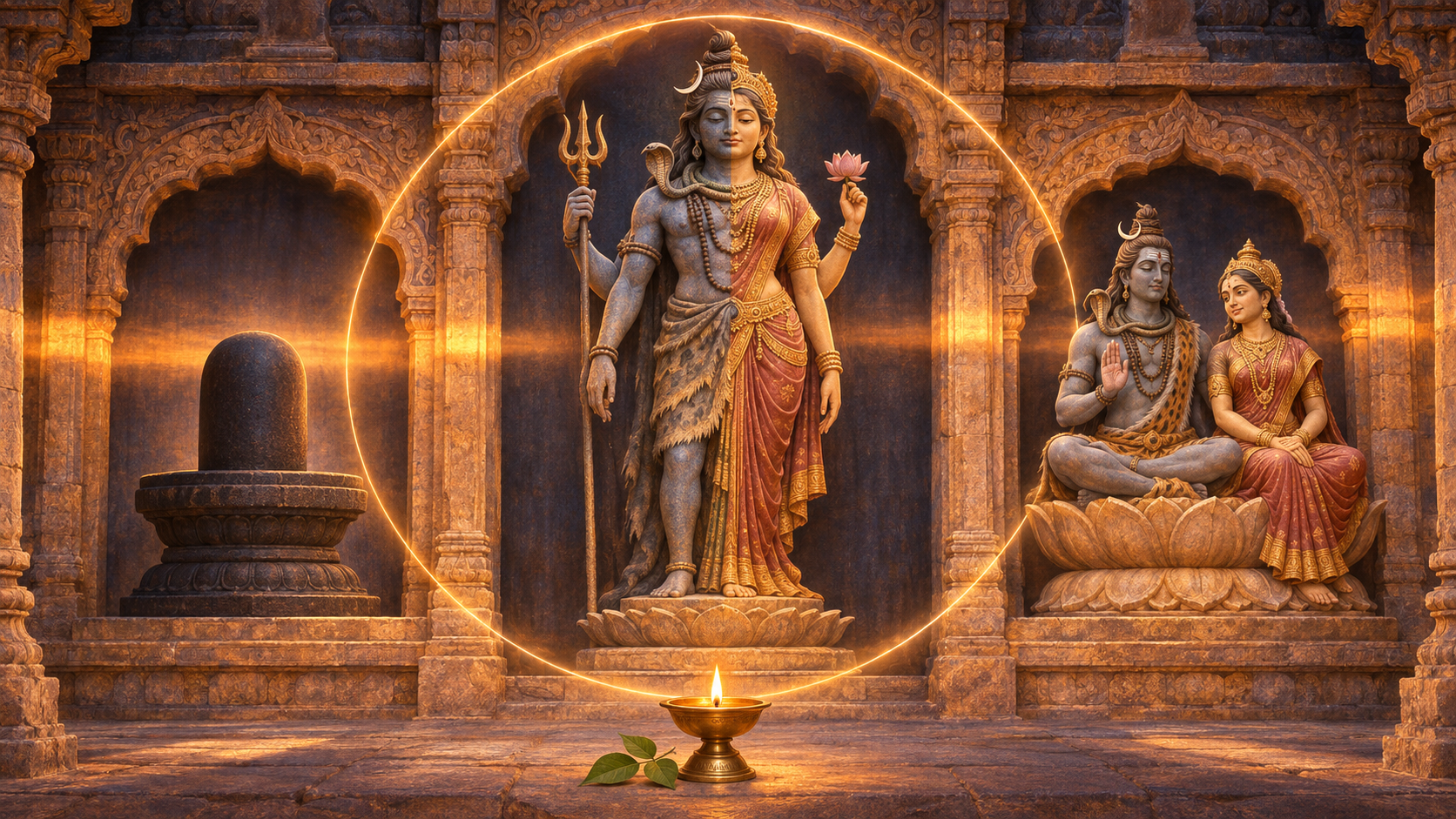
You may recognize Shiva immediately in one shrine and hesitate in the next: a linga here, a body divided between Shiva and Parvati there, and elsewhere the divine couple sharing a seat. If these images look like competing versions of the same deity, their meaning can dissolve into a catalogue of unfamiliar names.
A better approach is to read each form as a piece of theological grammar. The arrangement of body, boundary and seat shows you how unity and distinction relate. Once you know what to notice, Ardhanarishvara and Sambashiva become especially clear expressions of Shiva-Shakti unity.
Forms of Shiva are not a list of disguises
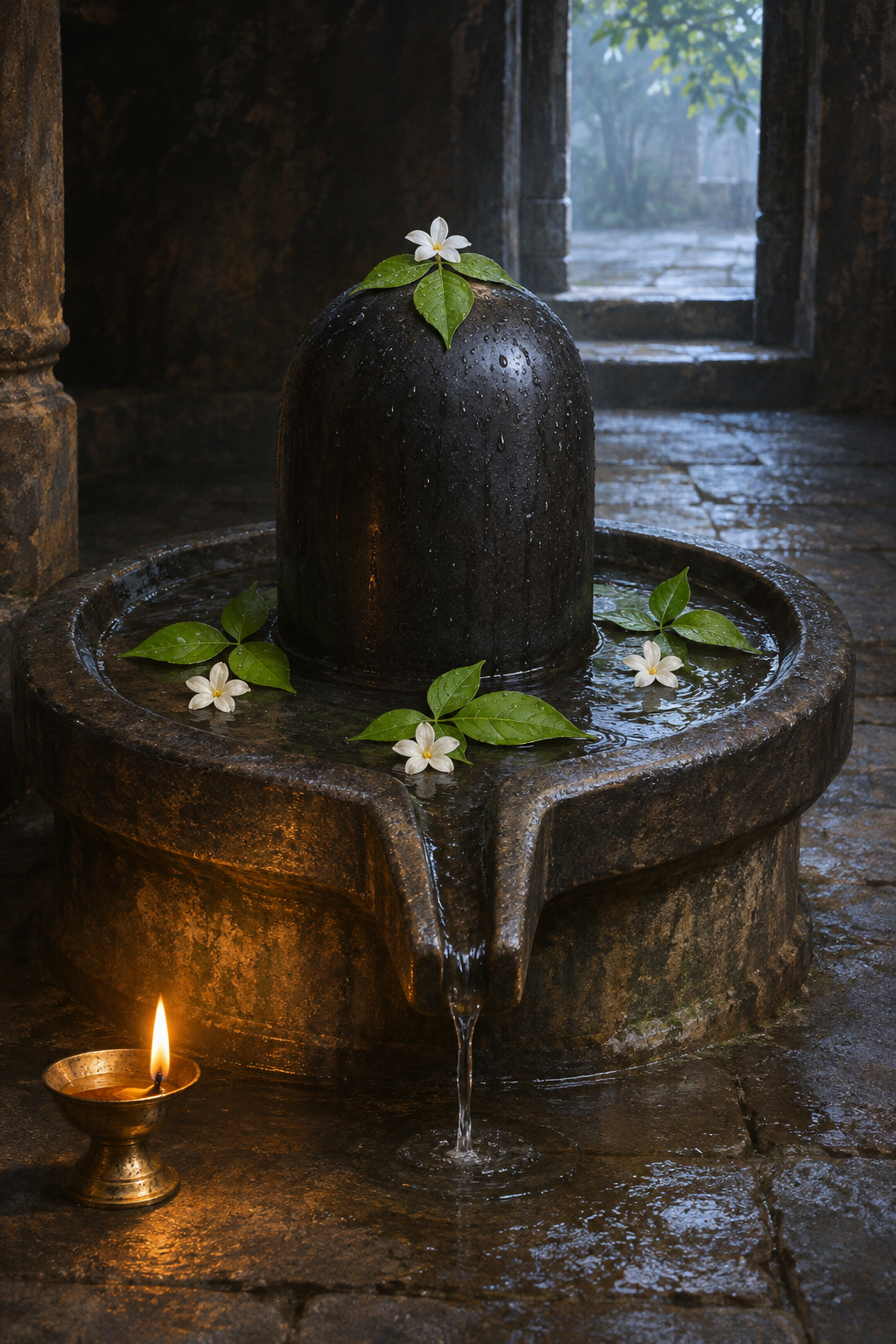
Shaiva Siddhanta recognizes 108 anthropomorphic forms known as Maheshvara Murtis. This classification distinguishes iconic forms from avataras, or incarnations, and describes them as secondary forms in relation to primary forms such as the Shivalingam.
That distinction changes the question you bring to an image. If you assume every form is an avatara, you will look first for a story about when Shiva descended in that identity. A murti asks you to look first at how Shiva is made present and intelligible: as ascetic, householder, teacher, cosmic power, composite being or divine partner.
The word secondary should not be mistaken for unimportant. It classifies the relation between forms; it does not tell a devotee that darshan through an anthropomorphic murti is spiritually inferior. The linga and the embodied forms do different iconographic work.
Before interpreting any Shiva murti, notice four concrete features:
- Body: Are you seeing one body, a composite body or two distinct figures?
- Boundary: Where does the image preserve a visible distinction?
- Position: Is one figure beside, within or seated with the other?
- Seat: Do the figures occupy separate places, or does one seat hold them together?
These questions keep interpretation anchored in what the murti actually presents. They also prevent every Shiva-Parvati image from being treated as though it makes exactly the same theological statement.
Ardhanarishvara holds difference within one body
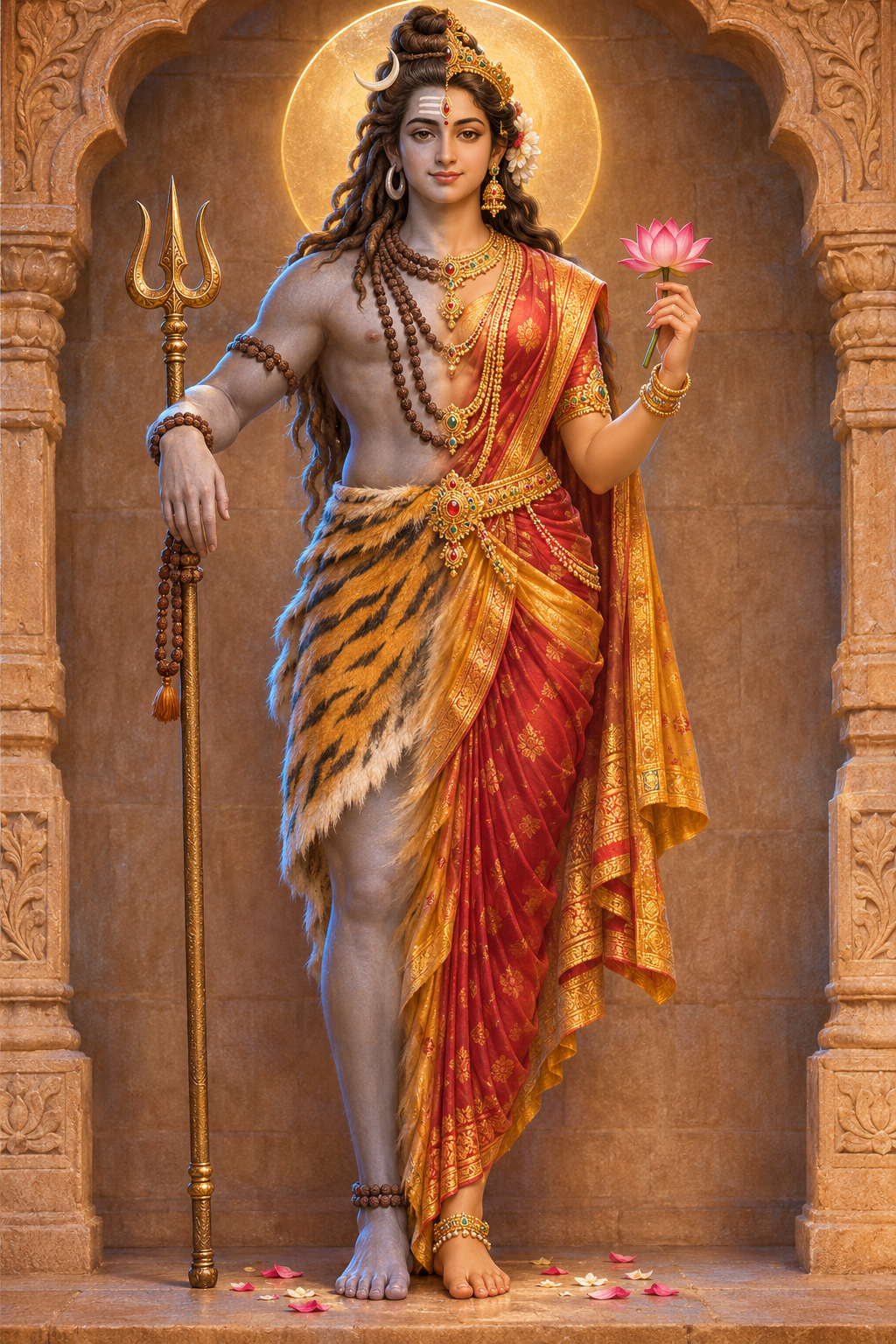
The name Ardhanarishvara means the half-man, half-woman form. Its defining feature is not merely the proximity of Shiva and Parvati but their union in a single composite body, with Shiva on the right and Parvati on the left.
Begin with the outer contour. Although the two halves retain recognizable characteristics, one outline contains them. The internal division makes difference visible, while the shared body prevents that difference from becoming separation. Unity here does not mean uniformity, and distinction does not mean rivalry.
This corrects two common misreadings. Parvati is not a decorative figure added beside an otherwise complete image of Shiva; she constitutes half of the manifest form. At the same time, the image does not erase every difference between Shiva and Shakti. It displays differentiation within an indivisible whole.
Ardhanarishvara can inspire reflection on reciprocity between masculine and feminine, but reducing the murti to a modern slogan about gender or marriage makes it smaller than it is. Its most immediate claim is theological: Shiva and Shakti may be distinguished in appearance without being torn apart in reality.
During darshan, let your attention follow the complete outline before examining either half. Then move across the internal boundary and notice that it never produces two separate bodies. That simple act of looking allows the composition itself to teach before you impose an explanation upon it.
Sambashiva expresses unity through one shared seat
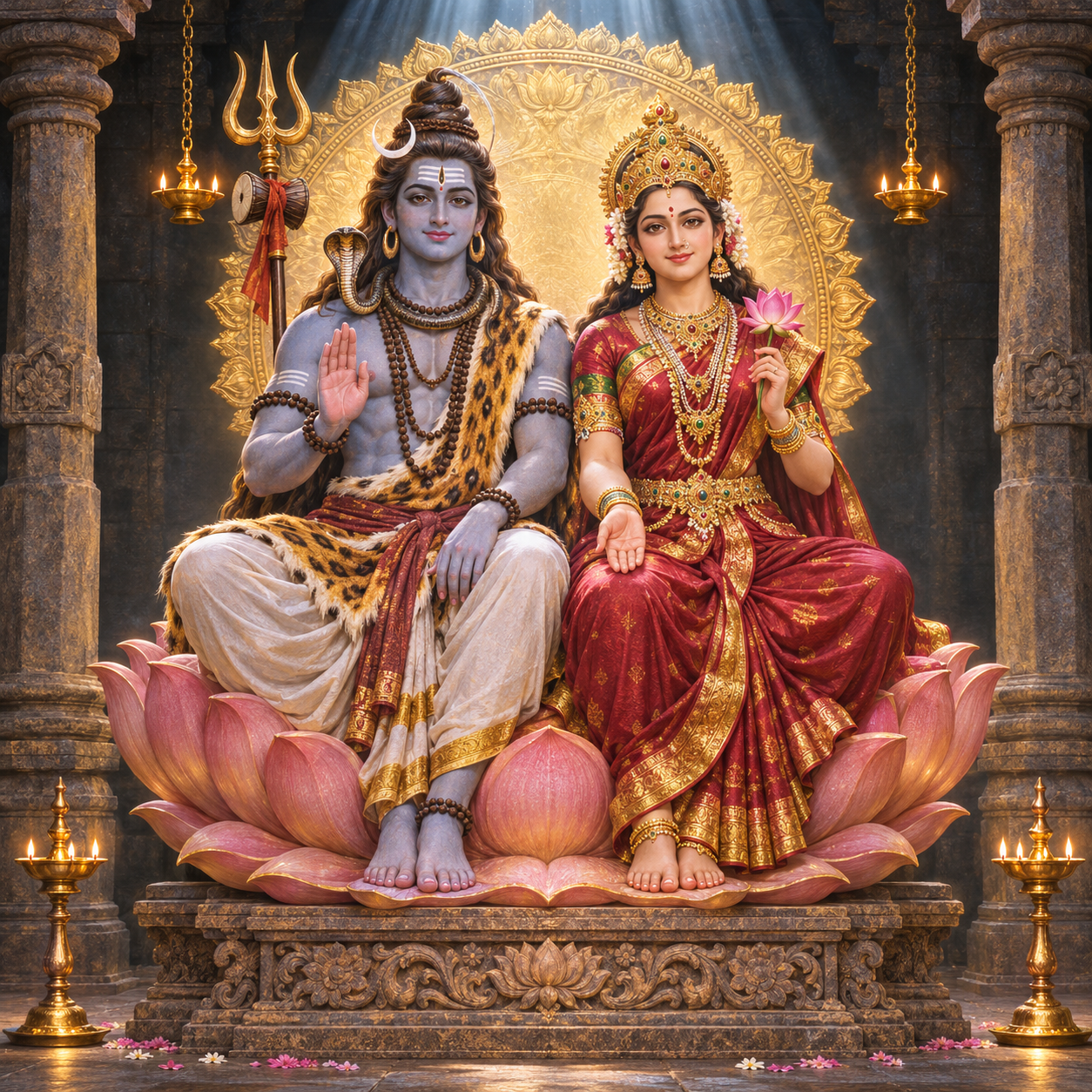
Sambashiva uses a different visual language. Shakti remains recognizable as a figure with Shiva and is seated on Shiva’s lap as they share a single seat. For that reason, the form is also called Ekasana Murthy: the single-seat form.
Unlike Ardhanarishvara, Sambashiva does not express non-separation by dividing one body into two halves. The figures remain relationally visible. Their shared seat, however, refuses the idea that they occupy isolated sacred worlds. Difference is preserved, but communion determines the composition.
The two forms therefore should not be forced into competition. Ardhanarishvara teaches through one body with differentiated halves. Sambashiva teaches through two recognizable presences gathered into one locus. One stresses inseparability within identity; the other makes unity-in-relationship visible.
| Form | What you first see | Question the composition invites |
|---|---|---|
| Shivalingam | A primary form of Shiva rather than a paired human composition | How can Shiva be approached without beginning from a human-shaped relationship? |
| Ardhanarishvara | Shiva and Parvati as differentiated halves of one body | How can difference remain real without becoming separation? |
| Sambashiva or Ekasana Murthy | Shiva and Shakti recognizably together on one seat | How can relationship express unity without erasing either presence? |
The table is a starting point, not a substitute for a tradition’s fuller theology. Different Shaiva and Shakta schools may use their own technical language for the relation between Shiva and Shakti. What the compositions securely show is that neither form treats Shakti as unrelated to Shiva.
A practical method for reading Shiva-Shakti imagery
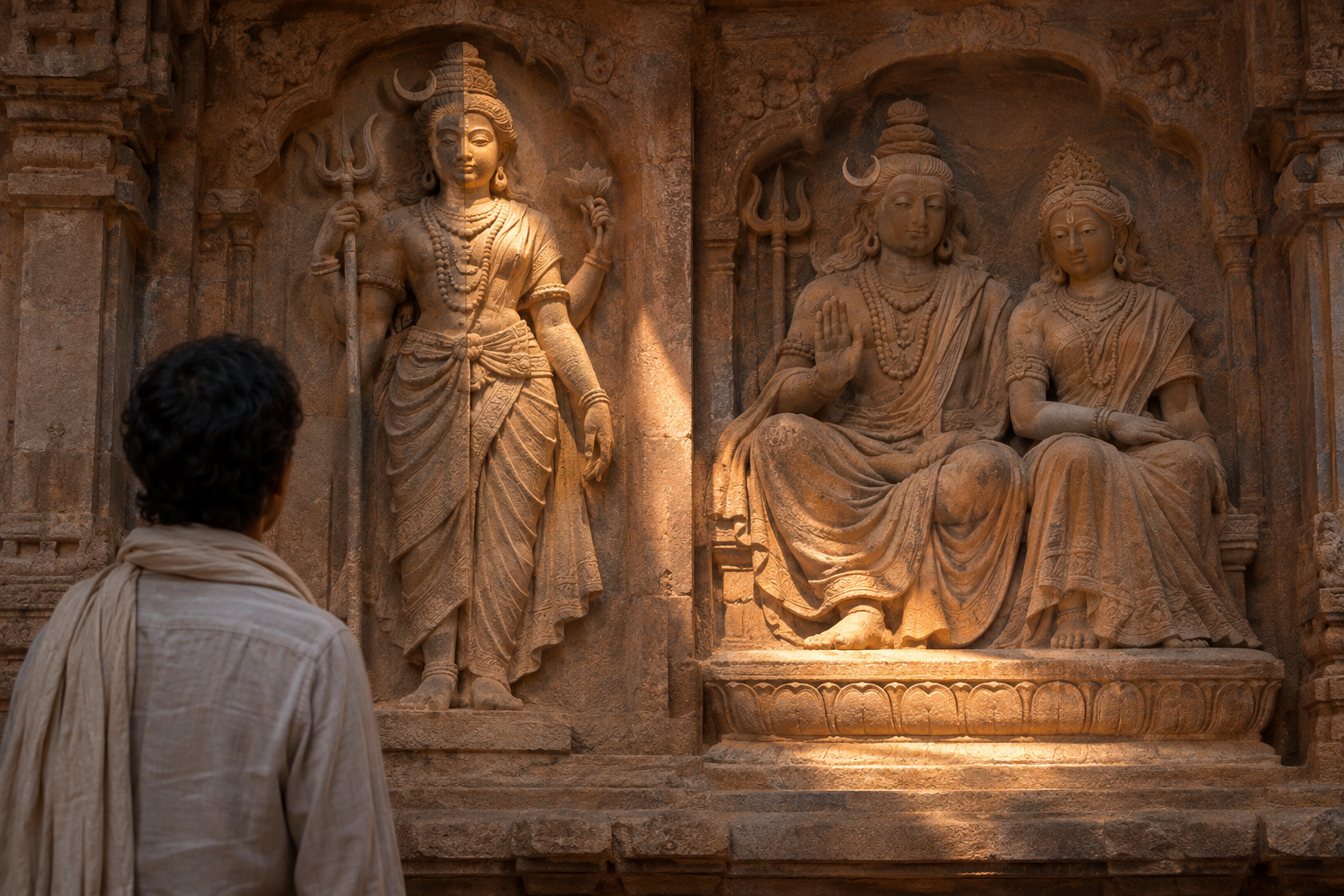
You do not need to memorize every Maheshvara Murti before you can look intelligently. Use this sequence whenever you encounter an image in a temple, book or home shrine:
- Identify the composition before naming it. One vertically differentiated body points toward Ardhanarishvara. Two recognizable figures sharing one seat point toward Sambashiva or Ekasana Murthy. Mere proximity between Shiva and Parvati establishes neither form by itself.
- Read structure before ornament. Clothing, weapons and gestures may carry further meanings, but body and seat establish the basic relationship. Start there.
- Separate observation from interpretation. First say what is visible: one body, right and left halves, two figures or one seat. Only then ask what the arrangement means. This keeps a familiar slogan from replacing the image.
- Respect the scope of a classification. The enumeration of 108 Maheshvara Murtis belongs to a Shaiva Siddhanta framework. Treat it as a meaningful traditional system, not as a census that every Hindu sampradaya must formulate identically.
- Carry the insight into practice. When two duties, identities or relationships seem opposed, ask whether harmony really requires one to disappear. Ardhanarishvara directs attention toward distinction without division; Sambashiva directs it toward relationship without isolation.
This method also protects against a subtler error: treating many forms as evidence of theological confusion. A tradition can use several images because no single composition foregrounds every relation at once. Multiplicity of murtis allows precision. Each arrangement makes one dimension of divine reality easier to contemplate.
Key takeaways for your next darshan
- The forms of Shiva are not automatically separate incarnations. In Shaiva Siddhanta, the 108 Maheshvara Murtis are anthropomorphic iconic forms, distinguished from avataras.
- The Shivalingam is treated as a primary form, while anthropomorphic murtis make particular divine qualities and relationships visible.
- Ardhanarishvara presents Shiva and Parvati as the right and left halves of one composite body.
- Sambashiva, also called Ekasana Murthy in this configuration, presents Shakti with Shiva on one shared seat.
- Ardhanarishvara expresses differentiation within one body; Sambashiva expresses unity through relationship and shared place.
- The most reliable interpretation begins with what the image actually does with body, boundary, position and seat.
When you next encounter one of these forms, pause before reaching for a label. Identify the body, trace the boundary and notice the seat. The murti will then lead you toward the central insight: Shiva-Shakti unity does not require difference to vanish, only the mistaken belief that difference must mean separation.
References
- Hindu Pad – Significance of Ardhanarishvara: Lord Shiva’s Half Man-Woman Form
- Hindu Pad – 108 Forms of Lord Shiva: Maheshvara Murtis
- Hindu Pad – Sambashiva, a Form of Lord Shiva with Ma Shakti Devi

Leave a Reply
You must be logged in to post a comment.