

You may know the outline of Srila Prabhupada’s Jaladuta journey and still wonder what makes it more than an inspiring episode from another person’s life. The useful question is not whether his courage was exceptional. It was. The useful question is what his decision exposes about age, limited means, spiritual obedience, and the moment when conviction must become action.
If you have been postponing a responsibility because you feel too old, too poorly equipped, or too unsupported, this journey deserves close attention. It does not give you permission to act recklessly. It gives you a disciplined way to tell the difference between a real limitation and an excuse that has quietly taken control.
Four facts give the Jaladuta journey its moral weight

In 1965, Srila Prabhupada was 70 years old, had only ₹40, carried his guru’s order, and undertook the voyage from India to America alone aboard the Jaladuta. Those facts should be kept together. Remove any one of them, and the meaning becomes easier but also thinner.
His age matters because people often treat later life as a period in which meaningful beginnings are no longer realistic. One life cannot establish a universal rule about aging, but it can disprove a careless assumption. Seventy was not automatically too late for Srila Prabhupada to begin the work before him. If you are using age to close a question before examining it, his example asks you to reopen it.
The ₹40 matters because it shows how little visible leverage stood behind the undertaking. It does not mean planning, money, or practical support are spiritually suspect. Deliberately creating hardship would miss the point. The lesson is narrower and more demanding: incomplete resources do not always cancel a genuine duty. You must determine what is truly necessary for the next step, rather than waiting for every uncertainty to disappear.
Travelling alone matters, but not because isolation is holier than companionship. Help should be accepted when it is available and honorable. The fact of aloneness reveals something else: a duty does not cease to be yours merely because no crowd has gathered around it. Support can strengthen resolve, but it cannot manufacture the conviction that the work requires.
The guru’s order is the central fact. Without it, age, money, and solitude could become ingredients in a story about individual daring. With it, the voyage becomes an act of service. Srila Prabhupada was not merely pursuing an adventurous personal ambition. His movement began with an instruction he accepted as binding.
Surrender becomes visible when it produces movement
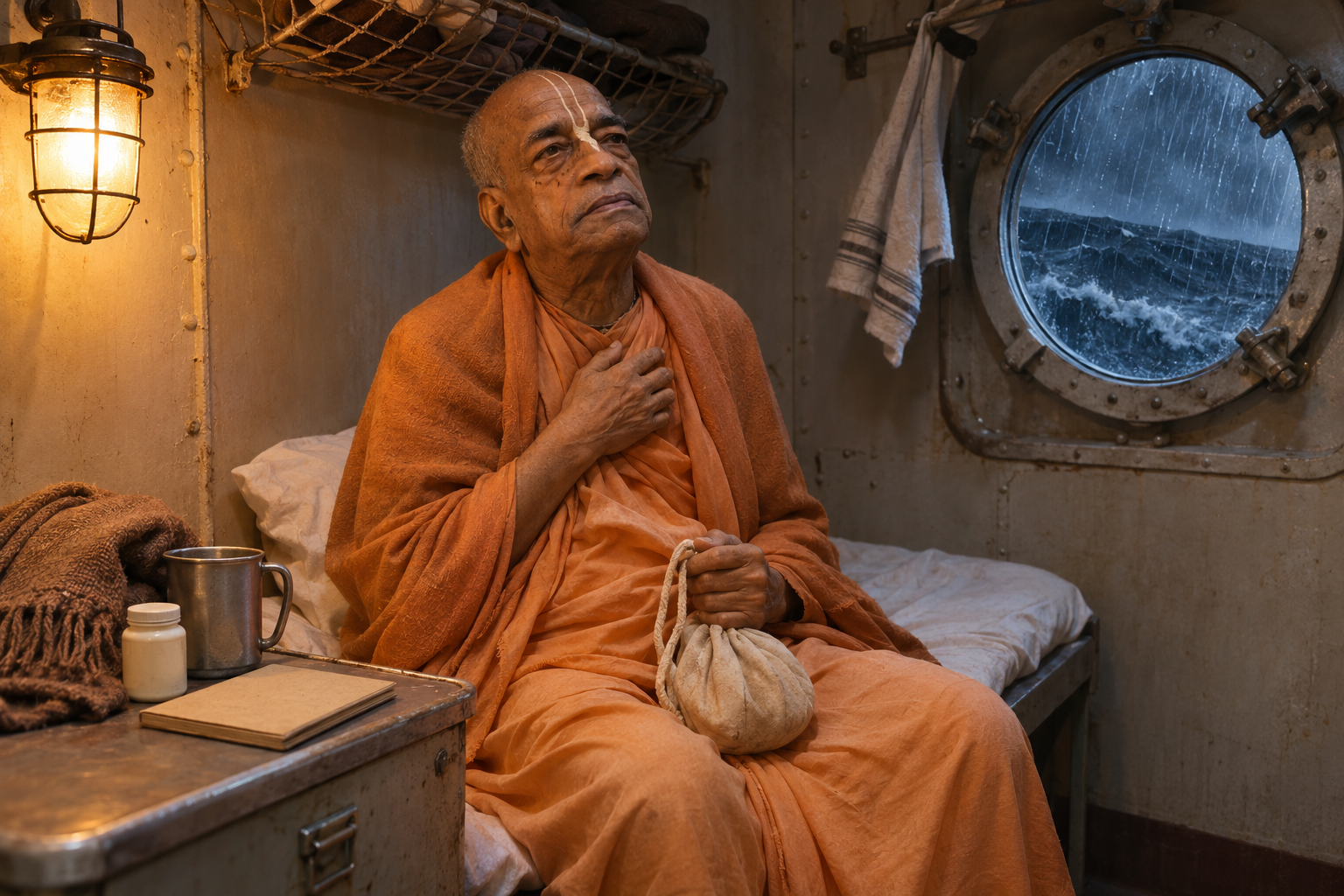
Surrender is sometimes mistaken for passivity. The Jaladuta journey presents a more exact sequence: an instruction is received, responsibility is accepted, action is taken, and the result is entrusted to Krishna. Remove action from that sequence and surrender becomes a comforting idea. Remove humility and it becomes self-assertion dressed in devotional language.
This balance is one of bhakti’s hardest disciplines. You act seriously without pretending to control every consequence. You prepare without making perfect conditions a prerequisite. You proceed without demanding that Krishna confirm your preferred result in advance.
When you face a difficult responsibility, test it with three questions:
- What is the instruction? State the duty in one sentence. If you can describe only a mood, a dream, or a desire for recognition, the obligation may not yet be clear.
- What belongs to you? Identify the next action within your control. Do not make other people’s approval, participation, or praise the condition for beginning.
- What must be entrusted? Name the outcome you cannot command. Entrusting that outcome to Krishna is different from neglecting the work required before it.
This test keeps devotion from drifting into either fatalism or egoism. It gives you something concrete to do while preserving the truth that the final result is not yours to possess.
Imitate the principle, not the hardship

Great devotional lives are easily romanticized. We notice the dramatic conditions and try to copy their outward shape. The more faithful response is to identify the inner principle and apply it honestly within your own obligations.
- Principle: Begin with the resources you genuinely have. Counterfeit: Refuse reasonable preparation so that your action appears more heroic.
- Principle: Continue when applause and companionship are absent. Counterfeit: Reject trustworthy assistance because being alone feels spiritually impressive.
- Principle: Honor a clear spiritual responsibility. Counterfeit: Label every intense personal impulse a divine command.
- Principle: Entrust results to Krishna. Counterfeit: Assume that sincerity entitles you to the exact outcome you want.
- Principle: Refuse to let age end discernment. Counterfeit: Ignore the real duties and limits that accompany your stage of life.
This distinction matters because the voyage is not a demand that every devotee cross an ocean with little money. It is a demand for honesty about what prevents us from serving. Sometimes the obstacle is real. Sometimes it is fear asking to be treated as wisdom. You will not distinguish the two by admiring courage from a distance; you distinguish them by examining the next decision in front of you.
Use the voyage as a practical devotional examination

You can remember the Jaladuta journey without reducing it to a slogan or anniversary sentiment. Watch the brief depiction of the voyage, then work through the following exercise with a notebook. The value lies in answering precisely, not dramatically.
- Name one responsibility you already recognize. Choose an actual duty: a neglected practice, a promise, a piece of service, a necessary apology, or a task you have repeatedly postponed.
- Write down the real constraints. Include time, health, money, knowledge, family obligations, and permissions where they genuinely apply. Do not minimize them.
- Separate requirements from preferences. Ask which conditions are necessary to act responsibly and which would merely make action more comfortable.
- Identify the smallest faithful step. It should be observable: make the call, open the text, write the first page, ask the required question, or set the appointment.
- Give that step a time. If it can be done safely and responsibly, place it within the next 24 hours. A duty without a next action is easily returned to the realm of intention.
- Offer the action, not a fantasy of the outcome. In your usual form of prayer, ask Krishna for clarity and steadiness. Then complete the step you named.
If the responsibility remains vague after this exercise, do not manufacture certainty. Seek guidance from a trusted and accountable spiritual teacher, study the relevant dharmic principles, and clarify the duty before making a major commitment. Srila Prabhupada’s obedience to his guru should deepen discernment, not become an excuse to surrender it to anyone who demands compliance.
Key takeaways
- The Jaladuta journey joins four inseparable facts: Srila Prabhupada was 70, possessed only ₹40, travelled from India to America alone, and acted under his guru’s order.
- Its central lesson is not that hardship is holy. It is that imperfect conditions do not automatically erase a clear spiritual responsibility.
- Devotional surrender includes action: prepare what you can, do what belongs to you, and entrust what you cannot control to Krishna.
- Do not imitate poverty, isolation, or danger. Imitate the steadiness that keeps service from depending on comfort or applause.
- The best way to honor the voyage is to turn one recognized duty into one scheduled, responsible action.
Before you leave this page, complete one sentence: “By this time tomorrow, I will take this specific step.” Keep the step proportionate, dharmic, and real. The Jaladuta journey began as movement in obedience to an instruction. Let your remembrance of it produce movement too.
References

Leave a Reply
You must be logged in to post a comment.