
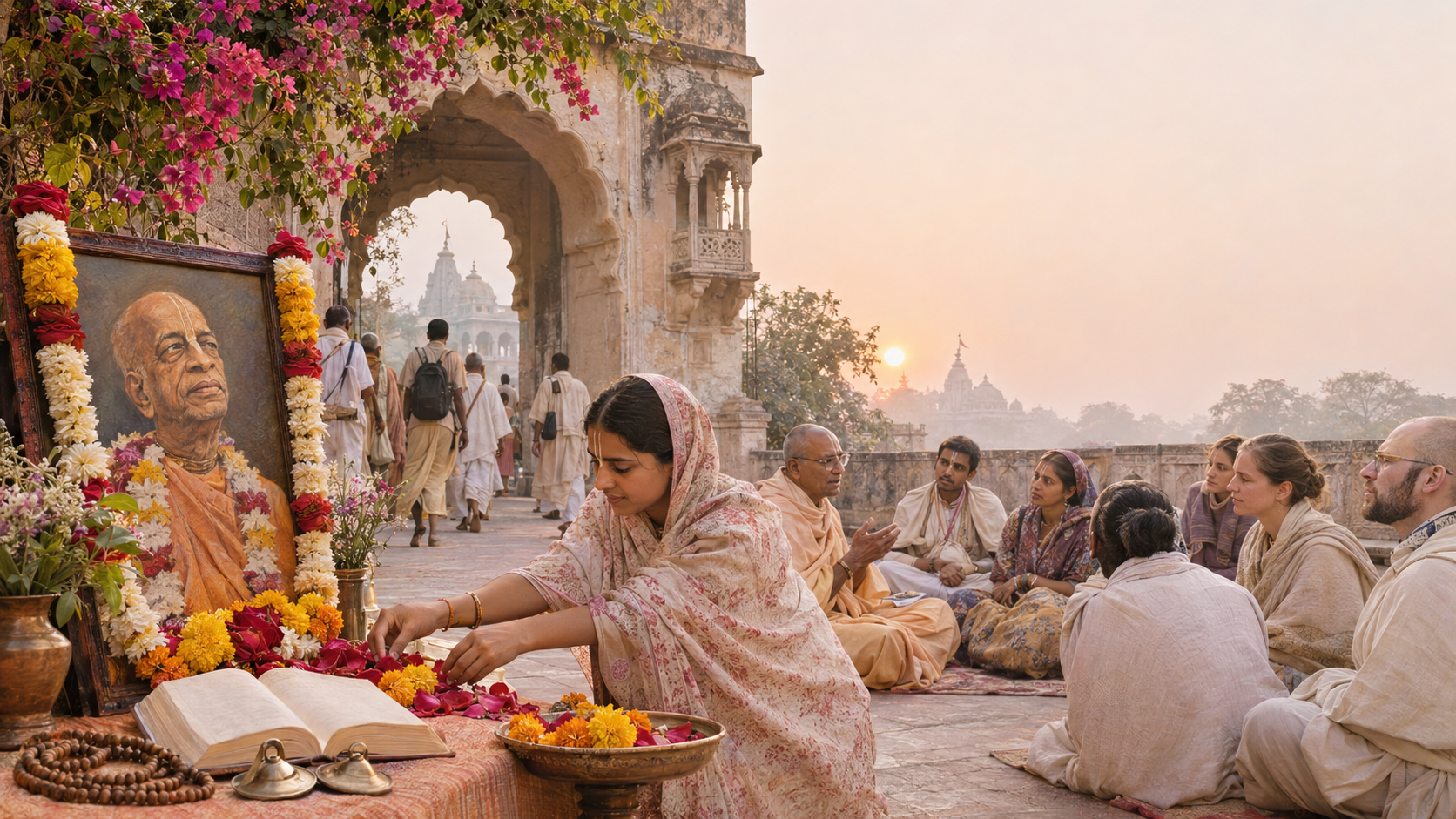
You want to honour Srila Prabhupada, but you may be unsure whether that means travelling to Vrindavan, joining a temple programme, or arranging a quiet observance at home. The most demanding option is not automatically the most devotional one. Choose the form that will help you hear his teachings, serve responsibly, and change something in your daily practice.
A well-planned commemoration does more than preserve a revered memory. It reconnects gratitude to discipleship. A pilgrimage can deepen that work, but only when the sacred place, the spiritual teacher’s instructions, and your conduct remain more important than the journey itself.
Choose the observance that matches your real purpose
Begin with a plain question: what are you trying to offer? If your answer is only “attendance,” the day can easily become ceremonial. A stronger intention names an action: to hear attentively, thank the spiritual teacher, assist the Vaishnavas, seek forgiveness for negligence, or renew a neglected instruction.
You have three sound ways to build the day:
- Join a local temple commemoration when you need the discipline of a shared schedule, kirtan, hearing, seva, and association.
- Observe at home or with a small sanga when travel is impractical, health or caregiving responsibilities limit you, or no suitable temple programme is accessible.
- Undertake a pilgrimage when you can give the journey enough time and attention to remain a spiritual practice rather than a hurried visit.
A Srila Prabhupada disappearance-day celebration held at ISV on 12 November 2026 offers a useful reminder that meaningful remembrance is not confined to Vrindavan. A community programme can place hearing and service at the centre without requiring a major journey.
Do not assume that 12 November is the fixed civil-calendar date every year merely because the 2026 programme occurred then. Confirm the current observance, starting time, and programme with the temple or community you intend to join. This small check prevents the common mistake of planning from an old announcement.
If you are deciding between the three forms, use capacity rather than prestige as your test. Choose the setting in which you can arrive on time, remain present, accept guidance, and complete a genuine service. Staying local with full attention is better than reaching a sacred place exhausted, distracted, or resentful.
Build the day around hearing, remembrance, service, and resolve
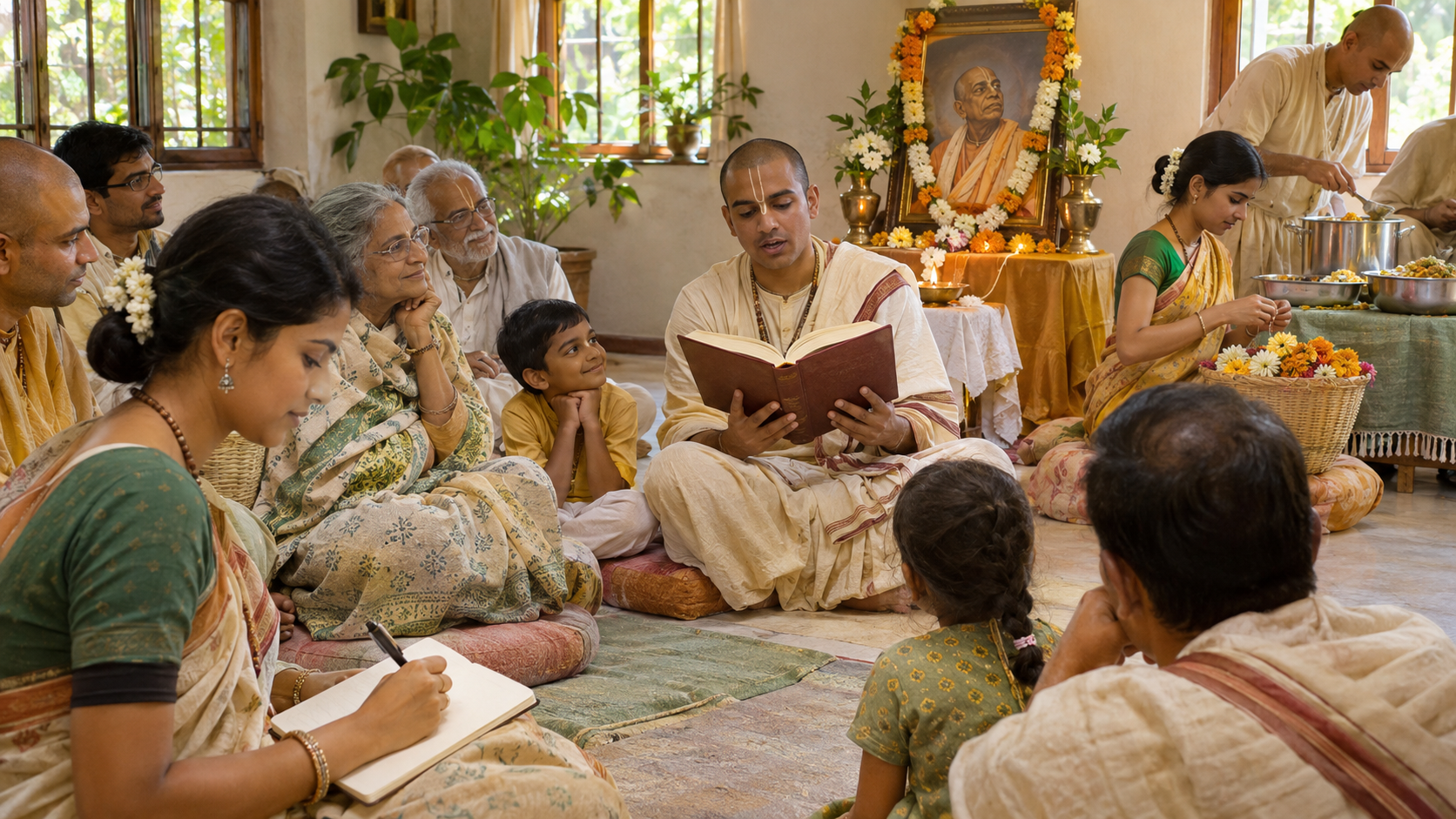
A disappearance-day observance should not treat disappearance as absence in an ordinary sense. The practical question is how the acharya remains present through instruction, example, worship, and the service carried forward by disciples and communities. You can keep that question visible by giving the day a clear sequence.
- Hear. Select an authentic lecture, passage, or remembrance connected to Srila Prabhupada before the programme begins. Do not spend the sacred time searching through clips or debating what to play.
- Remember. Pay attention to the qualities and instructions being honoured. Move beyond admiration by asking which quality exposes a weakness in your own practice.
- Serve. Accept a needed task such as preparing the space, assisting guests, cleaning, helping with prasada, supporting kirtan, or distributing authorised spiritual literature. Useful service is often quiet and unseen.
- Resolve. Choose one instruction you can carry into ordinary life. Make it small enough to repeat and clear enough to recognise when you have neglected it.
If you are organising the observance, publish the sequence in advance. Tell participants when to arrive, whether they may bring an offering, what service is needed, and which parts of the programme require silence. Assign practical responsibilities before people assemble. Otherwise, organisers spend the opening moments moving chairs, finding texts, and negotiating the order while everyone else waits.
At home, simplicity is an advantage. Clean the worship area, arrange an image respectfully, choose the reading beforehand, chant without multitasking, prepare or offer food according to your established practice, and conclude by naming the service you will continue. Do not imitate a large temple festival beyond your means. The aim is concentrated remembrance, not a miniature stage production.
If several people will speak, ask each person to connect remembrance with a teaching or practical example. This keeps the gathering from becoming a sequence of general compliments. Personal recollections may be precious, but unverified stories should not be embellished merely to make the programme more dramatic.
Plan a Vrindavan journey as pilgrimage, not sightseeing
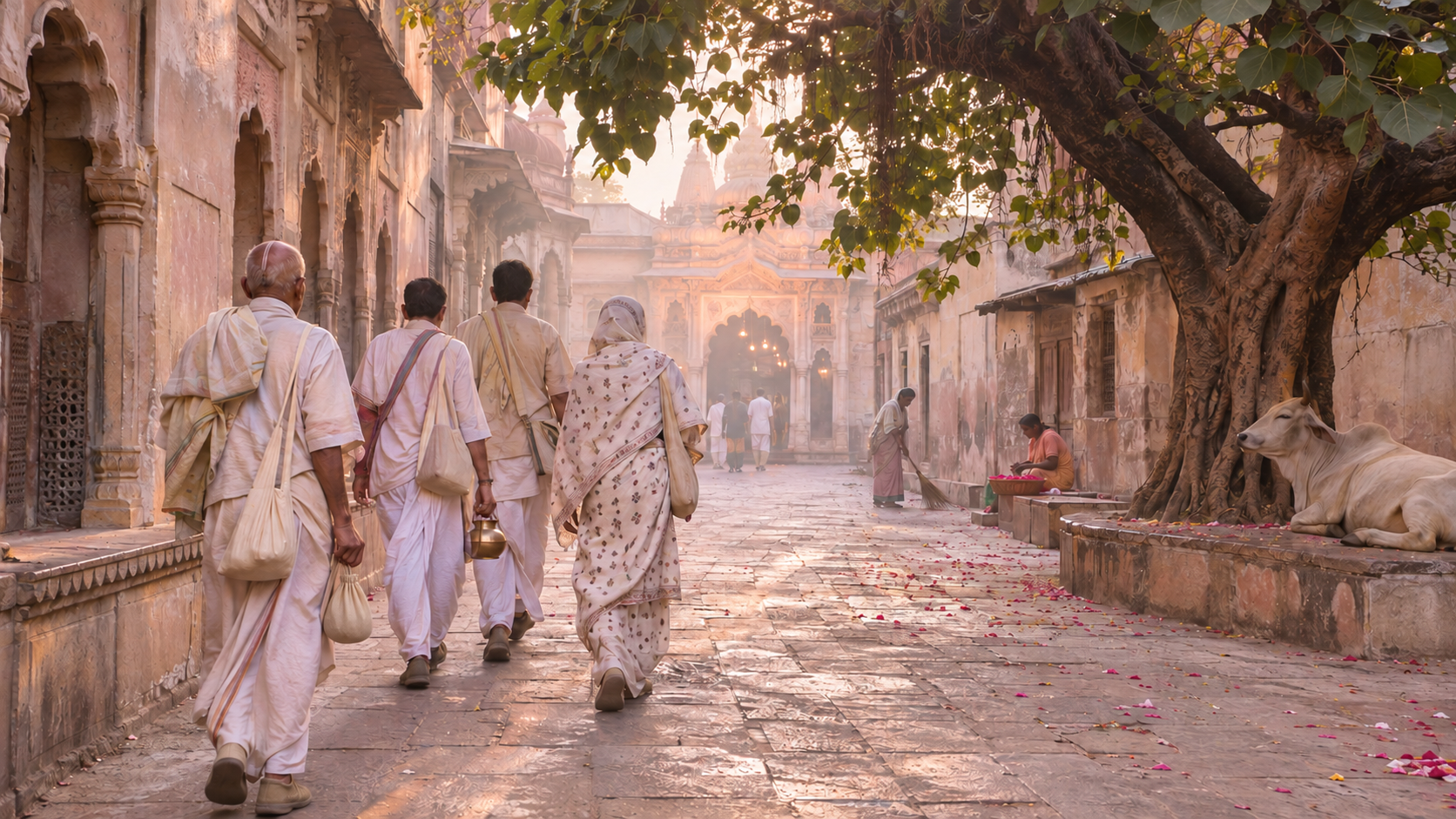
Vrindavan changes the scale of the decision. You are no longer arranging only a programme; you are entering a sacred landscape with its own temples, residents, rhythms, and demands. The preparation should therefore begin with humility, not an attraction list.
A Srila Prabhupada shobha yatra in Vrindavan joined public procession with darshan of the sacred Sapta Devalaya. That combination gives you a useful model for understanding the journey. The movement between temples is not empty transit. Walking together, chanting, following the host, making room for other pilgrims, and approaching each darshan attentively are themselves parts of the observance.
Before committing to a procession or temple circuit, confirm these practical points with the organiser:
- The meeting place, start time, expected finishing point, and whether the route can change.
- How much walking and standing the programme normally involves, and whether transport or accessible alternatives are available.
- Which temple customs, dress expectations, footwear arrangements, bag restrictions, and photography rules apply.
- Whether prasada, drinking water, or storage will be provided, and what you are expected to carry yourself.
- How children, older relatives, and anyone with limited mobility can participate without being separated from the group.
- Whom to contact if you become lost, unwell, delayed, or unable to complete the route.
Travel light enough that your bag does not become the centre of your attention. Keep essential medication, water where permitted, identification, and the organiser’s contact details easy to reach. If fasting, heat, crowding, or prolonged walking would put your health at risk, choose the safe form of participation and follow appropriate medical advice. Physical strain is not a measure of spiritual sincerity.
During the yatra, follow the devotional leadership rather than constructing a private itinerary around it. Do not repeatedly leave the group to obtain photographs or fit in unrelated stops. At each sacred place, first notice what the host is asking participants to do: chant, listen, wait, move, or take darshan. Your restraint protects both your attention and other people’s access.
If you cannot complete the full circuit, decide in advance what a complete pilgrimage means for you. It may be joining part of the procession, taking darshan at an accessible stop, hearing the programme from one location, or supporting the pilgrims through service. This avoids the discouragement of treating an inaccessible route as the only valid offering.
Protect the pilgrimage from three common distractions
Sacred travel can quietly turn into consumption. The change is easy to miss because every photograph, temple stop, and souvenir still appears religious. Watch for these three distractions before they set the tone of your day.
- The camera becomes the leader. If you approach every moment by asking where to stand for an image, you stop receiving the moment as darshan. Keep the device away during core worship and follow local photography rules. Take a permitted photograph only after you have actually looked, listened, and offered respect.
- The route becomes a checklist. Collecting temple names can replace encounter with sacred place. At each stop, resist rushing immediately toward the next one. Let the host’s explanation, the atmosphere of worship, and the needs of other pilgrims determine your pace.
- Remembrance becomes nostalgia. Admiration for Srila Prabhupada’s past achievements can remain emotionally powerful while leaving your conduct untouched. Ask what his example requires from you now: steadier sadhana, service to a community, serious study, support for teaching, or more responsible treatment of fellow devotees.
There is another test: notice how you behave when the programme becomes inconvenient. A delayed start, crowded entrance, hot walk, or change of route can reveal whether you came to control an experience or to serve within it. This does not require you to ignore unsafe conditions or poor organisation. It asks you to distinguish a genuine problem from wounded preference.
Respect for Vrindavan also includes respect for the people who live and worship there. Do not block entrances, stage other pilgrims as scenery, speak loudly during worship, or assume that possession of a camera grants permission to record. A sacred place is not a backdrop assembled for visitors.
Carry the commemoration into your ordinary week
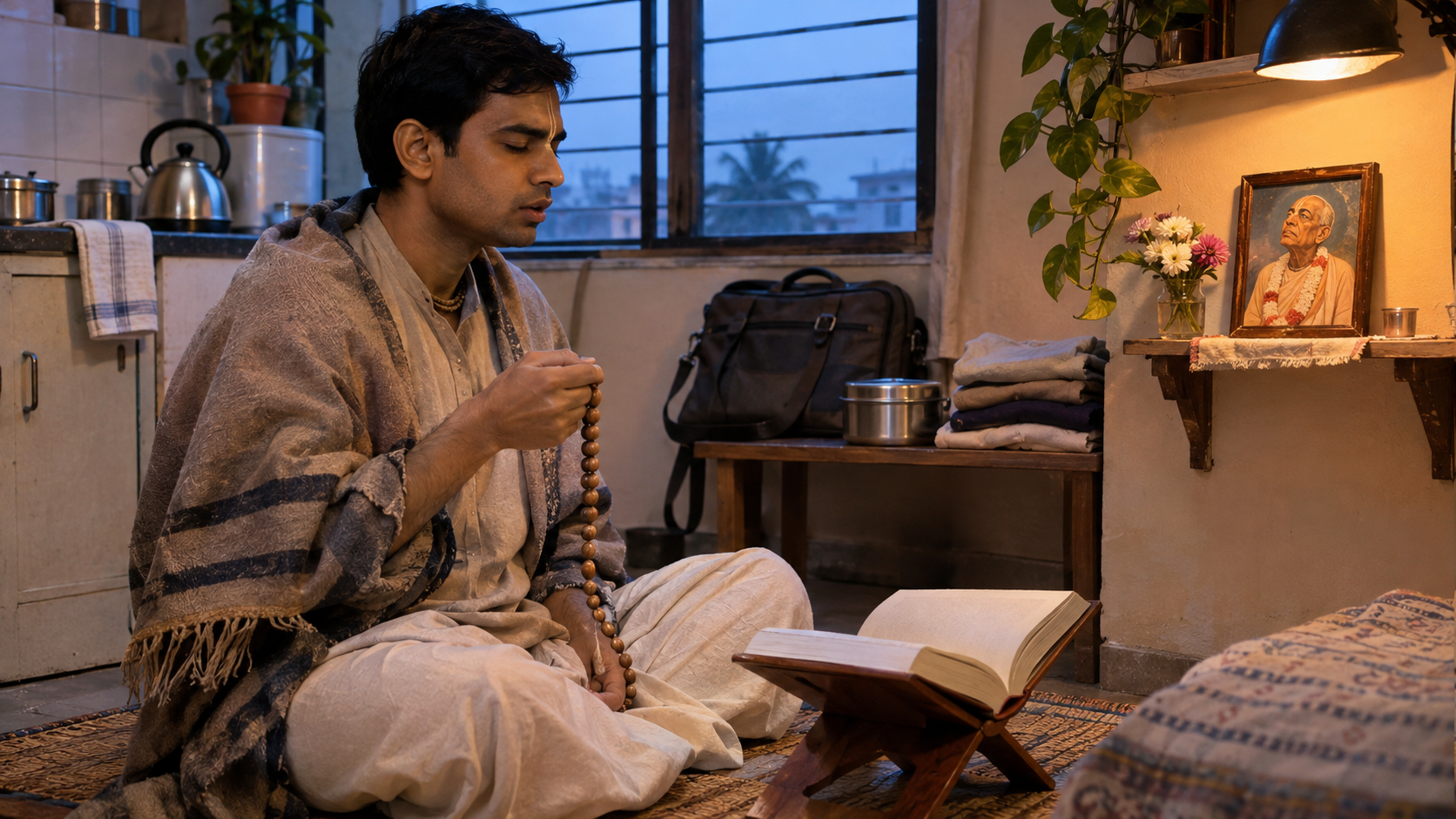
The decisive part of the observance begins after the programme. Inspiration naturally fades when travel ends and routine returns. Prevent that loss by converting one impression into a scheduled action before the day closes.
- Write down the instruction, passage, or quality that affected you most. Use your own words so that you know what you understood.
- Choose a repeatable expression of it: a regular reading practice, dependable temple service, support for book distribution, care for newcomers, more attentive chanting, or another duty recognised within your devotional setting.
- Tell one trustworthy devotee what you have chosen. Ask that person to check whether the resolve survived beyond the emotion of the event.
- Put the next action on your calendar. A resolve without a place in your week remains a wish.
Keep the commitment proportionate. Grand vows made in an elevated mood can collapse under ordinary responsibilities, leaving guilt rather than service. A modest discipline performed faithfully expresses gratitude more convincingly than an ambitious declaration abandoned soon afterward.
Key takeaways
- Choose a local programme, home observance, or Vrindavan pilgrimage according to your capacity for attentive hearing and service, not the prestige of the setting.
- Confirm the current date and schedule directly with the host instead of reusing an older event announcement.
- Structure the commemoration around hearing, remembrance, useful service, and one practical resolve.
- For a Vrindavan yatra, obtain the route, walking demands, customs, accessibility information, and organiser’s contact details before departure.
- Judge the day by what enters your regular practice after it, not by how many places you visited or images you collected.
Make your first decision now: identify the community you will contact, the sacred reading you will prepare, or the service you will offer. Once that is settled, the commemoration stops being an idea and becomes a deliberate act of discipleship.
References
- Dandavats — Srila Prabhupada’s Disappearance Day Celebrations | 2026-11-12 | ISV
- Dandavats — Srila Prabhupada Shobha Yatra in Vrindavan | Taking Darshan of the Sacred Sapta Devalaya

Leave a Reply
You must be logged in to post a comment.