
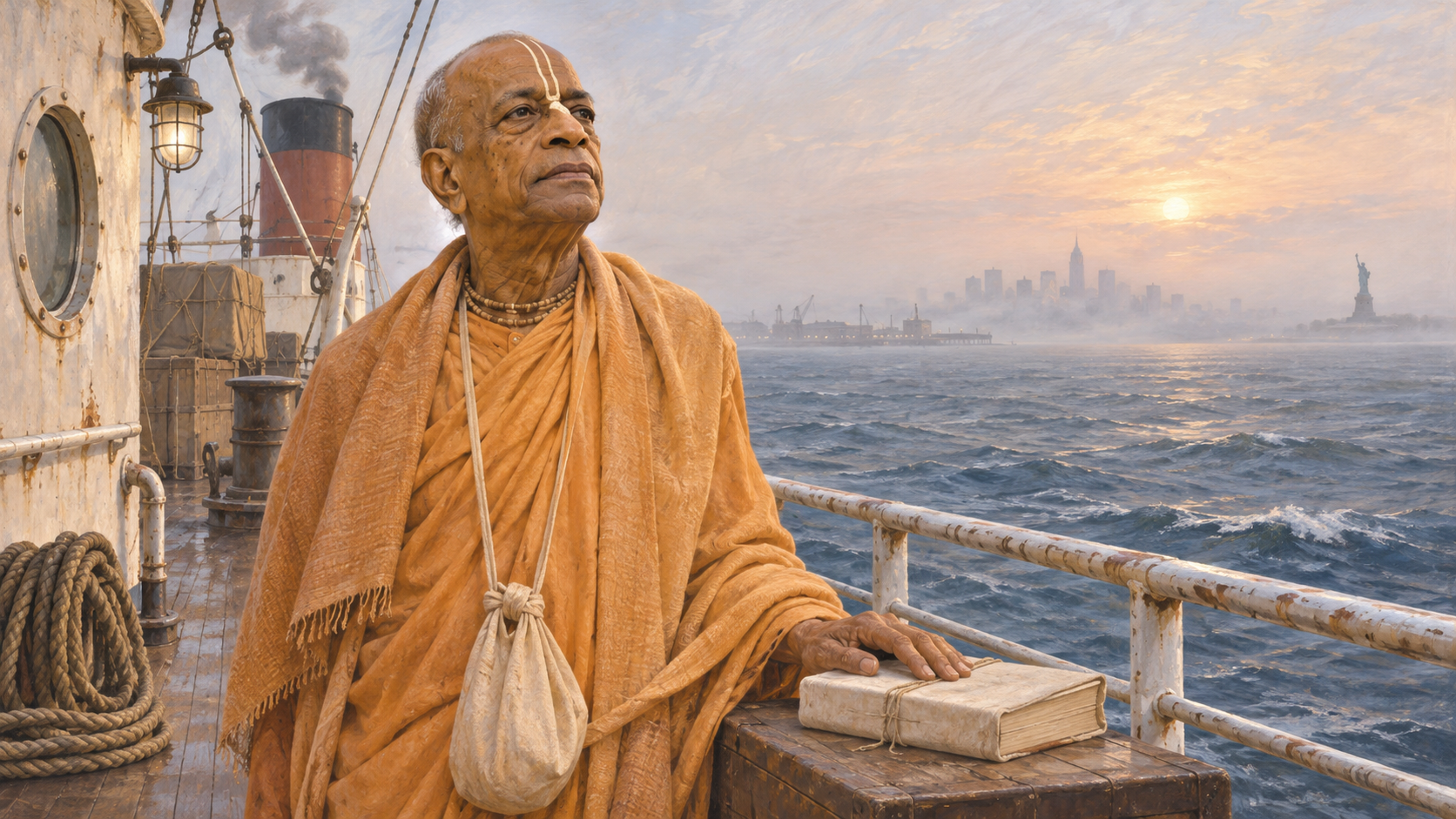
You may know Srila Prabhupada as a revered spiritual teacher, the founder of ISKCON, or the saffron-clad figure associated with Krishna consciousness in the West. Yet admiration alone doesn’t answer the practical question: what should you remember about his life, and how should that remembrance change what you do?
The clearest answer begins with the decision at the centre of his public mission. He carried a tradition rooted in Bharat into an unfamiliar cultural setting at an age when most people would have considered their major work complete. His legacy is therefore more than an institution or an inspiring story. It is a test of whether conviction can become disciplined service.
The journey that gives his life its practical meaning
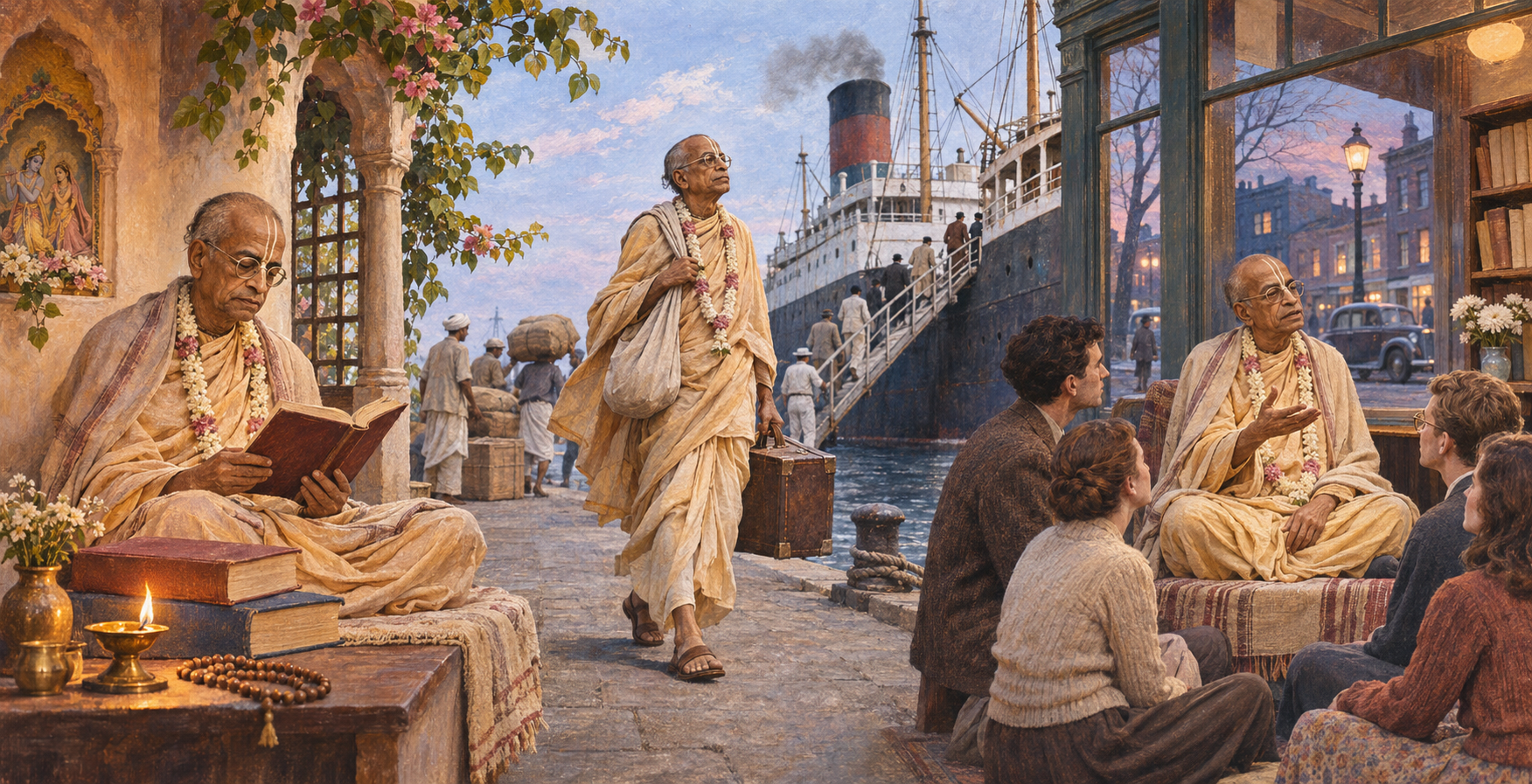
A long biography can bury its subject beneath dates and honours. Srila Prabhupada’s life becomes clearer when you begin with its decisive outward movement: at an advanced age, he travelled from India to the West and dedicated his life to spreading Krishna consciousness. His 1965 voyage to America matters because the timing, direction and purpose belonged to one decision.
The timing matters. This wasn’t a youthful experiment undertaken before responsibilities had accumulated. It was a demanding mission accepted late in life. The lesson isn’t that every devotee must attempt something dramatic in old age. It is that age, comfort and an unfavourable setting don’t automatically settle the question of what service remains possible.
The direction matters too. He moved from Bharat to the West without treating the tradition he carried as cultural baggage to be discarded. That distinction remains important for anyone presenting dharma outside its inherited setting. Accessibility may require explanation, patience and unfamiliar forms of communication. It doesn’t require embarrassment about the tradition’s origin.
The purpose matters most. Travel by itself is not sacrifice, and novelty by itself is not spiritual achievement. The journey gains meaning from its devotional aim: transmitting Krishna consciousness. If you want to draw a personal lesson from his example, don’t copy the visible scale of the act. Identify the service immediately in front of you, then ask which excuse has kept you from doing it steadily.
Why Founder-Acharya means more than institutional founder
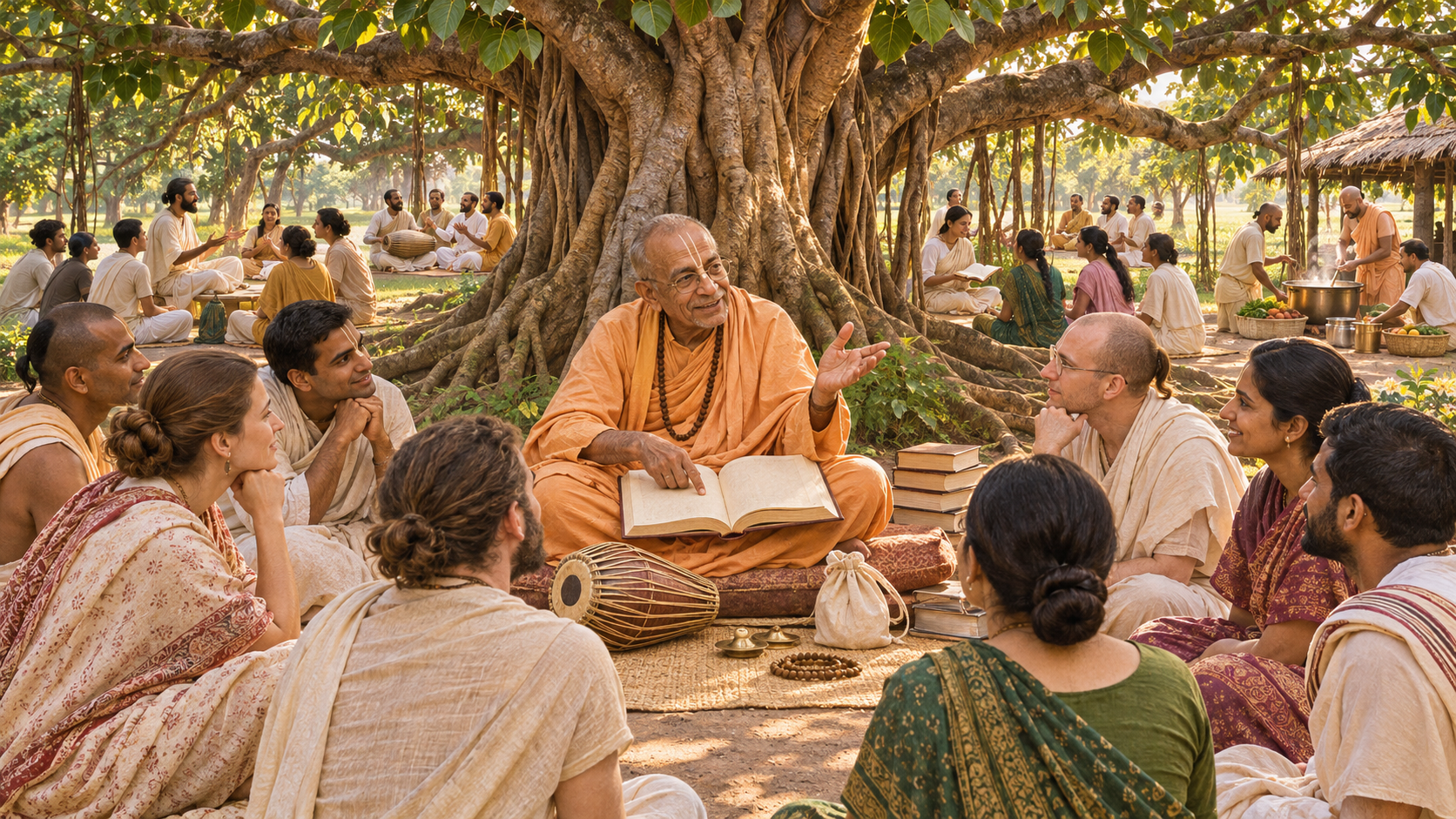
Srila Prabhupada is remembered as the Founder-Acharya of the International Society for Krishna Consciousness. Both parts of that title deserve attention. A founder establishes a durable vehicle for collective work. An acharya teaches a path and demonstrates it through conduct. Joined together, the words connect organisation with spiritual direction.
This distinction protects remembrance from two common reductions. The first turns him into an administrator whose principal achievement was creating an organisation. The second turns him into an inspirational personality detached from the community, discipline and responsibility required to transmit a tradition. Neither is adequate. The institution matters because it can carry teaching, practice and service beyond one lifetime; the acharya matters because an institution without spiritual orientation can preserve a name while losing its purpose.
For you, this creates a useful way to evaluate any tribute offered in his name. Does it direct attention towards Krishna, or does it end with admiration for a human personality? Does it lead people into study, practice and service, or merely give them commemorative language? Does it help newcomers encounter the tradition accurately, or assume that familiarity with institutional vocabulary is the same as understanding?
You don’t have to belong to ISKCON to recognise the force of this model. Dharmic communities of many lineages face the same challenge: preserving the authority of a teaching while making it intelligible in a different time and place. Srila Prabhupada’s example asks those communities to treat continuity as active work, not passive inheritance.
What the movement from Bharat to the West still teaches
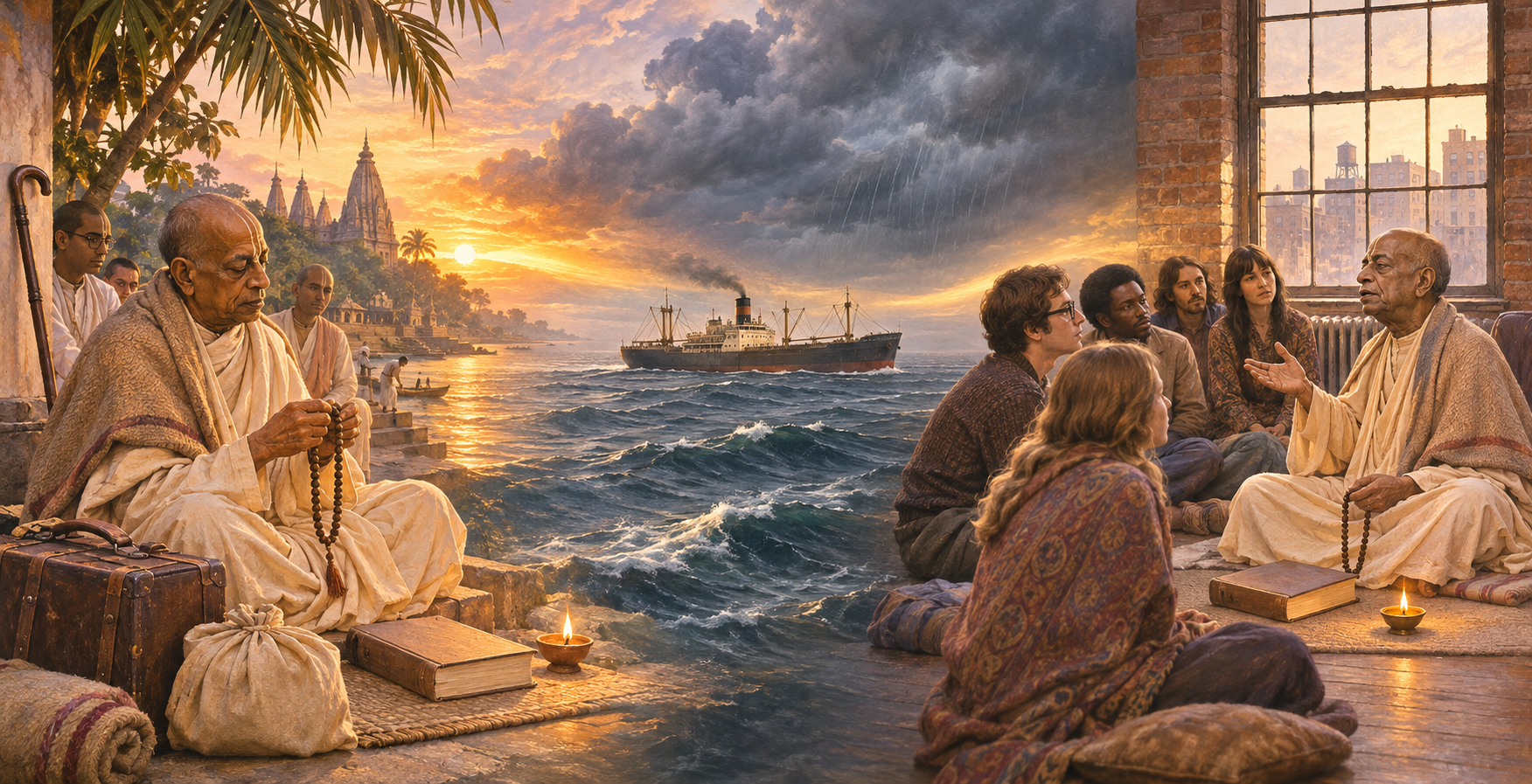
The westward journey enacted a consequential idea: a tradition can be rooted in Bharat without being confined to Bharat. That doesn’t mean every religious expression can be lifted from its context without loss. It means that thoughtful transmission is possible when the person carrying a tradition knows what must remain central.
There are two easy mistakes here. One is defensive pride, in which the greatness of dharma is repeatedly asserted but rarely explained or practised. The other is cultural dilution, in which everything unfamiliar is removed until little remains beyond a pleasant message of general wellbeing. Neither approach does justice to a living tradition.
A better approach keeps the spiritual purpose visible, explains unfamiliar terms rather than hiding them, and gives the listener something they can actually practise. It also allows conduct to carry part of the argument. Patience, discipline, hospitality and consistency make a teaching credible in ways that slogans cannot.
This is especially relevant if you teach younger Hindus, speak about dharma online, organise a temple programme or explain a practice to someone outside Bharat. Before simplifying anything, ask whether you are clarifying the tradition or quietly replacing it. Good translation reduces unnecessary confusion. It doesn’t change the destination.
Srila Prabhupada’s legacy therefore belongs to a larger history of Bharat’s influence on the world, but it should not be reduced to civilisational prestige. Pride becomes meaningful when it produces competence: knowing the teaching, representing it honestly and creating conditions in which another person can encounter it seriously.
How to observe his disappearance day with substance
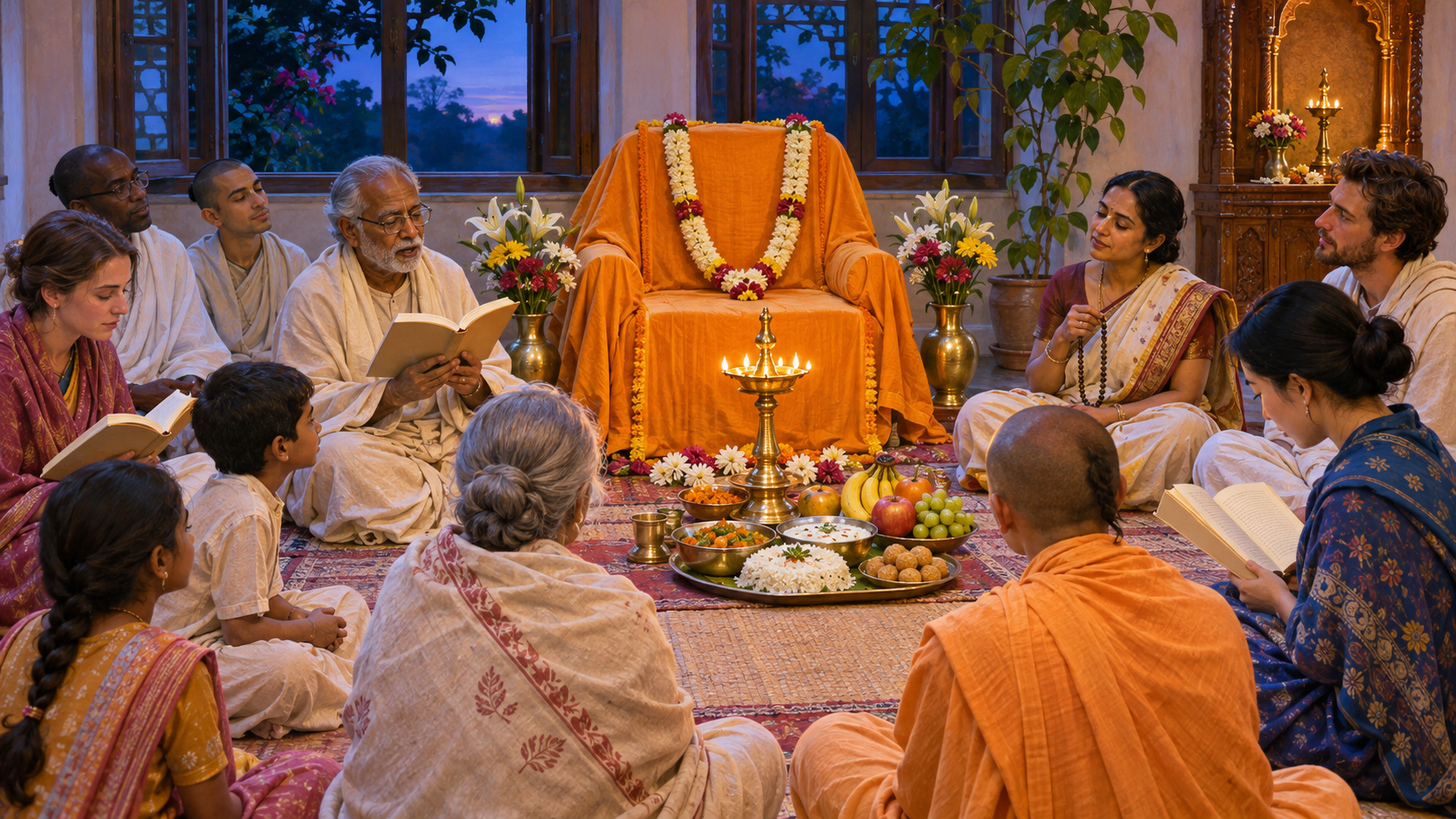
A sacred disappearance day isn’t merely the anniversary of a death. Within devotional language, remembrance affirms that a teacher’s bodily departure does not end the disciple’s responsibility to hear, practise and serve. The day should therefore move from gratitude to examination, and from examination to action.
Begin with his own teaching rather than a collection of praise about him. Choose a short passage from an original work or recorded instruction and read it slowly enough to identify the actual demand being made of the listener. A sentence that challenges your habits is more useful than many pages that leave you comfortably impressed.
Then connect the teaching to a documented feature of his life. His advanced-age journey is a strong place to begin because it exposes the weakness of vague admiration. Ask what he accepted that comfort would have told him to avoid: uncertainty, effort and responsibility for communicating across cultures. Your answer should lead to a comparable principle in your circumstances, not an imitation of his external acts.
Follow reflection with service that has a clear recipient. You might help a temple programme run reliably, make prasada available, welcome someone who doesn’t understand the customs, support the careful teaching of children, or explain one concept without mockery or condescension. The important shift is from thinking about legacy to becoming responsible for part of it.
Finally, make one commitment precise enough to verify. Avoid promises such as becoming more spiritual or serving more. Name the practice, the setting in which you will do it and the obstacle you expect. If the obstacle is lack of time, decide what will be displaced. If it is uncertainty, identify whom you will ask. If it is inconsistency, attach the practice to an existing part of your routine.
This approach also keeps reverence honest. A tribute need not exaggerate every detail of a teacher’s life to express devotion. Accuracy is itself a form of respect. It allows the known facts, the teachings and the visible consequences of service to carry their proper weight.
Key takeaways
- Read Srila Prabhupada’s journey as a lesson in responsible service, not as permission to romanticise difficulty for its own sake.
- Keep both dimensions of Founder-Acharya together: institutions preserve collective work, while spiritual teaching preserves their purpose.
- When presenting dharma outside Bharat, explain unfamiliar ideas clearly without concealing their origin or emptying them of devotional meaning.
- Use disappearance-day remembrance to move from hearing to self-examination, then from self-examination to a named act of service.
- Test any tribute by what follows from it: deeper attention to Krishna, more faithful practice, better service and clearer transmission.
Before the day ends, choose one teaching to hear and one duty you have postponed. Put the duty into your calendar, tell the person who depends on it, and begin. A legacy carried through practice needs no ornamental ending.
References

Leave a Reply
You must be logged in to post a comment.