
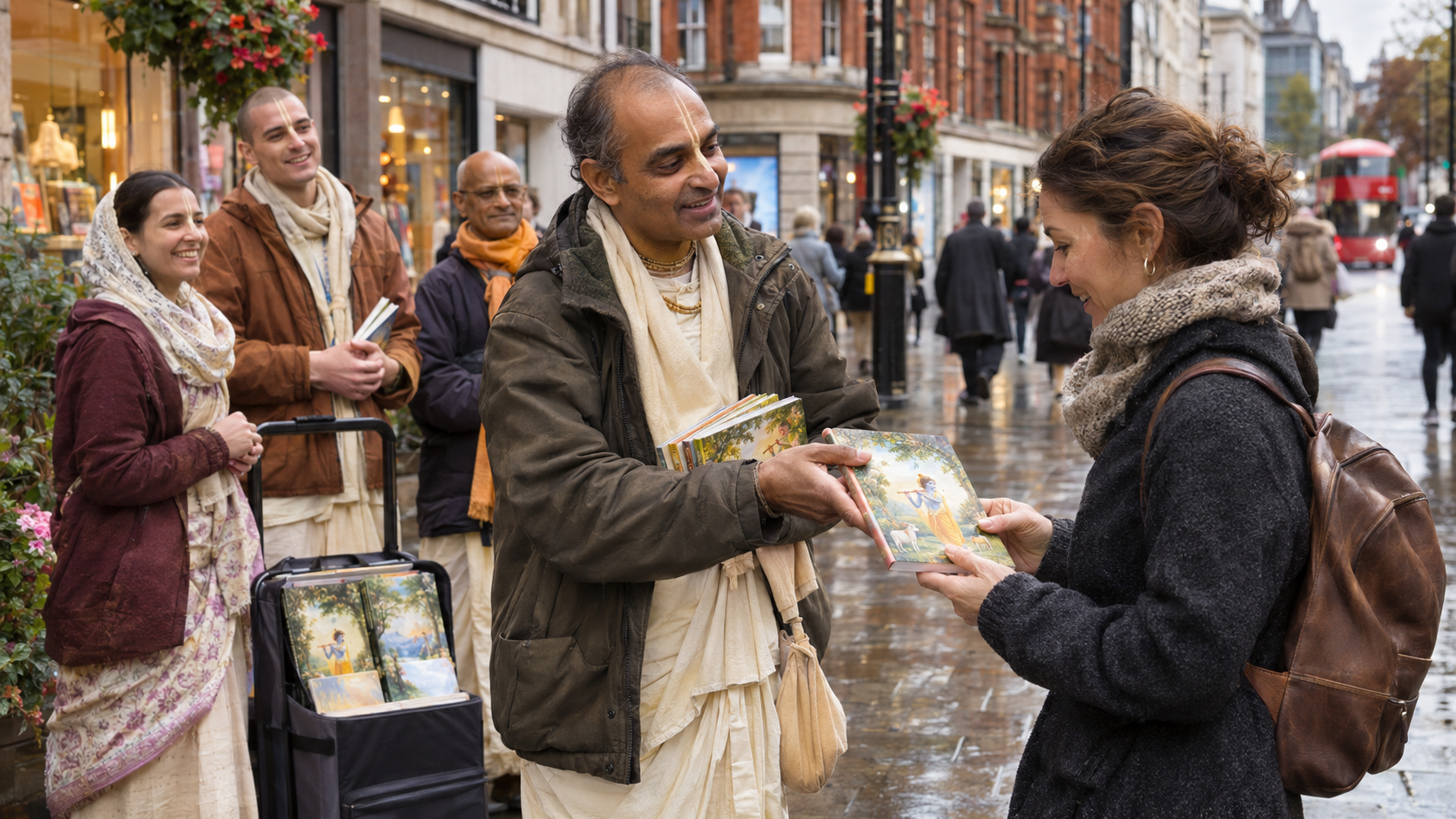
If you have seen the footage of Gopal Prabhu distributing books in the United Kingdom, you may be looking for the practical details: where he is serving, which books are available, and how you can help. The confirmed point is straightforward: Gopal Prabhu is undertaking book distribution in the UK.
That deserves attention, but it does not justify filling the gaps with guesses. If you want to attend, volunteer, donate, or share the news, first separate what is known from what still needs confirmation. That small act of care protects both the seva and the people who may respond to your invitation.
What we can responsibly say about the UK distribution

Gopal Prabhu’s book distribution in the UK is publicly documented through linked footage. Beyond that central fact, you should treat operational details as unconfirmed unless they come from Gopal Prabhu or a named local organizer.
In particular, do not assume that the footage announces a nationwide tour, a recurring programme, or a public event at a particular temple. A recorded distribution activity establishes that the service took place; it does not by itself establish an itinerary.
Before making plans or forwarding an invitation, confirm:
- The city and exact meeting point.
- The date, start time, and expected finishing time.
- Whether the distribution is still continuing.
- The titles and languages of the books being offered.
- Whether books are free, sold at a stated price, or offered for a suggested donation.
- The name and contact details of the local coordinator.
- Whether volunteers must register before arriving.
This is not needless caution. Someone who travels after seeing an old or incomplete message may arrive at the wrong place, while an organizer may suddenly receive volunteers who were never included in the plan. One verified line containing the place, time, and contact person is more useful than a widely forwarded clip with no context.
Book distribution is a meeting, not merely a handover

A Dharmic book can carry a teaching far beyond the few minutes available in a public conversation. The recipient can read privately, return to difficult passages, and decide whether to explore the tradition further. That is precisely why the manner of distribution matters.
The goal should not be to place an object into someone’s hands at any cost. The person should know what the book is, which tradition it represents, whether any payment is expected, and how to ask further questions. He or she must also be free to decline without being pressed.
For the volunteer, this changes the measure of a good interaction. A respectful exchange in which one interested reader knowingly accepts a suitable book is more faithful to seva than several hurried handovers built on confusion. Dharma does not need ambiguity to attract attention. Clarity strengthens the invitation.
How you can support Gopal Prabhu’s service responsibly

If you want to help after seeing the UK distribution, do not begin by choosing a role for yourself. Begin by finding the person coordinating the activity and asking what is actually needed. Book distribution involves more than the visible conversation with a reader; someone must also manage books, transport, permissions, money, volunteer conduct, and follow-up.
- Verify that the activity is current. Contact the community or person through whom you received the footage. Ask for a dated schedule and the name of the local coordinator before travelling.
- Ask for a defined task. Useful roles may include carrying cartons, arranging transport, keeping an inventory, welcoming interested readers, or helping with language needs. Accept the role the coordinator confirms rather than duplicating another volunteer’s work.
- Confirm permission for the location. Public access does not automatically mean unrestricted distribution. The organizer should verify the applicable rules with the venue, property manager, event host, or relevant local authority before books and volunteers are deployed.
- Clarify the financial arrangement. Every volunteer should use the same accurate explanation of whether a book is free, sold, or connected to a voluntary donation. Keep any money secure and follow the organizer’s recording procedure.
- Learn what you are offering. You should be able to state the book’s title, author, tradition, language, and central subject without exaggeration. If you have not read it, say so rather than pretending to answer questions you cannot answer reliably.
- Provide a genuine route for follow-up. Give an interested reader a verified temple, community, meeting, website, or contact approved by the organizer. Do not collect personal details unless there is a clear purpose and the person knowingly agrees.
If no coordinator can confirm these basics, pause rather than improvising in Gopal Prabhu’s name. You can still share the documented activity as an example of seva, but you should not present yourself as part of an official programme without authorization.
A simple way to speak with a potential reader

Public distribution works best when the opening gives the other person an easy, informed choice. You do not need a rehearsed sermon. You need a clear question that reveals whether the person is interested.
- Ask about interest. Try a plain question such as, “Are you interested in spiritual philosophy or Dharmic traditions?”
- Identify the book accurately. Name its tradition and subject in one or two sentences. Do not promise that it will solve a personal, medical, financial, or psychological problem.
- State the terms before the handover. If a payment or donation is involved, explain it before the person accepts the book.
- Allow an uncomplicated refusal. A polite “No, thank you” ends the approach. Respecting that boundary is part of representing Dharma well.
- Answer within your knowledge. If you do not know the answer to a doctrinal or historical question, offer an approved follow-up contact instead of inventing one.
- Close without pressure. Thank the person whether or not a book is accepted. The dignity of the encounter matters beyond the immediate result.
This approach also helps volunteers notice genuine interest. A person asking about the text’s subject, translation, practice, or community may benefit from a longer conversation. Someone hurrying past does not need to be pursued. Matching your attention to the reader’s interest makes the exchange calmer and more meaningful.
Key takeaways
- Gopal Prabhu’s book distribution in the UK is documented, but a city, itinerary, book list, and volunteer schedule should not be inferred without confirmation.
- Do not travel, advertise an event, or collect support in his name until a named organizer verifies the relevant details.
- Good distribution depends on permission, accurate descriptions, transparent financial terms, and the recipient’s freedom to decline.
- If you volunteer, ask for a specific assigned role and use the organizer’s agreed process for books, donations, and follow-up.
- Judge the encounter by informed interest and respectful conduct, not merely by how many books change hands.
Turn interest into one verified next step
If Gopal Prabhu’s example has moved you to participate, make your next action small and verifiable. Ask the person who shared the footage for the current city, date, meeting point, and coordinator. If you receive confirmed details, offer one specific form of help. If you do not, share the seva without turning it into an unverified event announcement.
A Dharmic book reaches people through trust as much as through effort. Protecting that trust is not separate from book distribution; it is part of the service.
References

Leave a Reply
You must be logged in to post a comment.