

If you are looking for a Srimad Bhagavatam class in Delhi or Mayapur, first decide what you actually need: a particular recorded discourse, an English class on a known lila, or a current timetable for attending in person. These are different searches, and confusing them can leave you with a useful video but no reliable travel plan.
Two clear listening options are available. Delhi offers a dated morning class by HG Malati Mataji, while Mayapur offers an English class by HG Ramesvara Das centred on Govardhan Lila. Here is how to choose between them and turn either class into serious Bhagavatam study.
Choose according to your immediate purpose
Start with Delhi if you want a particular speaker and a class tied to a definite date. The morning special class by HG Malati Mataji was presented through ISKCON Delhi on 10 November 2026. That makes it easy to identify and record accurately in your study notes.
Start with Mayapur if language and subject are your main filters. The English Mayapur TV class by HG Ramesvara Das focuses on Govardhan Lila. You know the theme before pressing play, so you can prepare questions drawn from that lila and listen for how the speaker connects the Bhagavatam text with devotional understanding.
If your real intention is to attend physically, pause before arranging a journey. The Delhi session establishes one dated morning class. The Mayapur session establishes an English class and its subject. Those facts do not establish a recurring timetable, present venue, admission arrangements, festival-day changes or the identity of a future speaker. Confirm current logistics directly with the relevant temple or channel before travelling.
Use the Delhi class as a complete, standalone session

The Delhi class is identified as a special morning class. Treat it as a self-contained discourse unless other sessions explicitly establish a sequence. Do not assume that its speaker, passage or format represents the temple’s programme on every morning.
Begin without trying to write down every sentence. Listen for the structure of the discourse: the text or passage announced, the central explanation, the examples used to clarify it and the practical direction offered to the listener. When the speaker moves from the words of the Bhagavatam into explanation, mark that transition in your notes. It helps you distinguish scripture, commentary and personal application instead of blending them into one undifferentiated recollection.
Use these questions while studying the Delhi session:
- Which verse, passage or narrative setting is announced in the class itself?
- What is the main spiritual question being answered?
- Which conclusion arises directly from the text, and which part is the speaker’s explanation?
- What practice, attitude or correction is being asked of the listener?
- Which point remains unclear enough to bring to a teacher or satsanga discussion?
If a verse reference or contextual detail is not stated clearly, leave it marked as unconfirmed. A blank in your notebook is better than attaching a confident but incorrect citation to the Bhagavatam.
Approach the Mayapur class through Govardhan Lila
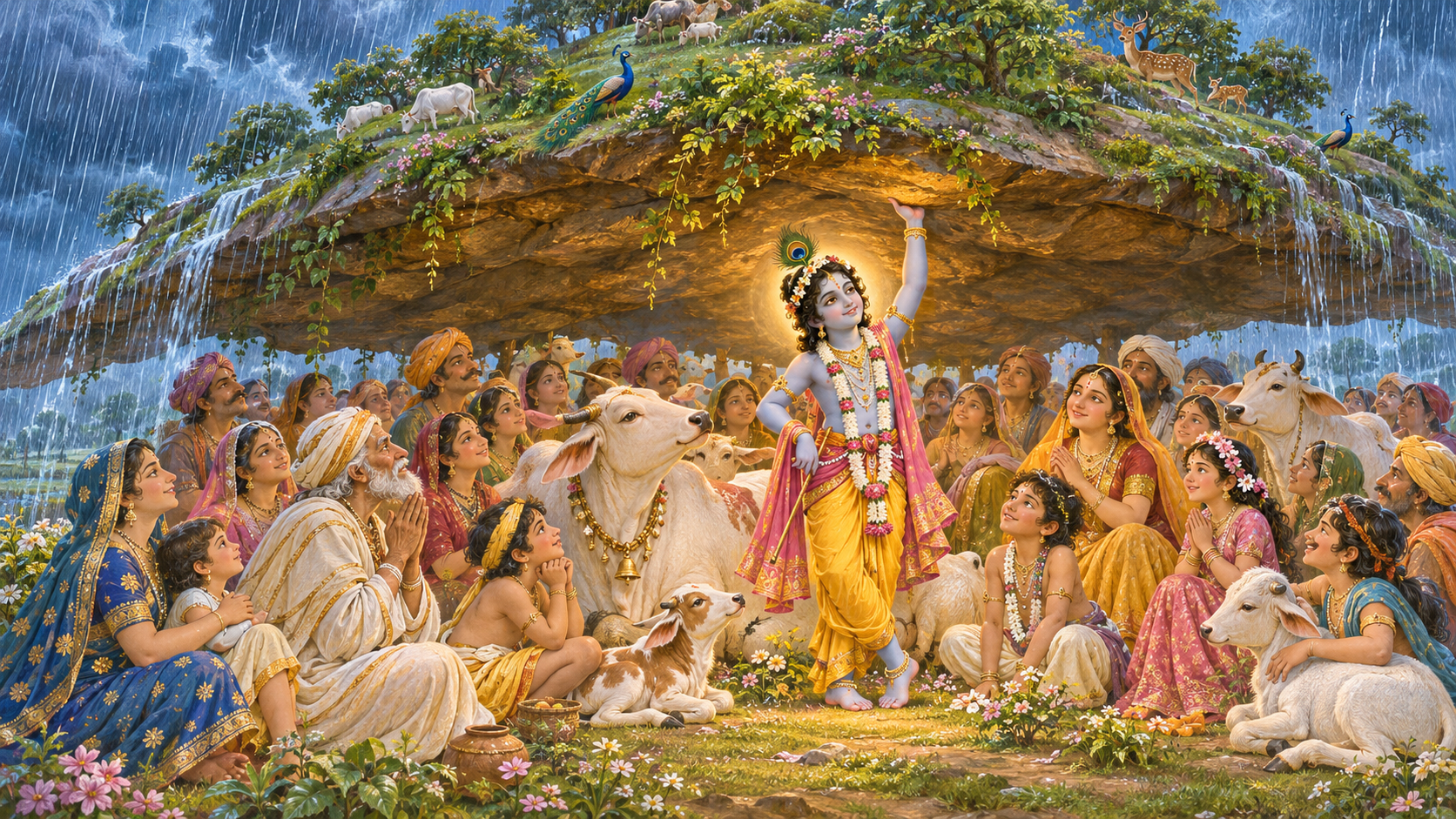
The Mayapur class gives you a more defined thematic doorway: Govardhan Lila. Familiarity can help you follow the discourse, but it can also create a subtle problem. You may begin recalling the story you already know instead of hearing the passage and emphasis actually being presented.
Use the lila title as an index, not as a substitute for attentive hearing. Before listening, write down the question you hope the class will clarify. During the class, notice whether the speaker is explaining narrative context, drawing out a theological point, discussing devotional conduct or connecting the lila with the hearer’s own practice. Do not decide in advance which lesson must dominate.
These prompts will keep a thematic class grounded:
- What portion of Govardhan Lila is being discussed rather than merely assumed?
- How does the speaker frame the relationship among Krishna, the devotees and the events being narrated?
- Which words or textual details carry the interpretation?
- What did you expect the lila to mean before listening, and did the discourse challenge that expectation?
- Can you state the central teaching without retelling the entire narrative?
The final question is especially useful. If you can only repeat the plot, you have remembered the lila but may not yet have grasped the class. If you can express the teaching while remaining faithful to the passage, the hearing has begun to become study.
Turn either recording into a repeatable study practice

A Bhagavatam class can pass through the mind like any other piece of online content. The remedy is not more playback. It is a small, consistent method that forces you to notice what was taught and what you will do with it.
Keep a dedicated notebook or digital file. For every class, record only these fields:
- Class identity: speaker, temple or channel, topic, and date when one is supplied.
- Text: the precise verse, passage or narrative setting announced during the discourse.
- Teaching: the main claim in your own words, without copying a title or description.
- Reasoning: the textual detail, example or line of explanation supporting that claim.
- Practice: a concrete change in attention, conduct, prayer or study that follows from it.
- Question: the point you still need to examine with the text, a teacher or your satsanga.
Make an uninterrupted listening pass before returning to difficult portions. Constant pausing can produce a detailed transcript while hiding the speaker’s larger argument. After the uninterrupted pass, explain the teaching aloud in your own words without replaying the class. If you cannot do so, revisit the transition where the discourse moved from textual context to its main conclusion.
You can study the Delhi and Mayapur sessions as a pair, but do not force them into a single theme merely because both are Bhagavatam classes. Preserve each speaker’s text, emphasis and application separately. The continuity should come from your discipline of hearing and reflection, not from an invented connection between distinct discourses.
Before opening another class, return to the question in your notes. Resolve it if you can, refine it if you cannot, and carry the sharper version into your next hearing. That is how a succession of recordings becomes a sustained engagement with scripture.
Key takeaways
- Choose the Delhi session when you want the dated morning special class by HG Malati Mataji.
- Choose the Mayapur session when you want an English discourse by HG Ramesvara Das on Govardhan Lila.
- Do not infer a current in-person timetable from an individual recorded class; verify travel details directly.
- Keep the Bhagavatam passage, the speaker’s explanation and your own application distinct in your notes.
- Finish with a precise question or practice before moving to another recording.
Open the class that matches your present purpose and prepare your notes before playback begins. If physical attendance is your goal, confirm the current programme before booking or travelling. If study is your goal, let one carefully heard class shape your practice before adding another to the queue.
References
- Dandavats — Morning Srimad Bhagavatam Special Class by HG Malati Mataji
- Dandavats — Srimad Bhagavatam – Govardhan Lila – HG Ramesvara Das

Leave a Reply
You must be logged in to post a comment.