
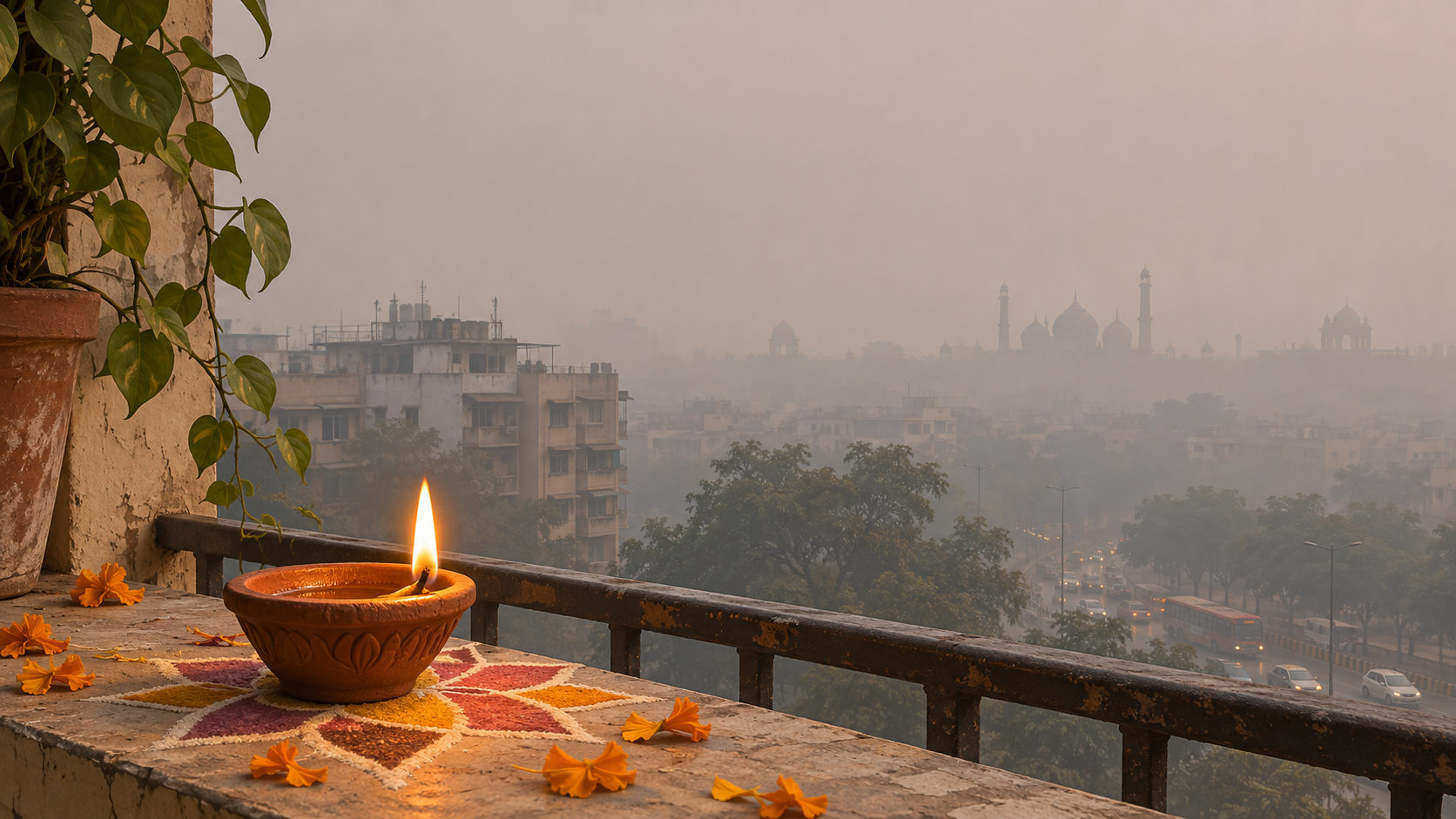
You are being asked to choose between celebrating Deepawali and caring about Delhi’s air. That is the wrong choice. You can protect the festival’s sacred meaning, make a responsible decision about avoidable smoke, and still demand serious action on the pollution that accumulates across the entire winter.
Two claims should make you cautious: that one Hindu festival creates Delhi’s winter crisis, and that a few hours of fireworks cannot matter at all. Neither is a sound basis for action. A dharmic response begins with the whole airshed, distinguishes ritual from combustion, follows the conditions actually present, and applies one standard of accountability to every polluter.
Delhi’s winter smog does not begin on Deepawali night
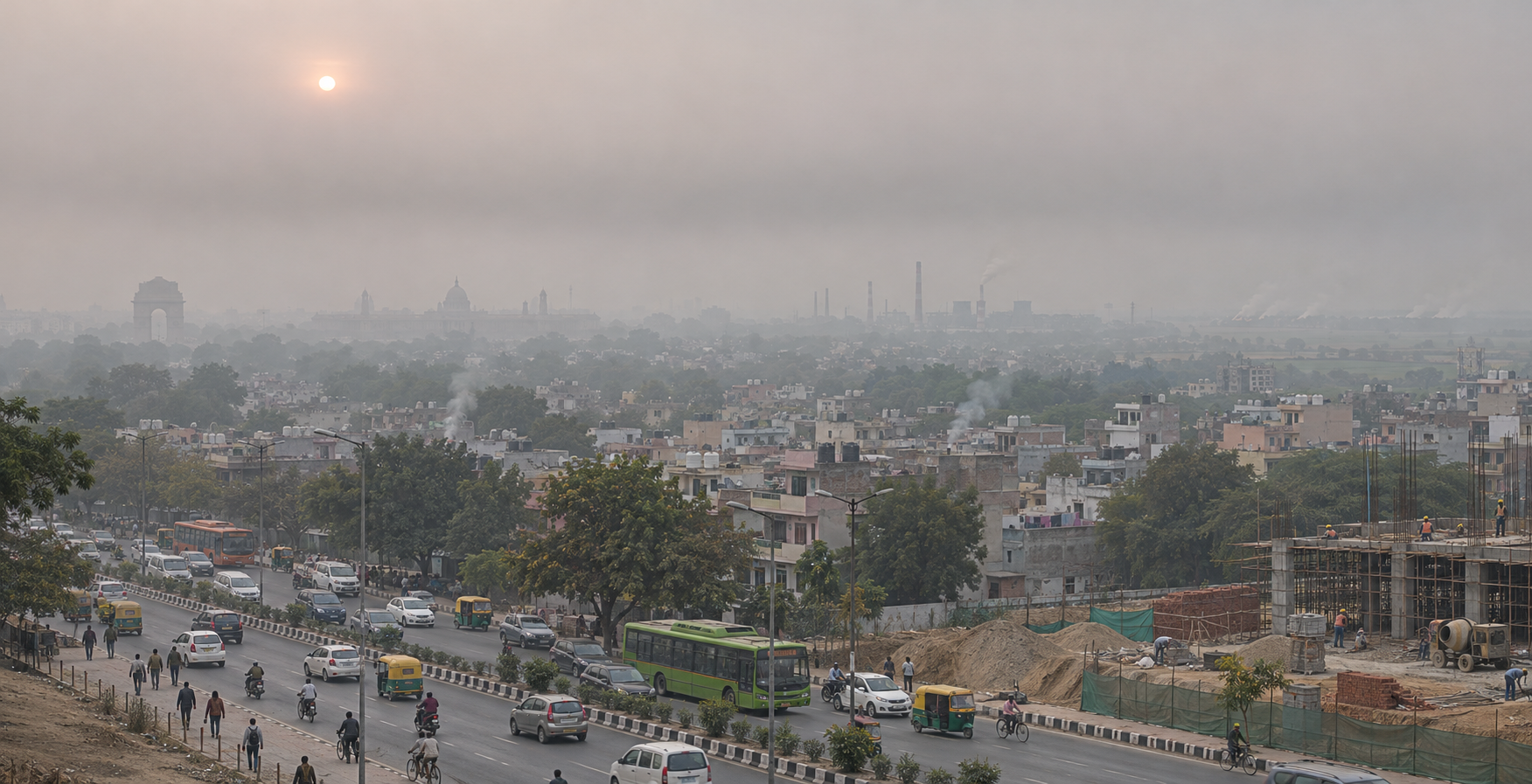
Delhi enters winter with a geographical disadvantage. Cold, dense air can become trapped beneath warmer air in a thermal inversion, keeping pollutants close to the ground. The Indo-Gangetic Plain and the Himalayan barrier compound the effect. Under these conditions, pollution from vehicles, industry, construction, road dust and neighbouring states can collect over the region instead of dispersing quickly.
This is why a single-evening explanation fails. From 2021 through 2025, Delhi’s annual average AQI remained between 201 and 209, while its November mean ranged from 354 to 380. The annual figures sit numerically within the Poor band even before the most visible festival debate begins. Episodic restrictions may suppress some activity, but they have not by themselves produced a clean annual baseline.
Crop-residue smoke is one important part of the seasonal mechanism, but its daily share is not constant. During one documented early-November spell, the estimated stubble-burning contribution to Delhi’s PM2.5 rose from 8.5 percent on 2 November to 16.2 percent on 4 November and between 20.2 and 22.2 percent on 5 November. It overtook transport on that particular day. The correct conclusion is not that stubble is always the dominant source; it is that source shares can change sharply with fires, wind and atmospheric conditions.
When someone assigns the smog to one community or activity, ask three questions: What period is being measured? Is the number an AQI reading or a source-apportionment estimate? Does the claim cover one monitoring day, the festival window, or the whole winter? A next-morning AQI can show that the air is dangerous. It cannot, by itself, tell you which source produced what fraction of the pollution.
Use the AQI to decide what to do, not whom to blame
The Graded Response Action Plan, or GRAP, connects restrictions to four AQI bands. These thresholds give you a practical decision tool, but AQI measures the severity of ambient pollution rather than the religious, agricultural or industrial identity of its source.
| GRAP stage | AQI range | Official description | What you should notice |
|---|---|---|---|
| Stage I | 201-300 | Poor | The air problem is already present; do not wait for a festival-day headline before paying attention. |
| Stage II | 301-400 | Very Poor | Additional local smoke enters an atmosphere that is already carrying a heavy pollution load. |
| Stage III | 401-450 | Severe | Restraint is warranted regardless of which source or community is politically convenient to discuss. |
| Stage IV | Above 450 | Severe Plus | This is the emergency band; active public orders and immediate health protection take priority. |
Check the current AQI, the active GRAP stage and the order operative in your locality on the day of the celebration. Do not reuse last year’s timing, permitted products or court directions as if they were permanent rules. A permission issued for a particular year and pollution stage is not standing legal advice for the next one.
AQI also does not describe your personal medical risk with precision. If you or someone in your household has a respiratory or other relevant medical condition, follow the plan given by the treating clinician. If anyone develops breathing difficulty during smoke exposure, end the exposure and seek appropriate medical help.
Key takeaways
- Delhi’s winter pollution is an accumulated, multi-source airshed problem intensified by thermal inversion.
- A high AQI tells you when restraint and protection are needed; it does not identify the culprit.
- Source contributions vary by day, so a percentage from one date should not be turned into a claim about the entire season.
- Deepawali’s sacred core can be protected without treating maximum combustion as the measure of devotion.
- Follow the live order, reduce avoidable smoke when the air is heavily polluted, and demand the same discipline from agriculture, transport, industry, construction and government.
Separate Deepawali’s sacred core from its emission choices
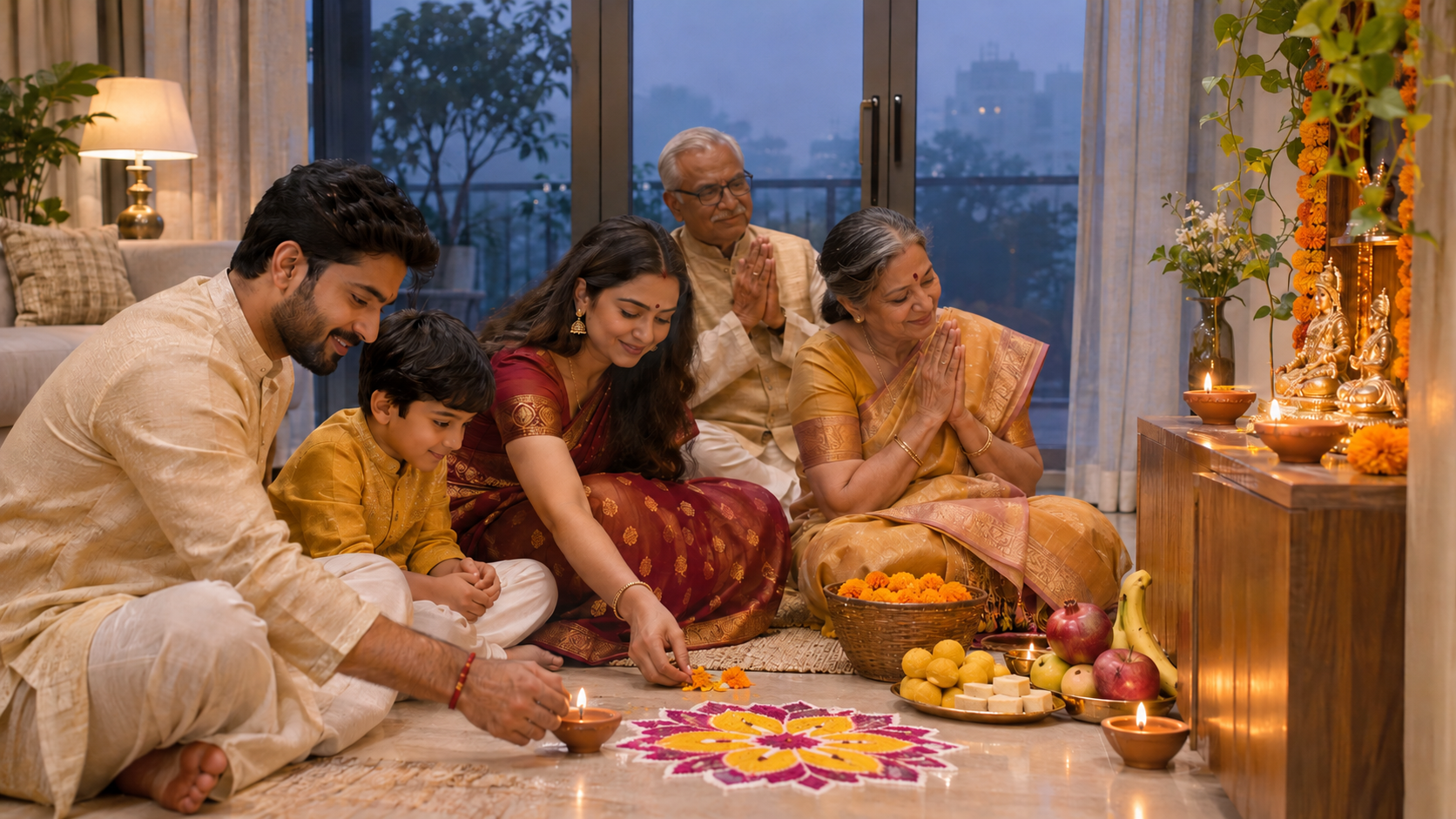
Deepawali is observed on Kartik Amavasya and expresses the victory of light, knowledge, goodness and virtue over darkness and ignorance. Diyas, illuminated homes and public celebration give visible form to that meaning. Firecrackers have also become a prominent mode of celebration, but these elements should not be collapsed into one undifferentiated environmental offence.
Lighting a diya, illuminating a home, performing worship and igniting a firecracker are not identical acts with identical emission profiles. A demand to erase lamps or suppress the festival as such reaches beyond a targeted air-quality intervention. Conversely, defending the dignity of Deepawali does not require you to pretend that combustion produces no smoke.
Without a defensible, source-apportioned percentage for the relevant festival window, neither extreme claim holds up: firecrackers should not be declared the sole cause of Delhi’s smog, and they should not be declared irrelevant merely because their use is concentrated into a short period. A thermal inversion can trap a short-lived emission near the surface. The existing pollution load therefore matters when you decide how to celebrate.
This is where desha, kala and paristhiti – place, time and circumstance – provide a useful dharmic frame. The question is not whether you are proud or ashamed of a Hindu festival. The question is how faithfully you can preserve its meaning under the actual conditions of your city, while avoiding harm that is within your control.
In the legal situation described for a particular celebration, the Supreme Court permitted green crackers during specified windows even while GRAP restrictions applied. Treat such a window as a regulatory ceiling, not a religious command to use it fully. Green crackers are a permitted category under a given order; the word green should not be read as meaning smoke-free or harmless. Verify the current order before buying or using anything.
A practical Deepawali plan for a polluted-air day
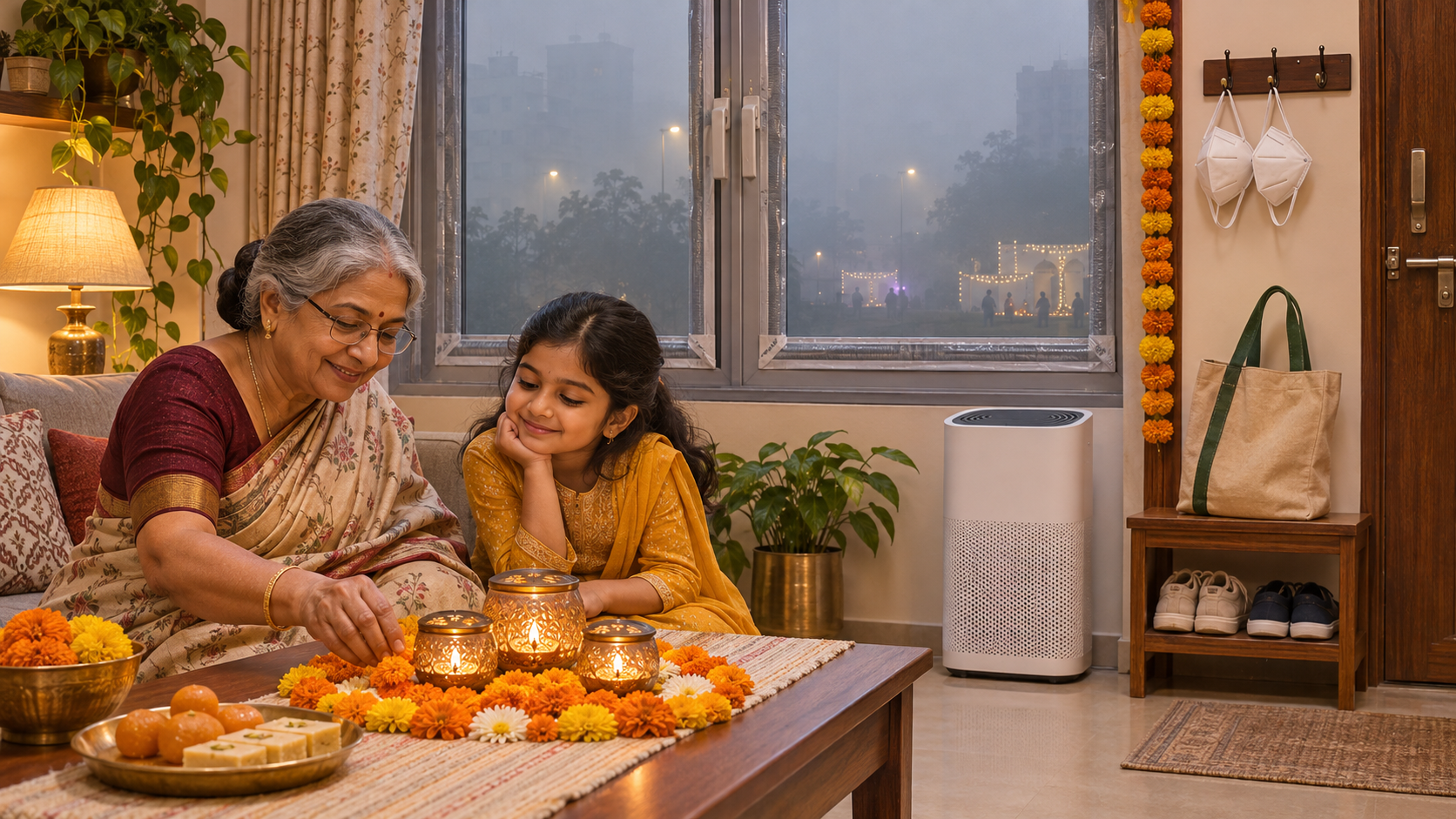
Make the decision before guests arrive and before social pressure takes over. The following sequence keeps devotion, law, health and civic fairness in the same frame.
- Check the live conditions. Note the AQI, the active GRAP stage and any local restriction or court-directed window. Use the rule in force on that date, not a screenshot circulating without a date.
- Name the sacred minimum. Plan the elements that directly carry Deepawali’s meaning: worship, diyas, illumination, hospitality and the teaching of why light and knowledge matter. This prevents the whole festival from being reduced to a dispute about one activity.
- Make a separate combustion decision. If crackers are prohibited, do not use them. If only a specified category and time window are permitted, remain within both limits. If the AQI is already Severe or Severe Plus, voluntary restraint is a coherent dharmic choice even when a narrow permission exists.
- Do not turn permission into a target. A two-hour window, for example, would define when an allowed activity may occur; it would not oblige a household to keep firing for two hours. Decide your limit in advance rather than letting competitive noise determine it.
- Protect vulnerable people from smoke. Keep anyone with a relevant medical vulnerability away from direct exposure and follow professional medical guidance. Stop immediately if breathing difficulty develops.
- Speak precisely afterward. If the next day’s AQI worsens, acknowledge the added festival emissions without assigning the whole winter smog to Deepawali. Ask for daily source-apportionment data before repeating a percentage or blaming a community.
This plan does not surrender Hindu practice to selective criticism. It makes the defence stronger. You are protecting the ritual’s substance, respecting a genuine public-health condition, and refusing a narrative that notices combustion only when Hindus are celebrating.
Fair accountability must cover the whole winter airshed
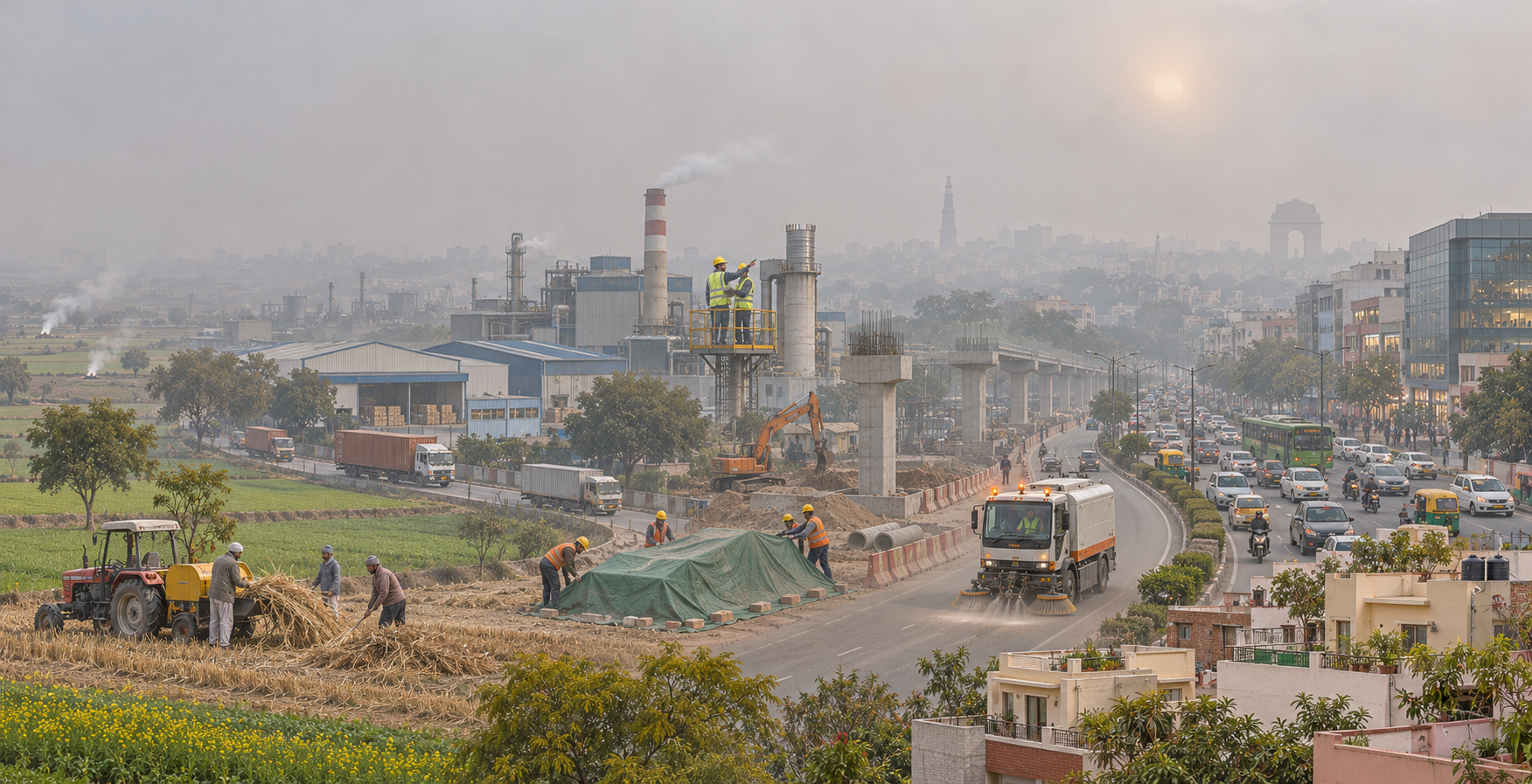
Household restraint cannot substitute for public policy. Delhi’s residents cannot solve regional smoke, road dust, industrial emissions, construction activity and transport pollution through one night’s personal choices. If official attention peaks around Deepawali and fades after the festival, the intervention is mistimed for a problem that persists across months.
Crop-residue burning illustrates why the policy must address mechanisms rather than merely condemn behaviour. Combine harvesters left residue that farmers could clear quickly by burning. The Punjab Preservation of Soil Water Act, 2009 then narrowed the interval between the paddy harvest and wheat sowing, increasing pressure to clear fields rapidly. North-westerly winds can carry the resulting smoke toward Delhi just as colder conditions begin trapping pollutants.
That chain points to the work required before the burning window begins: viable residue management, equipment and logistics that fit the sowing calendar, and credible enforcement across state boundaries. The Air (Prevention and Control of Pollution) Act, 1981 prohibits polluting residue burning in designated areas, while Section 15 of the Commission for Air Quality Management Act, 2021 provides for environmental compensation linked to landholding size. A rule without timely implementation, however, does not clear a field or clean Delhi’s air.
You can make the public argument more rigorous by asking elected representatives and regulators for five things: date-specific source-apportionment estimates, district-level residue-fire enforcement, measures for vehicles and road dust, construction and industrial compliance, and a published explanation of what changed after each GRAP stage. The same evidentiary standard should apply whether the emission comes from a farm fire, a diesel vehicle, a construction site, a factory or a firecracker.
Before the next Deepawali, make a one-page household plan with three entries: the sacred observances you will preserve, the AQI or legal conditions that will change your combustion decision, and the public data you will request from authorities. That turns a yearly quarrel into dharmic action: disciplined where your own conduct matters and unwavering where the state must do its duty.
References

Leave a Reply
You must be logged in to post a comment.