

You may have seen Sri Rasikananda Prabhu’s name on a Vaishnava calendar and wondered what you are actually meant to remember. The most reliable starting point is not a crowded list of dates and legends. It is a defining relationship: Sri Rasikananda Prabhu is remembered as the great disciple of Sri Syamananda Prabhu.
That relationship gives you a practical way to approach his appearance day. Learn his identity accurately, consider what disciplined discipleship requires, offer the devotional practice you already follow, and carry a concrete resolution into ordinary life. You do not need to decorate a thin biography with unsupported details to make the remembrance meaningful.
Begin with the relationship that defines the remembrance
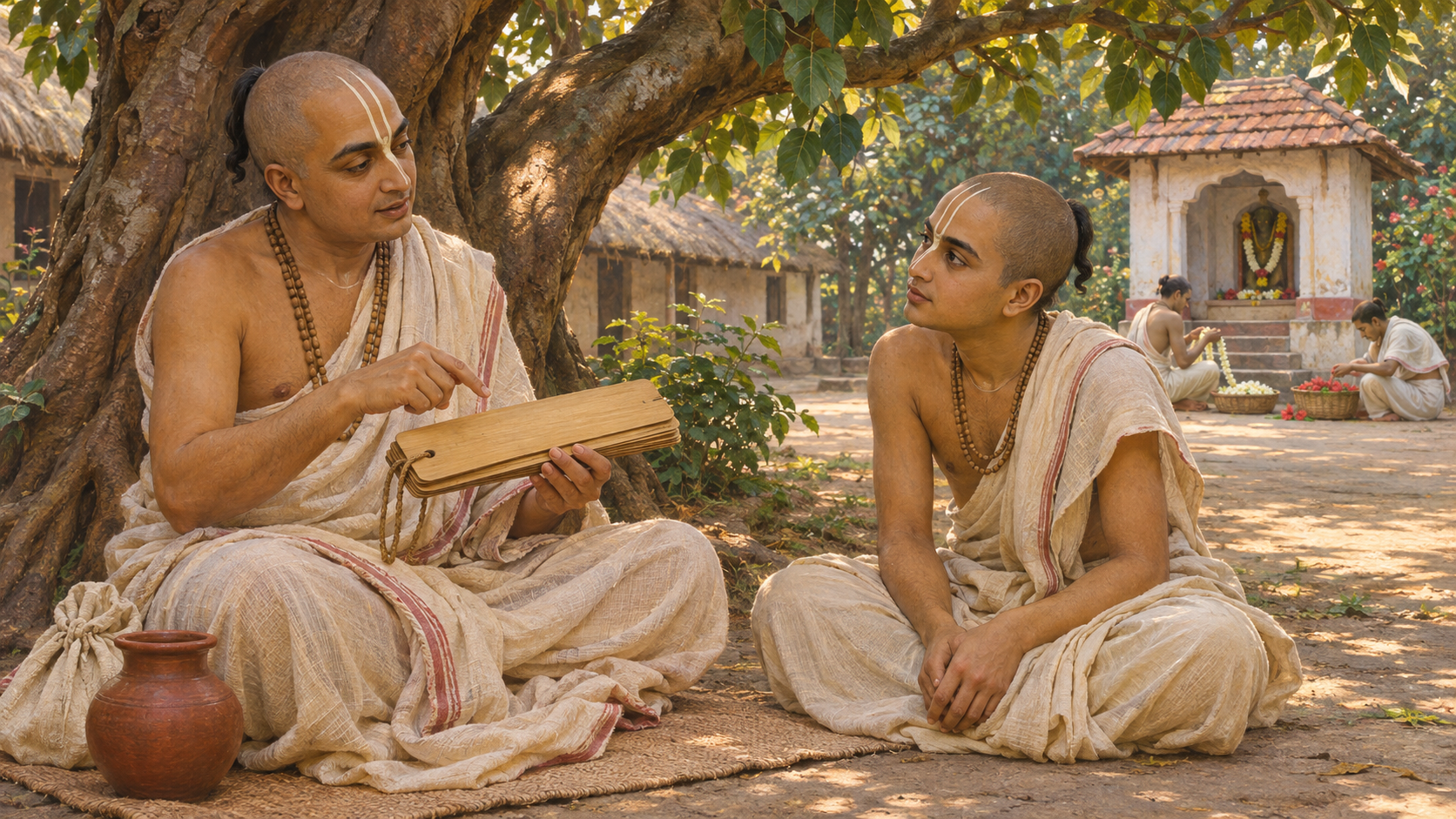
Keep the two names together in your notes: Rasikananda is the disciple being remembered, and Syamananda is his guru. This simple step prevents a common kind of confusion in devotional reading, where unfamiliar saints become isolated names and the lineage connecting them disappears.
A guru-disciple relationship is not the spiritual equivalent of celebrity and admirer. Within a devotional lineage, the disciple receives a way of understanding and practising Dharma, submits that understanding to discipline, embodies it through conduct, and helps transmit it without claiming personal ownership. Remembering Rasikananda as a disciple therefore directs your attention toward receptivity, fidelity, service and responsible transmission.
This distinction also changes the question you bring to the commemoration. Instead of asking only, What extraordinary things did this saint do?, ask: What does it take to receive sacred teaching without diluting it? How should a disciple respond to correction? What separates service to a lineage from using a revered name for personal status? Those questions turn remembrance into self-examination.
Accuracy is part of that discipline. Unless you have dependable support, do not attach precise dates, places, quotations, miracles, institutions or journeys to Rasikananda. A short, correct account is more respectful than an impressive narrative assembled from repetition. Devotion does not become stronger when uncertainty is hidden.
Make the appearance day a practice, not just a calendar entry

In devotional usage, an appearance day invites a different posture from an ordinary biographical anniversary. The emphasis is remembrance: receiving the example of a saint as a prompt for renewed practice. Your observance can be modest, especially if you are learning about Rasikananda for the first time.
- Confirm the observance through the calendar your community follows. If you belong to a temple or lineage, use its calendar and local instructions instead of guessing from an isolated civil-date listing.
- Begin by naming the relationship correctly. Say or write that Sri Rasikananda Prabhu was the disciple of Sri Syamananda Prabhu. This keeps the remembrance anchored in lineage rather than personality alone.
- Read a focused devotional account attentively. Note which claims are presented as received tradition, which are supported as historical particulars, and whether any quotation has a traceable origin. Do not rush through several retellings merely to accumulate anecdotes.
- Offer the practice already established in your life. If your community prescribes a particular prayer, kirtana, reading or form of service for the day, follow that direction. Otherwise, give undistracted time to your normal chanting, prayer, scriptural reading or contemplation rather than inventing a ceremony.
- Turn remembrance into seva. Help with a temple or household responsibility, support the sharing of accurate teachings, or complete a neglected duty without seeking recognition. The action should express service, not simply signal that you observed the date.
- Write a behavioural resolution. Choose something visible enough to practise: listening before answering, completing an assigned responsibility, accepting correction without defensiveness, or refusing to repeat a claim you have not checked.
If you are honouring Rasikananda from outside his lineage, keep the same respectful boundary you would want others to maintain around your own tradition. You can learn, offer reverence and reflect on discipleship without pretending to possess an initiation, office or ritual authority that you do not have.
Families can make the observance accessible without reducing it to folklore. Introduce the two names and their relationship, explain why a disciple preserves what is received from the guru, and ask each person to identify a duty they can perform more faithfully. Children do not need an embellished wonder story in order to understand careful listening, gratitude and service.
Keep devotional memory exact without stripping it of meaning

Saints often reach us through devotional memory. Such memory can carry theological and spiritual meaning even when it is not written in the manner of modern critical history. You do not have to dismiss a sacred narrative because it belongs to a devotional tradition. You do need to describe it honestly.
- Check the identity. Confirm that the name, honorific and guru-disciple relationship have not been mixed up with those of another figure.
- Check the category of the claim. Is it lineage tradition, theological interpretation, a historical assertion or a modern devotional application? Do not silently move a statement from one category into another.
- Check quotations word by word. If you cannot identify where a saying comes from, paraphrase the general principle without placing invented words in the saint’s mouth.
- Check precision before sharing. A date, location or institutional claim requires firmer support than a broad reflection on discipleship. Specificity sounds authoritative even when it is wrong.
- Check the purpose. Ask whether the detail helps someone understand Dharma and practise it, or merely makes a social-media caption look dramatic.
A useful community notice can remain concise. State who is being remembered, identify his relationship to Sri Syamananda Prabhu, explain that the day is being used for devotional remembrance, and name the practice or service your community will undertake. Leave unsupported particulars out. If a teacher later provides a reliable account, the notice can be expanded without having first spread confusion.
The same standard applies when you encounter a miracle narrative. Present it as the tradition presents it, with its devotional setting intact. Do not convert it into a vaguely sourced historical claim, and do not use disbelief or belief in that narrative as a shortcut for judging another person’s entire spiritual life. Honest framing protects both reverence and intellectual responsibility.
Key takeaways
- Sri Rasikananda Prabhu should first be understood through his defining relationship as the disciple of Sri Syamananda Prabhu.
- An appearance day becomes meaningful when remembrance leads to practice, service and a visible change in conduct.
- You can observe the day simply through attentive learning, your established devotional discipline and unadvertised seva.
- Devotional tradition and critical history need not be treated as enemies, but claims from each should be labelled honestly.
- Do not repeat precise dates, quotations, locations or extraordinary narratives unless you can support and frame them responsibly.
When the appearance day arrives, put Rasikananda’s name beside Syamananda’s, give your full attention to a trustworthy remembrance, and choose a duty through which discipleship becomes visible. The fitting tribute is not how much information you can repeat. It is whether remembrance makes you more faithful in receiving, practising and passing on Dharma.
References

Leave a Reply
You must be logged in to post a comment.