

You are not simply looking for another festival date. You need to know which observance belongs to which day, what you can meaningfully do, and how to respect your tradition without turning one temple’s custom into a rule for every Vaishnava.
In 2026, the sequence is clear: Mokshada Ekadashi falls on 20 December, followed by Vyanjan Dwadashi on 21 December. The first day directs your attention toward the Bhagavad Gita and vrata; the second brings the observance into temple offering and devotional service.
Put both observances on your calendar
Mokshada Ekadashi is observed on Margashirsha Shukla Ekadashi, the eleventh tithi of the bright fortnight of Margashirsha, also rendered Margashira. In 2026, its Vaishnava Gauna Ekadashi date is 20 December. The same observance is also known as Mauna Ekadasi and is widely marked as Gita Jayanti.
Vyanjan Dwadashi follows on Margashirsha Shukla Dwadashi, the twelfth tithi of the bright fortnight. Its 2026 date is 21 December. It is also written as Byanjana Dwadashi.
Keep the two dates separate in your calendar. One is not an alternative date for the other. Use distinct labels so that your household does not prepare for the Ekadashi vrata while overlooking the Dwadashi temple observance.
- Enter 20 December as “Mokshada Ekadashi and Gita Jayanti.”
- Enter 21 December as “Vyanjan Dwadashi.”
- Check the calendar or announcement issued by the Vaishnava temple or sampradaya you actually follow.
- Ask separately about the vrata rules, the time for completing the Ekadashi observance, and any Dwadashi programme. A festival date alone does not settle those details.
The word “Gauna” in the 2026 entry is another reason to consult your recognised Vaishnava calendar rather than transferring instructions from an unrelated regional calendar. If your temple publishes a date or procedure for its congregation, follow that guidance for communal participation.
Make the Bhagavad Gita the centre of Ekadashi

Mokshada Ekadashi is popularly observed as Gita Jayanti, remembering the teaching of the Bhagavad Gita by Sri Krishna. That connection gives you a concrete focus. The day should not disappear into meal planning, nor should Gita Jayanti become only a greeting exchanged online.
Choose a reading commitment you can complete attentively. Reading a smaller passage and carrying one teaching into conduct is more useful than selecting an ambitious amount that you rush through or abandon.
- Before the day, select the passage or portion of the Gita you will read. Keep a physical copy or trusted edition ready.
- Begin with a plain intention: listen to Sri Krishna’s teaching with attention and identify what it asks of you.
- Read slowly enough to notice one instruction, tension, or question that bears directly on your present duties.
- Write one sentence describing the action that follows from your reading. It might concern steadiness, discipline, attachment, responsibility, devotion, or the way you speak to another person.
- Carry out that action within the next day. This prevents scripture reading from remaining detached from dharma in ordinary life.
If you are observing as a family, let each person name one teaching they understood rather than asking everyone to produce the same interpretation. If children are participating, a short, intelligible reading followed by one sincere question is enough. The purpose is attentive engagement, not a display of endurance.
Do not guess the rules of mauna or vrata
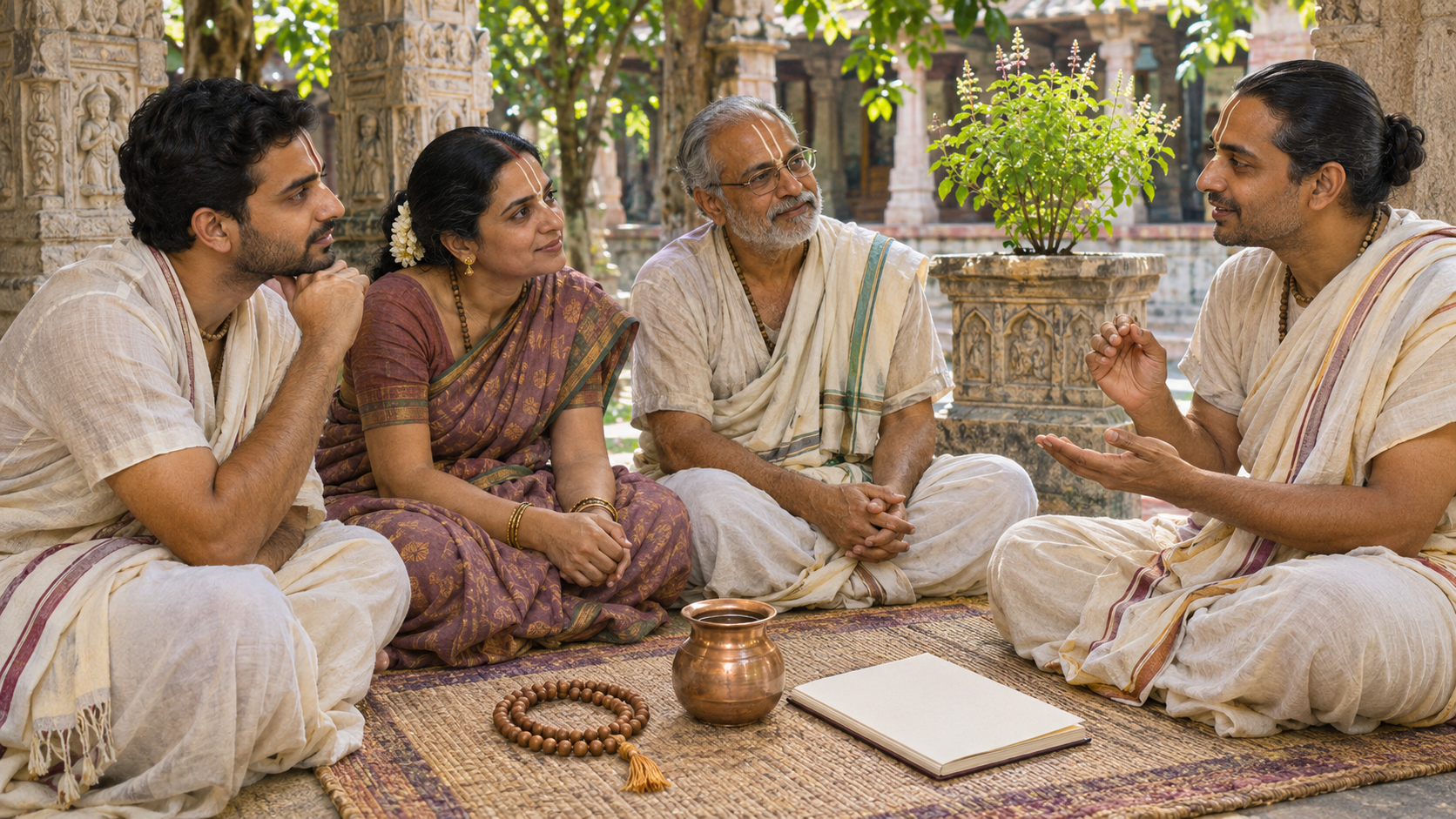
The name Mauna Ekadasi can lead people to assume that complete silence is universally required. Vaishnava practices differ, and a name by itself does not establish the detailed rule followed by your lineage, temple, or household. Treat inherited discipline as inherited discipline, and personal devotional choices as personal choices.
Before undertaking the vrata, get clear answers to four practical questions:
- Which Ekadashi date does your sampradaya recognise for you?
- What form of food restraint, if any, does your tradition prescribe?
- When and how is the observance completed on Dwadashi?
- Does mauna mean complete silence in your practice, limited silence, or disciplined restraint in speech?
If you voluntarily adopt silence, decide its boundaries in advance. Tell the people who may need to reach you, settle necessary responsibilities beforehand, and use the quiet for japa, Gita reading, prayer, or reflection. Merely replacing speech with constant messaging and scrolling misses the point of the discipline.
Do not undertake a severe fast simply because a generic calendar calls the day a vrata. Food rules vary, and fasting can be unsafe for some people. If you have a medical condition, take medication with food, are pregnant or nursing, or have another reason that makes fasting uncertain, obtain appropriate medical guidance and ask a trusted religious authority about a suitable observance. Devotion does not require you to conceal a real health need.
Let Vyanjan Dwadashi move devotion toward offering
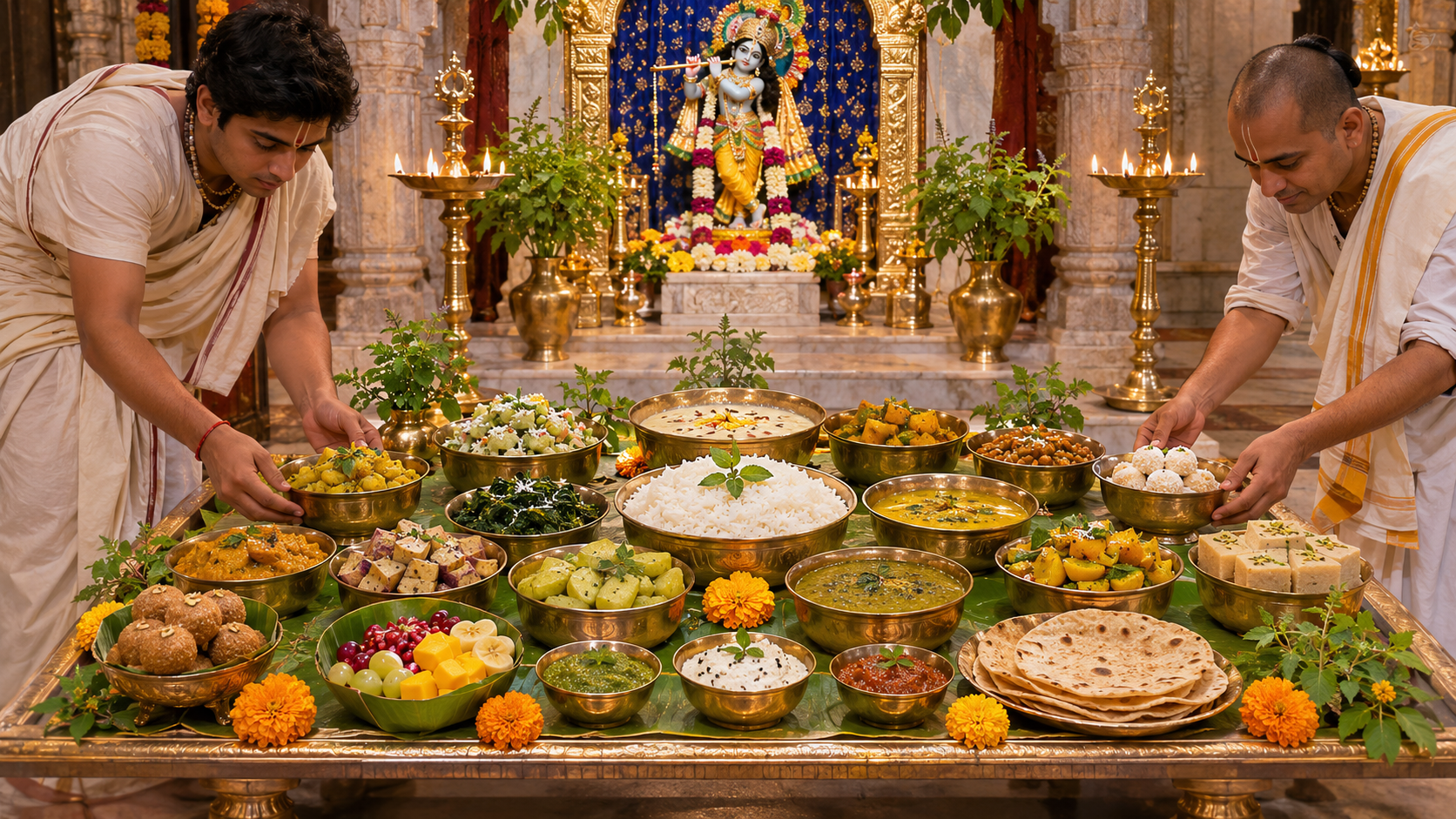
On 21 December 2026, Vyanjan Dwadashi marks the beginning of the khichdi bhog offering to Sri Radharaman Dev, a form of Sri Krishna. The observance is especially associated with Sri Krishna temples. This temple setting matters: it cautions you against assuming that every Vaishnava household or every Krishna temple follows an identical programme.
If you want to participate, contact your temple before the date. Ask whether it is observing Vyanjan Dwadashi, whether the bhog or darshan is open to the public, and whether devotees may contribute ingredients, volunteer time, or another form of seva. Follow the temple’s instructions rather than arriving with an unsolicited preparation that its kitchen cannot accept.
If your temple does not mark this observance, do not manufacture a universal obligation. You can still recognise the transition from inward discipline to offering: complete your Ekadashi practice according to your tradition, make your ordinary household offering with care, support a Krishna temple, or perform a useful act of seva. Present such an act honestly as your devotional response, not as a prescribed Vyanjan Dwadashi ritual.
The khichdi bhog custom also gives you a helpful distinction. A temple’s particular offering is a living expression of Vaishnava devotion, but its particularity is part of its value. Respecting a tradition does not require flattening every local practice into a rule for the entire Dharmic world.
Key takeaways for your 2026 observance
- Mokshada Ekadashi falls on 20 December 2026 and is observed on Margashirsha Shukla Ekadashi.
- The day is also associated with Mauna Ekadasi and Gita Jayanti, making attentive engagement with the Bhagavad Gita a natural centre for your observance.
- Confirm vrata, mauna, and completion rules with the Vaishnava authority you follow; the calendar date does not supply a universal fasting procedure.
- Vyanjan Dwadashi falls on 21 December 2026 and marks the beginning of khichdi bhog for Sri Radharaman Dev.
- Ask your Krishna temple how it observes the day before planning participation, food contributions, or seva.
- Distinguish what your tradition prescribes from what you personally choose as a devotional aid.
Before 20 December arrives, make three decisions: what portion of the Gita you will read, which recognised authority will guide your vrata, and how you will turn the following Dwadashi toward offering or seva. With those choices settled early, the two days can become one coherent movement from receiving Sri Krishna’s teaching to expressing devotion through action.
References
- Hindu Pad – Mokshada Ekadashi 2026 | Mauna Ekadasi Vrat
- Hindu Pad – Vyanjan Dwadashi 2026 | Byanjana Dwadashi

Leave a Reply
You must be logged in to post a comment.