
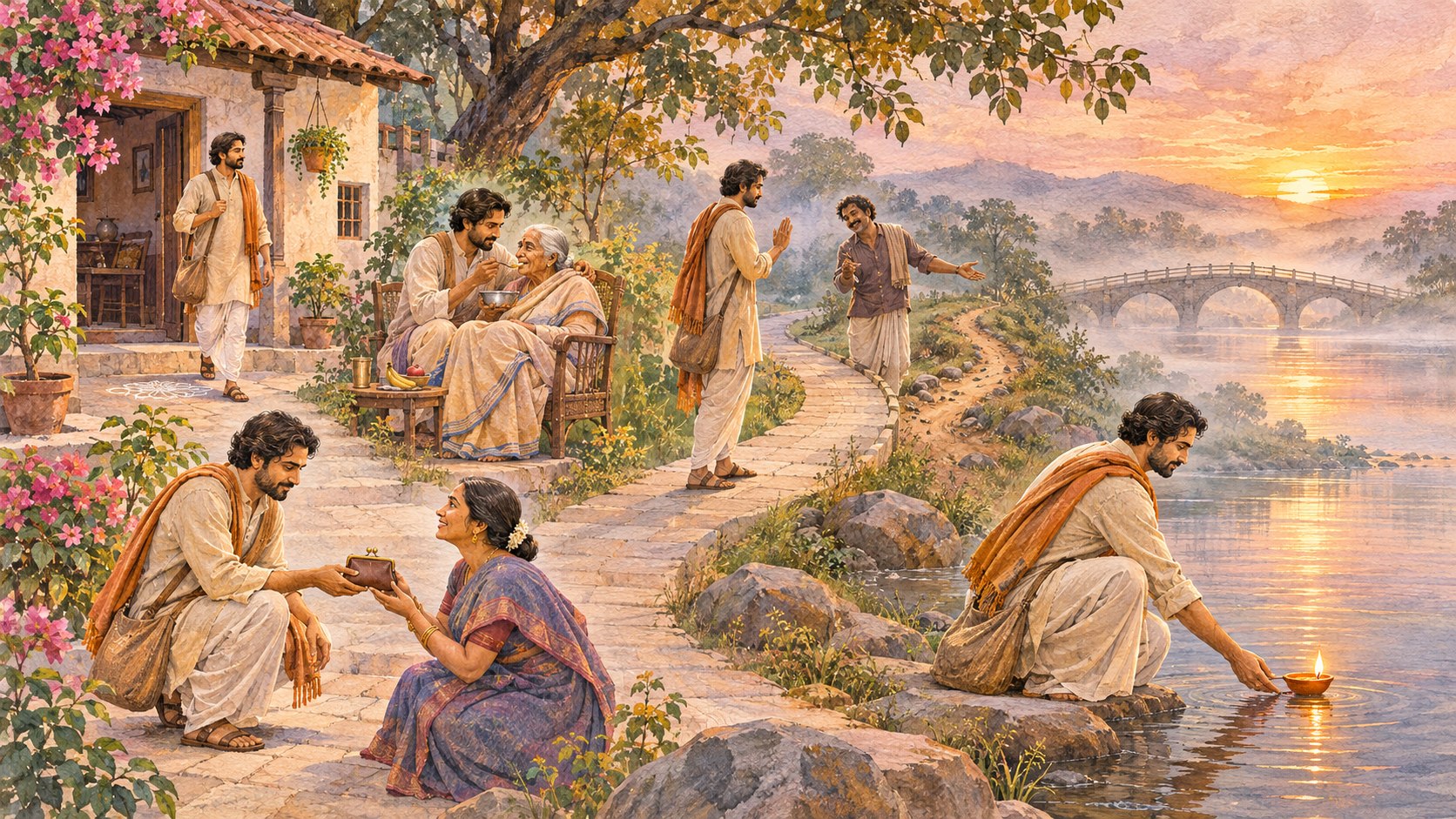
You may accept moksha as the highest aim of life and still wonder what you should do differently today. Liberation sounds remote, while your actual tests arrive as an argument at home, a difficult obligation, a tempting shortcut, or the desire to control an outcome.
Dharma connects those ordinary moments to the ultimate aim. It gives you a way to examine conduct, train attention, loosen attachment, and discover whether spiritual life is changing how you actually live.
Dharma is the bridge between moksha and daily conduct
Dharma has no exact equivalent in English. Righteousness, virtue, duty, and moral law each convey part of its meaning, but none carries the whole. Dharma is not merely what you believe. It concerns the order you recognise and the conduct through which you uphold it.
Moksha, meanwhile, is not simply a better mood, a reward for respectable behaviour, or an unusually peaceful experience. Hindu traditions use different philosophical and devotional vocabularies for liberation. One influential understanding approaches it as an awakening to essential oneness with the totality of existence: the apparent isolation of the ego no longer defines what you are.
Held together, the two ideas give you both a path and a direction. Dharma asks, “What is the right way to act in this situation?” Moksha asks, “What kind of identity does this action reinforce?” The first question governs conduct. The second exposes attachment to the separate, possessive self.
This is why dharmic conduct matters even when an action seems small. A careless lie trains the mind to protect a preferred image. A promise honoured without applause weakens dependence on recognition. Possessions used responsibly remain useful things; possessions treated as proof of personal worth become material for bondage.
Dharma should not be turned into spiritual bookkeeping. Good conduct does not purchase liberation as if moksha were the payment due after enough virtuous transactions. Its practical value is transformative: your conduct can reduce the conflict between what you profess, what you desire, and what you do. A mind no longer occupied with defending those contradictions becomes more capable of clear self-examination.
Habit and social approval can resemble Dharma without producing that transformation. You can follow a convention merely to avoid criticism. You can perform generosity to build a reputation. You can speak about renunciation while remaining deeply attached to being seen as spiritually advanced. The outward form alone is therefore an incomplete test. Examine the motive, the means, and the effect on your character.
Use four questions when duty and desire pull apart

The word “Dharma” can become vague precisely when you need it most. A practical inquiry helps when several duties compete, when desire presents itself as principle, or when every available choice carries a cost. Write a brief answer to each of the following questions before making a consequential decision.
- What responsibility genuinely belongs to me? Name the promise, relationship, role, or harm that makes action necessary. Do not confuse responsibility with the urge to control what properly belongs to someone else.
- Are my means truthful and proportionate? A desirable result does not cleanse deceit, humiliation, or needless harm. Examine how you intend to reach the goal, not only the goal itself.
- Which attachment is distorting my judgment? Look for the need to win, possess, be praised, avoid embarrassment, punish an opponent, or preserve a flattering self-image. Naming the attachment makes it harder for desire to masquerade as duty.
- Will this choice widen or narrow my awareness? Ask whether you are recognising the reality of everyone affected or reducing people to obstacles, instruments, or members of a category you have already condemned.
These questions will not turn every moral conflict into a painless calculation. Dharma is often difficult because obligations are real on more than one side. The questions do something more modest and useful: they prevent you from calling the most convenient option the righteous one without scrutiny.
When responsibilities genuinely conflict, identify what each choice protects and what each choice sacrifices. Then prefer the course that fulfils the clearest duty through the cleanest available means, with the least self-serving distortion. Accept that even a conscientious decision may leave a cost to acknowledge or repair.
Watch for a revealing warning sign: an explanation in which you are entirely pure and everyone else is entirely at fault. That story may occasionally be accurate, but it is also the ego’s preferred arrangement. Review your answer to the attachment question before acting.
Measure spiritual elevation by conduct, not sensation

Spiritual practice can produce moments of calm, devotion, clarity, or expanded awareness. Such experiences may be meaningful, but intensity is not the same as liberation. An experience comes and goes. The more reliable question is what happens when irritation, praise, disappointment, or temptation returns.
Look for changes that ordinary life can test:
- You notice anger without immediately granting it the authority to speak or act for you.
- You can perform a necessary service without keeping an internal ledger of who owes you gratitude.
- You become more willing to accept correction because defending an image of yourself matters less than seeing clearly.
- You use possessions without making them the basis of identity, status, or security.
- You feel less need to display your spirituality or compare your progress with someone else’s.
- Your circle of concern widens while your commitment to specific duties remains intact.
These signs concern freedom from compulsion, not the manufacture of a permanently pleasant personality. You may still experience grief, fatigue, anger, or uncertainty. The important change is that a passing state no longer has to become your master or your identity.
Do not confuse detachment with indifference. Detachment means acting carefully without treating the result as your possession. Indifference refuses the responsibility to act. If someone depends on you, invoking “non-attachment” to avoid an inconvenient duty is not elevation; it is withdrawal dressed in spiritual language.
Suppression is another false marker. A person may look calm because anger has been denied rather than understood. The better practice is to acknowledge the emotion, refuse its demand for automatic obedience, and choose a response consistent with Dharma. This preserves honesty without surrendering self-command.
Track one recurring difficulty rather than trying to grade your entire spiritual life. Choose a situation in which you predictably become possessive, defensive, or impatient. Each time it occurs, notice the trigger, the story your mind constructs, the action you take, and the consequence. Progress appears when awareness enters the sequence earlier and gives you room to choose differently.
Keep worldly aims inside a liberating order

Hindu thought commonly places Dharma, artha, kama, and moksha among the aims of human life. Artha includes material means and security; kama includes enjoyment and fulfilled desire. Their presence matters. The spiritual path does not require you to pretend that work, family, beauty, pleasure, or material stability have no place in life.
The order matters just as much. Dharma disciplines the pursuit of artha and kama, while moksha prevents either from becoming the final definition of a successful life. You can earn without exploiting, enjoy without clinging, own without worshipping, and pursue excellence without making victory the measure of your being.
Before beginning a major pursuit, decide what “enough” means. Without that boundary, desire continually moves the finish line. Also name the dharmic limit you will not cross to obtain the result. This turns principle into a decision made before pressure, fear, or ambition begins bargaining with it.
Then give the work your full attention. Renouncing attachment to the result does not mean lowering the quality of your effort. It means releasing the demand that the outcome confirm your worth, secure permanent satisfaction, or obey your timetable. You remain responsible for preparation and action, but you stop treating reality as something the ego must command.
A simple daily rhythm can keep this orientation practical:
- At the beginning of the day, name one duty that deserves your undivided attention and one attachment likely to interfere with it.
- Before a high-friction decision, pause long enough to apply the four questions. Give special attention to the motive you would prefer not to admit.
- At the end of the day, review one moment in which you acted freely and one in which compulsion took over. Identify the next action required: fulfil a neglected duty, correct a false statement, apologise, restore what was damaged, or release a claim you cannot control.
Keep the review factual. Self-condemnation makes the ego the centre of attention just as surely as self-congratulation does. The purpose is to see the pattern, take responsibility, and make the next choice more consciously.
This also protects you from a common spiritual inversion: using the idea of moksha to escape the human situation in which Dharma must be practised. Universal concern does not erase particular obligations. If your understanding of oneness makes you less dependable, less truthful, or more contemptuous of ordinary people, examine the understanding rather than congratulating yourself on transcendence.
Key takeaways
- Moksha gives spiritual life its ultimate direction; Dharma translates that direction into conduct you can examine today.
- Test an action by its responsibility, its means, the attachment behind it, and whether it widens or narrows awareness.
- Do not measure elevation by unusual experiences alone. Look for less compulsion, less possessiveness, greater accountability, and more dependable action.
- Detachment is wholehearted action without ownership of the result. It is not passivity, neglect, emotional denial, or indifference.
- Let Dharma govern the pursuit of security and enjoyment, and let moksha remind you that neither can provide your final identity.
Choose one recurring decision for your next practice: a conversation you avoid, a result you try to control, or a desire that repeatedly overrides judgment. Apply the four questions before you act. Moksha may be the highest horizon, but the next movement toward it is the dharmic choice directly in front of you.
References
- Hindu Blog — Liberation In Hinduism Is Experiencing Essential Oneness With The Totality
- Hindu Pad — Spiritual elevation through Dharma

Leave a Reply
You must be logged in to post a comment.