
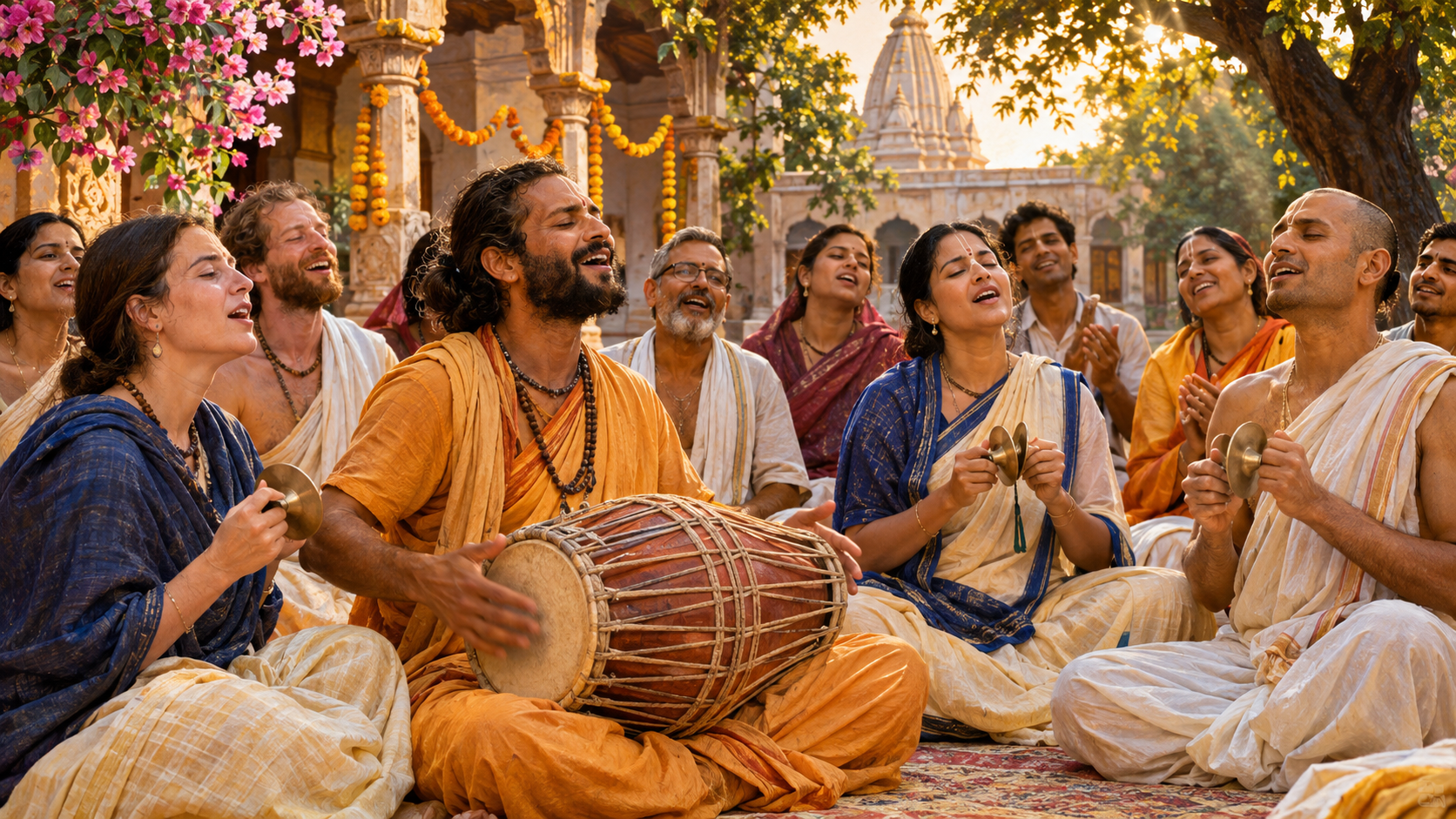
If you saw Tulsi Gabbard participating in kirtan at ISKCON and wondered what the moment means, resist the two easiest conclusions. It is not automatically a political endorsement, and it should not be dismissed as a celebrity appearance. It is first an encounter with a living devotional practice.
That distinction matters because public Dharma is easily turned into partisan evidence or social-media spectacle. A better response is to understand what kirtan asks of a participant, separate what you can see from what you merely infer, and then use the visibility to help someone encounter the tradition on its own terms.
Read the moment at the scale of the practice

Kirtan is congregational devotional chanting. A leader voices a sacred name or phrase, the gathering responds, and repetition draws individual voices into a shared act of remembrance. In an ISKCON setting, that practice belongs to the Gaudiya Vaishnava tradition of Krishna bhakti. Music supports the devotion, but the gathering is not simply a concert with religious lyrics.
This gives you the first rule for interpreting Gabbard’s participation: begin with the religious act actually taking place. The central fact is not that a recognisable political personality appeared near Hindu symbols. It is that she entered a participatory form of bhakti in a community organised around that practice.
When you assess or share a public Dharmic moment, keep three levels separate:
- Observation: What can you directly see or reliably establish? Here, Gabbard participated in kirtan in an ISKCON setting.
- Interpretation: What might the action reasonably indicate? It can indicate familiarity, respect, devotion or willingness to participate, but the event alone does not tell you which motive is primary.
- Claim: What larger conclusion are you being asked to accept? A kirtan appearance does not by itself establish an organisation’s political endorsement, a complete policy position or a mandate from Hindus as a whole.
This discipline does not make the moment less meaningful. It prevents exaggeration from consuming the meaning that is actually present.
Kirtan makes Dharma public without turning it into an argument
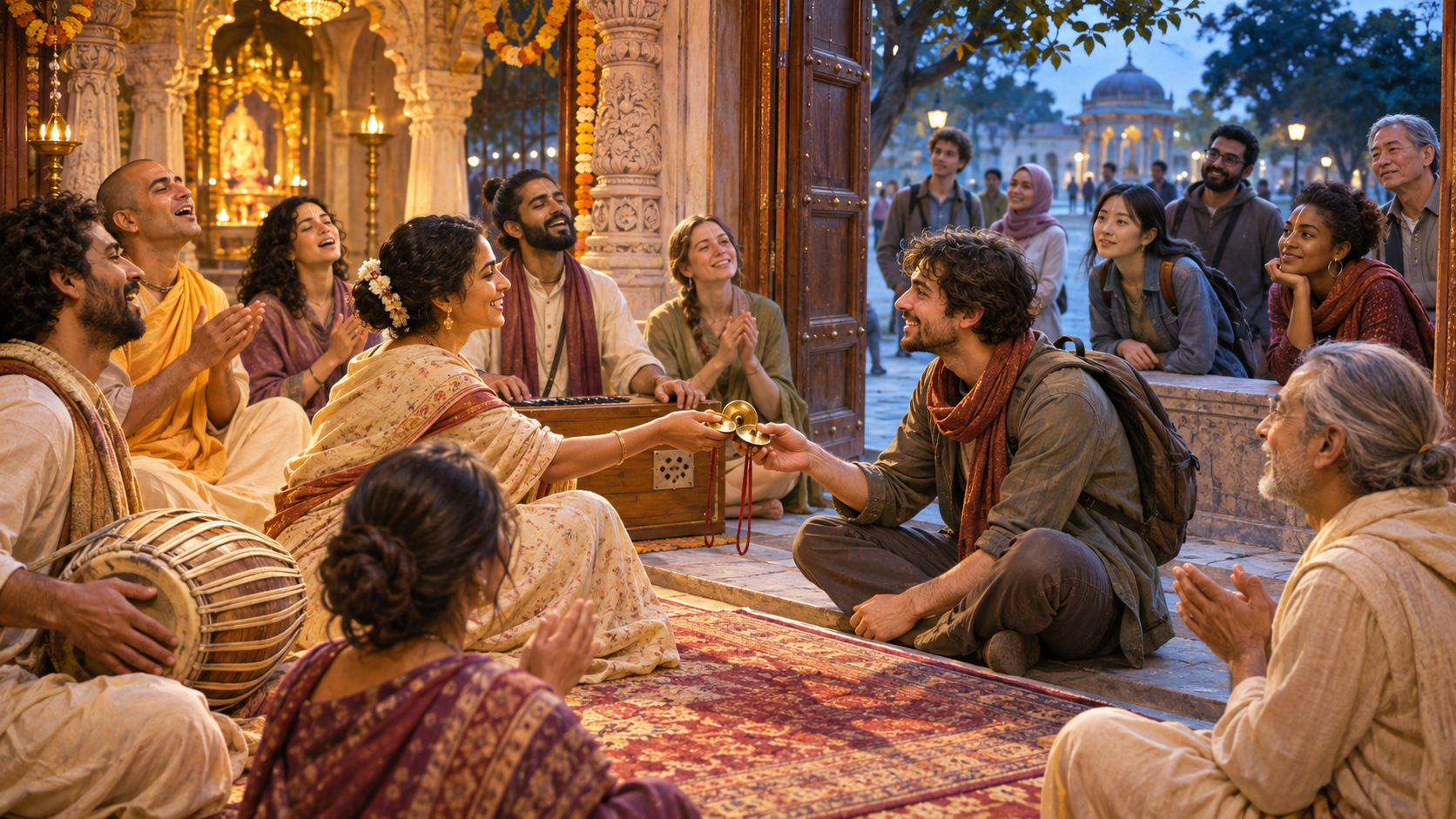
Kirtan travels well because participation can begin before intellectual mastery. A newcomer can listen, recognise the response, and join the congregation without first completing a course in theology. The philosophical depth remains, but the first doorway is embodied: hearing, singing, keeping rhythm and directing attention toward the divine.
That is an important form of Bharatiya civilisational influence. Dharma does not move through the world only as a set of propositions to be defended. It also moves through practices that people can enter: chanting, meditation, seva, pilgrimage, temple worship and disciplined community life. Kirtan allows a sacred vocabulary to become audible in public while retaining its devotional purpose.
If you bring someone to an ISKCON kirtan for the first time, a short explanation is enough:
- Tell them that it is worship conducted through congregational chanting, not a performance requiring silent spectators.
- Explain the call-and-response pattern so they know when they may join.
- Let them listen before participating; do not treat immediate enthusiasm as a test of openness.
- Explain that the names being chanted are sacred within a particular Vaishnava lineage, not generic sounds chosen only for relaxation.
- Afterward, answer the question they actually ask instead of forcing the occasion into a political or civilisational debate.
This approach protects both hospitality and seriousness. A newcomer is welcomed without being misled about the nature of the practice.
Cultural confidence does not require celebrity validation
Public participation by a well-known person can lower social hesitation. It may help a Hindu who has kept devotional life private recognise that kirtan need not be hidden. It may also prompt a non-Hindu observer to ask what the gathering is actually doing. Those are worthwhile effects.
But the value of kirtan does not rise or fall with the status of the participant. Krishna bhakti does not become more authentic because a politician joins it, and it does not lose authenticity when the cameras leave. If our confidence depends on recognition from prominent people, that confidence remains dependent on forces outside the tradition.
The useful distinction is among presence, endorsement and mandate:
- Presence means a person took part in a religious setting.
- Endorsement means a person or institution explicitly supported a political candidate, programme or position.
- Mandate means someone claims authority to speak for an entire religious community.
Kirtan participation establishes presence. Move to the other categories only when separate evidence supports them. This standard should apply whether you admire the public figure or oppose them.
Because Gabbard is widely associated with politics, many viewers will instinctively read the event through a partisan lens. You do not have to accept that frame. You can appreciate visible Dharmic participation while judging political leaders through their complete public records, stated positions and actions. Spiritual familiarity may inform your assessment of character, but it cannot replace examination of policy.
Key takeaways
- Tulsi Gabbard’s ISKCON kirtan should first be understood as participation in a Vaishnava devotional practice.
- Kirtan is congregational worship, even when a public personality or camera makes the occasion look like a media event.
- Participation may show familiarity or respect, but it does not by itself prove political endorsement or authority to represent Hindus.
- The most constructive response is to give viewers accurate context and a path toward genuine participation.
Turn a visible moment into deeper participation
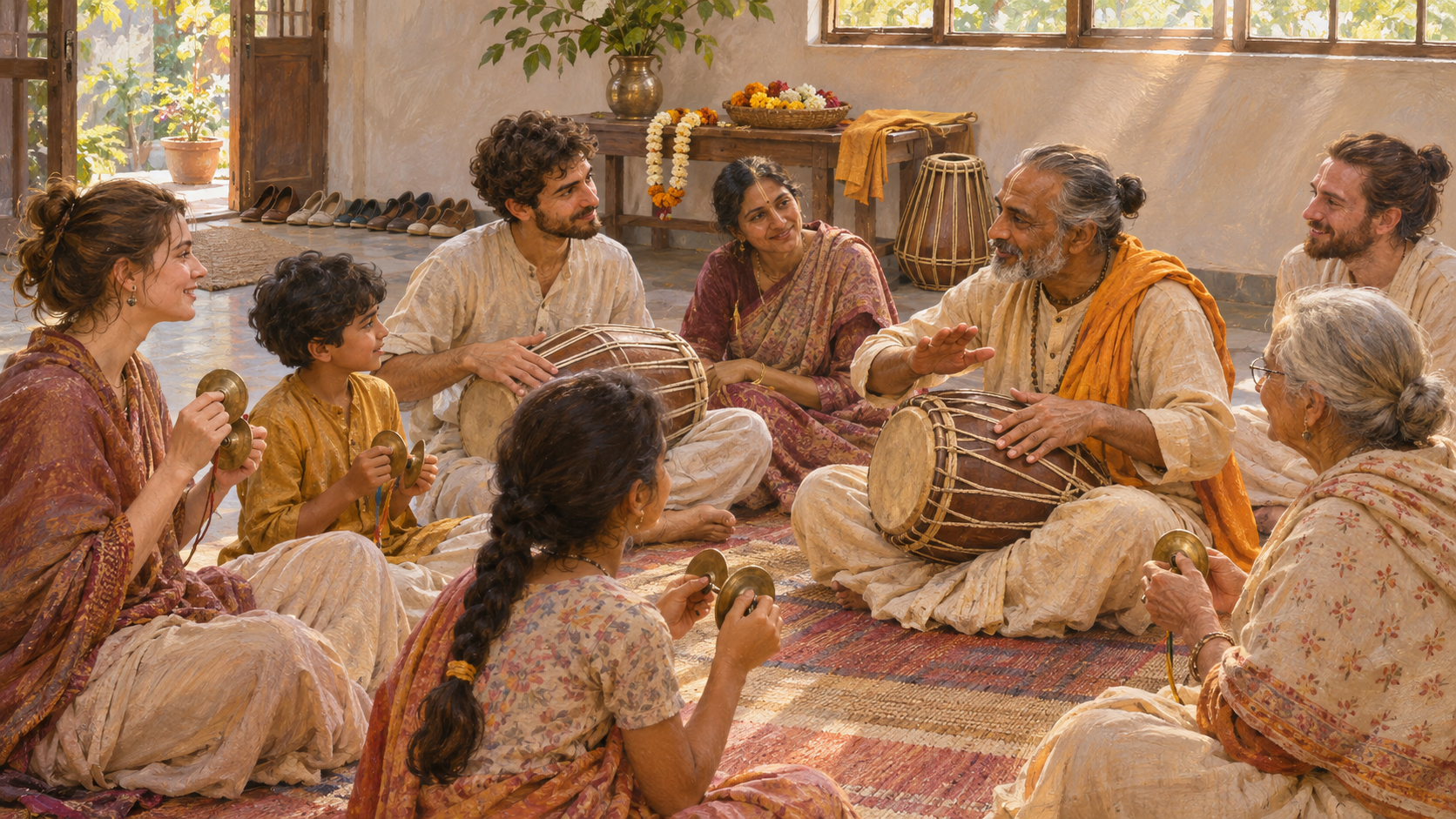
A public kirtan has lasting value only if attention moves from the personality toward the practice. If you plan to share this moment, use the following sequence.
- Describe only what is established. A precise caption such as “Tulsi Gabbard participates in kirtan at ISKCON” is more credible than a sweeping declaration about what an entire country, party or community now believes.
- Add one sentence of religious context. Explain that kirtan is congregational chanting within bhakti and that an ISKCON kirtan belongs to a Gaudiya Vaishnava setting.
- Avoid converting devotion into partisan proof. If the discussion concerns policy, examine policy evidence separately. Do not ask a temple appearance to carry conclusions it cannot support.
- Give interested readers a next step. Encourage them to attend a local kirtan, learn how the response works, or ask an ISKCON community about its devotional teachings and regular programmes.
- Keep the sacred centre visible. In your caption and conversation, devote more attention to kirtan and Krishna bhakti than to celebrity status.
The next time a prominent person appears in a Dharmic setting, ask a practical question before celebrating or condemning: will your response help someone understand the practice more accurately? If it will, share the moment with context and point beyond the personality to the living tradition.
References

Leave a Reply
You must be logged in to post a comment.