
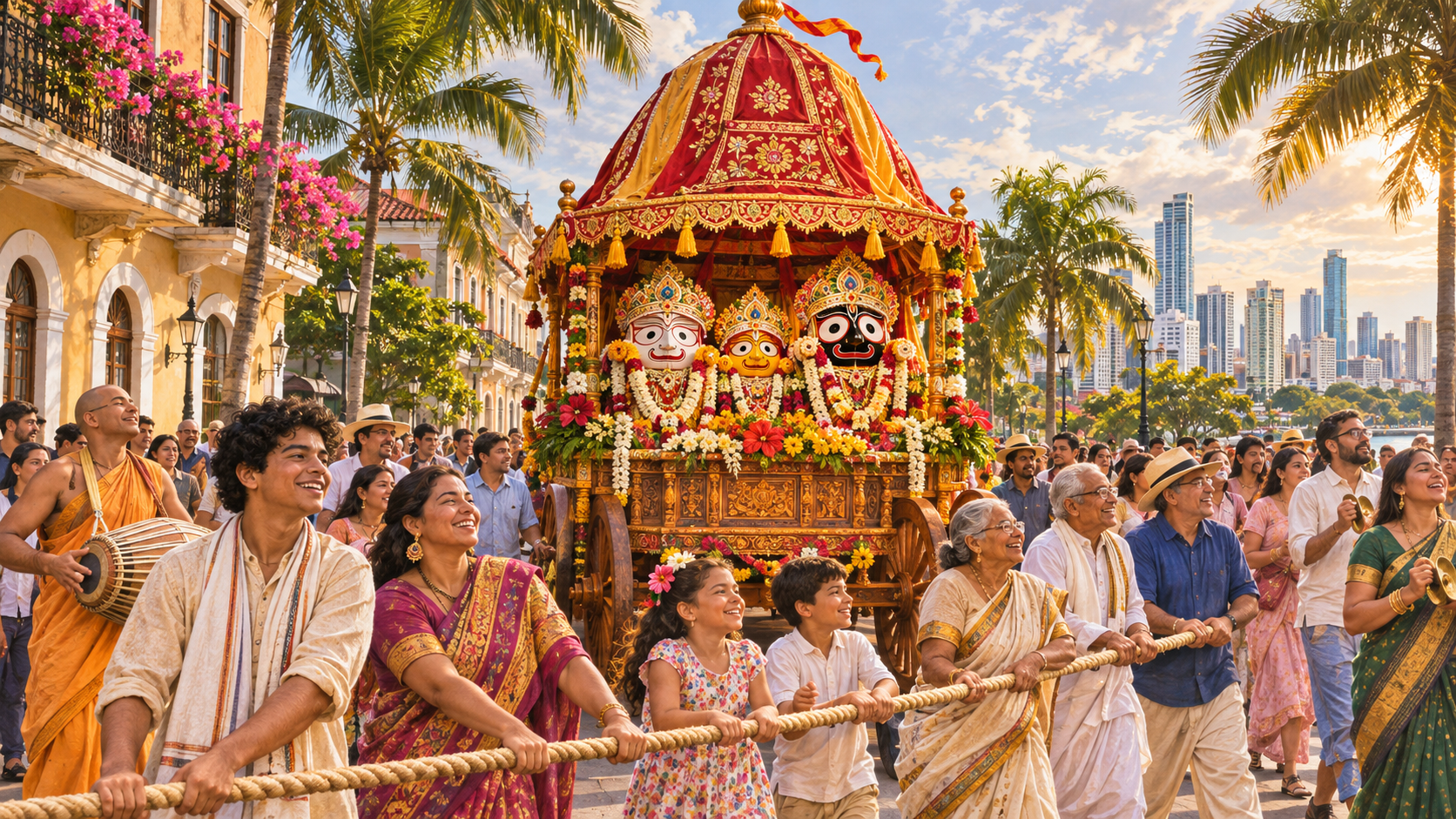
If you encountered ISKCON Panama’s 2025 Ratha Yatra and wondered whether you were seeing a cultural parade, a temple ritual, or a public celebration, begin with Lord Jagannath. The 2025 celebration in Panama was identified as a festival of Lord Jagannath. Its chariot and public character belong to a devotional tradition, not merely to festival pageantry.
That distinction changes how you understand the gathering and how you participate in one. The visible procession matters, but it serves an inward movement: turning attention toward the Divine through darshan, remembrance, service, sacred sound, and shared hospitality.
Begin with the name: Jagannath’s journey among the people
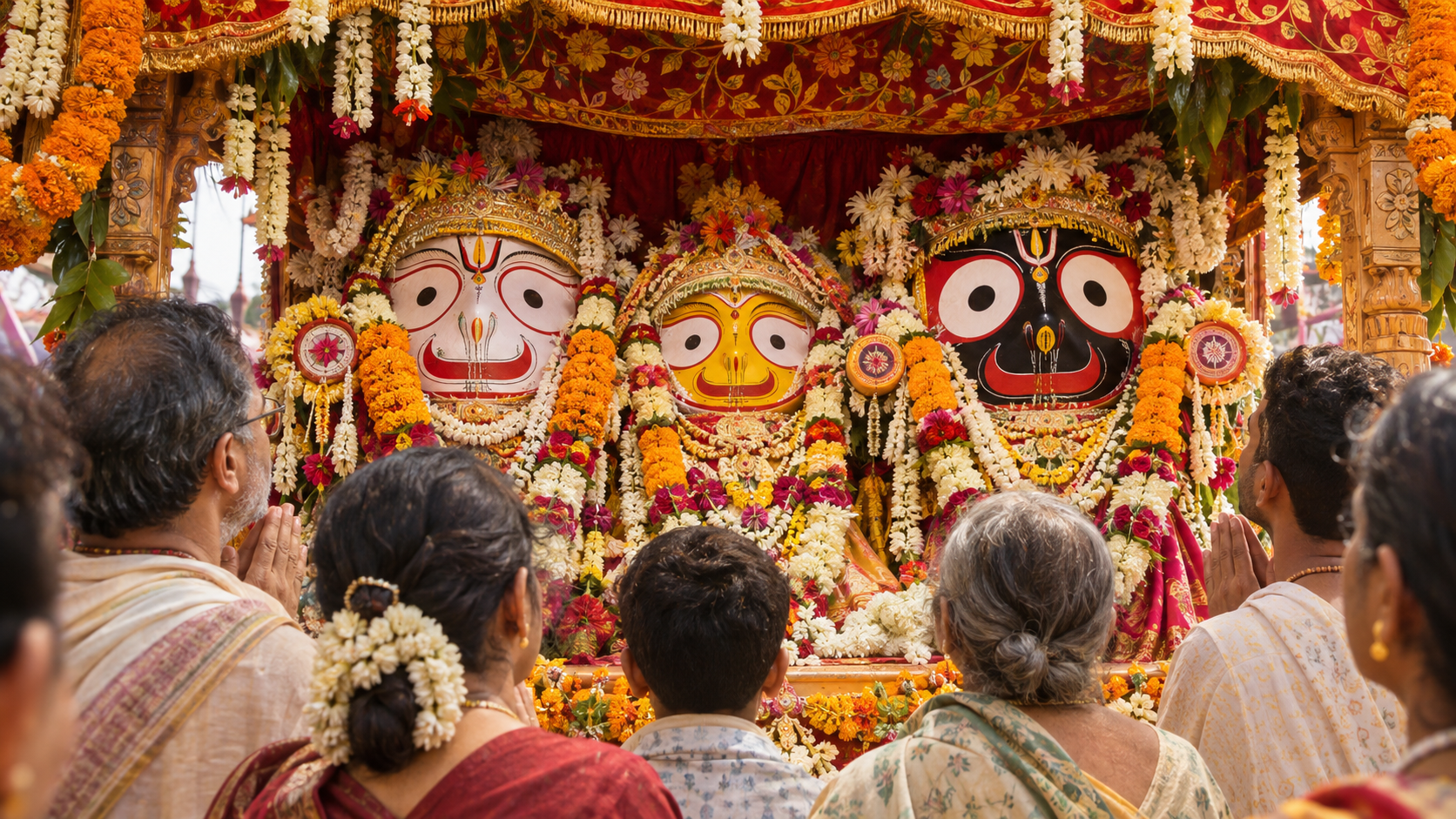
Ratha Yatra can be translated simply as a chariot journey. Jagannath means the Lord of the universe. Put those meanings together and the central idea becomes clear: the Lord does not remain distant or accessible only within a temple. The deity comes into public view, allowing people who might never cross a temple threshold to receive darshan.
Darshan is often translated as seeing, but ordinary sightseeing doesn’t capture it. A devotee approaches the deity with the understanding that sacred vision is reciprocal. You aren’t simply observing an image; you are presenting yourself before the Divine. This is why folded hands, attentive chanting, a bow, or a quiet moment of contemplation can be more appropriate than treating the chariot as a photographic attraction.
The chariot also makes theology tangible. A stationary shrine asks you to travel toward it. Ratha Yatra reverses that movement: sacred presence enters the shared streets of everyday life. The procession therefore expresses divine accessibility. It lets children, elders, committed practitioners, curious neighbours, and passers-by occupy the same devotional space without requiring the same level of prior knowledge.
Local arrangements can differ from one Ratha Yatra to another. The route, language, music, food distribution, chariot design, and programme are practical matters shaped by the host community. Those variations shouldn’t be confused with the festival’s centre. Lord Jagannath, rather than the size of the crowd or production, is the proper measure of what the gathering is about.
Participate as a guest, not merely as a spectator
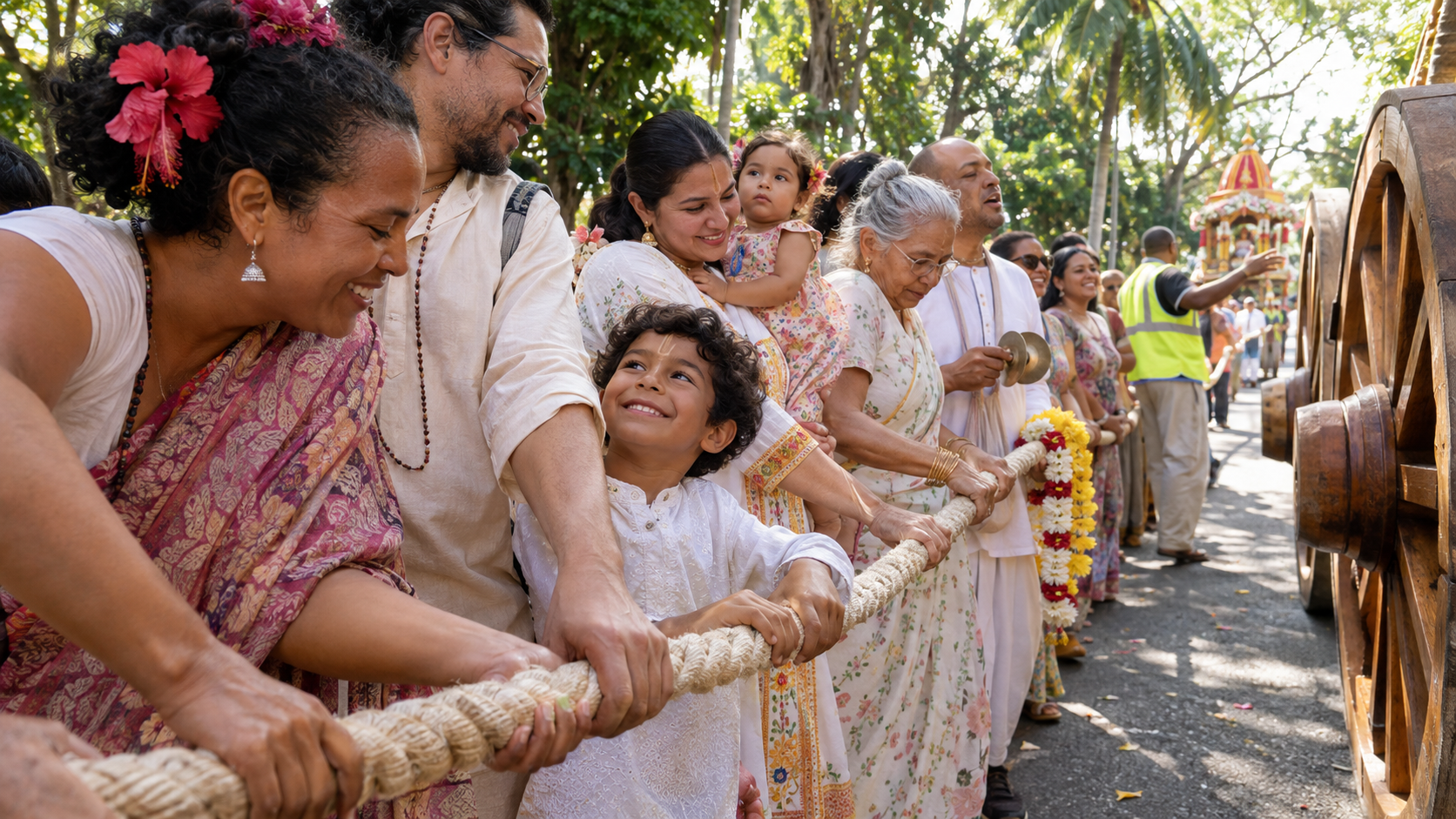
You don’t need to be an initiated devotee, know every ritual, or understand Sanskrit to attend a Ratha Yatra respectfully. You do need to recognise that participants regard it as worship. A few practical choices will help you enter that devotional atmosphere without pretending to know more than you do.
- Pause for darshan before reaching for your camera. Look toward Lord Jagannath, offer a respectful greeting in the manner natural to you, and allow the encounter to be more than image collection.
- Listen before joining the kirtan. Kirtan is congregational remembrance through sacred sound, not a performance with a passive audience. Once you recognise the repeated response, you can participate without needing to master the whole chant.
- Follow the volunteers around the chariot. Procession ropes, moving wheels, musical groups, and dense crowds require coordination. Don’t touch or pull anything until an organiser indicates that public participation is welcome.
- Ask before taking close photographs. A public procession can usually be seen from public space, but an unobstructed view doesn’t erase courtesy. Avoid blocking worshippers, photographing someone in an intimate devotional moment, or stepping into the route for a better angle.
- Receive prasada respectfully if it is offered. Prasada is food offered to the Divine and then shared; it isn’t treated as an ordinary sample. Follow the servers’ directions, accept only what you intend to consume, and don’t discard it carelessly.
- Ask sincere, specific questions. “What does darshan mean here?” will usually open a better conversation than asking whether the gathering is simply an Indian festival.
These practices are useful even when you already identify as Hindu. Familiarity with the vocabulary can create its own kind of carelessness. The strongest participation is not the loudest display of belonging; it is attention directed toward the deity, consideration for other worshippers, and willingness to serve where help is actually needed.
Why a Ratha Yatra in Panama matters
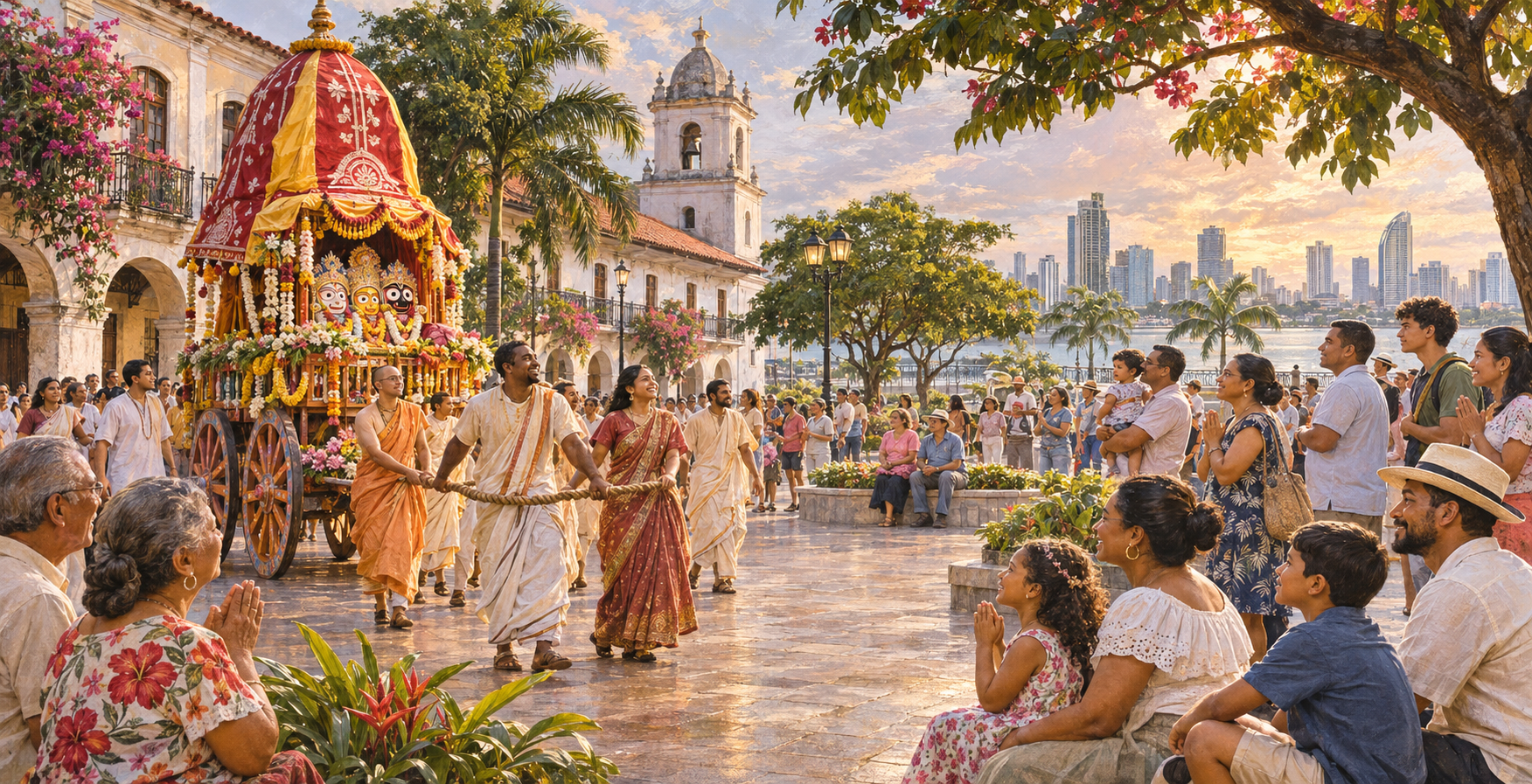
A Ratha Yatra in Panama shows how a Dharmic tradition can inhabit a place beyond Bharat without becoming detached from its sacred centre. That doesn’t mean every local expression will look identical. Living traditions retain continuity through practice, meaning, and disciplined transmission, not by freezing every external detail.
This is an important distinction for anyone evaluating Hindu life in the diaspora. Cultural visibility is valuable, but visibility alone isn’t continuity. A procession can be colourful and still communicate very little about its sacred purpose. Conversely, a modest gathering can transmit the tradition clearly when Lord Jagannath remains central, the chanting is treated as devotion, prasada is handled reverently, and newcomers are told why these practices matter.
You can use three questions when looking at any diaspora Ratha Yatra:
- Does the event direct attention toward Lord Jagannath, or does the deity disappear behind entertainment and branding?
- Can a newcomer recognise the difference between darshan, kirtan, seva, and ordinary festival activity?
- Does the community welcome participation while preserving the sacred character of what participants are being invited to do?
These aren’t tests of how closely a community imitates another location. They are tests of whether adaptation serves transmission. Using a local language, explaining unfamiliar terms, arranging an accessible route, or welcoming neighbours can strengthen the tradition’s public presence. Removing the devotional meaning to make the gathering easier to market would do the opposite.
Panama also matters because public Dharma is relational. A chariot moving through shared space creates contact between a Hindu devotional community and people who may know nothing about Lord Jagannath. The quality of that encounter depends on both clarity and hospitality. Devotees shouldn’t hide the theological meaning to appear universally agreeable, and visitors shouldn’t reduce a sacred procession to exotic culture.
Read the record of the 2025 event carefully
If you are researching the 2025 Panama celebration for a calendar, community history, school project, or future event, separate confirmed facts from features that are merely typical of Ratha Yatra. The confirmed identification is narrow but meaningful: ISKCON Panama held a 2025 festival centred on Lord Jagannath.
Don’t turn general knowledge of the tradition into claims about this particular gathering. A Ratha Yatra commonly involves a chariot procession and devotional participation, but the festival’s name alone cannot establish its exact date, route, attendance, programme, speakers, number of chariots, or distribution arrangements. Repeating an unsupported detail can quickly make it appear established when later writers copy it.
For precise historical work, verify each local detail against material tied to the organiser and the event itself. Look for a dated announcement, programme, route notice, complete caption, or recording that identifies both the place and year. Keep the distinction between an announcement and evidence that an activity occurred: a planned programme documents intention, while dated event material can document what took place.
This discipline protects more than factual accuracy. Diaspora communities build their institutional memory from notices, photographs, recordings, and recollections. Recording the year, organiser, location, and programme while those details remain recoverable gives future readers a usable history rather than a collection of detached images.
Key takeaways
- ISKCON Panama’s 2025 Ratha Yatra was a festival of Lord Jagannath.
- Ratha Yatra is best understood as a public act of devotion in which sacred presence becomes accessible beyond the temple setting.
- Darshan, kirtan, seva, and prasada are forms of participation, not decorative additions to a parade.
- A visitor should follow volunteers, avoid obstructing worship, ask before close photography, and treat offered prasada with respect.
- The significance of a diaspora celebration lies in faithful transmission and intelligible hospitality, not crowd size alone.
- Exact local details such as the date, route, attendance, and programme should be verified rather than inferred from common festival practice.
If the Panama celebration has prompted you to attend a future Ratha Yatra, take one deliberate step before you go: learn the difference between darshan and spectatorship. Then arrive ready to listen, follow the community’s guidance, and offer a small act of service. That is how a public festival stops being something you merely watch and becomes an encounter with Dharma.
References

Leave a Reply
You must be logged in to post a comment.