
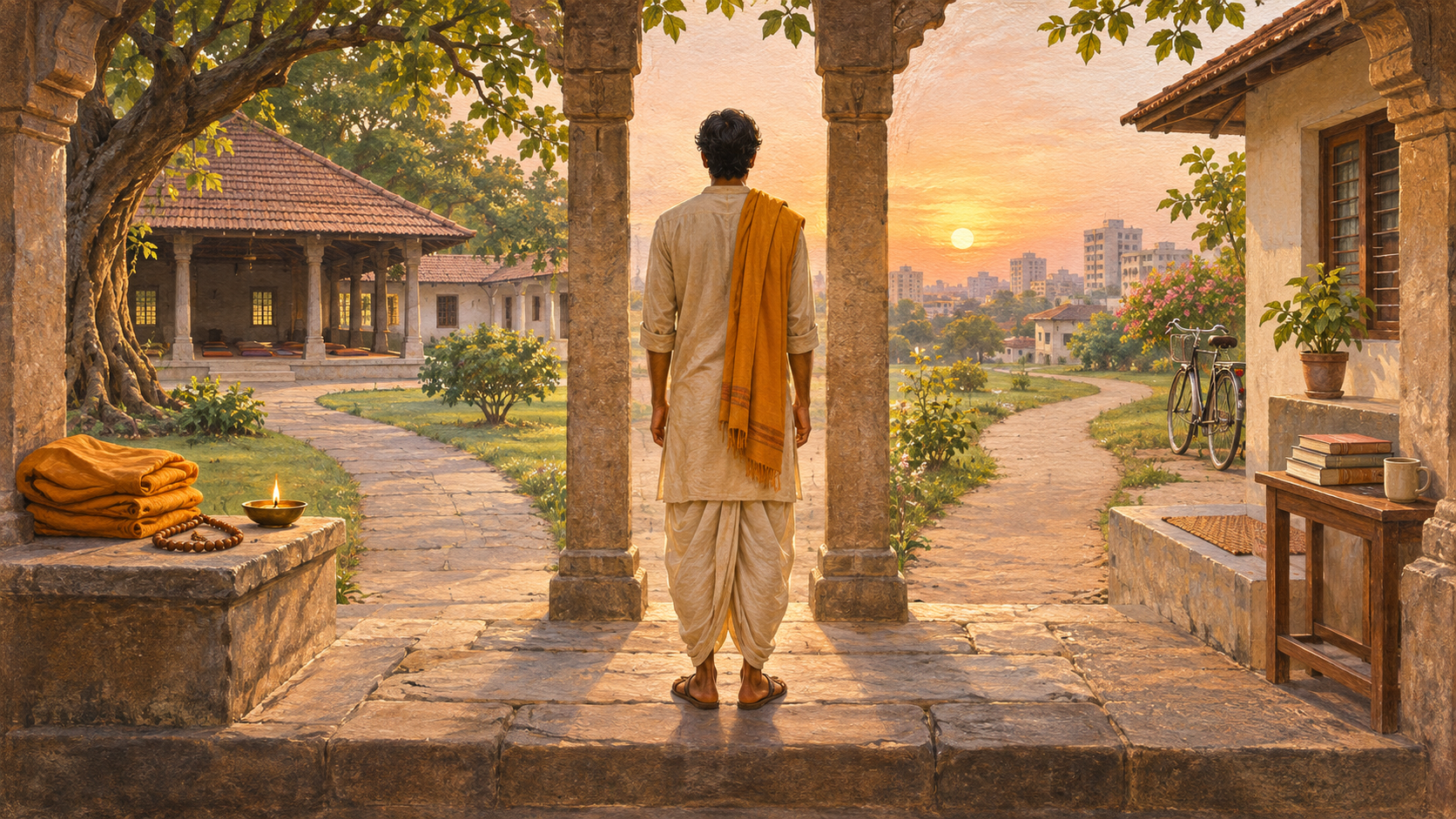
You may be asking two questions at once: whether a serious spiritual awakening requires you to leave ordinary life, and whether Brahmin identity is something inherited or something proved through character. Those questions meet in Gauranga Das’s journey, but they should not be collapsed into a single answer.
A dramatic turning point can awaken you, yet it cannot make your decision for you. Nor can a respected identity replace the conduct it is supposed to demand. The practical task is to distinguish an experience from a vocation, and a social label from a spiritual qualification.
A shock can clarify your life without deciding it
Gauranga Das was an IIT Bombay graduate moving from engineering toward monastic life in ISKCON when a near-death accident at the age of 22 changed his priorities. The event matters because it forced the question of what deserved the limited time available to him. It does not establish a rule that a frightening experience must be followed by renunciation.
Mortality can reveal that your present arrangement is misaligned. It may expose work pursued only for status, relationships taken for granted, or spiritual practice repeatedly postponed. But the urgency produced by danger can also make every radical alternative look pure. You therefore need to separate three things:
- The trigger: the event that interrupted your assumptions.
- The direction: the values, duties, or practices that now deserve greater weight.
- The form: the particular way of life in which you will embody that direction.
A crisis may clarify the first two without settling the third. You might be called to monastic life. You might instead need to become a more disciplined householder, simplify your livelihood, serve more consistently, or place daily sadhana before professional ambition. Do not treat the most visible change as automatically the deepest one.
If the decision would affect dependants, debt, health care, property, marriage, or other serious obligations, do not make an irreversible commitment in the emotional aftershock of an event. First identify what remains yours to resolve. Renunciation is not a spiritual name for transferring the cost of your decision to somebody else.
Test a monastic calling in the life you already have

The useful question is not whether a monastery feels peaceful when compared with a stressful week. It is whether you are drawn to sustained discipline, service, obedience, simplicity, and correction after novelty has disappeared. A vocation should survive contact with the ordinary.
- Name what you are moving toward. Write the attraction in concrete terms: concentrated sadhana, service to a guru and community, scriptural learning, simplicity, or freedom from private accumulation. If you can describe only what you want to escape, you have identified distress rather than a vocation.
- Practise before claiming an identity. Establish the daily worship, study, service, restraint, and punctuality expected by the community you are considering. Continue until the routine has survived boredom, fatigue, disagreement, and work for which nobody praises you.
- Watch your response to unglamorous service. Public teaching and visible ritual can attract admiration. Cleaning, administration, listening, accepting correction, and supporting another person’s work reveal whether service itself attracts you.
- Audit your obligations honestly. List dependants, debts, promises, unresolved family responsibilities, medical needs, and legal commitments. Take them to a competent senior in the community instead of assuming that spiritual enthusiasm cancels them.
- Examine the institution as carefully as the aspiration. Ask what vows are expected, how authority works, how health and ageing are handled, what financial arrangements apply, how conflicts are addressed, and what happens if a candidate later leaves. Traditions and institutions differ, so general admiration is not informed consent.
- Seek counsel from more than one life path. Speak with a mature monastic who knows the discipline from within and a spiritually serious householder who understands duty outside it. Their different questions can expose whether you have confused intensity with suitability.
This process is not a demand to suppress conviction. It protects conviction from fantasy. If disciplined practice strengthens the attraction while making you more truthful, responsible, and service-minded, the possibility deserves serious guidance. If the attraction fades when inconvenience begins, that is valuable knowledge too.
Ask which meaning of Brahmin is actually in play
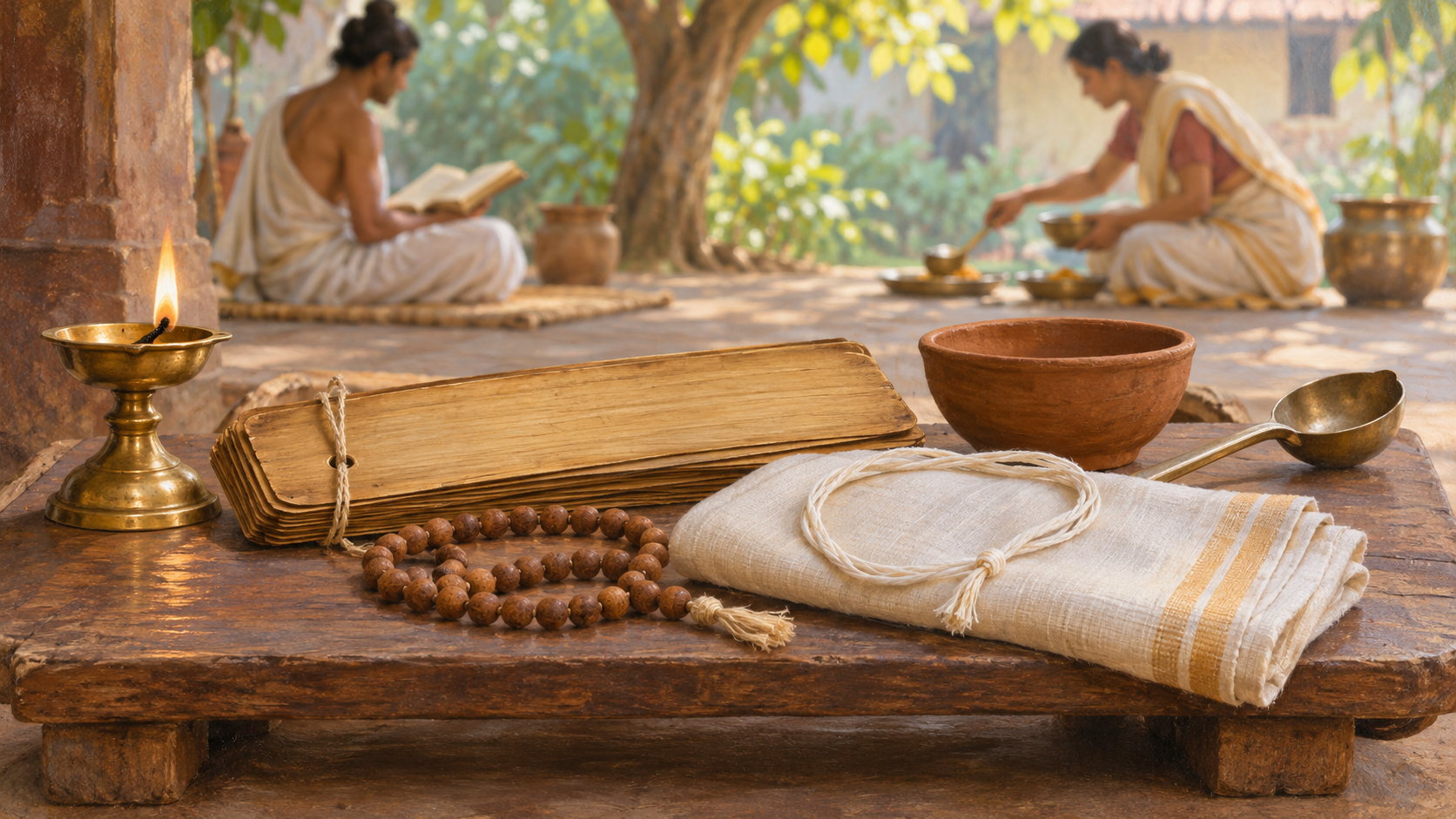
The question “Who is a Brahmin?” becomes confused because the same word can be used for different kinds of identity. In social usage, Brahmin may describe inherited community and family background. In institutional settings, it may concern eligibility for a particular ritual, teaching, or representative role. In spiritual and ethical discussion, it may name qualities such as truthfulness, learning, restraint, self-command, and dedication to higher knowledge.
These meanings overlap in some Hindu lineages and remain distinct in others. Different communities give birth, initiation, training, conduct, and recognised function different weight. You should therefore resist any argument that moves silently from one meaning to another.
When someone makes a claim about Brahmin identity, ask three direct questions:
- Are we discussing family lineage, qualification for a defined role, or an ethical-spiritual ideal?
- What conduct, knowledge, training, or initiation is required in this particular tradition?
- Does the claimed status create greater duties and accountability, or is it being used only to demand deference?
This distinction prevents two common errors. The first is pretending that inherited caste and its social consequences vanish merely because spiritual character matters. The second is imagining that inherited status makes character, discipline, or competence unnecessary. Social history is real, but lineage alone cannot perform sadhana, master a teaching, control speech, or make an unethical act pure.
Conduct-based language also needs care. Declaring that anyone with noble qualities is a Brahmin may express a spiritual ideal, but it does not automatically answer questions about ritual authority or recognition within a specific sampradaya. Before accepting or rejecting the claim, identify the domain in which it is being made.
A Dharmic identity should increase responsibility

Monastic and Brahmin identities can both be misunderstood as promotions. A better test is whether the identity narrows self-indulgence and expands duty. A monastic vocation entails discipline under a tradition, not freedom from accountability. A Brahmin ideal entails learning, restraint, truthfulness, and service, not merely social precedence.
This is also why you should not rank every sincere seeker by outward form. The monastic may have renounced possessions while still struggling with pride. The householder may carry family and professional duties while maintaining deep practice and generous service. Clothes, titles, education, ancestry, and public visibility can indicate a role; none can substitute for the inner and ethical work expected of that role.
Apply the same test to yourself. If a spiritual identity mainly makes you feel exceptional, it is probably feeding the self it was meant to discipline. If it makes you more careful with speech, more dependable in service, more receptive to correction, and less interested in privilege, it is beginning to function as a vocation rather than an ornament.
The movement from IIT-trained engineer to ISKCON monastic is striking because it crosses familiar markers of success. Its most useful lesson, however, is not that education and worldly competence must be discarded. It is that competence cannot answer the prior question of what your life is for. Education may become an instrument of seva when purpose, discipline, and responsibility govern it.
Key takeaways
- A life-changing event can reveal misplaced priorities without proving that monastic life is your proper response.
- Test a calling through sustained practice, ordinary service, correction, and an honest audit of existing duties.
- Before debating Brahmin identity, distinguish inherited community, institutional role, and cultivated spiritual character.
- Conduct does not erase social history, while lineage does not remove the need for knowledge, restraint, and ethical qualification.
- A genuine Dharmic identity should increase accountability and service rather than entitlement.
Begin with two unfinished sentences: “I am being drawn toward…” and “I may be trying to escape…” Then place both before a trustworthy teacher and test them through the discipline already available to you. Let practice clarify the name of your path before the name of the path begins to define you.
References

Leave a Reply
You must be logged in to post a comment.