
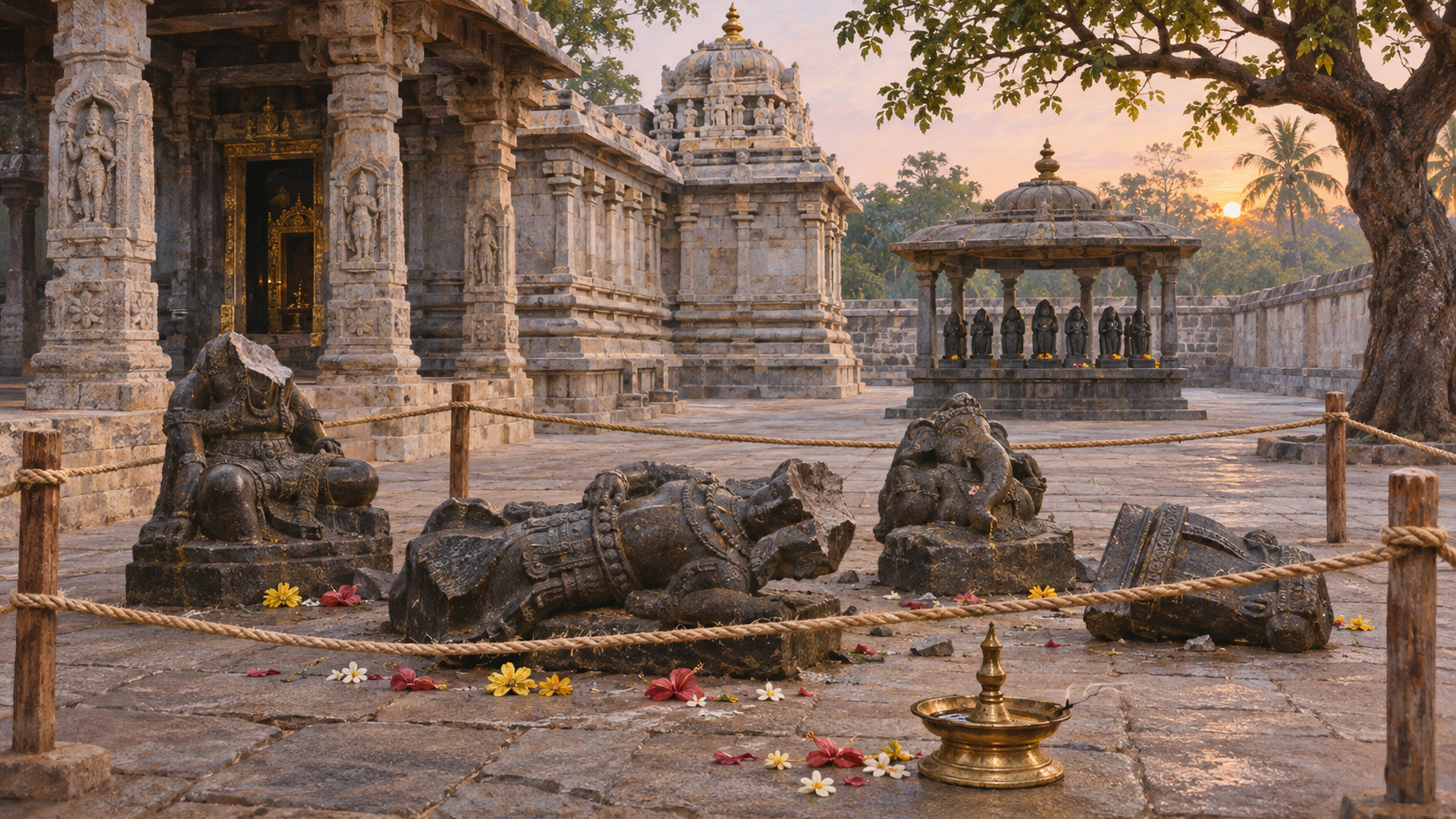
If you have seen reports of the damaged Navagraha murtis in Ramanagara, you need two things at once: a clear account of what has actually been established and a way to respond that protects the temple without compromising the investigation. Anger at desecration does not have to be muted, but it does have to be disciplined.
At the Lakshmi Venkataramana Swamy Temple in Ramanagara, Hindu sacred objects were deliberately damaged. The strongest response is an exact one: preserve the evidence, restore worship according to the temple’s tradition, improve protection and insist on answers that can withstand scrutiny.
What is known, and what has not been established
The first duty in a case like this is to keep confirmed facts separate from inference. That distinction does not minimize the offence. It prevents rumour from overtaking the evidence needed to identify and hold the offender accountable.
Key takeaways
- The damaged Navagraha murtis were within the premises of the Lakshmi Venkataramana Swamy Temple, near Kempegowda Circle on Jalanamangala Road in Ramanagara.
- An unidentified person reportedly entered at about 10:45 PM on a Saturday night, remained briefly and damaged the murtis.
- A mini-bus parked in front of the temple reportedly obstructed the view from outside. The damage was discovered the following morning when the pujari arrived.
- A CCTV camera at a nearby bakery reportedly captured the incident. After the temple committee complained, Aijoor police registered a case and began investigating.
- The person’s identity, motive and possible connection to anyone else had not been established in the information available for this account.
Those limits matter. A recording may help establish entry, movement, clothing, actions and timing. It does not automatically establish motive, ideology, mental condition or association with a religious or political group. Even a clear image is not the same as a verified identity. Keep each conclusion tied to the evidence that can actually support it.
The reported obstruction also explains why the act may have gone unnoticed in the moment. It does not prove that the parked vehicle or its owner had any connection to the vandalism. Investigators should examine that possibility if the evidence warrants it, but devotees should not convert a blocked sightline into an allegation.
Why damage to Navagraha murtis is not ordinary property damage

A murti installed for worship is not interchangeable with decoration. It belongs to a living relationship among deity, temple, ritual practice, pujari and devotee. The Navagrahas represent the nine grahas within Hindu sacred practice, and devotees may approach them through prayer, offerings, circumambulation and observances shaped by the temple’s sampradaya. Deliberately damaging their forms violates both a physical object and a sacred boundary.
That is why a repair bill alone cannot measure the harm. Desecration can interrupt worship, disturb devotees and force the temple to determine what physical and ritual restoration is required. The criminal investigation and the religious response are separate processes, and both deserve care.
- Preserve the scene first. Before fragments are moved or surfaces are cleaned, the committee should allow police to complete the necessary documentation and collection of evidence.
- Create a precise damage inventory. Trustees and the pujari should record which murtis, bases, fixtures and ritual areas were affected. Photographs taken for official use should remain unedited and retain their original files.
- Let the temple’s tradition govern restoration. The pujari, trustees and a competent authority from the relevant ritual tradition should determine whether repair, replacement, purification, reconsecration or another procedure is appropriate. A social-media poll cannot settle an Agamic or sampradaya-specific question.
- Announce one authorized plan. Devotees should receive a clear statement about temporary worship arrangements, the restoration decision and any official donation channel. That protects the temple from conflicting appeals and unauthorized fundraising.
If you want to help, do not touch damaged objects, move fragments or independently arrange replacements. Wait for the temple committee’s direction. Devotion is best expressed here by helping the temple preserve evidence and restore worship in the proper order.
How you can help without weakening the case
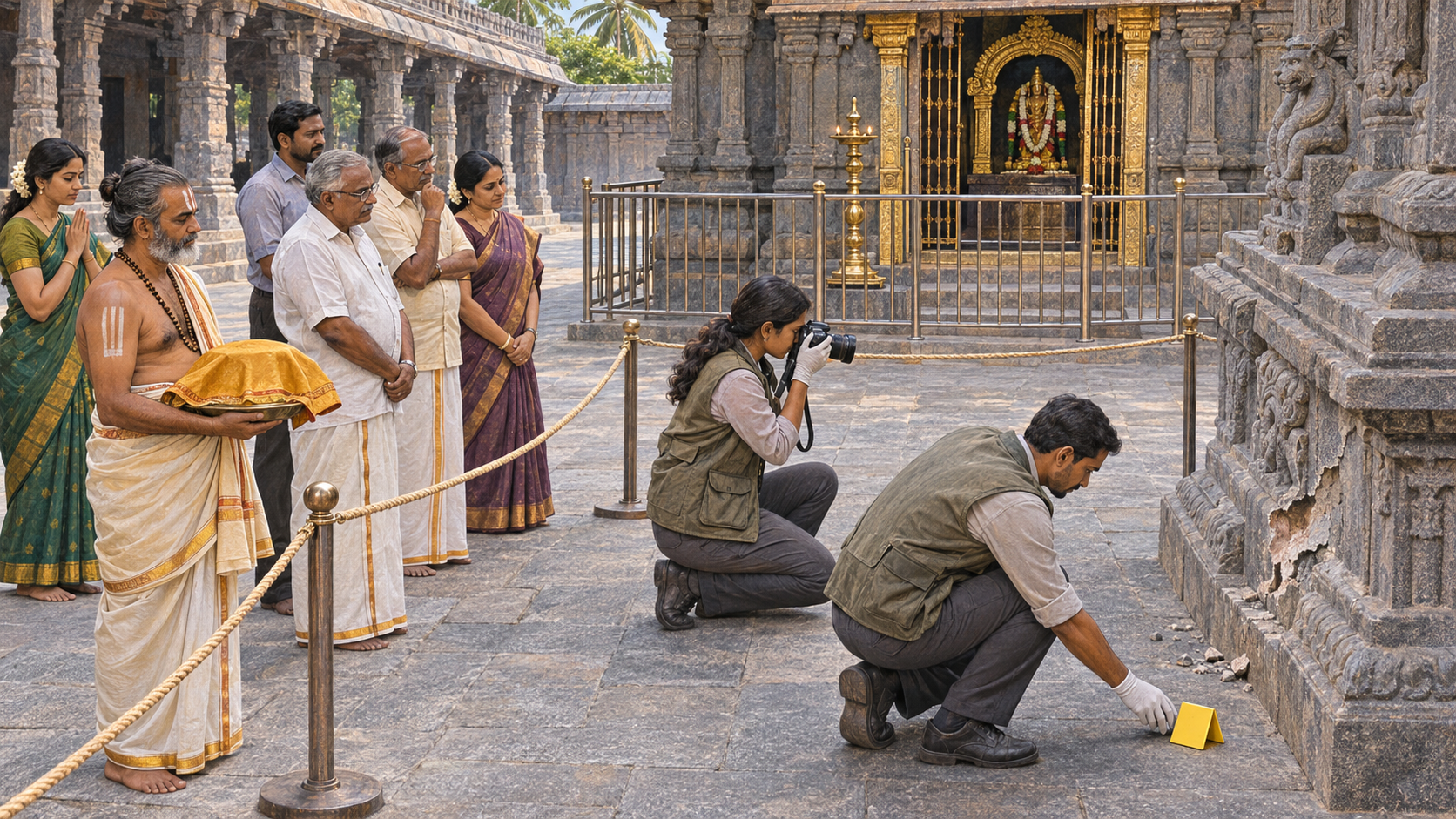
The hours after temple vandalism often produce two competing impulses: circulate everything immediately or say nothing until the case is over. Neither extreme is necessary. You can support disclosure while protecting the quality of the evidence.
- Use verified updates for case status. Look first to the temple committee and Aijoor police for information about identification, arrest or investigative progress. A forwarded message is not confirmation, even when it comes from someone you trust.
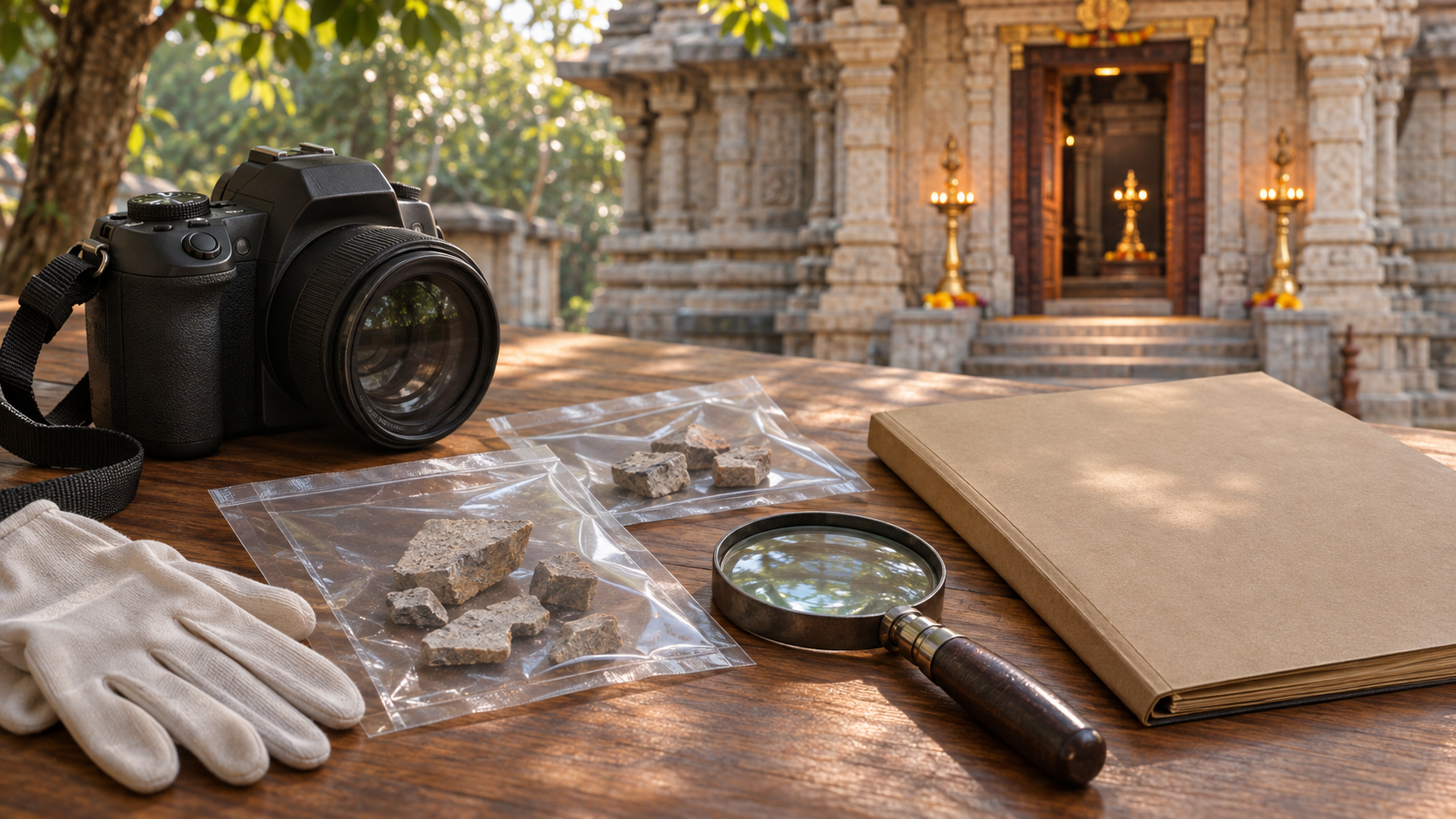
- Keep original evidence intact. If you possess relevant video, photographs or messages, retain the original files. Do not crop, enhance, compress, add music, place text over the image or repeatedly forward the only copy. Note when and where the material was obtained and which device produced it.
- Submit evidence before publishing it. Give potentially useful material to the investigating officers and alert the temple’s designated liaison. Public circulation can expose investigative details, encourage false identifications or allow a suspect to adapt a story to what is already known.
- Do not identify a person from appearance alone. Clothing, complexion, gait or a blurry face cannot establish a name, religion, organization or motive. If you recognize someone, pass the information privately to police and explain the basis for the recognition.
- Support only an authorized restoration effort. Confirm that a donation request comes from the temple committee. Ask what the funds cover and whether the physical and ritual assessments have been completed.
- Gather peacefully. Darshan, collective prayer and a properly organized community meeting can demonstrate solidarity. Do not confront a suspected person, obstruct investigators or turn a temple gathering into collective blame against an unconnected community.
The temple committee’s complaint has already led to a case being registered by Aijoor police. The most useful public pressure now is specific: preserve every available recording, identify the individual through lawful investigation, test possible motives against evidence and disclose meaningful progress without exposing witnesses or investigative material.
A protection plan based on the vulnerabilities exposed

This incident points to three practical vulnerabilities: access after normal activity had declined, a sightline blocked by a parked vehicle and crucial footage reportedly coming from a nearby business. Temple committees elsewhere do not need to wait for their own incident before examining the same weaknesses.
Protect the line of sight
The reported mini-bus obstruction is a concrete security lesson. Map the view from the road, neighboring shops, the entrance and every vulnerable shrine. Identify places where a large vehicle, temporary stall, banner, vegetation or construction material can create concealment.
- Work with adjacent property owners and the appropriate local authorities to keep critical viewing areas clear where lawful and practical.
- Do not place festival decorations, storage or donation infrastructure where they block a camera or the natural view of an entrance.
- Include sightlines in the closing inspection. A camera that worked in the afternoon may be useless after a vehicle parks in front of it.
Design cameras for identification, not merely recording
A camera system should help answer who entered, how the person approached, what happened inside and how the person left. A distant overhead view may prove that an offence occurred while failing to capture an identifiable face.
- Cover the entrance, principal approach, vulnerable sacred area and likely exit path without intruding on spaces where devotees reasonably expect privacy.
- Test footage under the lighting conditions that exist after dark. Check whether faces are visible when a person is moving, wearing a cap or standing near a bright light.
- Keep camera clocks synchronized. Conflicting timestamps make it harder to combine recordings from the temple, shops and street-facing systems.
- Set a recurring check for image quality, storage health and the ability to export an original clip. Discovering a failed drive after an incident is too late.
- Restrict access to recordings and record who exports them. Security footage should not become entertainment or material for partisan editing.
Give the closing routine a named owner
Security fails when everyone assumes someone else completed the final check. The temple should assign responsibility for each closing period and use a short written checklist suited to its worship schedule and access practices.
- Inspect vulnerable shrines and the perimeter before departure.
- Confirm gates, locks, lighting and alarms where those measures are compatible with the temple’s practices.
- Verify that no object or vehicle has newly obstructed a critical view.
- Record the completion time and the responsible person’s name.
- Maintain two reachable contacts so that a pujari, neighbor or police officer can promptly reach a trustee if damage is discovered.
Prepare an incident protocol before it is needed
The first person to find damage should not have to invent the response. A one-page protocol can state who calls police, who prevents unnecessary entry, who contacts trustees, who requests recordings from nearby properties and who speaks publicly for the temple.
The protocol should also keep two records separate. The evidence record contains original photographs, footage, witness details and police communications. The restoration record contains the ritual assessment, physical damage estimate, authorized vendors, temporary worship plan and donations. Separating them reduces confusion and helps the committee answer devotees without disclosing sensitive investigative material.
Accountability requires evidence, consistency and follow-through
The target and impact in Ramanagara are clear: Hindu murtis in a temple were damaged. The offender’s motive is not yet clear. That is not a reason to soften the demand for justice; it is a reason to make the demand precise.
- Who entered the temple premises and damaged the murtis?
- What do the available recordings and physical evidence establish about the full sequence?
- Was the temple selected deliberately, and what evidence establishes the motive?
- Did anyone aid, encourage, plan or conceal the act?
- What immediate safeguards will reduce the chance of repetition while the case proceeds?
No unsupported explanation should be treated as a conclusion. That includes claims of an organized communal conspiracy, political provocation, intoxication, a prank or mental illness. If investigators later advance any such explanation, the temple community can reasonably ask what evidence supports it and whether all other leads were examined. A mental-health label casually applied by observers is not a diagnosis; even a properly established condition would not remove the need to determine what happened, protect the temple and complete the appropriate legal process.
Collective accusation is especially damaging when the offender has not been identified. It can endanger innocent people, divert attention from the actual perpetrator and replace a provable case with a political argument. Strong Hindu advocacy does not require inventing certainty. It requires refusing to let the desecration be trivialized while also refusing to make claims the evidence cannot yet carry.
Your most useful next step is concrete. Follow the temple committee’s authorized updates, preserve any original evidence you possess, support restoration only through verified channels and ask for continued police follow-through on identity, motive and possible accomplices. A disciplined response protects the sanctity of the temple and gives the case its best chance of reaching a credible conclusion.
References

Leave a Reply
You must be logged in to post a comment.