
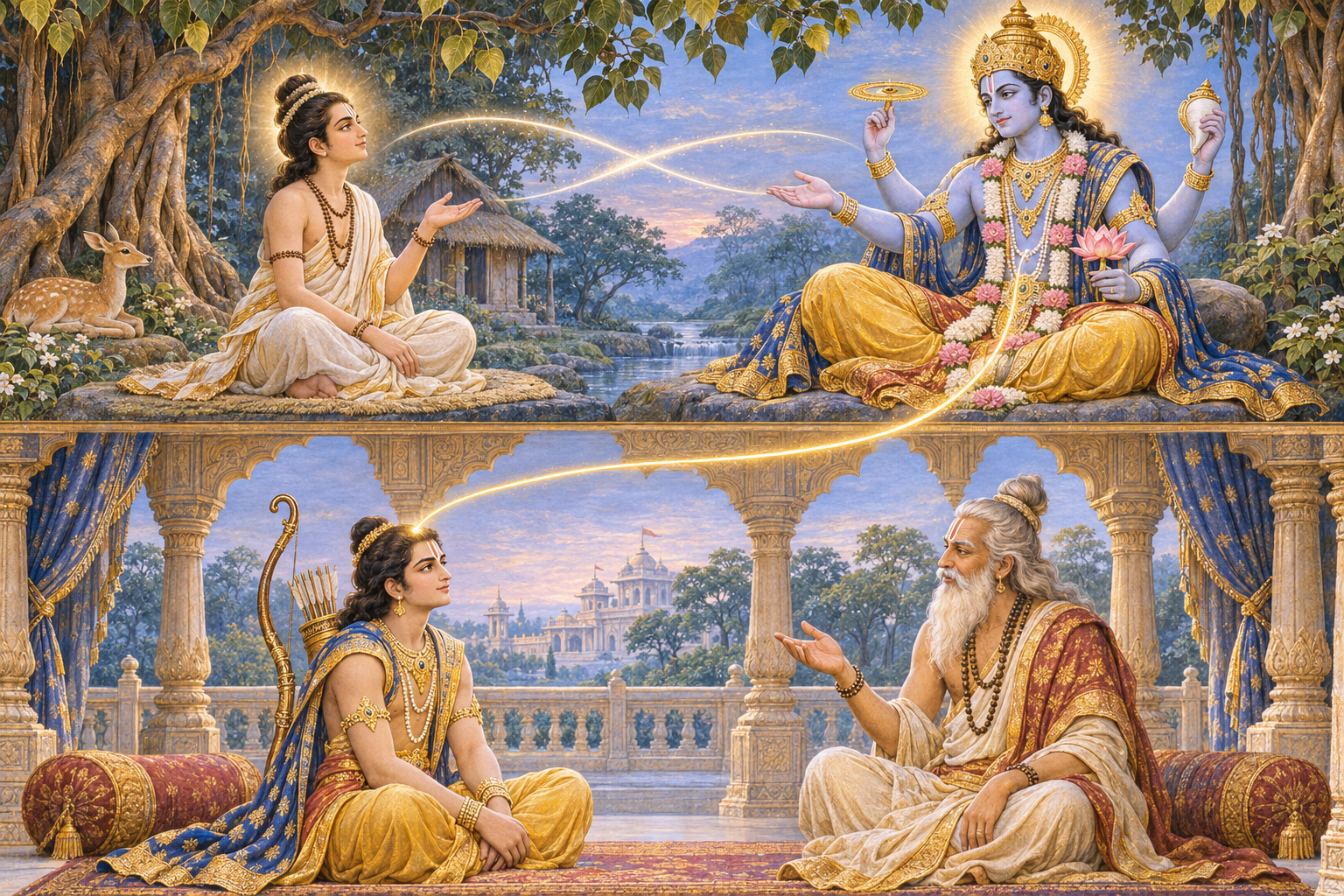
You may have reached this story with an apparent contradiction: if Sri Rama is Bhagavan Vishnu, how can a rishi curse him? And why would the all-knowing Lord need Vasistha to teach him?
The contradiction begins to dissolve when you notice what Sanatkumara’s curse changes. It does not destroy Vishnu’s eternal nature. It establishes the human condition under which Vishnu appears as Rama, making Rama’s dispassion, questioning and discipleship spiritually meaningful rather than ceremonial.
What the mutual curse actually does
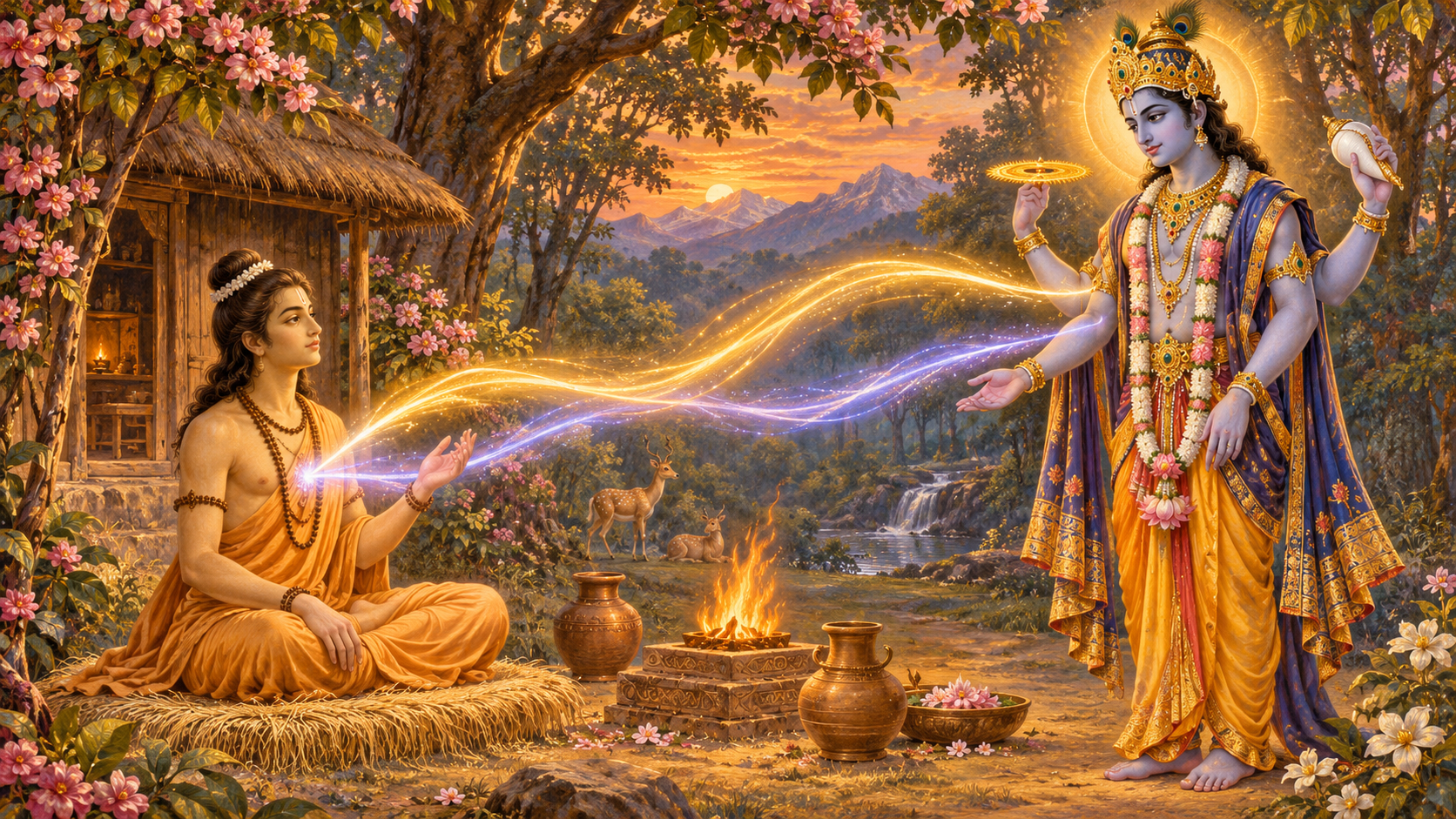
Within the Vairagya Kanda of the Yoga Vasistha, Sanatkumara is a desireless sage dwelling in Brahmaloka. Bhagavan Vishnu comes there from Vaikuntha, but Sanatkumara does not receive him with the expected honour. Vishnu curses the sage to experience desire. Sanatkumara answers with a curse of his own: Vishnu’s omniscience will be obscured for a time, and he will undergo the condition of a mortal. The exchange is presented as a cause of Vishnu’s earthly appearance as Rama.
Four details keep the episode in focus:
- Sanatkumara and Vishnu both utter a curse; this is not a one-sided defeat of Bhagavan.
- The counter-curse concerns Vishnu’s manifested knowledge during a limited condition, not the destruction of his eternal being.
- The result is connected specifically with the mortal experience of Rama.
- The episode prepares the ground for Rama to seek and receive spiritual instruction from Vasistha.
This is why calling it merely “the curse on Vishnu” is misleading. The story turns on reciprocity. Sanatkumara’s conduct brings a consequence, Vishnu’s response brings a counter-response, and both words enter the causal structure of the incarnation.
A shapa, or curse, in this kind of sacred narrative is more than an angry remark. It is consequential speech. Once uttered by a being of spiritual power, it becomes a condition through which later events unfold. You therefore do not have to choose between “Rama is divine” and “the curse has a real effect.” The narrative asks you to hold both truths together.
Why the curse does not make Vishnu powerless
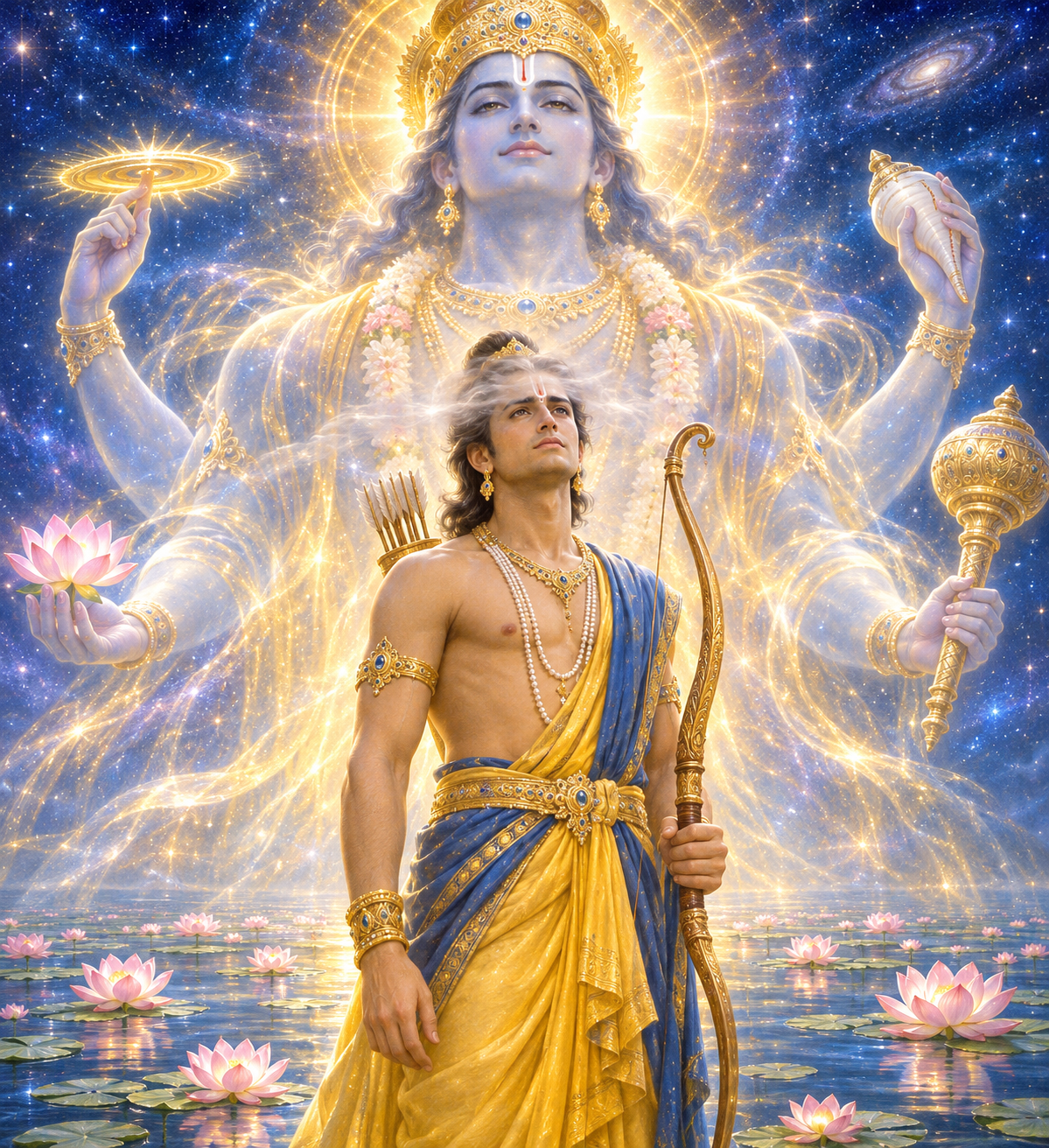
The hardest question is usually not whether the curse occurred, but how it could affect Vishnu at all. If Bhagavan is sovereign, does a rishi’s word overpower him?
That question assumes that incarnation must mean either unrestricted divine manifestation or complete helplessness. The episode works through a third possibility: real self-limitation. Vishnu enters a condition in which omniscience is not continuously manifest in Rama’s human awareness. The limitation is genuine within the incarnation, but it does not become a final statement about Vishnu’s eternal nature.
Think in terms of essence and condition. The essential identity is Vishnu. The lived condition is Rama’s mortal embodiment, complete with the human experience necessary for inquiry, duty, sorrow, discernment and liberation. A temporary veil over manifested knowledge is not the same as the annihilation of divinity.
This distinction protects you from two opposite mistakes. The first reduces Rama to an ordinary man who happens to become wise. The second turns every human feature of Rama into an empty performance. Neither reading does justice to an avatara who truly enters the world while remaining rooted in the divine.
The word avatara means a descent. Descent implies that the divine accepts a particular field of action and its limits. Birth, relationship, duty and instruction are not defects accidentally imposed on the story. They are the form through which the divine life becomes accessible to human beings.
You should also resist making this episode the only explanation for Rama’s incarnation. Dharmic narratives frequently preserve several levels of causation: a cosmic purpose, the restoration of dharma, the consequences of earlier actions, the words of rishis and the Lord’s own lila can all operate within the same sacred history. One cause does not automatically cancel the others.
Why Rama genuinely needs Vasistha’s instruction
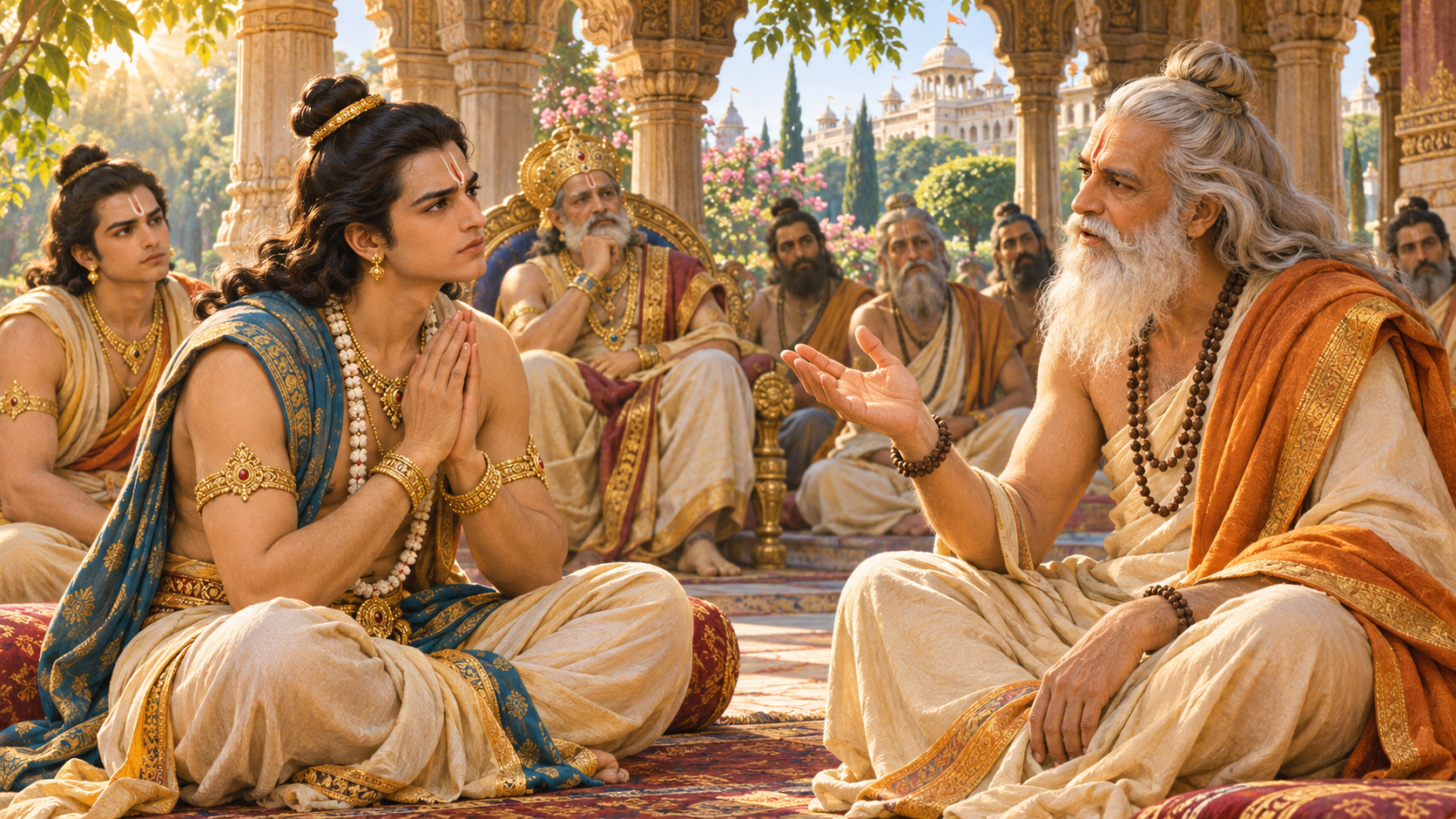
The counter-curse answers a theological question built into the Yoga Vasistha: why does Rama, who is Vishnu, experience profound dispassion and require a guru’s teaching?
If Rama merely pretended to be troubled while secretly standing outside every question, his dialogue with Vasistha would become theatre. His inquiries might remain eloquent, but they would cease to model the seeker’s path. The temporary obscuring of omniscience allows Rama’s questions to be real within his embodied condition.
That makes three features of Rama’s journey especially important for you as a reader:
- Vairagya is a beginning, not the destination. Dispassion loosens the mind’s attachment to appearances, but it must mature into clear knowledge rather than collapse into withdrawal or despair.
- Divine identity does not make the guru-disciple relationship disposable. Rama listens, questions and receives instruction. The highest status in the narrative does not excuse anyone from attentiveness and humility.
- Confusion can become the doorway to discernment. Rama’s unsettled condition creates the need for inquiry. The teaching matters because the question is allowed to matter.
This is the practical centre of the episode. When you encounter spiritual uncertainty, the Dharmic response is not to protect your image by pretending that you already know. Name the question, approach a trustworthy teaching and submit your first assumptions to examination. Rama’s stature makes that discipline more significant, not less.
The story also places a limit on intellectual pride. Sanatkumara’s freedom from desire is an extraordinary attainment, yet the encounter still turns on recognition, conduct and consequence. Inner attainment cannot simply be used to declare every relational duty irrelevant. At the same time, Vishnu’s cosmic status does not make the exchange consequence-free. Both figures stand inside a moral and spiritual order in which words matter.
A practical way to read this episode without distorting it

Stories about curses and avataras are often flattened into slogans. One person treats the curse as proof that a sage was stronger than God. Another declares that nothing really happened because Vishnu could not possibly be affected. A more careful reading takes five steps.
- Name the textual setting. Say that this explanation belongs to the Yoga Vasistha. Do not present every Ramayana tradition as though it tells the episode in precisely the same way.
- Identify the exact limitation. The important effect is a temporary obscuring of manifested omniscience under mortal conditions. Avoid vague claims that Vishnu somehow ceased to be divine.
- Preserve the mutuality. Vishnu first curses Sanatkumara, and Sanatkumara answers. Reading only the counter-curse removes the ethical structure of the scene.
- Follow the narrative consequence. The limitation helps explain why Rama’s dispassion, inquiry and instruction by Vasistha can be genuine.
- Do not turn one cause into an exclusive doctrine. Treat the curse as one theological account of the conditions of Rama’s incarnation, not as a reason to discard the incarnation’s wider Dharmic purpose.
This method is useful in a satsang, a classroom or a family discussion. A precise formulation would be: “In the Yoga Vasistha, Sanatkumara’s counter-curse accounts for a temporary veil over Vishnu’s manifested omniscience during Rama’s mortal life, making Rama’s spiritual inquiry meaningful.” That sentence says what the episode explains without making it claim more than it does.
Watch especially for interpretations that make Sanatkumara a simple villain or Vishnu a helpless victim. The exchange is more demanding than either caricature. It shows spiritually powerful beings entering a chain of consequential speech that ultimately serves the revelation of wisdom through Rama and Vasistha.
Key takeaways
- The account belongs specifically to the Yoga Vasistha’s framing of Rama’s mortal condition.
- Vishnu and Sanatkumara exchange curses; the event is mutual rather than a unilateral conquest of Bhagavan.
- Sanatkumara’s curse temporarily obscures manifested omniscience; it does not erase Vishnu’s eternal identity.
- The curse helps explain why Rama’s vairagya, questions and discipleship under Vasistha are genuine.
- The episode should be read alongside, not against, the wider Dharmic purposes of avatara.
When you next read Rama’s questions to Vasistha, do not treat them as an embarrassment that devotion must explain away. Read them as the opening deliberately created for the seeker. Rama enters the difficulty of the human condition deeply enough to show how that condition can be understood and transcended.
References

Leave a Reply
You must be logged in to post a comment.