
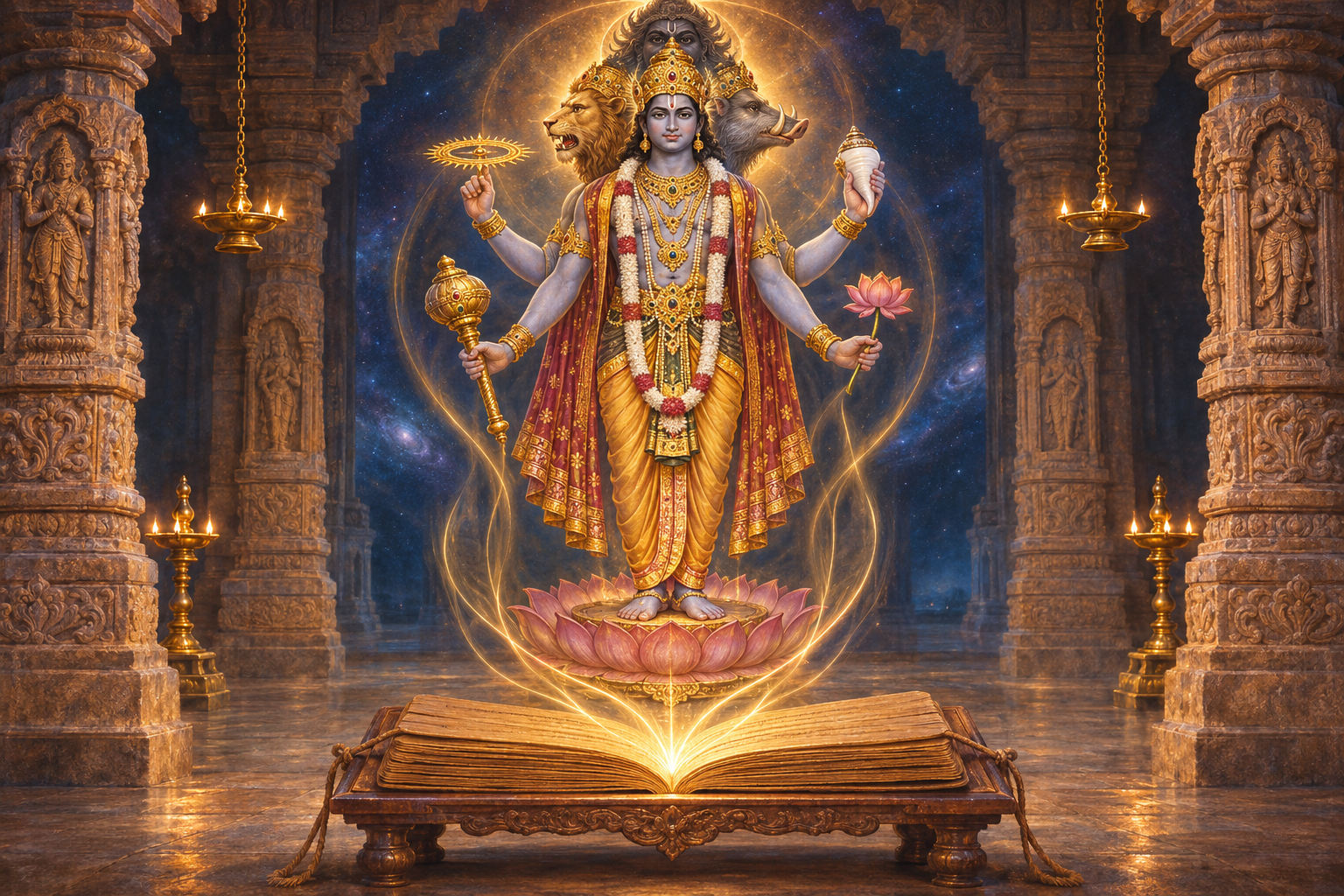
You open a Purana to understand Vishnu, then encounter a four-headed murti whose human, lion, boar, and fearsome aspects seem to belong to different stories. The immediate temptation is to collect labels. That gives you names, but not necessarily understanding.
A better method is to read sacred narrative and sacred form together. Scripture unfolds Vishnu’s nature through action, manifestation, and devotion; iconography gathers several meanings into one form. Once you see that relationship, the Vishnu Purana and Vaikuntha Chaturmurti stop looking like separate subjects.
Begin with the tradition’s theological centre
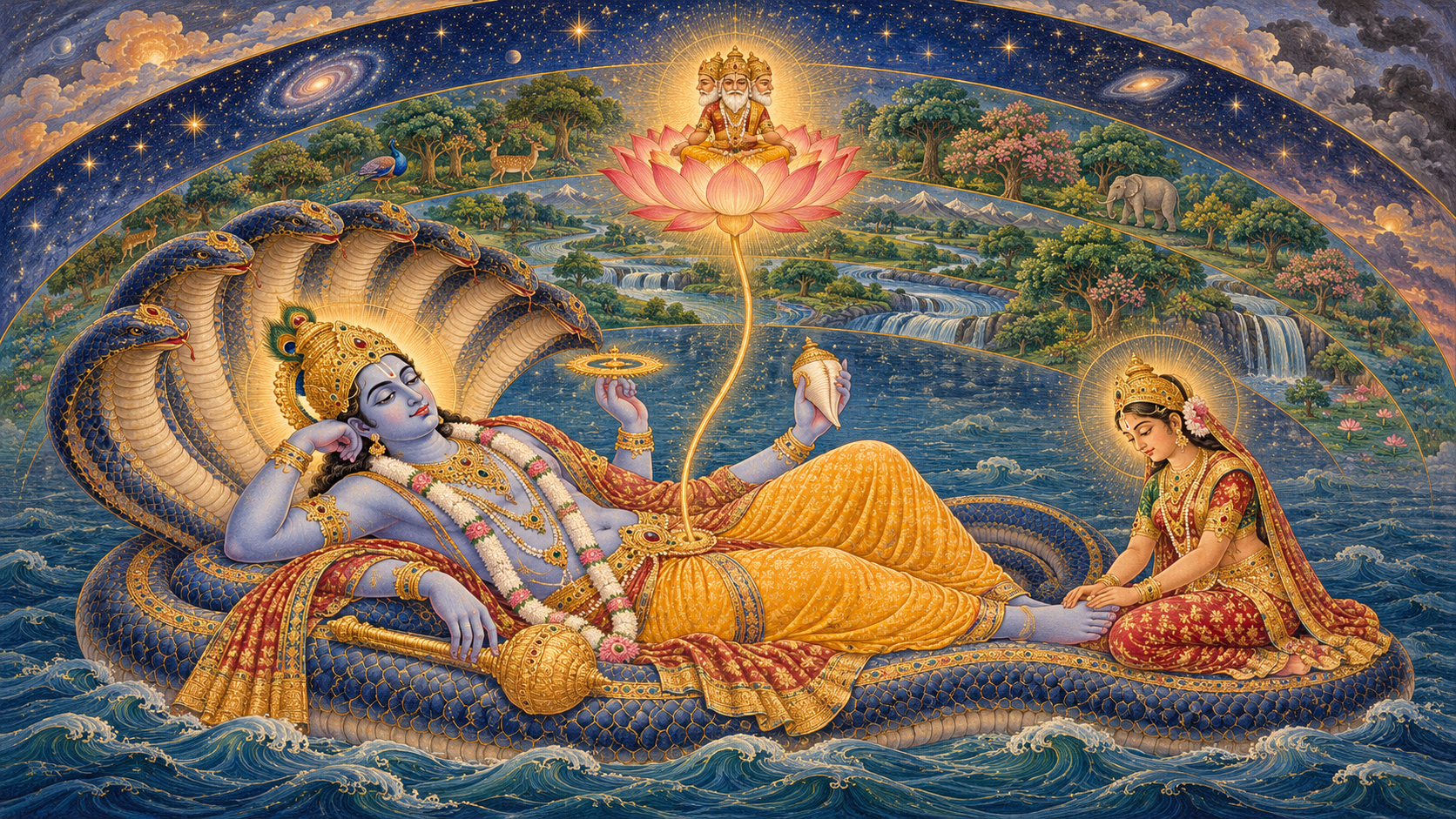
Within a Vishnu-centred tradition, Vishnu is not merely one character among many. He is the theological centre through whom divine sovereignty, protection, manifestation, and the devotee’s relationship with the Divine are understood. You need to grant that starting point before interpreting either a Vishnu scripture or a Vishnu murti.
Other Hindu sampradayas may express divine supremacy differently. Respectful reading does not erase those differences, but it also does not turn them into a contest. When you enter a Vaishnava text or temple, first allow its Vishnu-centred vision to speak in its own terms. Comparison can come later.
Three distinctions will keep your reading clear:
- Supremacy is not the same as contempt. A tradition can affirm Vishnu as supreme without giving you permission to dismiss every other deva, community, or sampradaya.
- An avatar and an iconographic form are not automatically the same thing. An avatar is encountered through a narrative manifestation of Vishnu. A composite murti can bring several manifestations or powers into one visual form. The categories may overlap, but they are not synonyms.
- A murti is not merely an illustration. A picture can help explain a story. A sacred form belongs to darshana and worship, where seeing and being seen carry devotional significance.
These distinctions prevent two common errors. One is to flatten Vishnu into a generic symbol that could mean anything. The other is to treat a sectarian affirmation of Vishnu as an excuse for hostility. Neither approach helps you understand the tradition on its own terms.
Read the Vishnu Purana through relationships, not isolated facts
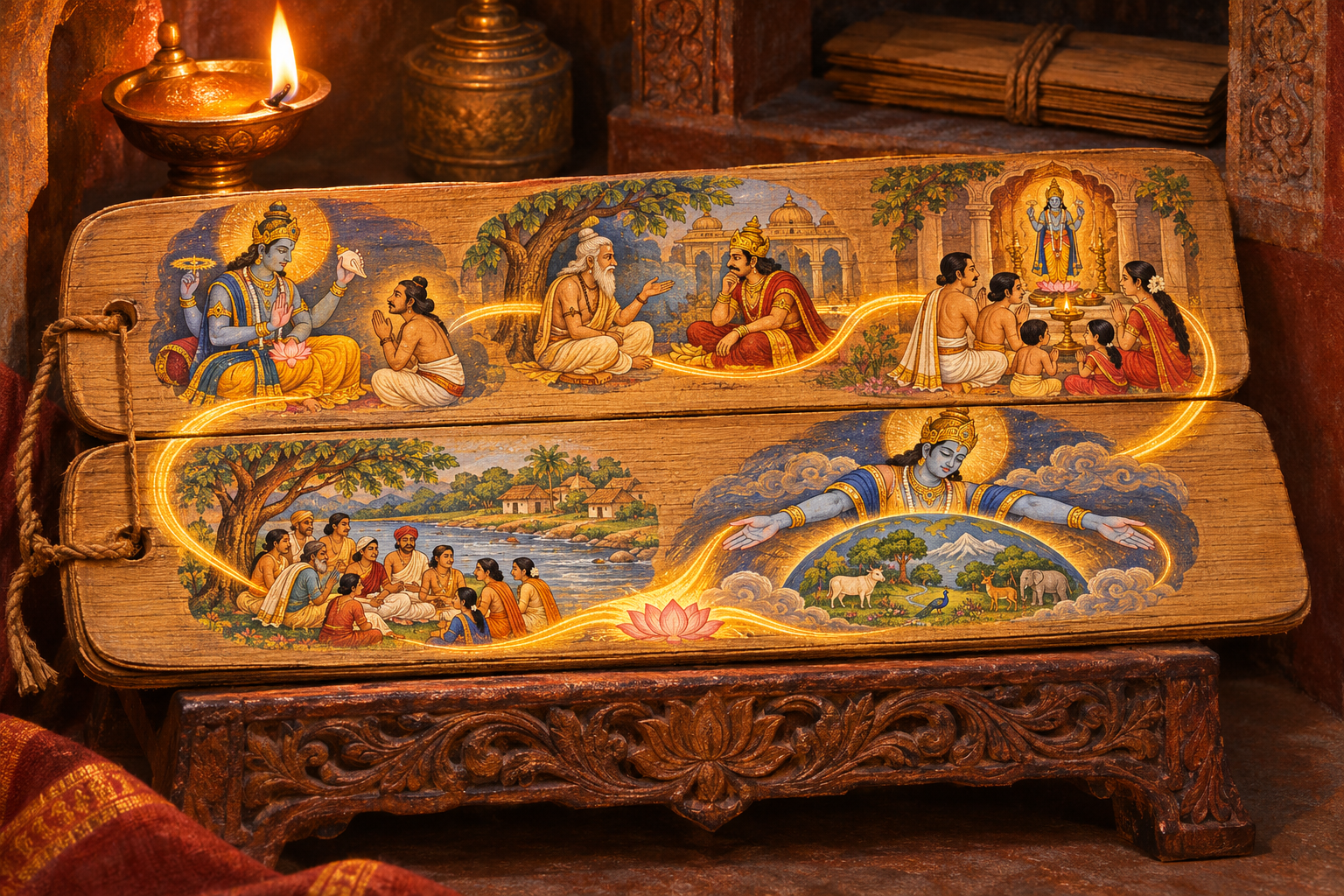
The Vishnu Purana is counted among the eighteen Mahapuranas and turns to Vishnu, his avatars, and devotees such as Narada, Prahalada, Thumburu, and Dhruva. That range tells you how to approach it: do not look only for a catalogue of divine forms. Watch how Vishnu, manifestation, and devotion are related.
A name list can tell you who appears. A relational reading tells you why the appearance matters. When a devotee enters the narrative, ask what kind of orientation toward Vishnu the person embodies. When an avatar appears, ask what disorder or need makes that manifestation intelligible. When Vishnu is presented as supreme, ask how the narrative makes that claim visible rather than merely repeating the title.
Use this sequence for a Puranic episode
- Locate the relationship. Identify whether the passage centres on Vishnu, an avatar, a devotee, or a relationship among them.
- Name the immediate pressure. Notice the conflict, question, danger, duty, or spiritual difficulty that moves the episode forward.
- Watch the response. Pay attention to what Vishnu does, what the devotee does, and which response the narrative treats as spiritually significant.
- Separate plot from claim. Retell what happened in one sentence. Then state what the episode asks you to understand about Vishnu in a second sentence.
- Notice what remains unresolved. If a name, action, or symbolic element is unclear, mark it for further study instead of filling the gap with a confident guess.
- Carry one point into practice. Choose a response the passage actually supports. Do not attach a generic moral that could have come from any story.
You can test your reading with two sentence stems: This episode presents Vishnu as… and The devotee is asked to respond by… If the second sentence has no connection to the events in the passage, you have probably imposed a lesson instead of discovering one.
Do not force a Purana into only one modern category. Reading it solely as a chronological report can obscure its theological work. Treating it as disposable fiction is equally reductive. Puranic narrative teaches through events, characters, sacred memory, and relationships. A competent reading asks how those layers work together.
Read Vaikuntha Chaturmurti from the whole form outward
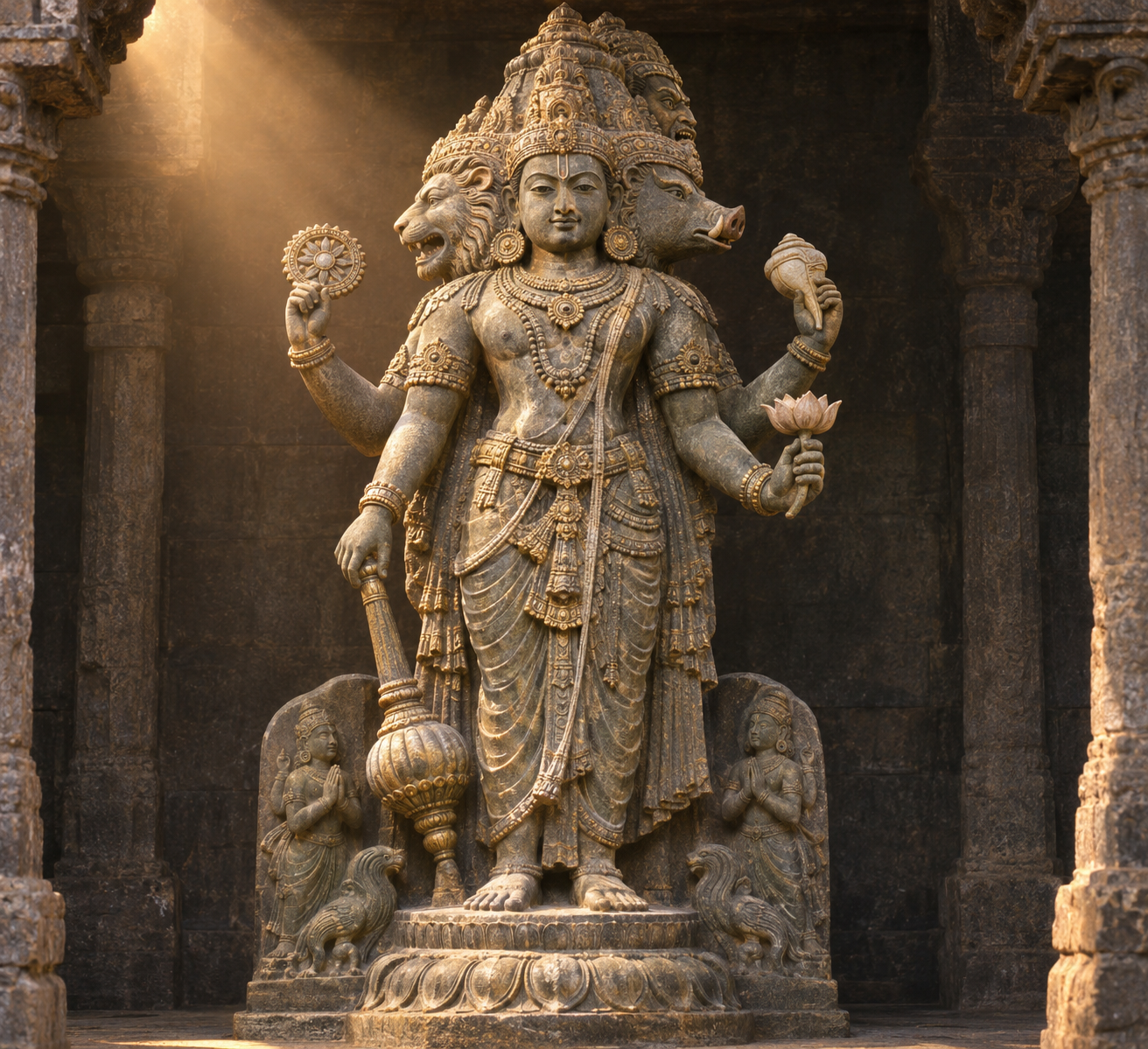
Vaikuntha Chaturmurti is a four-headed form of Vishnu associated with worship in Kashmir, combining human, lion, boar, and demonic heads and regarded there as a supreme manifestation. The essential fact is not simply that four heads appear. It is that one Vishnu form contains them.
That changes the first question you should ask. Do not begin with, Which four separate beings am I looking at? Begin with, What does this form communicate by holding these different aspects in one divine identity? The composition directs you toward unity that contains differentiated powers.
The human head gives the eye a recognisable centre. The lion and boar heads direct attention toward familiar avataric modes of Vishnu. The fourth, fearsome head prevents the entire form from being reduced to a merely gentle or decorative image. These observations provide a starting point, not a complete decoding key.
When an English caption calls the fourth head “demonic,” do not leap to the conclusion that the murti represents the worship of evil. A translated label can flatten an indigenous visual grammar into a foreign good-versus-evil binary. Treat the term as a prompt to seek the form’s traditional explanation, ritual context, and local name.
Use an observation, connection, and verification test
- Observe before interpreting. Record what is actually visible: the number of heads you can see, their placement, and whether the form is intact. Do not supply a missing feature from memory.
- Connect only what is secure. Human, lion, boar, and fearsome aspects belong to one Vishnu form. That is firmer ground than assigning an elaborate meaning to every facial detail.
- Use provenance as evidence, not proof. A connection with Kashmir makes identification as Vaikuntha Chaturmurti more plausible, but one regional clue cannot authenticate an object by itself.
- Verify the traditional identity. In a temple, ask how the community names the murti. In a museum or book, check the catalogue description, provenance, and any inscription rather than relying on visual resemblance alone.
Avoid four common identification errors
- Do not call every multi-headed Vishnu image Vaikuntha Chaturmurti.
- Do not assume a front-facing photograph reveals every head of a three-dimensional murti.
- Do not label a composite sacred form as an avatar unless the tradition presenting it does so.
- Do not detach the form from worship and treat it as nothing more than an iconographic puzzle.
The disciplined phrase is sometimes appears consistent with, not must be. That is not timid writing. It is the proper boundary between observation and attribution.
Key takeaways for reading Vishnu scripture and imagery
- Let a Vishnu-centred tradition state its own theological claim before comparing it with another sampradaya.
- Read a Puranic story at two levels: what happens and what it reveals about Vishnu, manifestation, or devotion.
- Do not use avatar, murti, and symbol as interchangeable words.
- Read a composite image from the unified form outward, not as a collection of unrelated heads.
- Treat Kashmir as an important context for Vaikuntha Chaturmurti, while still verifying the identity of any particular image.
- Stop where the evidence stops. A careful unanswered question is better than an invented symbolic meaning.
Bring the text and the murti into one practice
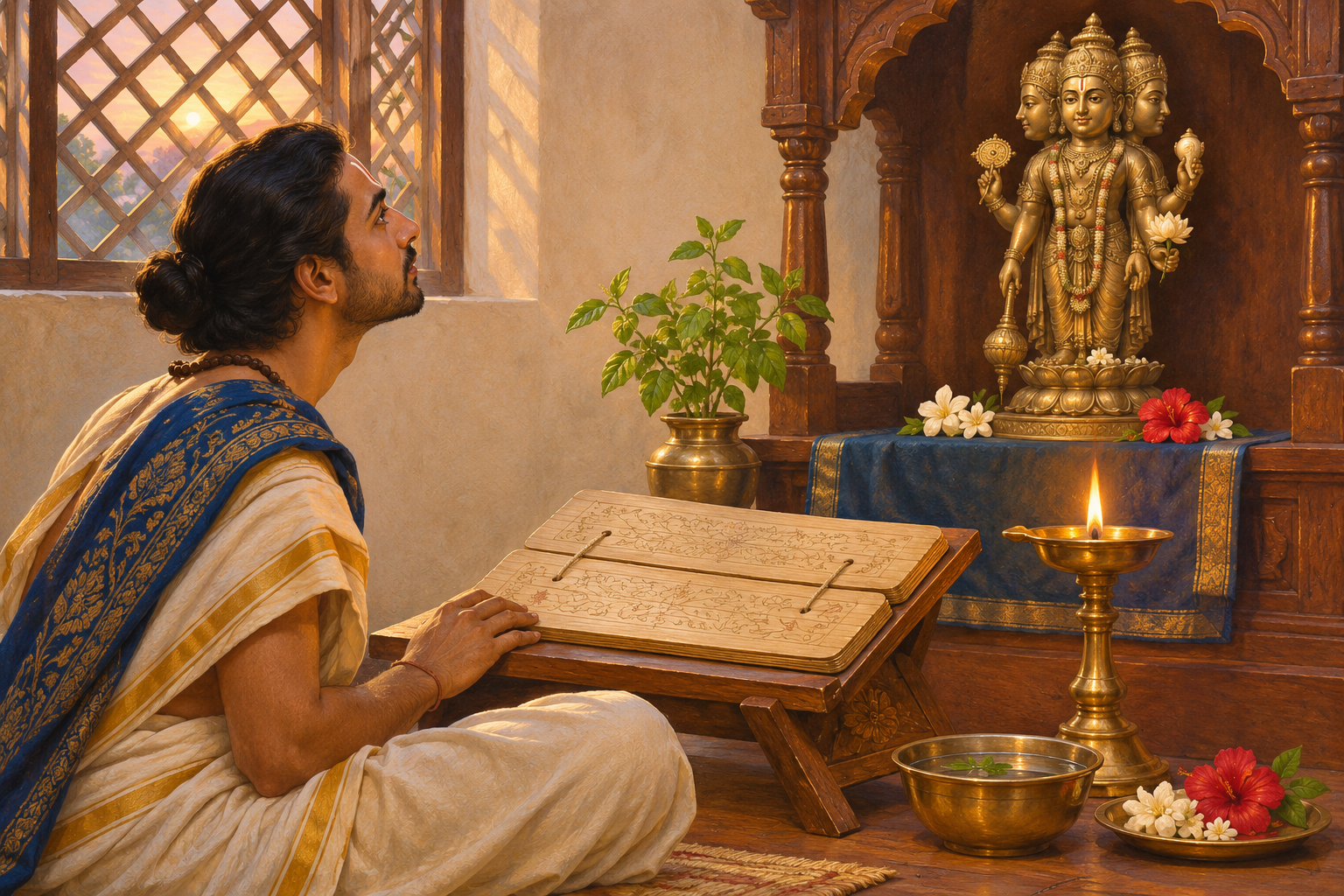
The next time you study Vishnu, choose one episode involving Vishnu, an avatar, or a devotee. Read it first for the sequence of events and again for the relationship it establishes. Then look at a Vishnu murti without immediately searching for a label. Notice the whole form, its centre, its contrasting features, and the response it invites from you.
Write one sentence connecting them: In this story Vishnu is known through ______; in this form that reality is made visible through ______. If the connection depends on a detail you cannot verify, leave the space open. Do not force each head, gesture, or feature to match a separate episode.
If you encounter the murti in a temple, let the living tradition lead. Ask its name, observe how devotees approach it, and follow the temple’s rules. Iconography can help you recognise a form, but darshana is not an identification exercise conducted over the heads of worshippers.
You do not need to decode everything at once. Begin with the right identity, respect the tradition’s theological centre, and let narrative and sacred form illuminate each other. That is the step from merely looking at Vishnu to learning how the Vishnu tradition teaches you to see.
References
- Hindu Pad – Stories from Vishnu Purana
- Hindu Pad – Vaikuntha Chaturmurti | Powerful Aspect of Lord Vishnu

Leave a Reply
You must be logged in to post a comment.