
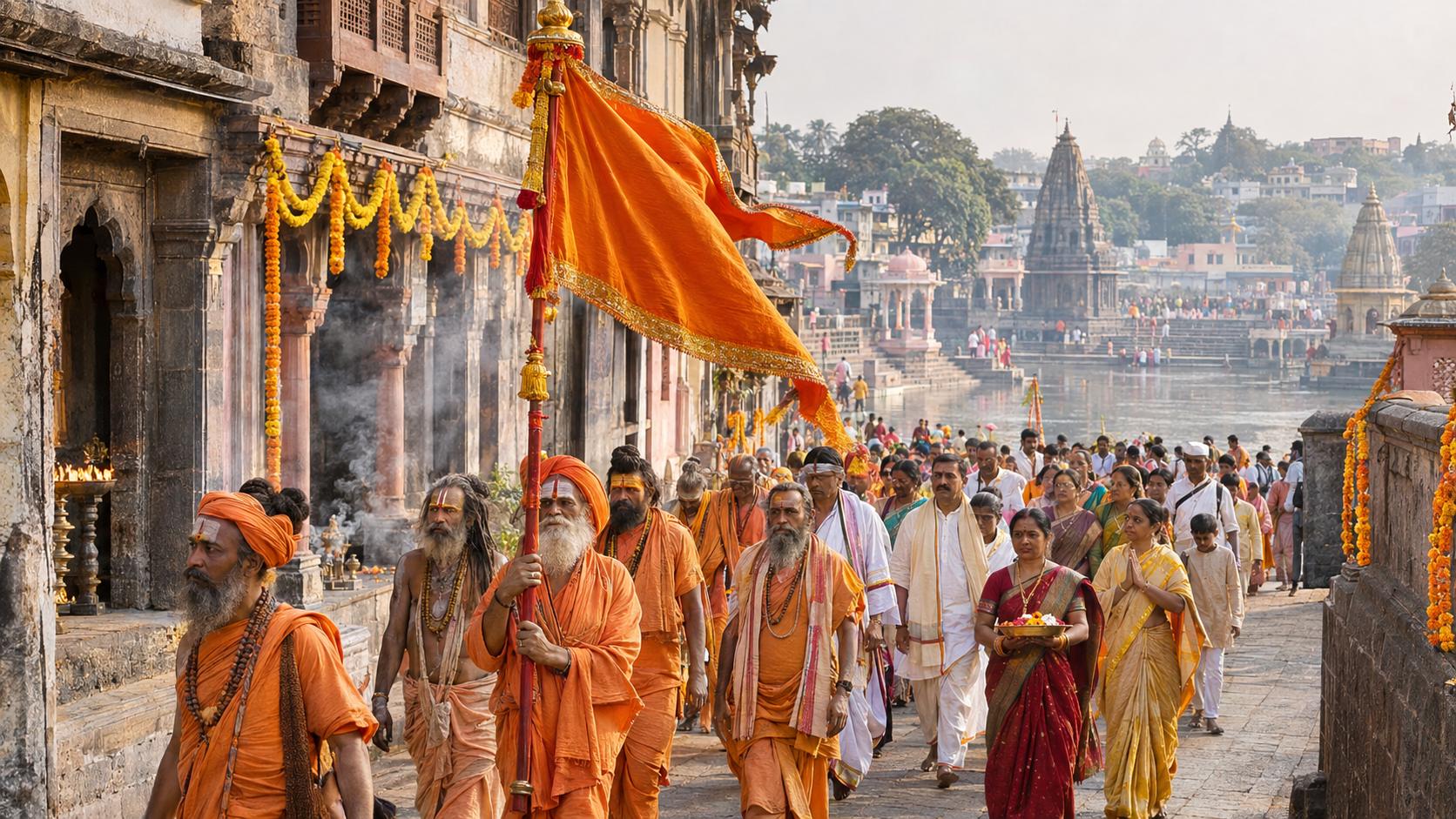
If you saw the Nashik procession and wondered whether it was a Kumbh bathing rite, a civic march, or a religious ceremony, its full name gives you the answer. The Dharmadhwaja Nagar Parikrama was a sacred circuit through Nashik held ahead of the Nashik-Trimbakeshwar Kumbh Mela.
To understand it properly, keep three elements together: the dharmadhwaja, the movement through the city, and the disciplined participation of saints and devotees. Separate any one of these from the others and the procession can look like a spectacle rather than an act of public dharma.
The name tells you what kind of event this was
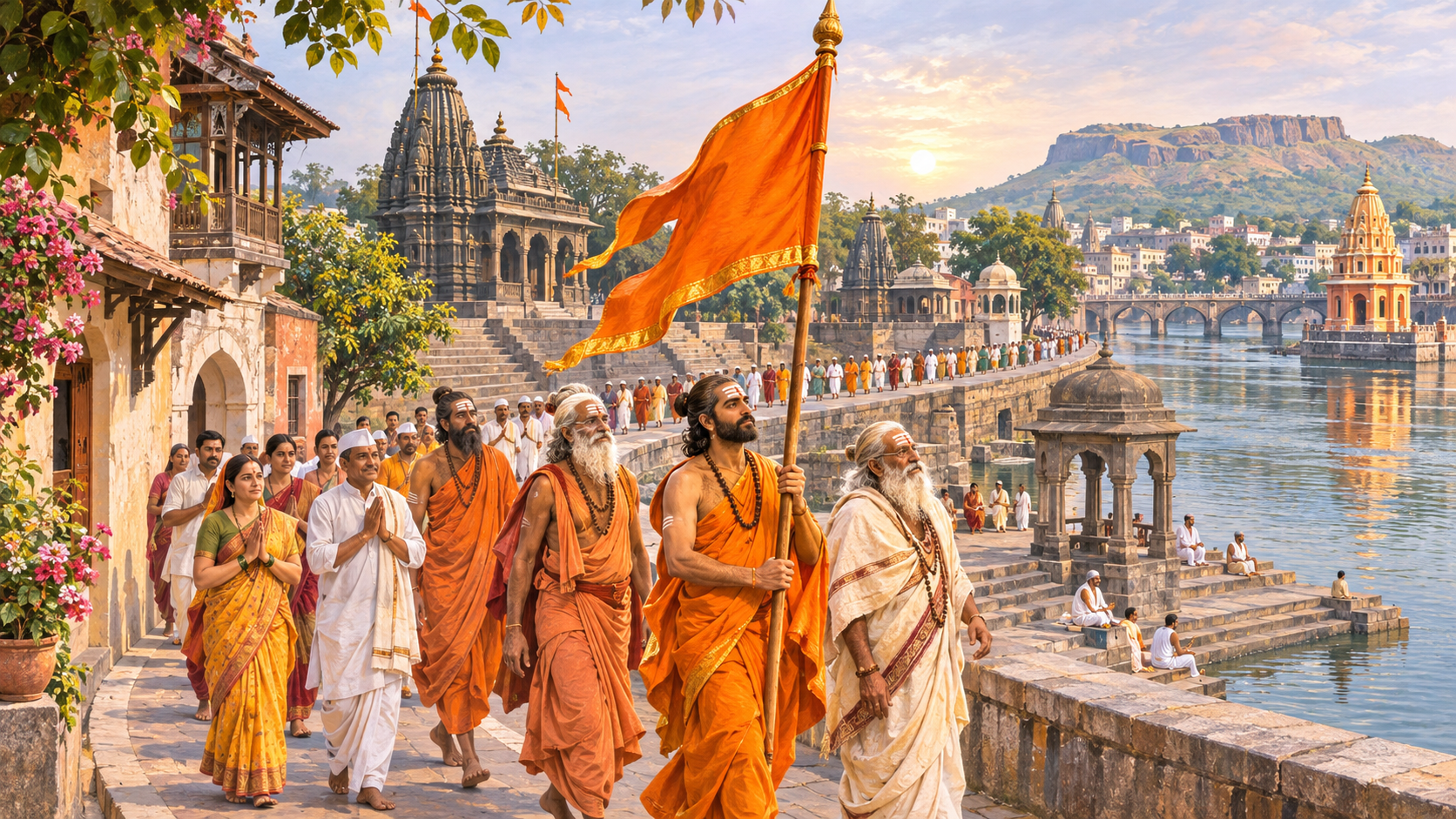
Dharmadhwaja means the banner or standard of dharma. In a procession, it is not merely decoration. It gives the gathering a visible religious centre. Participants do not simply move in the same direction; they move in relation to a sacred symbol and the duties it represents.
Nagar means the city, while parikrama and pradakshina describe ritual movement around or through sacred space. A Nagar Parikrama therefore treats the urban landscape as more than the road between temples. Streets, neighbourhoods, residents, volunteers and places of welcome all become part of the religious circuit.
The scale was substantial: more than 40,000 devotees and prominent saints participated. Hindu Janajagruti Samiti also welcomed the procession in Nashik. The gathering was held ahead of the Nashik-Trimbakeshwar Kumbh Mela, so it should be understood as a preparatory and public expression of dharma rather than as the whole Kumbh or as a substitute for its other observances.
That distinction matters if you are planning a visit. A procession announcement does not automatically give you a bathing schedule, and a Kumbh announcement does not automatically tell you when a Nagar Parikrama will pass. Confirm the exact event name before making travel or darshan plans.
Why carrying the sacred banner through a city matters
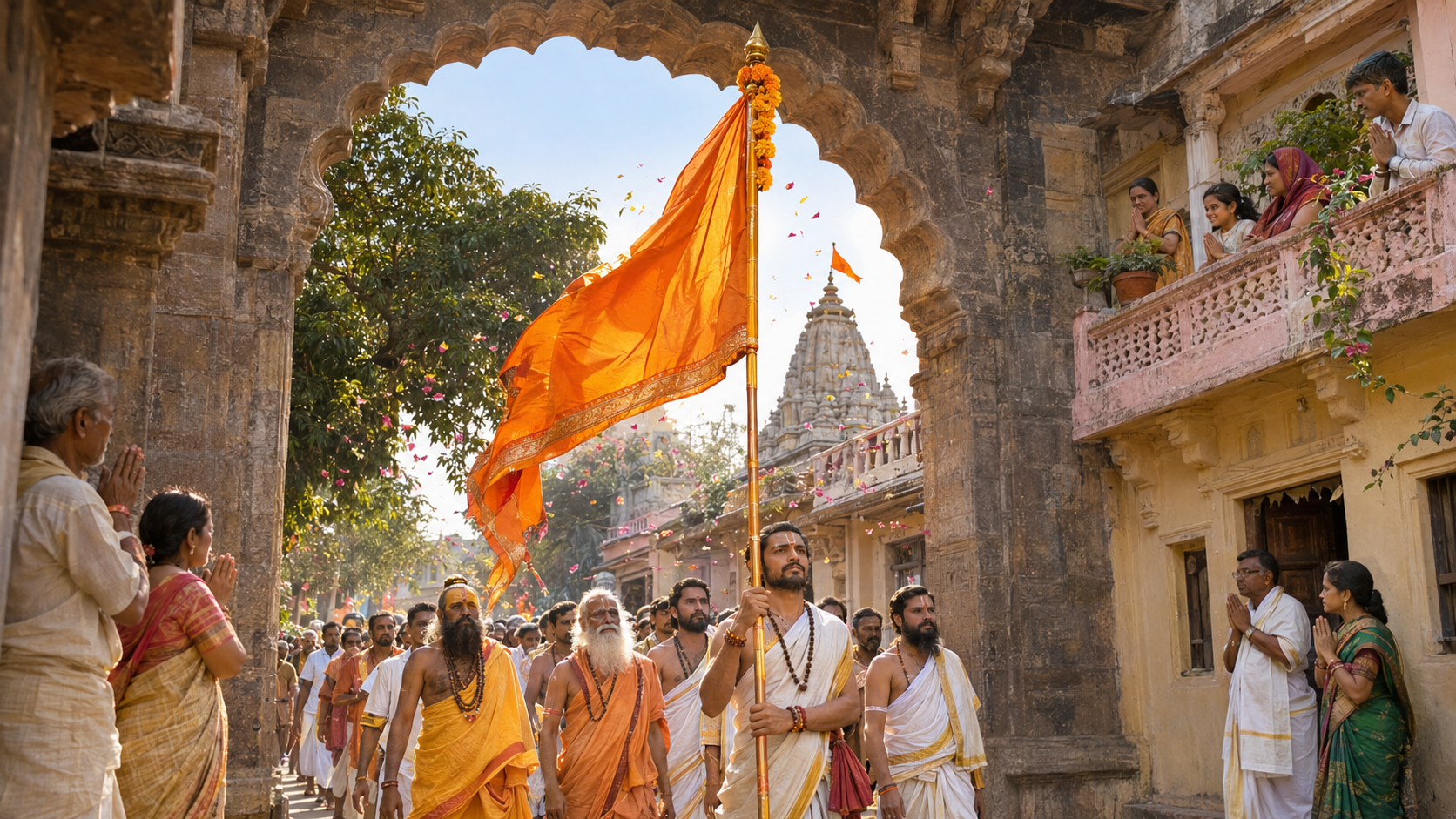
A temple invites you to enter a consecrated place. A Nagar Parikrama reverses that movement: sacred symbols, saints and devotees pass through the shared spaces of ordinary life. The city is asked to receive them. People who cannot enter the moving procession may still participate by maintaining a respectful passage, joining familiar chants, assisting at an organised seva point or simply offering namaskar without obstructing the route.
This public visibility carries a responsibility. The dharmadhwaja should not be reduced to a background for photographs or an identity marker emptied of conduct. It calls attention to dharma as restraint, reverence, service and responsibility. The best welcome is therefore not the loudest one. It is the one that protects the dignity of the procession and makes participation easier for others.
You can notice whether that sacred centre is being preserved. Is the route left open? Are elders and saints given room? Are volunteers reducing confusion? Are offerings handled without creating litter or congestion? These details reveal more about the quality of collective devotion than the size of a banner or the volume of a loudspeaker.
How to join without turning devotion into congestion
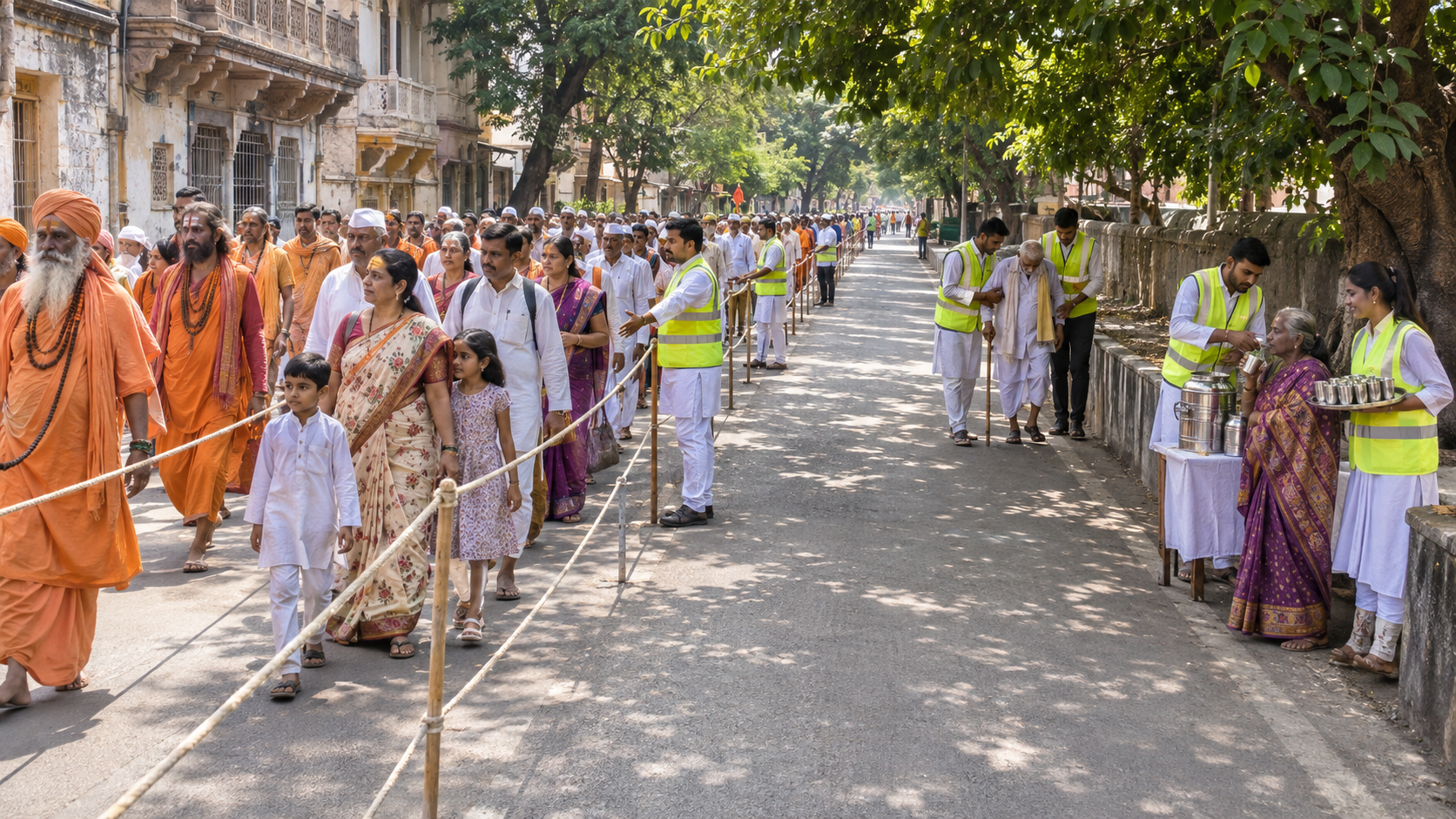
A gathering reported at more than 40,000 participants requires practical preparation. Past images and attendance figures cannot provide a usable route, start time or access plan for a future procession. Use a current notice from the relevant organisers or local authorities, and then decide whether you will walk, receive the procession from one place or serve through an assigned group.
- Verify the full name of the event. Look specifically for Dharmadhwaja Nagar Parikrama or Nagar Pradakshina rather than assuming that every Kumbh-related notice refers to the same observance.
- Choose your role before you arrive. If you are joining the procession, follow its designated formation and pace. If you are receiving it, remain at the side of the route. If you want to volunteer, obtain a defined seva assignment instead of improvising inside the moving crowd.
- Prepare for separation. Carry essential identification and medicines, agree on a fixed meeting point, and keep children or relatives who need assistance with a designated companion. A verbal plan is more dependable than assuming everyone will remain together.
- Protect the path of the dharmadhwaja, saints and organised groups. Do not cross in front of them for a photograph or stop in the route to greet someone. A few seconds of obstruction can force many people behind you to compress or change direction.
- Use the camera with restraint. Take wide photographs from the edge when permitted, avoid intrusive close-ups of people praying, and do not ask saints or devotees to interrupt worship for staged content.
- Make offerings through organised seva points. Unplanned distribution from a narrow roadside position can block movement and create discarded cups, packaging or flowers. If no arrangement exists, a respectful namaskar is already a complete act of welcome.
- Choose a stationary vantage point if dense movement is unsafe for you. Anyone with limited mobility, a health concern or responsibility for a vulnerable family member should not use a moving crowd to test personal stamina.
None of these practices diminishes enthusiasm. They give enthusiasm a form that other devotees can safely share.
What the turnout does and does not tell you
The reported participation makes clear that this was a large religious gathering. It demonstrates the continuing ability of saints, devotees and Hindu organisations to bring people into a shared act of public worship. That deserves to be described accurately.
The number should not be made to prove more than it can. A turnout figure is not an opinion poll, does not reveal every participant’s motive and does not convert a sacred procession into a political mandate. Nor should the presence of a large crowd tempt you to describe the event as merely a rally. Its identity came from the dharmadhwaja, the parikrama and its place ahead of the Kumbh Mela.
If you share the event online, preserve three facts: use the full name Dharmadhwaja Nagar Parikrama, say that it took place ahead of the Nashik-Trimbakeshwar Kumbh Mela, and describe the participants as devotees and prominent saints. Do not turn a total involving devotees and saints into a claim that tens of thousands of saints attended. Accurate language protects the dignity of the occasion better than an inflated caption.
Key takeaways
- The Nashik event was a Dharmadhwaja Nagar Parikrama, a sacred city procession held ahead of the Nashik-Trimbakeshwar Kumbh Mela.
- More than 40,000 devotees and prominent saints were reported to have participated.
- The dharmadhwaja, the ritual movement through the city and disciplined collective conduct are essential to understanding the procession.
- A past turnout figure is not a future timetable. Confirm the current route, time, access conditions and organiser instructions before attending another procession.
- Devotional participation means protecting the route, respecting worship, using photography carefully and placing seva within an organised arrangement.
When the next sacred procession is announced, begin with the exact event notice and choose one clear form of participation: walk with discipline, receive the procession respectfully or accept an organised seva duty. Let your conduct explain the meaning of the dharmadhwaja before any caption has to.
References

Leave a Reply
You must be logged in to post a comment.