

If you want Margashirsha to become more than another name on the Hindu calendar, your planning task is manageable: set aside time for two observances that fall close together in December. Decide in advance what will happen at home, what requires a temple visit, and which preparations your family can realistically sustain.
The occasions have distinct purposes. Vishnu Saptami centres worship and the relationship between Vishnu and Shiva. Gita Jayanti centres the Bhagavad Gita and the movement from hearing dharma to applying it. Keeping those purposes clear will give the month a coherent rhythm without collapsing everything into a generic puja.
Key dates and takeaways for Margashirsha 2026
- Vishnu Saptami falls on December 16, 2026. It is observed on Saptami, the seventh tithi of the bright half of Margashirsha.
- Gita Jayanti falls on December 20, 2026. It coincides with Mokshada Ekadashi, the Ekadashi of Margashirsha Shukla Paksha.
- Use these civil dates as planning anchors. Confirm the locally applicable tithi and worship time through a panchang prepared for your location or through the temple you attend.
- Preserve the character of each occasion: worship and reverence on Vishnu Saptami, then scriptural attention and practical reflection on Gita Jayanti.
Observe Vishnu Saptami with reverence, not sectarian rivalry
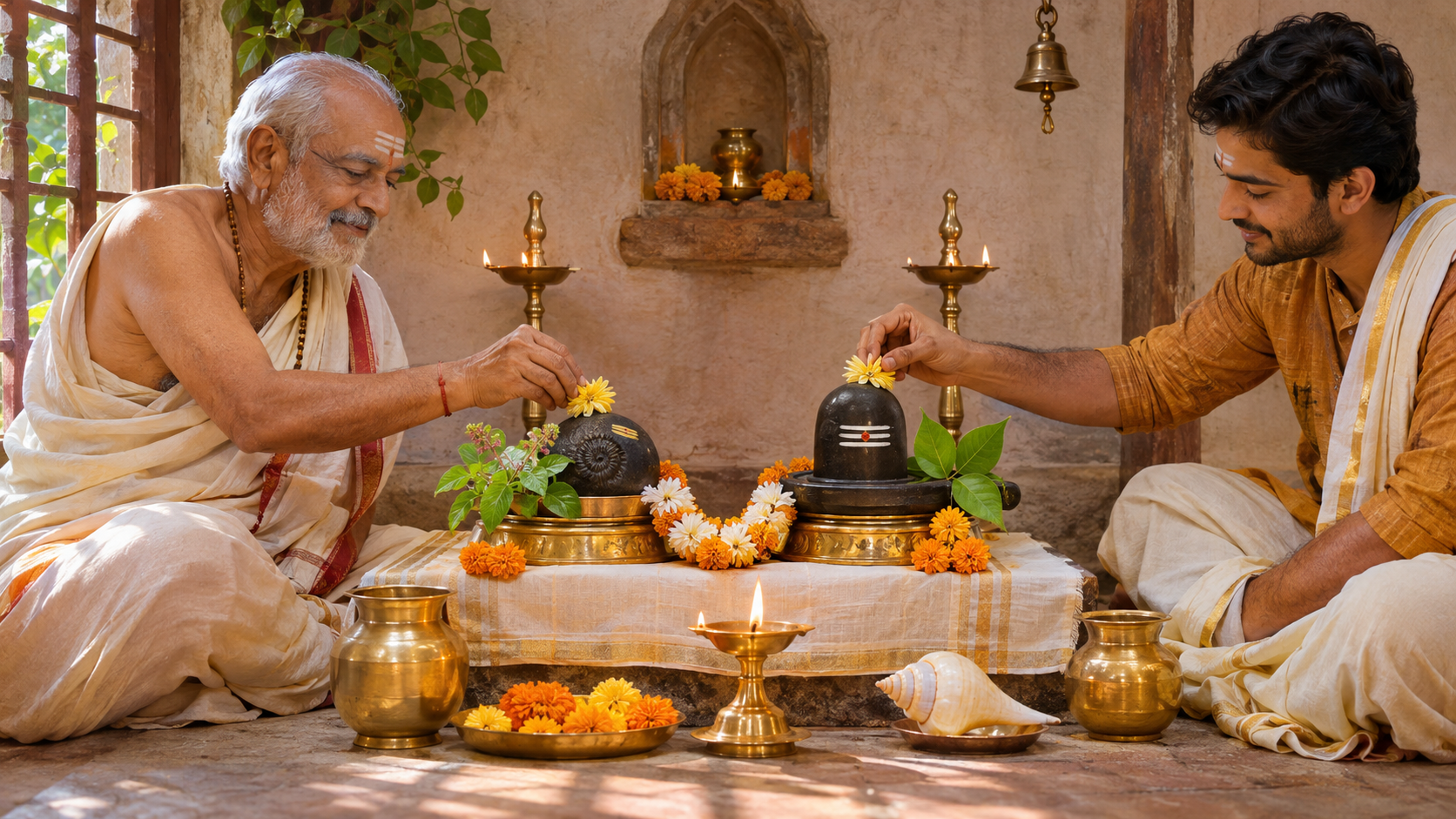
Vishnu Saptami belongs to the bright half of Margashirsha. Worship of Lord Vishnu and Lord Shiva is associated with the day, together with a theological emphasis on their non-difference. For a Hindu household, that emphasis has an immediate practical meaning: devotion to your chosen form of the Divine need not become contempt for another form honoured within Sanatana Dharma.
This does not require you to flatten every sampradaya into the same theology. Vaishnava, Shaiva and other traditions retain their own language, disciplines and understandings. The useful lesson is more exact: follow your lineage faithfully while refusing the idea that reverence must be proved through hostility. Vishnu Saptami offers an appropriate day to examine whether your speech about another Hindu tradition reflects that standard.
Shodashopachara Puja is associated with the observance. If this formal mode of worship is already part of your household or temple practice, prepare its materials and procedure beforehand. If it is unfamiliar, do not imitate a complicated sequence from a generic checklist and treat accuracy as an afterthought. Ask a knowledgeable priest, teacher or experienced family member, or choose a simpler act of worship that you can perform with attention and respect.
Make the practical decision before December 16:
- If you will attend a temple, check its announced schedule and whether registration, offerings or other preparations are expected.
- If you will worship at home, decide whether you are following an established family procedure or a simple devotional observance.
- If children or younger relatives will participate, explain why Vishnu and Shiva are both being honoured rather than giving them ritual actions without meaning.
- End the observance with a concrete question: does loyalty to your ishta-devata deepen your respect for other Dharmic paths, or merely reinforce a label?
Make Gita Jayanti a meeting with the text
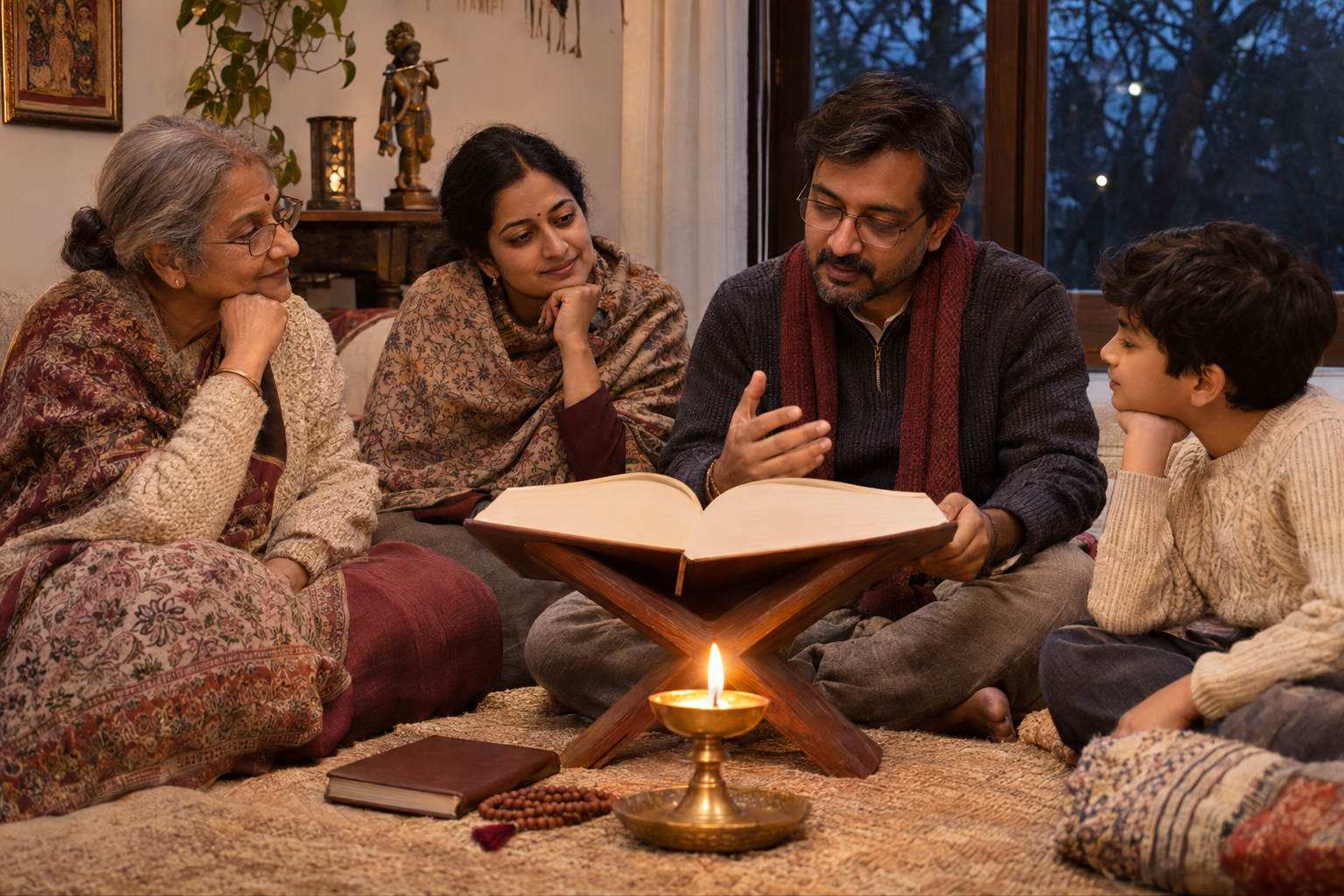
Gita Jayanti commemorates the origination of the Bhagavad Gita. In 2026 it falls on December 20, the same date as Mokshada Ekadashi. Its placement in Margashirsha makes it a natural point at which worship becomes study and study becomes discernment.
The most common planning error is to make the commemoration larger than the reading. A long program can be meaningful, but decoration, forwarding quotations and ceremonial activity should not displace direct engagement with the Gita. If your available time is limited, read a manageable passage carefully rather than racing through more than you can absorb.
A useful home observance can follow this sequence:
- Choose a passage connected to a real question in your life, such as duty, disciplined action, attachment or steadiness.
- Use the Sanskrit text, transliteration or a trusted translation appropriate to your level. If your sampradaya follows a particular commentary, keep that interpretive context visible.
- Read slowly enough to distinguish what the passage actually teaches from a slogan you may already associate with it.
- Write down the duty or confusion the passage helps you see more clearly.
- Choose a practical response that can begin in your ordinary responsibilities rather than remaining a devotional intention with no consequence.
If you are gathering as a family or study group, ask each participant to bring a question rather than a prepared speech. Discussion becomes more useful when it begins with the text and a lived dilemma. Where interpretations differ, identify the commentary or tradition being followed instead of presenting every reading as universally accepted.
Do not infer a complete Ekadashi discipline from the festival name alone. Practices vary across lineages and households. If Mokshada Ekadashi observances are part of your tradition, confirm their details with the authority you normally follow rather than assembling rules from unrelated calendars.
Build one Margashirsha practice across both dates

Because the observances are only a few civil days apart, prepare for them as a connected movement: reverence, study and action. That connection saves effort while preserving the meaning of each date.
- Before December 16: confirm your local calendar, decide between temple and home worship, and gather only the materials required by the practice you will actually follow.
- On Vishnu Saptami: worship with attention and reflect on how reverence for Vishnu and Shiva challenges unnecessary sectarian antagonism.
- Between the observances: select the Gita passage or trusted edition you will use. If others are joining, share the reading plan early enough for them to prepare.
- On Gita Jayanti: read, discuss and identify a dharmic responsibility that deserves clearer action.
- After the observance: keep the chosen responsibility visible in your routine. The point is not to preserve the mood of a holy day but to allow its teaching to shape conduct.
This approach also prevents the two occasions from becoming interchangeable. Vishnu Saptami establishes a devotional disposition. Gita Jayanti then tests whether that disposition can listen, discern and act. The first prepares the ground for the second.
Confirm local timing before making firm arrangements
A civil-calendar date answers the first planning question, but it does not always settle the locally applicable worship period. Saptami and Ekadashi are lunar tithis, and their relationship to a civil day can differ with location and calendrical convention. This matters especially if you live outside Bharat or will travel during the observance.
Before arranging leave, inviting a group or committing to a temple visit, check:
- a panchang calculated for your city rather than a calendar with no stated location;
- the schedule published by the temple where you intend to participate;
- the procedure followed by your family or sampradaya;
- the text, translation or commentary you will use for Gita Jayanti; and
- whether your plan is small enough to carry out attentively.
If a generic online calendar and a qualified local temple calendar differ, ask what tithi rule and location each is using. The difference may concern calendrical application rather than a dispute over the significance of the observance. Use December 16 and December 20 to begin planning, then let the locally applicable panchang determine the final timing.
Put both dates on your calendar now. Let Vishnu Saptami prepare your home for reverent worship, and let Gita Jayanti carry that reverence into study and responsible action. A modest observance completed with understanding will serve you better than an elaborate plan assembled at the last moment.
References

Leave a Reply
You must be logged in to post a comment.