
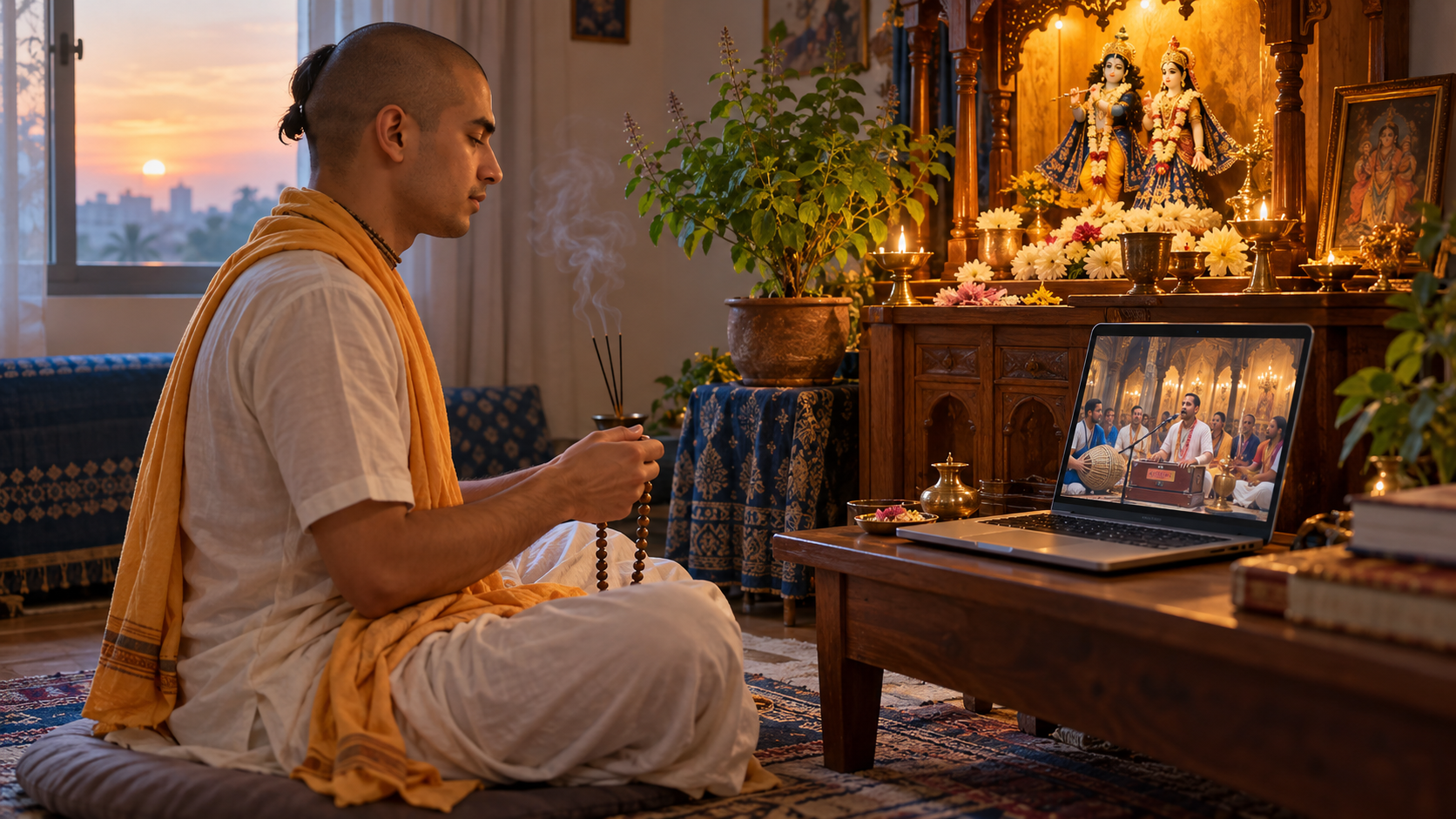
You open a devotional platform intending to hear Hari-katha, but the number of livestreams, classes, temple feeds and recordings leaves you browsing instead of practising. The real question is not whether online devotion is valid. It is whether you are using the screen with a clear spiritual purpose.
An ISKCON broadcast can support a disciplined routine when you choose the right format, arrive prepared, participate rather than spectate, and end with something you will carry into the day. The following approach will help you turn convenient access into steady sadhana.
Choose the broadcast by the practice you need
Do not begin with the recommendation queue. Begin by deciding what kind of devotional activity you need: scriptural study, congregational remembrance or connection with a temple’s worship. These formats may appear beside one another online, but they ask different things of you.
- Choose a scripture class when you want to understand a text. Hare Krishna Melbourne, for example, streams a daily Srimad Bhagavatam morning class at 7:30am. Its 1 November 2026 session identifies both the passage, Srimad Bhagavatam 10.13.9, and the speaker, His Grace Navina Nirada Prabhu. A named passage gives you something concrete to read before the class and revisit afterward.
- Choose a temple-centred livestream when you need the rhythm of a sacred place. A feed such as the ISKCON New Vrindaban Land of Krishna livestream can help a distant devotee orient the day toward temple worship. Approach it as a window into an ongoing devotional setting, not as a lecture that must deliver a sequence of arguments.
- Choose focused devotional singing when you are ready to participate. A presentation such as Damodar Ashtakam with His Grace Deena Bandhu Prabhu on 31 October 2026 is best approached as prayer. Keep the words available, follow the melody as you are able, and direct your attention toward the prayer rather than evaluating the performance.
A useful decision rule is to complete this sentence before pressing play: “At the end of this session, I intend to have practised…” If your answer is “understanding a verse,” choose a class. If it is “singing and remembering Krishna,” choose a bhajan or prayer. If it is “joining the atmosphere of temple worship,” choose a temple stream. If you cannot finish the sentence, you are probably about to browse rather than practise.
Turn the livestream time into a real appointment

A fixed broadcast time can provide structure that an on-demand library cannot. Yet the schedule helps only when you treat it as an appointment. A daily 7:30am class, for instance, removes the repeated decision about when to begin. You still have to protect that time from notifications, household drift and the temptation to sample another video.
- Select the session in advance. Save the direct link and note whether you are joining for study, chanting or temple connection. Do not wait until the intended start time to search.
- Prepare the physical setting. Put the relevant scripture, a notebook and any items normally used in your devotional practice within reach. Sit where you can remain attentive rather than where the broadcast will become background noise.
- Remove competing signals. Silence unrelated notifications, close extra tabs and use the full-screen or audio view that causes the least distraction. If a live chat is present, leave it closed unless it serves a clear part of the session.
- Give the session one task. During a class, listen for the central teaching and its connection to the named passage. During singing, follow the prayer. During a temple feed, keep your attention on the worship rather than on production quality.
- Close deliberately. When the broadcast ends, do not let autoplay decide what comes next. Restate the central teaching or prayer, note what remains unclear, and choose a practical response for the same day.
If work, caregiving or your time zone makes the live hour impractical, use the recording at a stable time of your own. Simultaneous viewing can strengthen a sense of participation, but it is not a test of devotion. A replay attended to carefully is more useful than a livestream running unheard in the background.
Practise with the broadcast instead of merely consuming it
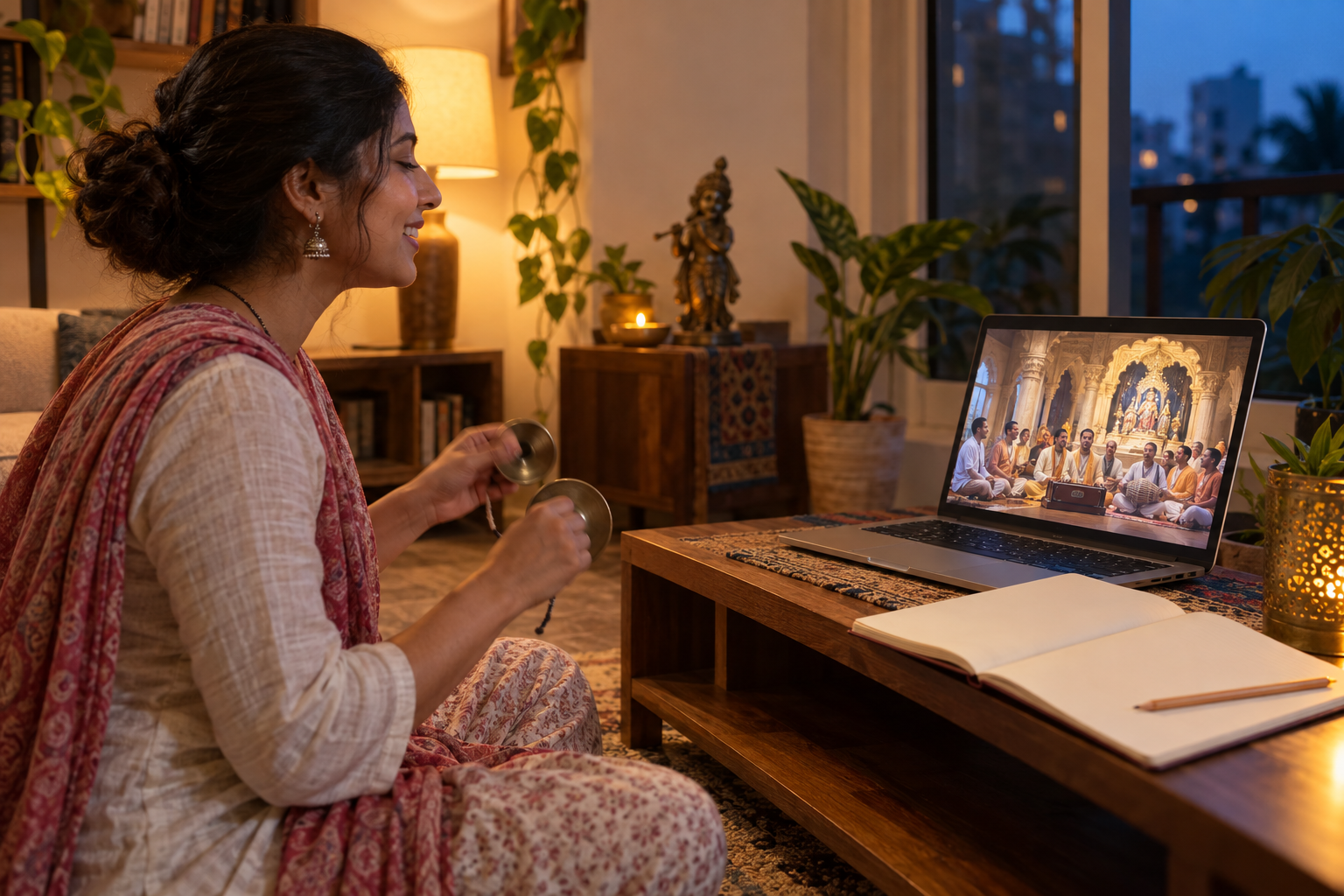
The internet trains you to assess content quickly: Is the speaker engaging? Is the camera clear? Is there a more attractive recommendation nearby? Sadhana requires a different posture. You stay with the chosen practice long enough to receive, remember and respond.
During a Bhagavatam class, keep your attention anchored to the named verse. Write down the passage before listening. Record the main explanation, a question you genuinely need to resolve, and an application that belongs in your life. Avoid chasing every unfamiliar reference in another tab while the speaker is still developing the point. Mark it and return after the class.
During a bhajan, kirtan or ashtakam, let your voice and attention join the prayer. You do not need a polished voice or an ideal room. Follow the words at a level suitable for your household, listen when you cannot sing, and return gently when the mind shifts to the performers or the recording quality. The relevant question is whether you remembered Bhagavan, not whether you completed a media review.
During a temple livestream, preserve devotional etiquette. Sit with reasonable attention, offer pranam according to your practice, and avoid carrying on unrelated conversations while claiming to attend. A temple feed can accompany necessary household duties, but decide honestly whether the moment is formal participation or simply devotional ambience. Both may have a place; confusing them makes it difficult to know whether your sadhana actually happened.
Use audio when it improves attention. The Hare Krishna Melbourne class page also points listeners toward morning-class audio files. Audio can be useful when a screen would add needless distraction. If you listen while travelling or working, do not attempt to take notes while driving or doing anything that requires full attention. Return to the passage later if the session raises a question worth keeping.
Apply a simple test for context and discernment
Easy access does not remove the need for discernment. A livestream transmits an event, but a short clip or isolated sentence may not carry the scriptural context, the speaker’s qualifications or the scope of the claim. Before repeating a teaching as an ISKCON-wide position, check what was actually said and where it was situated.
- Is the speaker or temple identified? A clear name lets you understand whose instruction you are hearing rather than treating every circulating clip as anonymous authority.
- Is the scriptural passage named? A reference such as Srimad Bhagavatam 10.13.9 allows you to read the surrounding passage and distinguish the text from commentary upon it.
- Are you hearing a complete explanation? If a surprising claim appears only in a fragment, find the full session before sharing or disputing it.
- Can you state the teaching without describing the video? If you remember the thumbnail, comments and recommendations but cannot express the central spiritual point, the platform held more of your attention than the practice did.
- Did the session change what you will do? The result may be a passage to revisit, a prayer to learn, a question for a qualified teacher or a correction in conduct. If every session ends only with another session, reduce the queue.
When a doctrinal statement remains unclear, preserve the exact passage and its context, then ask a qualified teacher rather than building a conclusion from a clipped recording. Online access is most valuable when it connects you more carefully to guru, sadhu and shastra, not when it encourages instant certainty.
Key takeaways
- Choose a scripture class for textual study, devotional singing for active prayer, and a temple stream for connection with worship.
- Decide your purpose before opening the platform so that recommendations do not determine your sadhana.
- Treat a published broadcast time as an appointment, but use a stable replay time when live attendance does not fit your duties or time zone.
- Prepare the text and setting, remove distractions, participate according to the format, and close the session without autoplay.
- Check the speaker, temple, passage and full context before repeating an online statement as authoritative teaching.
- Judge the session by what you remember and practise afterward, not by how many devotional videos you watched.
Choose one broadcast that matches the practice you need next. Put its title and time into your routine, prepare the relevant text or prayer, and decide in advance what you will do when it ends. Stay with that pattern long enough for the broadcast to become a doorway into sadhana rather than another stream of content.
References
- Dandavats — Morning Class SB 10.13.9 – HG Navina Nirada Prabhu – 1 November 2026
- Dandavats — ISKCON New Vrindaban Land of Krishna Live Stream
- Dandavats — Damodar Ashtakam || His Grace Deena Bandhu Prabhu || 31-10-2026

Leave a Reply
You must be logged in to post a comment.