
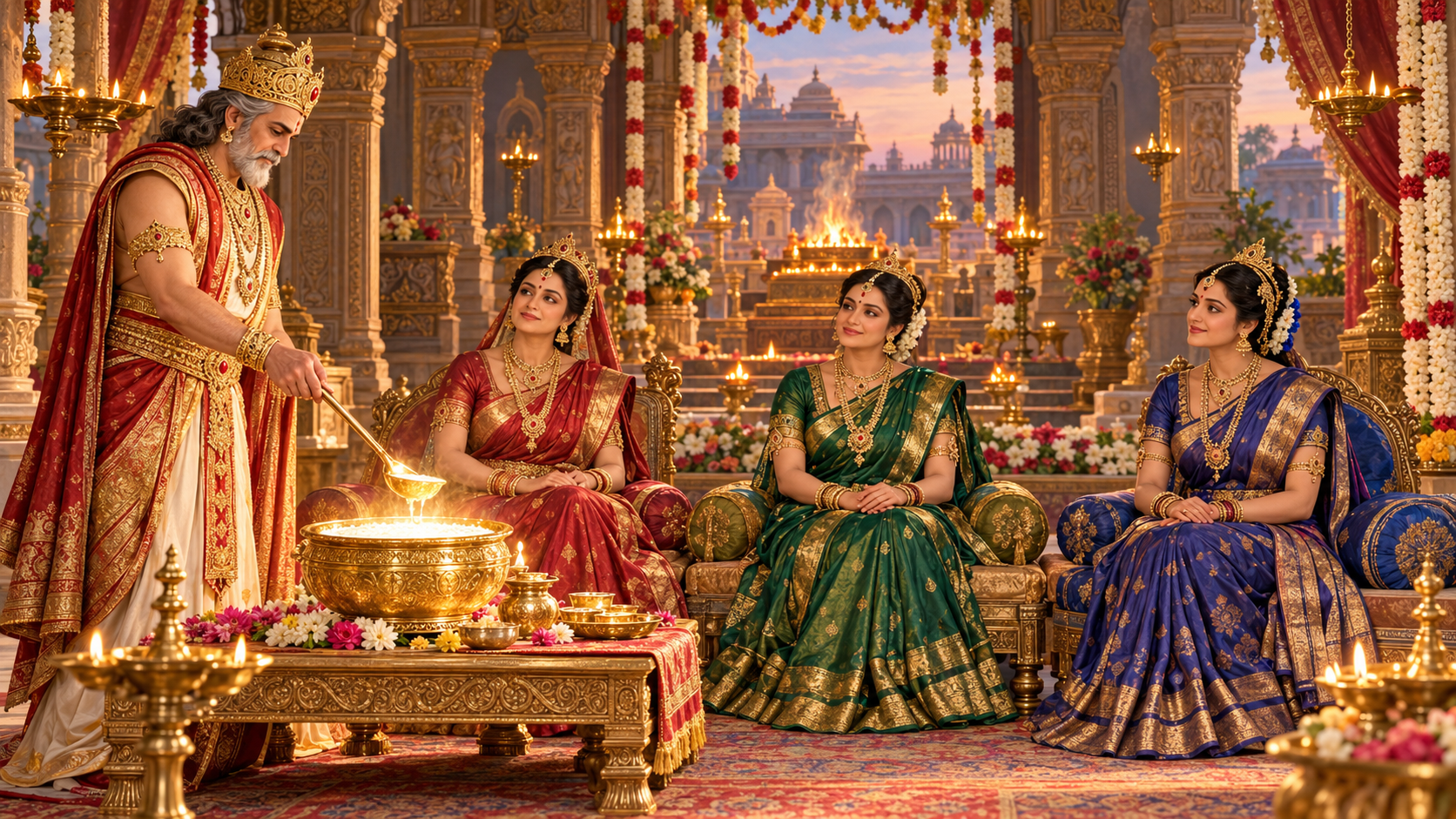
If you are trying to remember which queen received which portion of the divine payasam, the usual one-line answer can hide the most important detail: Dasharatha did not make three equal divisions. He distributed the sacred preparation in four successive allocations because Sumitra received it twice.
The clean way to understand the episode is to begin with the entire vessel, follow what remained after each allocation, and only then calculate each queen’s total. That resolves the arithmetic and prevents several common interpretive mistakes.
The four-step distribution of the payasam
Dasharatha had no son, so he performed the Putrakameshti yajna under the guidance of Rishyashringa. At its completion, a divine being arose from the sacrificial fire carrying the sacred preparation that Dasharatha was to give his queens.
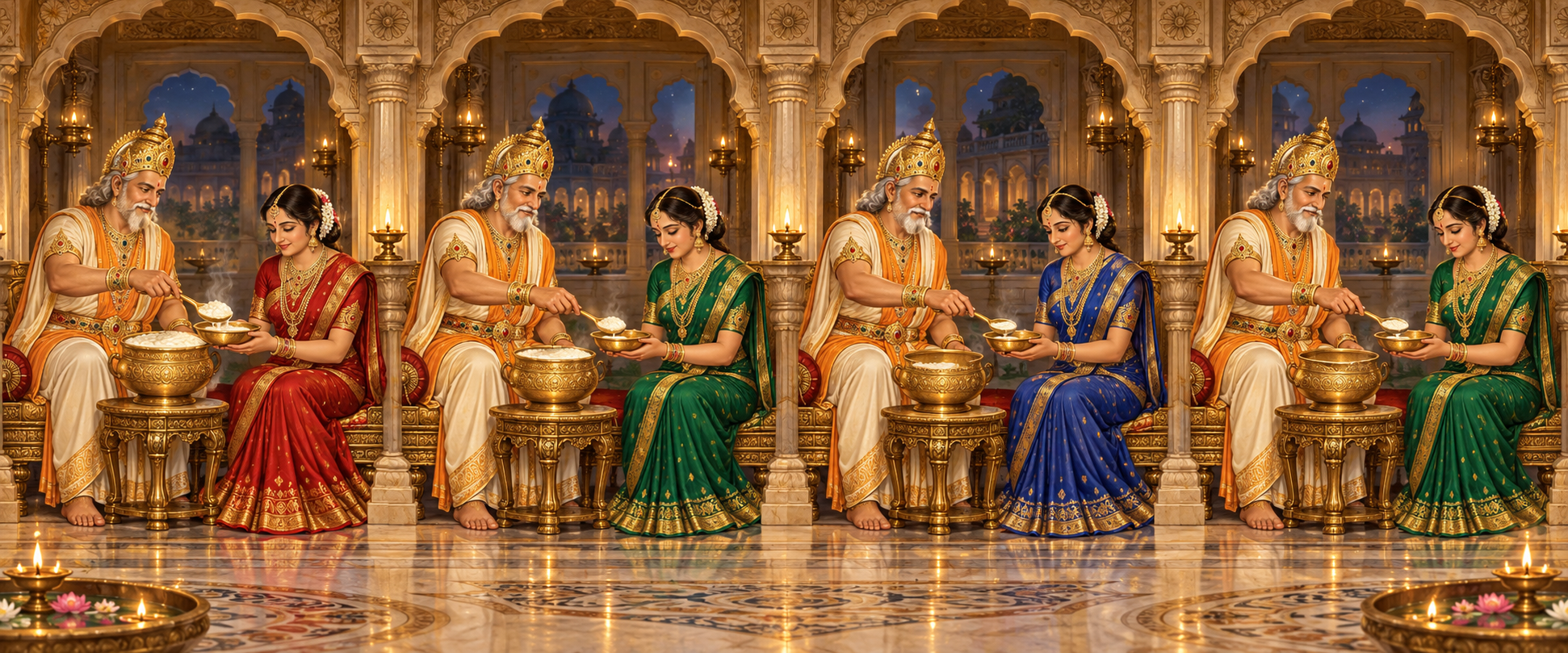
Taking the vessel as one whole, Dasharatha distributed it in this order:
| Queen | Place in the sequence | Amount received | Final total | Son or sons |
|---|---|---|---|---|
| Kausalya | First allocation | 1/2 of the whole | 1/2 | Rama |
| Sumitra | Second allocation | 1/2 of the first remainder, or 1/4 of the whole | 1/4 at this stage | Lakshmana and Shatrughna |
| Kaikeyi | Third allocation | 1/2 of the next remainder, or 1/8 of the whole | 1/8 | Bharata |
| Sumitra | Fourth and final allocation | The final 1/8 | 3/8 altogether | Lakshmana and Shatrughna |
The final totals are therefore straightforward: Kausalya received 1/2, Sumitra received 3/8, and Kaikeyi received 1/8. Expressed with a common denominator, their shares were 4/8, 3/8, and 1/8. Together they account for the entire vessel.
Why the arithmetic is often misunderstood
The phrase that causes confusion is half of the remainder. It does not mean that every queen received half of the original quantity.
After Kausalya received 1/2, only 1/2 remained. Sumitra then received half of that remainder, which was 1/4 of the original whole. This left 1/4. Kaikeyi received half of that amount, or 1/8 of the whole. The final 1/8 went to Sumitra.
Sumitra’s total must therefore be calculated by adding two separate allocations: 1/4 plus 1/8 equals 3/8. Saying merely that she received half of what remained is incomplete because there were two different remainders at two different points in the sequence.
If you are explaining the episode to someone else, do not begin with three totals and expect the pattern to be obvious. Begin with the four actions. The totals then emerge without guesswork.
What Sumitra’s two allocations mean – and do not mean
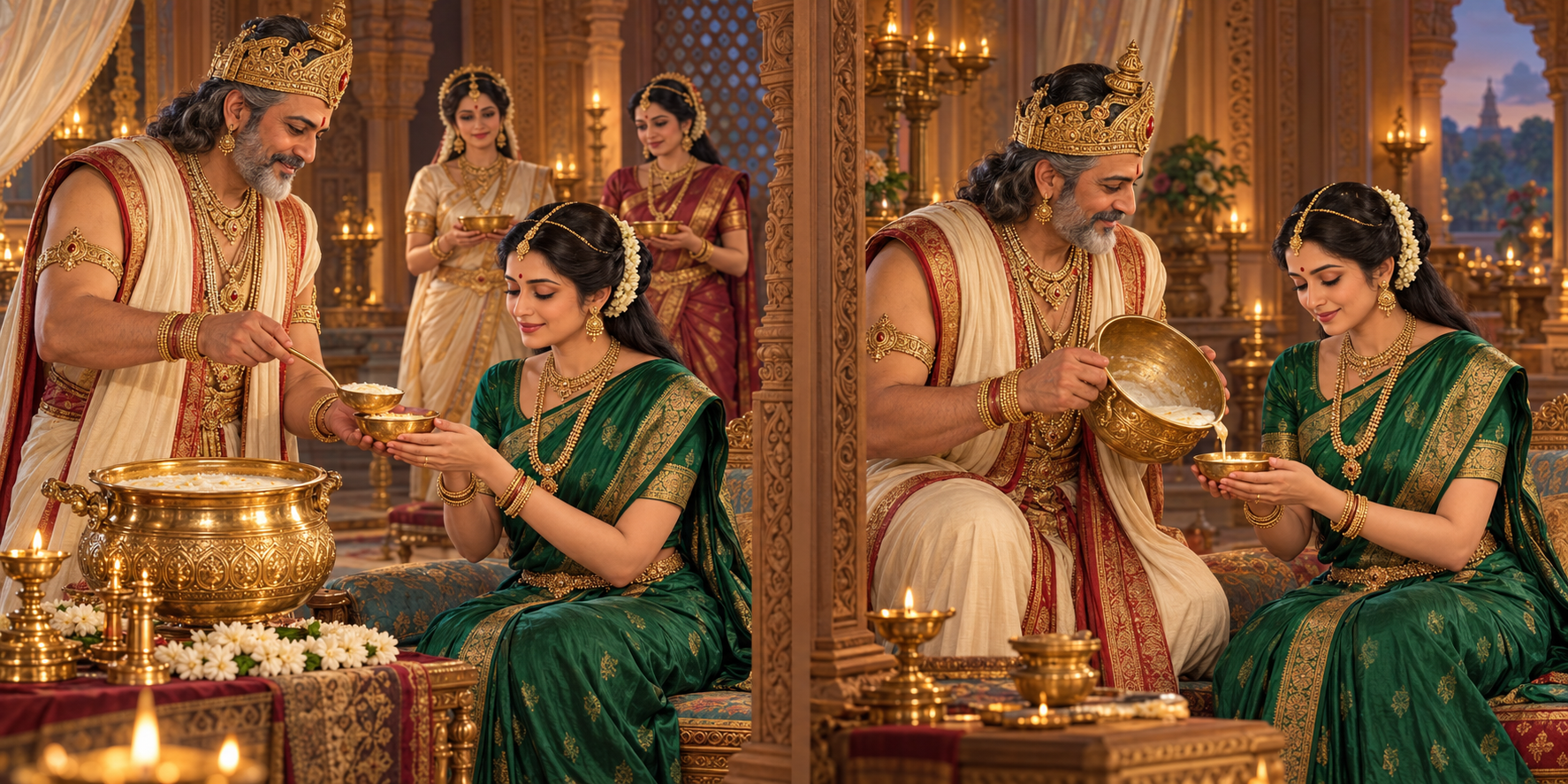
Sumitra’s repeated place in the sequence is not a trivial detail. She receives payasam once after Kausalya and again after Kaikeyi. She later becomes the mother of two sons, Lakshmana and Shatrughna, while Kausalya and Kaikeyi each become the mother of one.
That correspondence helps explain why the distribution is remembered as a meaningful narrative pattern. Yet you should distinguish a pattern in the story from a formula the passage never states. The episode does not provide a mechanical rule assigning one portion to one particular child, nor does it invite us to treat the sacred preparation as ordinary food governed by a modern biological calculation.
The quantities also should not be turned into a moral ranking of the queens or their sons. Kausalya’s larger portion does not establish that every quality associated with her is proportionally greater. Kaikeyi’s smaller portion does not make Bharata a lesser son. Bharata’s conduct within the Ramayana cannot be measured by the fraction his mother received before his birth.
One sound principle will keep your reading grounded: use the fractions to understand the narrated distribution, but do not make them carry claims about virtue, affection, status, or destiny that the episode itself does not declare.
How to read and teach the episode responsibly
Establish the event before interpreting it
Start with the narrative chain: Dasharatha desires sons, Rishyashringa guides the yajna, the divine payasam is presented, and Dasharatha distributes it among his queens. Only after establishing that sequence should you discuss symbolism or spiritual significance. Otherwise, an interpretation can quietly replace the event it was meant to explain.
Keep sequence and total in separate columns
There are four allocations but three recipients. Kausalya appears once, Kaikeyi appears once, and Sumitra appears twice. If a discussion counts recipients while another counts allocations, the two sides may seem to disagree even when both are recalling part of the same episode.
A useful verbal formula is: Kausalya received one half; Sumitra received one quarter and then another one eighth; Kaikeyi received one eighth. This preserves both the order and the final totals.
Label interpretation as interpretation
The unequal shares naturally raise the question of why Dasharatha chose this arrangement. The passage records what he did, but it does not give us a complete account of his private calculation. You may explore the distribution as a sign of order, grace, differentiated roles, or the unfolding of destiny, but present those as readings rather than as missing dialogue from the king.
Do not confuse difference with exclusion
Each queen receives a share, and each becomes the mother of a son or sons central to the royal family. The portions are unequal, but no queen is left outside the sacred gift. That distinction matters: differentiation within a shared blessing is not the same thing as rejection.
This makes the episode useful beyond arithmetic. Divine grace enters the story through the yajna, but Dasharatha must still receive, apportion, and entrust the gift. Sacred agency and human responsibility are not presented as rivals. The blessing comes from beyond the king, while its orderly distribution becomes his duty.
Key takeaways
- Dasharatha distributed the payasam in four allocations, not three equal shares.
- Kausalya received 1/2 of the whole and became the mother of Rama.
- Sumitra received 1/4 and later the final 1/8, giving her a total of 3/8; she became the mother of Lakshmana and Shatrughna.
- Kaikeyi received 1/8 and became the mother of Bharata.
- The fractions explain the distribution, but they do not establish a moral ranking of the queens or the four sons.
- A careful explanation separates the narrated sequence from later symbolic interpretation.
When you next encounter this episode in a reading, class, or family discussion, trace the vessel from the whole to the final eighth. Then ask which conclusions belong to the narrated event and which belong to interpretation. That small discipline preserves both the clarity of the account and the depth of the Ramayana.
References

Leave a Reply
You must be logged in to post a comment.