
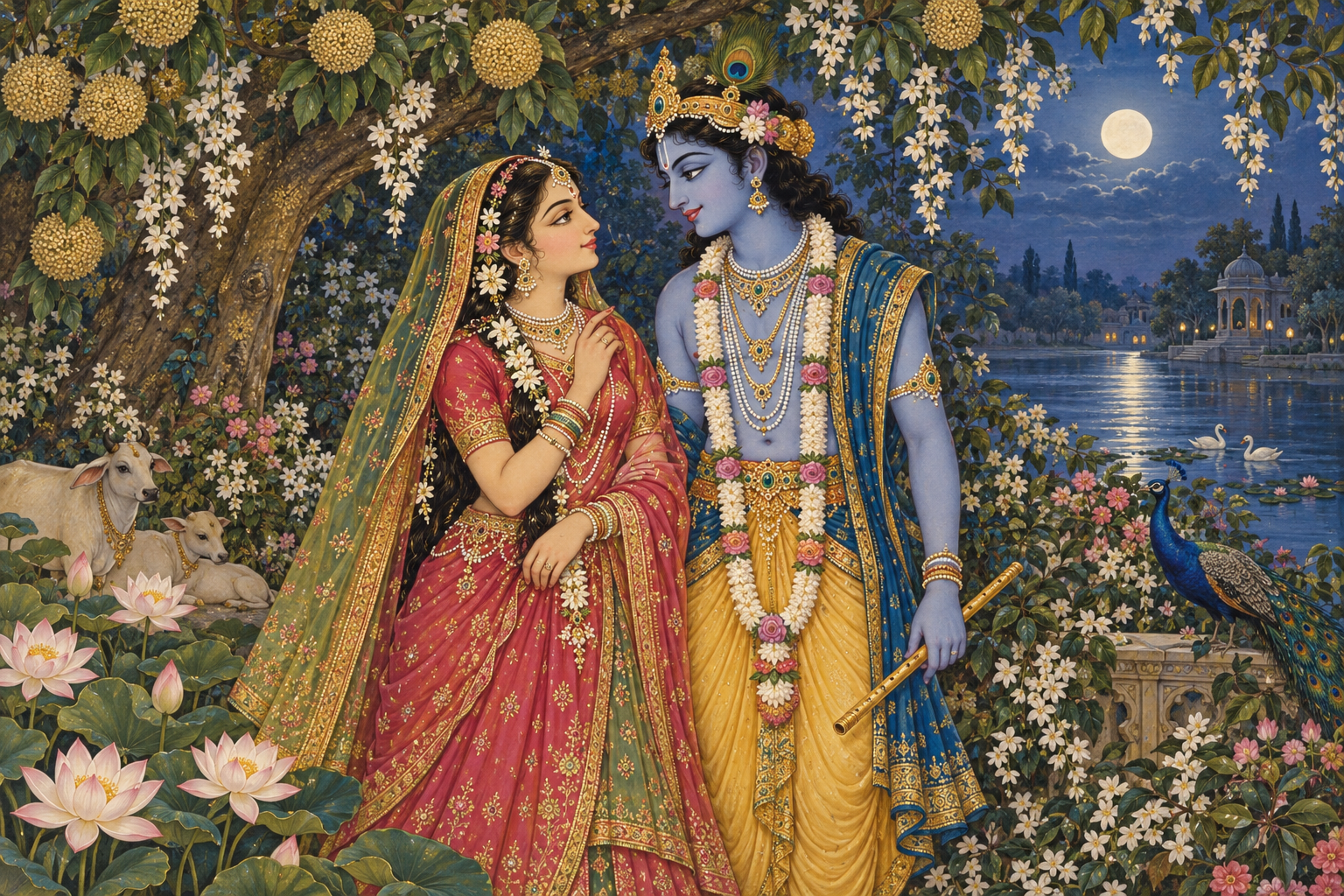
You have reached a verse praising Sri Radha’s lips and hesitated. Is this sacred contemplation, refined poetry, or merely sensual description? The answer depends less on whether bodily beauty appears than on how you read the relationship carried by that beauty.
Read well, the image does not leave you staring at an isolated feature. It leads you toward Sri Radha as a person: toward her speech, smile, silence, affection, dignity, and unique relationship with Sri Krishna. That shift from possession to relation is the key to approaching the image reverently.
Begin with the relationship, not the anatomy
Devotional description is not an anatomical inventory. A physical feature matters because it belongs to the beloved and participates in a living exchange. Sri Radha’s lips may be associated with speaking, smiling, answering, withholding an answer, or expressing an emotion that words alone cannot contain. The feature is meaningful through the person, action, and relationship surrounding it.
Your first task, therefore, is not to decode the lips as a free-standing symbol. Read the whole scene and ask four concrete questions:
- Who is noticing? Identify the speaker or observer before deciding what the description means.
- What are Sri Radha’s lips doing? Look for the governing verb: speaking, smiling, becoming still, or another action actually present in the passage.
- Who receives the expression? A smile or utterance gains its devotional meaning through the one to whom it is directed.
- What changes because of it? Notice whether the scene produces remembrance, longing, joy, tenderness, wonder, restraint, or an impulse toward service.
This method keeps interpretation accountable to the passage. If the text describes a smile, do not treat it as though it described speech. If it emphasizes silence, do not invent an utterance. If you cannot identify the observer or recipient, resist the urge to build an elaborate theology from one adjective. Re-read the surrounding lines first.
The decisive question is simple: does the feature reveal Sri Radha’s presence within a relationship, or have you detached it from her and made it an object for your own attention? In devotional aesthetics, the part must keep returning you to the whole person.
What a stimulation for ecstatic love actually does

A meditation on Sri Radha’s lips can treat them as a stimulation for ecstatic love. Here, stimulation should not be reduced to bodily excitement. It is better understood as a perceptible sign that intensifies loving remembrance within an already meaningful devotional relationship.
Three movements help you recognize how this works:
- Perception: The reader encounters a particular feature, gesture, sound, or expression.
- Remembrance: That detail recalls the beloved person and the relationship in which the detail has meaning.
- Orientation: The awakened feeling turns toward reverence, praise, attentive hearing, prayer, or service rather than acquisition.
The middle movement is easy to miss. Without remembrance, beauty remains a surface impression. Without devotional orientation, the reader may appreciate the poetry but fail to receive its spiritual direction. The image fulfills its devotional purpose when perception passes through remembrance and changes the quality of your attention.
Suppose a passage emphasizes speech. Do not stop at the beauty of the lips that speak. Attend to the utterance, its recipient, and the loving consequence of hearing it. If the emphasis is a smile, ask what the smile communicates that direct speech does not. If the lips are still, let the silence remain meaningful rather than filling it with something the passage never supplies.
Descriptions of color, softness, sweetness, or form require the same discipline. A comparison may create a sensory impression, but its purpose is not exhausted by visualizing the comparison as precisely as possible. Ask what emotional quality it conveys. Does it suggest tenderness, freshness, reserve, delight, or another quality supported by the surrounding language? Let the actual context decide.
A reliable test is to notice where your attention lands after the image has done its work. If you remain preoccupied with an isolated body part, return to the scene. If you become more attentive to Sri Radha’s expression, character, relationships, and the love that the passage seeks to awaken, the image is functioning devotionally.
Neither secularize nor sanitize embodied beauty

Two opposite misreadings can flatten this kind of sacred poetry.
The first is secularization. It assumes that any description of bodily beauty must be an invitation to erotic consumption. On that reading, the devotee becomes a spectator and Sri Radha becomes an object arranged for the spectator’s pleasure. The relational and devotional center disappears.
The second is sanitization. It becomes so uncomfortable with embodiment that it treats every physical detail as a disposable code for an abstract idea. The lips are no longer permitted to be lips; beauty is tolerated only after being translated into something disembodied. This also misses the point. Sacred aesthetics can take embodied beauty seriously without making it available for possession.
The better reading holds two truths together: the description is genuinely beautiful, and its beauty belongs within a devotional relationship. You need not deny the sensory force of the language. You do need to refuse the assumption that whatever is vividly imagined is therefore offered for consumption.
Ordinary possessive desire asks, “How can this beauty satisfy me?” Devotional attention asks, “What does this beauty reveal, and how should I respond?” The first movement brings the object toward the self. The second turns the self toward reverence and service.
This distinction also protects Sri Radha’s particularity. Her lips do not matter merely because lips can symbolize speech, sweetness, or affection. They matter because they are hers. A generic symbolic meaning cannot replace the personal identity at the center of the contemplation.
When you feel tension between embodiment and reverence, do not solve it by collapsing the passage into secular romance or by erasing its physical imagery. Stay with the relationship. Ask who sees, who speaks, who responds, and what loving disposition the exchange awakens. Those questions preserve both beauty and devotion.
A five-step discipline for reading one passage
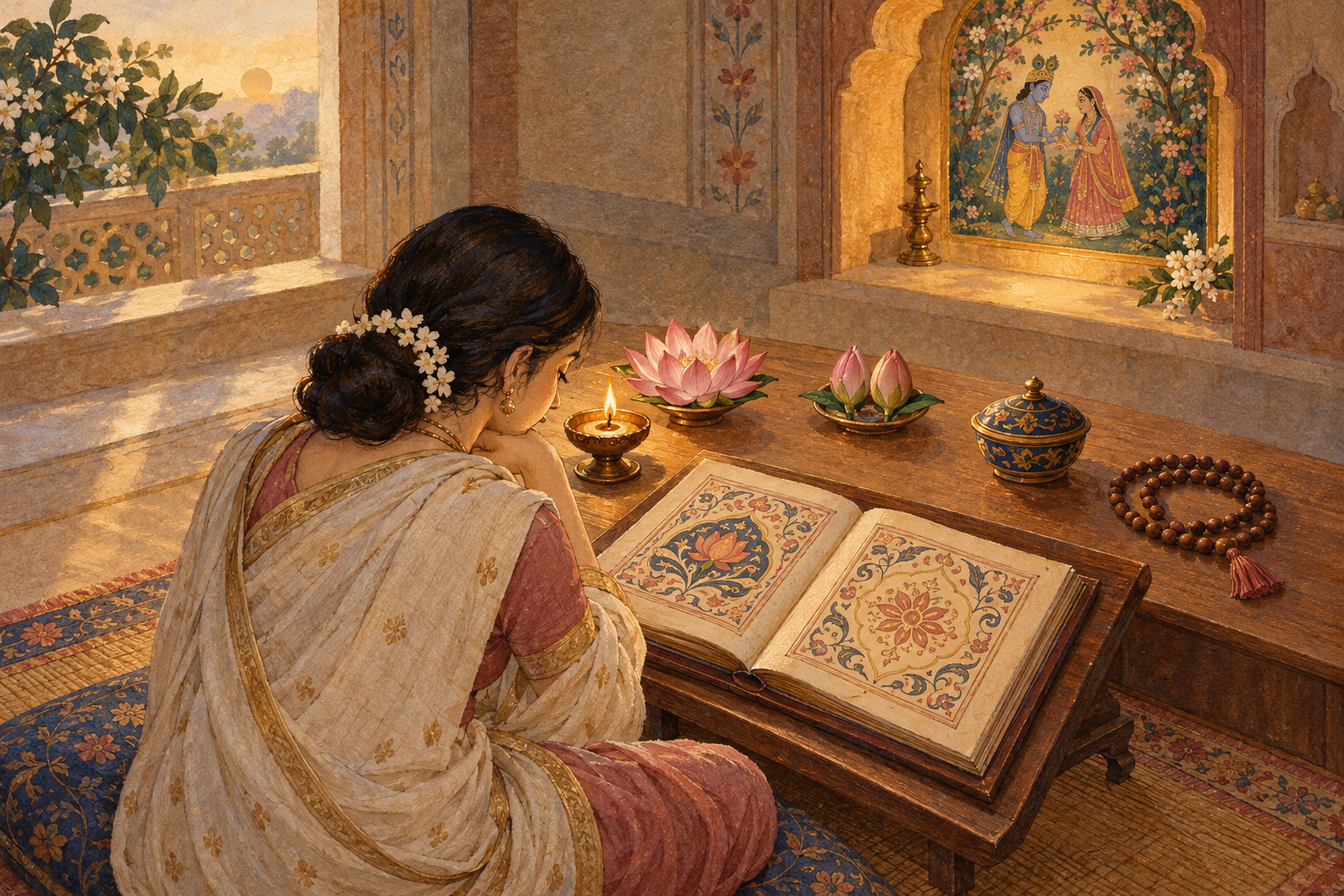
You can apply the following method to a verse, translation, commentary, painting, or passage of devotional prose. It is a reading discipline, not a replacement for instruction received within your sampradaya.
- Read beyond the beautiful phrase. Include enough surrounding material to identify the speaker, observer, recipient, and action. A detached quotation can lose the relationship that makes it intelligible.
- Mark the verbs before the adjectives. Adjectives tell you how the lips appear; verbs tell you what is happening. Begin interpretation with the action. This prevents decorative language from eclipsing the scene.
- Connect the feature to the person. Complete this sentence in your own words: “This description reveals Sri Radha as…” If your answer refers only to physical attractiveness, read again and look for expression, intention, emotion, or relationship.
- Observe the direction of your response. Does the passage produce possessive curiosity, or does it deepen remembrance, humility, praise, and willingness to serve? Do not condemn yourself for distraction; simply notice it and return attention to the complete devotional setting.
- Close by restoring the whole. Paraphrase the passage in one sentence that includes Sri Radha, the action, the recipient, and the devotional effect. Then return to the prayer, holy name, or form of remembrance customary in your practice.
For example, a weak paraphrase would say only, “Sri Radha’s lips are beautiful.” A more useful paraphrase would identify what their expression communicates, to whom it is communicated, and how that exchange intensifies loving remembrance. The exact wording must come from the passage in front of you; the method should not supply details that the passage lacks.
Translation deserves special care. A modern English word may sound clinical, sentimental, or overtly sexual in a way that narrows the devotional register. Before reacting to one word, examine its verbs, comparisons, tone, and place in the full sentence. If a trusted lineage commentary is available, use it to check your reading rather than assuming that the first modern association is the intended one.
The same caution applies to visual art. Do not decide whether an image is reverent solely by measuring how much physical beauty it shows. Ask how composition, gesture, gaze, setting, and relationship direct your attention. Restraint can be devotional, but so can vivid beauty; the question is what the whole work asks you to notice and become.
Key takeaways for reverent attention
- Sri Radha’s lips should be read as part of her personal presence, not as a detachable object or generic symbol.
- Begin with the scene’s relationships and verbs before interpreting its comparisons and adjectives.
- A devotional stimulus moves attention from perception to remembrance and then toward reverence, praise, or service.
- Do not secularize embodied beauty into consumption, and do not sanitize it into a bloodless abstraction.
- Judge your reading by its direction: it should lead back to Sri Radha, Sri Krishna, their relationship, and a more disciplined devotional response.
The next time you meet this image, pause before either indulging it or explaining it away. Locate the relationship, follow the action, and let the beauty return you to the person whose beauty it is.
References

Leave a Reply
You must be logged in to post a comment.