
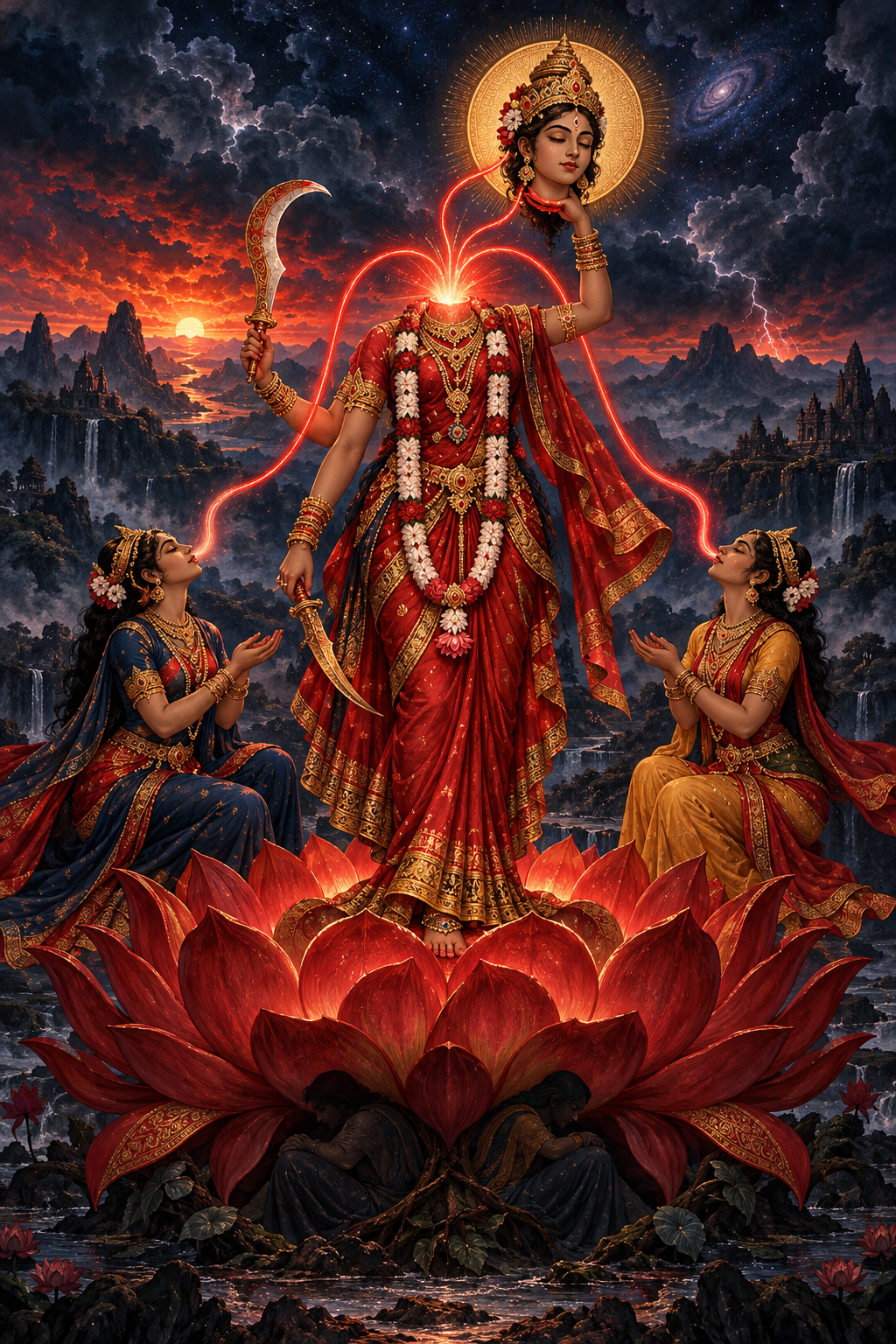
If Chinnamasta unsettles you, that reaction is not a failure of devotion. Her form resists the comfortable idea that divinity must always appear gentle, decorative, or easy to understand. Your task is not to make the image pleasant. It is to notice what its fierceness reveals about your fear, appetite, identity, and need for control.
Chinnamasta belongs to the ten cosmic personalities of the Divine Mother and is revered as a fierce form of Parvati. Those two facts give you a sound starting point: she is not outside the sacred feminine, and her ferocity should be approached as spiritual instruction rather than cruelty or spectacle.
The severed head challenges the identity you defend

Chinnamasta’s self-decapitated image interrupts an ordinary religious expectation. We often approach a deity hoping to protect the body, preserve our plans, confirm our identity, or secure what we desire. Here, the very centre from which we say this is who I am is severed from its usual authority.
The image can carry different layers of meaning within different traditions. A useful contemplative reading, without pretending that it exhausts those meanings, is to see the head as the seat of the story you continually tell about yourself: your status, grievances, ambitions, labels, fears, and explanations. Chinnamasta asks what remains when that story is no longer allowed to command every action.
- Which identity are you defending even when defending it causes harm?
- Which desire has begun to decide your conduct before discernment can speak?
- What becomes visible when you stop justifying yourself and remain silent?
This is iconography, not an instruction to harm the body. Nor does surrender mean accepting abuse, abandoning responsibilities, or allowing another person to erase your judgement. A spiritual challenge to ego must deepen discernment. If an interpretation makes you less truthful, less responsible, or easier to exploit, that interpretation has gone wrong.
Why Chinnamasta belongs within the ten Mahavidyas

The Dasha Mahavidyas present ten manifestations of divine wisdom rather than a single, emotionally convenient picture of the Mother. Their plurality matters. Reality can nourish and unsettle, conceal and reveal, attract and terrify. A complete spiritual vision cannot keep the welcome aspects of existence while pretending that death, desire, sacrifice, and loss belong outside the sacred.
Chinnamasta’s place within this larger field prevents two common mistakes. The first is isolating her as though she were merely a frightening anomaly. The second is smoothing away everything difficult until she becomes another generic symbol of kindness. Her fierceness has meaning precisely because it remains within the unity of the Divine Mother.
The Mahavidya framework also places limits on intellectual collection. Knowledge grasped only through the intellect remains limited, while silence opens another mode of understanding. Learning names and symbols is useful, but it is not the same as allowing a form to expose your habits.
The Dasha Mahavidyas are especially associated with worship during Navratri. If you approach them then, resist the urge to race through information about all ten. Read enough to establish context, sit quietly with the form that most challenges you, and record the reaction you would normally dismiss. Attraction, aversion, confusion, and resistance can each show you where attention is needed.
Bring Chinnamasta into ordinary choices

Chinnamasta is associated with purity, sexual self-control, energy in married life, blessings concerning children, and self-realization. These ideas become useful only when they change conduct. If they remain supernatural claims detached from responsibility, the fierce image has been admired but not heard.
Place desire under dharma, not under disgust
Sexual self-control does not require hatred of the body or shame about desire. Control means that desire is not sovereign. You acknowledge its energy, see the stories gathering around it, and decide how to act through dharma rather than impulse.
- Notice the charged moment before it becomes an automatic action.
- Separate the bodily sensation from the story that says it must be obeyed immediately.
- Name the duty that the impulse is trying to push aside.
- Choose the smallest truthful action that avoids manipulation, secrecy, and exploitation.
This method applies beyond sexuality. It works when you crave praise, want to win an argument, reach for distraction, or feel compelled to control another person’s response. Chinnamasta’s practical question is the same: can energy remain present without becoming your master?
Make restraint mutual within marriage
Energy in married life should not be reduced to sexual performance or a promise that worship will remove incompatibility. A more responsible application is to direct vitality toward intimacy, candour, restraint, and shared duty. Sexual self-control must be mutual; it is not a religious weapon one spouse may use to police or coerce the other.
Purity is best tested first in your own intention. Ask whether you are being honest, whether consent and dignity are intact, and whether desire is strengthening the household or hollowing it out through concealment. This moves purity away from judging other people’s bodies and toward governing your own conduct.
Let self-realization begin with observation
Self-realization can sound so elevated that it becomes unusable. Begin closer to the ground. Notice the difference between awareness and the passing identity awareness observes. Anger appears, but you are capable of seeing anger. Desire appears, but you can examine it before acting. Fear appears, but it does not have to write your next sentence.
This does not prove a final metaphysical doctrine. It gives you a disciplined starting point: the personality you defend is visible to awareness and therefore cannot be the whole of awareness. Chinnamasta makes that distinction difficult to ignore.
Receive devotional promises without turning them into guarantees

Devotional language attributes profound blessings to Chinnamasta, including help with family life, children, self-realization, and immortality after death. Such language belongs to faith. It should guide prayer and conduct without being converted into a transaction in which a ritual supposedly obliges the Divine to produce a particular outcome.
| Devotional language | A responsible way to receive it | What it does not guarantee |
|---|---|---|
| Purity and sexual self-control | Clarity of intention and disciplined desire | Permission to shame the body, sexuality, or another person |
| Energy in married life | Vitality directed toward intimacy and shared responsibility | Compatibility, sexual performance, or an effortless marriage |
| Blessings concerning children | Prayer for a child’s welfare and the parents’ capacity to serve | Conception, a particular pregnancy outcome, or a child’s temperament |
| Immortality after death | A religious promise of transcendence beyond ordinary identification | Bodily invulnerability or an empirically demonstrable result |
| Self-realization | A life oriented toward seeing beyond ego-bound identity | Instant attainment through a single observance |
If you are dealing with infertility, pregnancy concerns, sexual-health problems, or mental distress, seek care from an appropriately qualified professional. Devotion can give meaning, discipline, and moral direction, but it should not replace medical or psychological assessment.
The same restraint applies to claims about death. Immortality after death is a theological promise, not evidence that physical death can be avoided. Its practical force lies in loosening the conviction that the mortal personality is the entirety of the Self. You can live differently under that conviction without pretending to possess certainty that no ritual performance can publicly verify.
Key takeaways for approaching Chinnamasta
- If you are new to Chinnamasta, begin with contemplation and ethical application rather than advanced ritual.
- Read the severed-head image as a challenge to ego-bound identity, never as an act to imitate physically.
- Apply her teaching where strong appetite meets responsibility: sexuality, anger, praise, control, and fear.
- Treat blessings for marriage, children, self-realization, and life beyond death as devotional orientations, not guaranteed outcomes.
- If you pursue formal mantra, initiation, or esoteric worship, learn from a trustworthy teacher within a living tradition.
At your next encounter with Chinnamasta, refuse both reactions that keep her at a distance: sensational fascination and frightened rejection. Sit with one question instead: What am I trying to possess or control that should be governed by dharma? Write down the honest answer, then change one corresponding action. That is a steadier beginning than chasing an intense spiritual experience.
References
- Hindu Pad – Chinnamastha Mahatmya | Significance of Chinnamasta Mahavidya
- Hindu Pad – Significance of Dasha Mahavidyas in Daily Life

Leave a Reply
You must be logged in to post a comment.