

You may know the pattern: discipline gives you clarity, then slowly becomes dry; enjoyment restores warmth, then begins to scatter your attention. You respond by choosing a side. Either you tighten control or abandon it.
Tapa and rasa offer a better question. Instead of asking whether your energy should be restrained or expressed, ask what form it needs now. The answer can help you turn anger into a boundary, devotion into service, study into understanding, and effort into a joy that does not leave you depleted.
Stop treating restraint and expression as enemies
Tapa is energy gathered inward. It appears as concentration, restraint, patience, silence, sustained practice, or the willingness to remain with difficulty without reacting immediately. Rasa is energy flowing outward. It appears as expression, relationship, creativity, beauty, celebration, service, and the felt meaning of an experience.
They look opposite because their movements differ. Tapa concentrates; rasa circulates. Tapa protects energy from premature expenditure; rasa gives that energy a living form. Yet they are two conditions of one underlying force, not competing substances.
Consider the difference between a seed and a flowering plant. The seed’s life is enclosed, but it is not lifeless. The flower’s life is visible, but it did not appear from nowhere. The inward phase prepared the outward one. Expression reveals what concentration made possible.
This is a philosophical account of lived energy: attention, desire, emotion, devotion, intention, and creative capacity. It should not be confused with a scientific claim that spiritual experience is a measurable form of physical energy. Its value is practical. When an impulse changes form, you can work with that transformation instead of pretending the impulse has disappeared.
Neither movement is automatically higher. Silence can be wise, or it can conceal fear. Expression can be generous, or it can be uncontrolled discharge. The important question is not whether energy is inward or outward. It is whether the movement clarifies, ripens, and completes something worthwhile.
Use coherence and completion to test the transformation

Not every restriction is tapa, and not every pleasant experience is rasa. You need a way to distinguish transformation from suppression on one side and dissipation on the other.
The tapa test: is the energy becoming coherent?
Healthy restraint brings scattered forces into relation. After a period of tapa, you should be better able to identify what matters and choose your response. You may still feel intensity, but the intensity is less likely to command you blindly.
- Can you describe what you are holding without condemning yourself for feeling it?
- Is the restraint protecting a chosen purpose, or merely avoiding discomfort?
- Does the practice make your next action more precise?
- Are you developing steadiness, or only becoming numb and rigid?
If restraint leaves you unable to feel, decide, or relate, calling it tapa does not redeem it. You may simply be suppressing the energy. Genuine tapa does not require you to deny that an impulse exists. It prevents the impulse from selecting its own crude outlet.
The rasa test: does the expression reach completion?
Rasa is not merely stimulation. A meaningful expression carries concentrated energy into an appropriate form. It lets you participate, communicate, create, celebrate, or serve without losing the capacity to return to stillness.
- Does the expression connect you more honestly with the person, task, or value involved?
- Does it produce a fitting result, rather than only temporary relief?
- Can you stop when the expression has done its work?
- Do you emerge able to reflect, or do you immediately need another dose of intensity?
When expression creates only a demand for more expression, energy is leaking rather than ripening. Rasa has an element of fulfilment. It does not have to be cheerful, but it should make experience more intelligible and more capable of being integrated.
Practise the full cycle in five deliberate moves
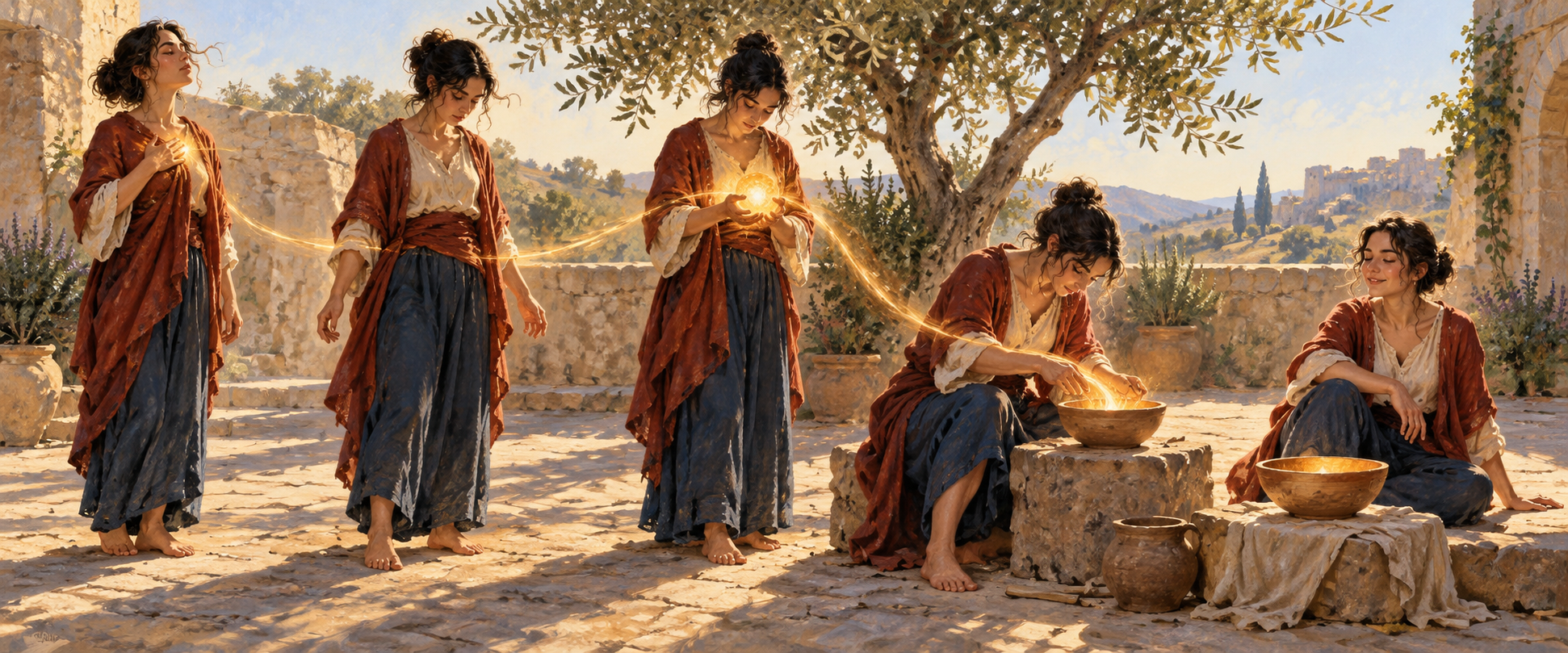
You do not need an elaborate theory to use this distinction. Begin with one charged impulse: the urge to argue, create, withdraw, celebrate, buy, speak, or prove something. Then take it through a complete tapa-rasa cycle.
- Pause before choosing an outlet. Do not send the message, make the promise, or suppress the feeling immediately. A short pause creates the first container. Its purpose is not indefinite delay; it is to prevent momentum from making the decision.
- Name the energy beneath the first impulse. Move past the proposed action and identify the force seeking expression. It may be anger, affection, ambition, fear, devotion, curiosity, grief, or creative excitement. Naming it separates the energy from its first suggested behaviour.
- Give it one firm boundary. Choose a simple act of tapa suited to the situation: remain silent until you can speak accurately, finish a defined period of focused work, keep a commitment, write without publishing, or listen without preparing a reply. The boundary should gather attention around a purpose.
- Find a form worthy of what you gathered. Ask what outward expression would preserve the truth of the energy without surrendering to its crudest demand. Anger may become a clear boundary. Affection may become care. Devotion may become worship or service. Curiosity may become study followed by explanation.
- Close the movement. After acting, stop and notice what remains. If the expression was fitting, you should be able to return to attention without immediately repeating it. If agitation remains unchanged, do not simply intensify the outlet. Reconsider the original need and the form you chose.
The fourth move is where many attempts fail. People often contain energy but never give it a worthy outlet. Restraint then hardens into resentment. Others express the energy before it has acquired shape, so the moment feels powerful but produces little of value. The cycle needs both phases.
Recognise the same movement in ordinary life

Tapa and rasa become useful when you can recognise them outside explicitly religious settings. The language applies wherever human energy moves between concentration and expression.
- In disagreement: refusing an immediate retort is tapa only if the pause helps you identify the actual violation or misunderstanding. Stating a proportionate boundary is rasa because the contained force has acquired intelligible form. Silent resentment and an uncontrolled outburst are failures at opposite ends of the same movement.
- In creative work: research, repetition, revision, and the refusal to publish too early gather energy. The finished poem, performance, design, or explanation lets it circulate. Endless preparation blocks rasa; constant production without refinement abandons tapa.
- In devotion: regularity, attention, and the keeping of a sacred commitment form the inward movement. Reverence expressed through worship, song, generosity, or service forms the outward movement. The practice becomes incomplete when discipline never softens conduct or when devotional enthusiasm cannot sustain regular practice.
- In learning: careful reading and reflection are tapa. Explaining the idea in your own words, applying it to a decision, or teaching it to another person is rasa. If you only collect information, it remains enclosed. If you speak before understanding, expression outruns formation.
- In celebration: preparation and self-command create the conditions for enjoyment. Rasa is the shared meal, music, beauty, affection, or gratitude that follows. A celebration need not reject discipline; its depth often depends on what was patiently prepared.
These examples also reveal a larger pattern. Tapa without rasa can become sterile self-control. Rasa without tapa can become restless consumption. The remedy for excessive discipline is not necessarily the abandonment of discipline; it may be the recovery of meaningful expression. The remedy for scattered enjoyment is not hostility to joy; it may be enough inward gathering to let joy acquire depth.
This prevents a common spiritual mistake: turning a temporary phase into a permanent identity. You do not have to become only austere or only expressive. A mature practice learns when to gather, when to release, and when to begin gathering again.
Key takeaways for your next charged moment

- Tapa gathers energy; rasa gives gathered energy a meaningful outward form.
- Restraint is useful when it creates coherence, not when it merely produces numbness or rigidity.
- Expression is fruitful when it reaches completion, not when it creates an endless demand for stimulation.
- Pair every serious discipline with a worthy form of expression, and pair every powerful expression with a return to attention.
- When you feel torn between suppression and impulsive release, look for a third option: contain the force long enough to choose its form.
Choose one unfinished energy today. Ask two questions: What boundary would help it become clear? What outward form would make it useful, truthful, or beautiful? Give it that boundary, then that form. This small, repeatable movement is how tapa becomes rasa without either discipline or joy being sacrificed.
References

Leave a Reply
You must be logged in to post a comment.