
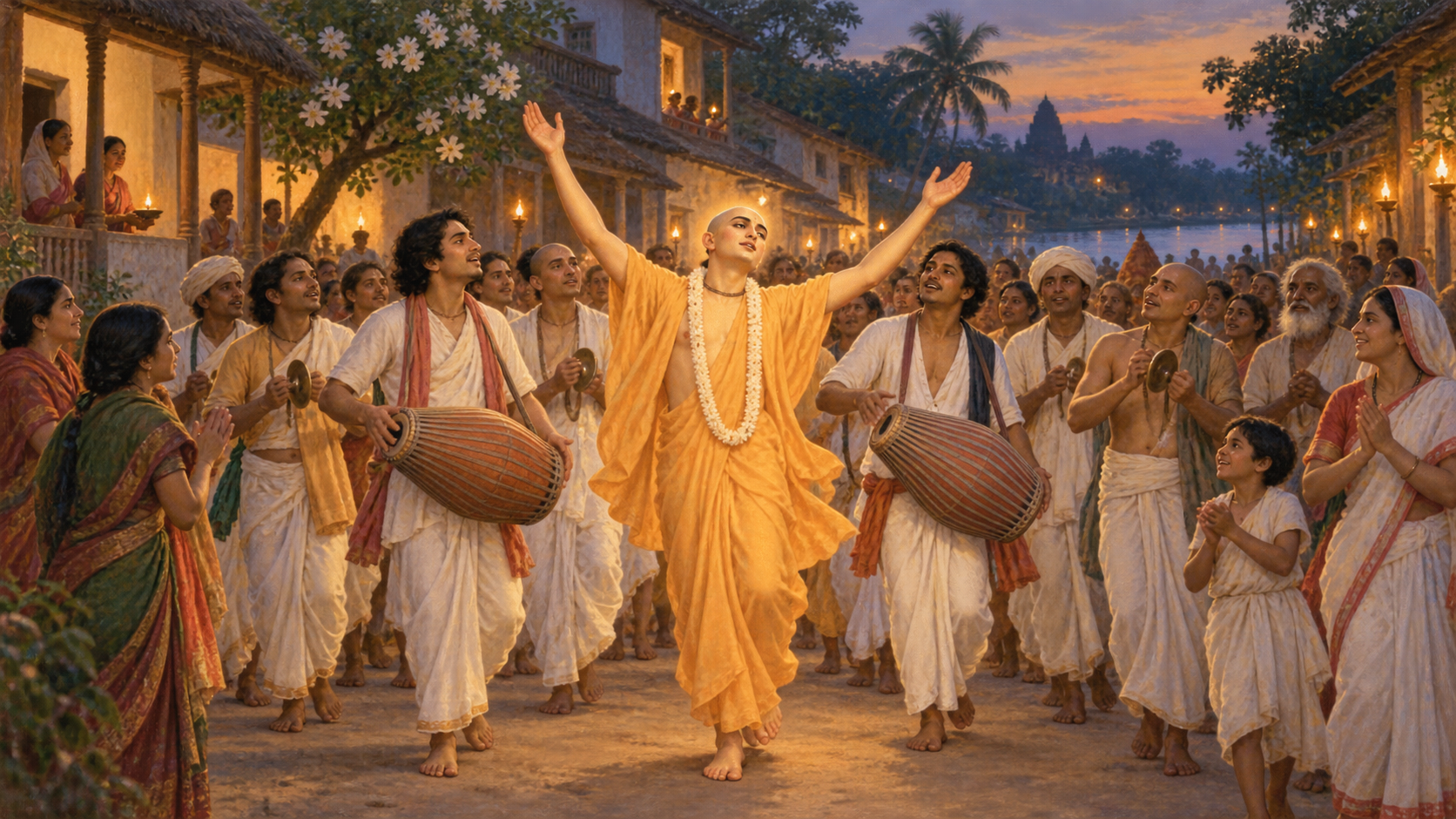
You may know Sri Chaitanya Mahaprabhu through a temple kirtan, a procession, a painting, or the name of a Vaishnava institution. The harder question is what his legacy asks of you after the music stops. Is it mainly an inheritance to admire, or a way of ordering devotion, learning, relationships, and public conduct?
A useful answer begins with the movement at the center of his life: inward love expressed through a practice that people could share. Sri Chaitanya brought the holy name into public life without emptying it of theological depth. If you want to carry his legacy faithfully, hold those two dimensions together: intimate devotion to Krishna and generous participation with others.
Bhakti begins with participation, not qualification
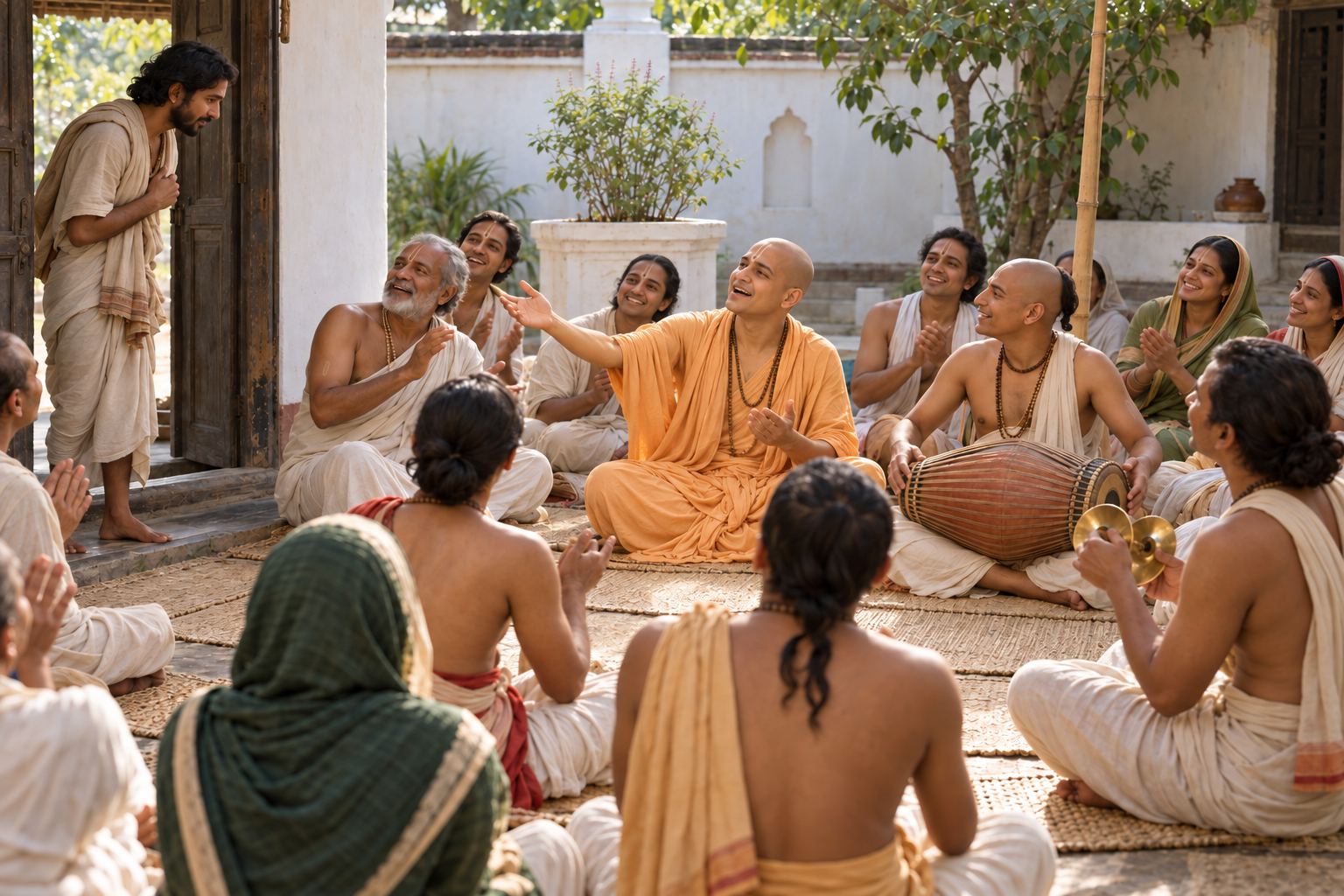
Sri Chaitanya’s public sankirtan made a decisive claim about spiritual access. Congregational chanting was not reserved for people with social standing, extensive learning, or material advantage. People of different backgrounds could enter the practice through the holy name.
This does not mean that every distinction in a spiritual tradition becomes irrelevant. Nor does it mean that discipline, guidance, philosophy, or mature conduct no longer matter. It means that they must not be turned into a locked gate in front of devotion. A newcomer should not have to master a vocabulary, prove a pedigree, or imitate an established devotee before being welcomed into sincere chanting and service.
You can apply that principle whenever you organize a kirtan, welcome somebody to a temple, speak with a curious relative, or introduce bhakti on a campus. Look for the hidden entrance tests. Are newcomers expected to understand every Sanskrit word? Do regular participants cluster with people they already know? Does the explanation before the chanting become so long that nobody gets to participate? Does unfamiliarity get mistaken for irreverence?
Remove those barriers without making the practice shallow. Explain an unfamiliar term in one plain sentence. Tell people what will happen before it begins. Let them listen if they are not ready to sing. Give them a simple way to serve. The point is not to lower bhakti to the level of entertainment. It is to make the first honest step possible.
That is one reason sankirtan remains so powerful. It does not require everyone in the gathering to possess the same education, temperament, or life history. They can direct their voices toward the same divine center. The resulting equality is not based on pretending that everyone is identical; it comes from recognizing that access to devotion cannot be made the property of a privileged group.
Scholarship must ripen into a change of heart

Sri Chaitanya’s early life as Nimai, the brilliant young scholar of Navadvip who became a leader of ecstatic devotion, corrects two opposite mistakes. The first is contempt for learning. The second is treating intellectual accomplishment as the final measure of spiritual advancement.
Bhakti does not ask you to become less intelligent. It asks what your intelligence serves. Knowledge can clarify a teaching, expose a false argument, preserve memory, and protect a tradition from distortion. It can also become a refined way of defending the ego. The difference appears in its fruit. Does your learning make you more attentive in chanting, more willing to serve, and more patient with people who know less? Or does it mainly make you difficult to correct?
This is especially important in an age of fast religious content. It is possible to collect quotations, labels, debates, and doctrinal distinctions while avoiding sustained practice. You can sound informed about bhakti without allowing devotion to inconvenience you. Sri Chaitanya’s movement points in the other direction: knowledge reaches its proper end when it awakens loving service and deepens the soul’s relationship with Krishna.
Use a simple test after your next period of study. Name the change the teaching calls for. It may ask you to chant with greater attention, repair an avoidable offense, perform an unglamorous service, or meet another person without social condescension. If you cannot identify any consequence for your conduct, you may have understood the information without yet receiving its instruction.
The reverse warning also matters. Emotion without understanding can be easily redirected by charisma, fashion, or group pressure. Study gives devotion a grammar and a memory. Practice gives study a heart. Sri Chaitanya’s legacy is weakened when either side is discarded.
Public devotion needs courage without contempt
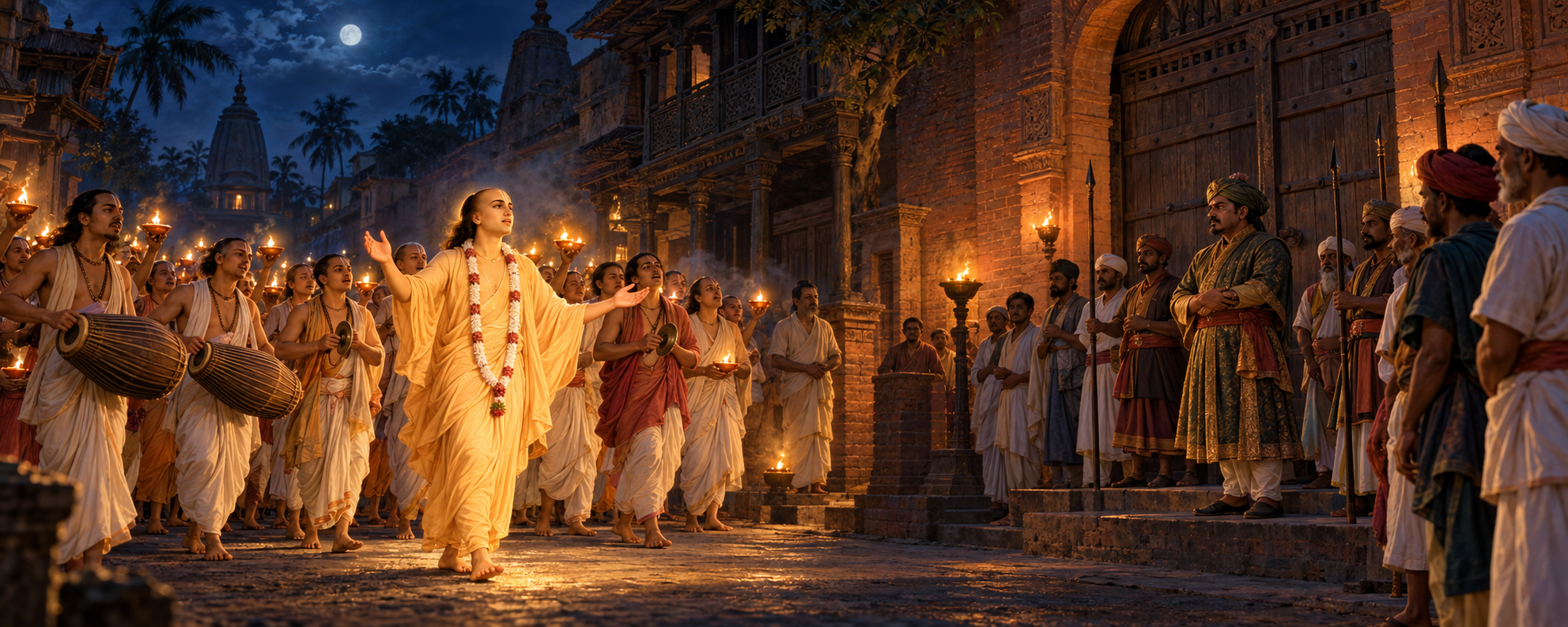
Taking the holy name into the street made bhakti visible. Visibility brought fellowship, but it also brought resistance. Sri Chaitanya’s response joined courage with compassion, public conviction with nonviolent action, and leadership with dialogue.
That combination is demanding. Courage by itself can become aggression. Courtesy by itself can become fear dressed as tolerance. Sri Chaitanya’s example refuses both distortions. Devotion need not disappear from public life to prove that it is peaceful, and public confidence need not turn opponents into objects of hatred.
If you are defending a Dharmic practice, separate the principle from your wounded pride. State clearly what must be protected: the freedom to chant, gather, worship, teach, or serve peacefully. Then choose conduct that makes the moral character of that claim visible. Do not imitate the contempt you oppose. Do not circulate an accusation merely because it flatters your side. Do not humiliate a person when correcting the person’s position would be enough.
This is not a call for passivity. A community can organize, speak publicly, refuse an unjust restriction, and stand together. But its means should remain answerable to its devotional end. If the method trains participants in rage, dishonesty, or dehumanization, a nominal defense of dharma may be cultivating adharma within the defenders.
The same discipline improves interfaith encounters. You do not have to hide what Gaudiya Vaishnavas believe in order to speak respectfully with someone who does not share it. For Gaudiya Vaishnavas, Sri Chaitanya is revered as Krishna appearing in the mood and devotion of Srimati Radharani. That conviction should be expressed accurately, not diluted into a vague claim that every tradition means the same thing. Dialogue becomes honest when conviction and courtesy remain together.
Divine longing keeps kirtan from becoming a performance

The public accessibility of sankirtan can tempt us to interpret Sri Chaitanya mainly as a social reformer or organizer. That reading stops before the center. His public mission arose from devotion to Krishna, and his later life disclosed the extraordinary intensity of that devotion.
His renunciation also carried a human cost. Those who loved him experienced pain as he accepted sannyasa and pursued his mission. That element matters because it prevents the spiritual journey from being reduced to a sequence of inspiring public scenes. Renunciation is serious precisely because love, responsibility, and separation are serious.
Sri Chaitanya’s journeys to Jagannath Puri and other sacred places are remembered alongside his absorption in Krishna and the depth of separation associated with the highest expressions of bhakti. For a practitioner, this gives a needed correction: religious emotion is not valuable merely because it is intense or visible. Its meaning depends on its object, its discipline, and the service it produces.
This distinction is useful whenever kirtan acquires an audience. Musical skill can support chanting, but musical display is not its purpose. A large gathering can serve the holy name, but size does not measure surrender. Tears may accompany devotion, but their visibility cannot certify anyone’s inner state. Ask a quieter question: after the chanting, are you more ready to remember Krishna and serve others, or only eager to reproduce an exciting atmosphere?
You need not imitate advanced devotional states. Begin with honesty. Chant as attentively as you can. Notice when you are performing for approval. Return your attention to the name. Let longing expose distraction without turning that discovery into self-display. The legacy lies in the direction of the heart, not in manufacturing the outward appearance of ecstasy.
Key takeaways: carry the legacy into your next gathering
- Make entry simple. Tell a newcomer what kirtan is, what will happen, and how to join without testing social background or prior knowledge.
- Keep the center theological. Present the holy name as devotion to Krishna, not merely as music, wellness, cultural display, or a technique for producing a mood.
- Turn learning into conduct. After study, identify the service, correction, or discipline that the teaching now requires from you.
- Defend public practice cleanly. Be firm about freedom of worship and association while refusing falsehood, humiliation, and hatred.
- Do not perform advanced emotion. Give attention to the holy name and let devotional feeling mature through remembrance and service.
- Offer a path beyond the first encounter. When someone responds to kirtan or Sri Chaitanya’s life, point them toward the Bhagavad-gita, Srimad-Bhagavatam, and Sri Chaitanya-charitamrita rather than leaving the experience without depth.
Sri Chaitanya’s worldwide legacy continued through teachers such as A.C. Bhaktivedanta Swami Prabhupada, who carried the message through books, personal teaching, and public harinama-sankirtan. Your part in that inheritance may look modest: one attentive period of chanting, one hospitable gathering, one honest explanation, or one courageous act conducted without contempt. Begin there. The movement remains living when the holy name changes how you worship, learn, welcome, and act.
References

Leave a Reply
You must be logged in to post a comment.