
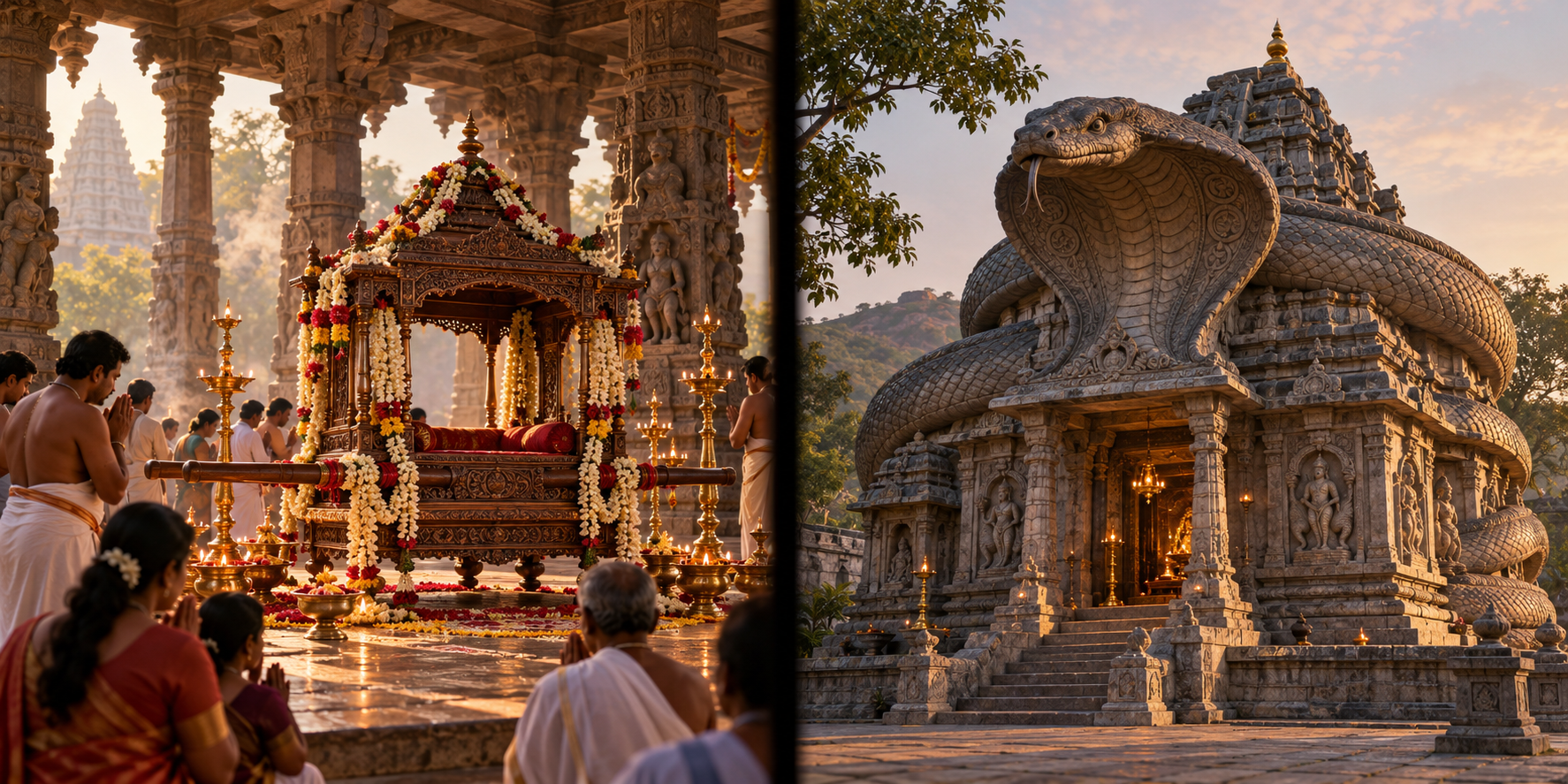
You enter a temple expecting darshan through a familiar sculpted murti. Instead, you find an empty palanquin at the devotional centre, or discover that the shrine itself has taken the shape of a giant snake. If you treat either encounter as mere novelty, you miss the temple’s own way of locating sacred presence.
The useful question is not whether the form looks conventional to you. Ask what is being worshipped, which part is symbolic, which part is architectural, and what the local tradition actually claims. That method lets you approach unfamiliar temples respectfully without inventing theology or dismissing a form because it does not match your expectations.
An empty palanquin can be the sacred focus
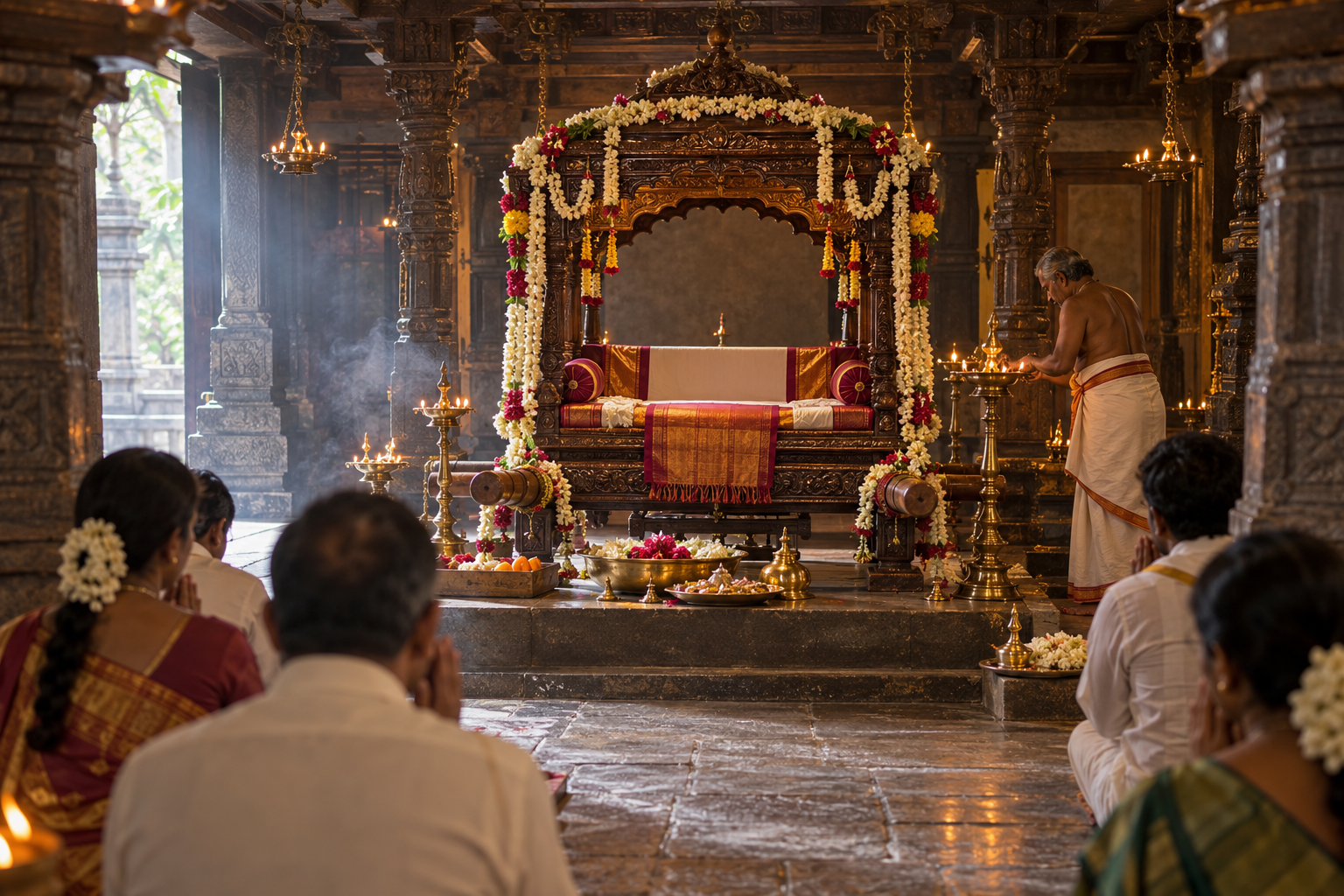
At Alopi Devi Mandir in Prayagraj, the unusual feature is not a missing murti awaiting replacement. An empty wooden palanquin, or doli, is worshipped instead of a traditional idol. The temple is revered as a Shakti Peetha, and the doli symbolizes Alopi Devi, who is believed to have disappeared.
That wording matters. The physical fact is an empty palanquin. The devotional claim is that it signifies the goddess whose disappearance is remembered there. Calling the shrine empty in the sense of having no sacred presence would therefore misread the very sign through which that presence is approached.
A representation does not always need to reproduce a divine body. It can point toward a relationship, an event or a presence that is deliberately not enclosed in an anthropomorphic image. At Alopi Devi Mandir, absence is not simply a deficiency to be corrected. It participates in the meaning of the shrine.
You should still resist making the example prove more than it does. It does not establish that every empty seat, vacant sanctum or unadorned object is sacred. The temple’s identity, worship and remembered account give this particular doli its significance. Form cannot be separated from the tradition that recognizes it.
A temple building can carry a sacred image
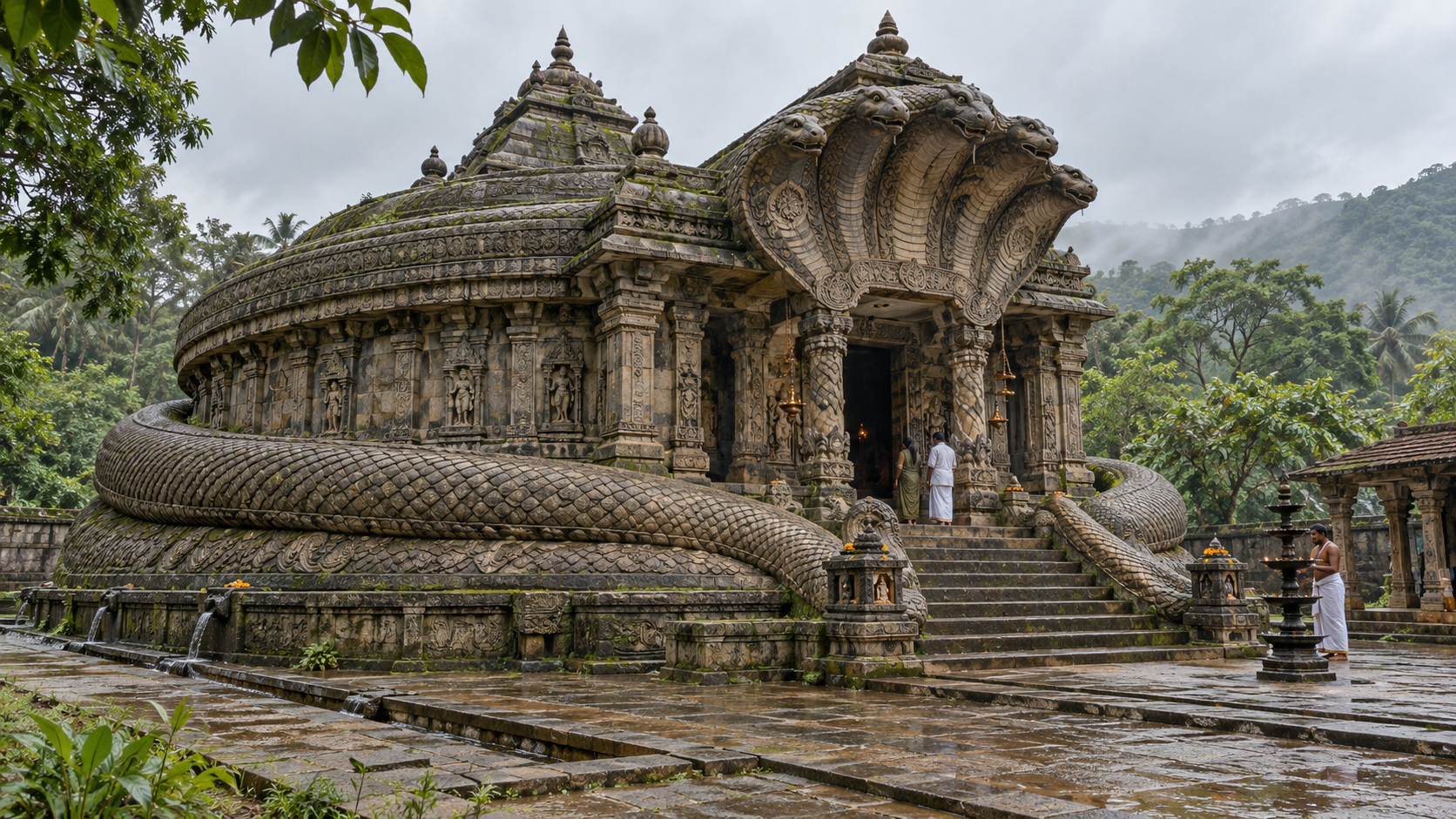
Nampally Gutta presents a different kind of encounter. The Lakshmi Narasimha Swamy temple takes the form of a giant snake. It stands on a hill near Nampally village, close to Vemulawada in the Karimnagar district of Telangana, approximately 160 kilometres from Hyderabad.
Here the unconventional element belongs to the architecture, while the temple’s named devotional centre remains Lakshmi Narasimha. That distinction prevents a common error: seeing a striking building and assuming that its shape, its presiding deity and its ritual focus must all be identical.
A precise description would call it a giant snake-shaped temple of Lakshmi Narasimha. Calling it only a snake temple leaves the deity unclear. Claiming that every part of the structure represents a particular serpent, episode or scriptural teaching would go beyond the information available unless the temple’s own tradition explicitly supplies that interpretation.
This is especially important when images circulate without context. A dramatic photograph can show the building’s outline, but it cannot by itself tell you what devotees worship, what narrative explains the design, how the sacred space is used or when the structure was made. Architecture is evidence of form, not automatic proof of every meaning assigned to it online.
Use four layers before deciding what a form means
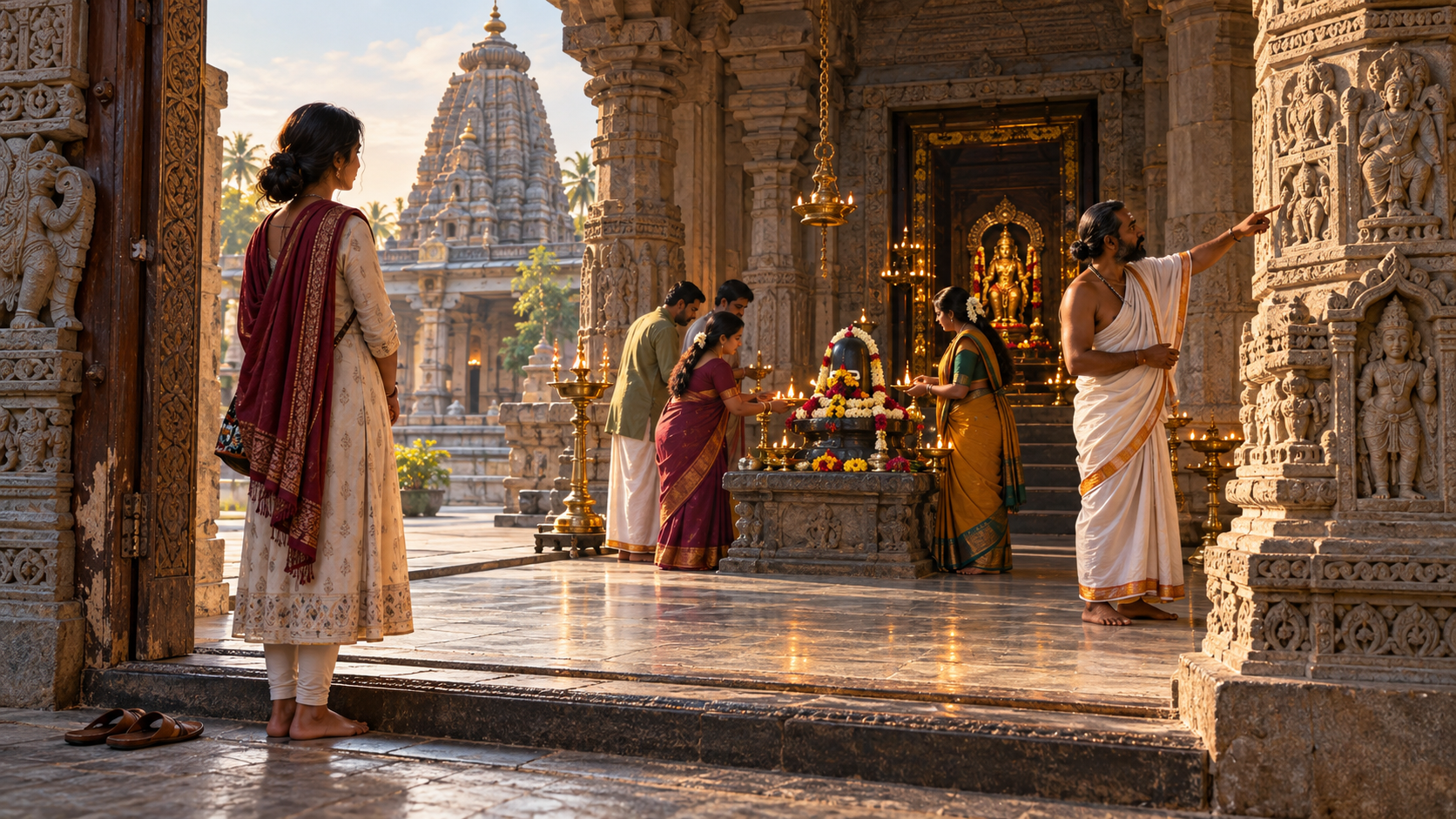
When a temple confounds your expectations, separate four layers. Keeping them distinct is the simplest way to avoid both sceptical dismissal and enthusiastic invention.
- Identify the physical form. State only what can be observed or reliably established: an empty wooden doli, a serpent-shaped building or a named sanctum. Do not begin with symbolism.
- Identify the devotional meaning. Ask which deity is named and how worshippers understand the unusual form. Phrase a remembered sacred account as a belief when that is what it is. Alopi Devi is believed to have disappeared; that devotional account should not be disguised as a dated historical event.
- Identify the ritual focus. Notice where prayers, gestures and offerings are directed. A building may frame the encounter without being identical to the object of worship. If the focus is unclear, ask rather than infer.
- Separate history from interpretation. A form can be spiritually meaningful even when you do not yet know its date, patron, architectural development or textual basis. A compelling explanation is not automatically historical documentation.
Applied to Alopi Devi Mandir, the physical and devotional layers are clear: the doli is empty, it is worshipped, and it signifies the goddess associated with disappearance. Applied to Nampally Gutta, the unusual visual layer is architectural, while Lakshmi Narasimha remains named in the temple’s identity. The same analytical discipline produces two different readings because the forms perform different roles.
This four-layer test also protects a Dharmic tradition from two opposite reductions. One reduction says that only a humanlike image can support genuine worship. The other treats every striking form as a code from which unlimited secret meanings can be extracted. Neither approach listens closely enough to the temple in front of you.
Visit with precision, not curiosity alone
An unfamiliar sacred form is a reason to slow down. It is not permission to handle an object, enter a restricted area or stage a photograph. You can learn a great deal without turning worship into spectacle.
- Use the local name. Learn the temple’s full name before arriving. Alopi Devi Mandir is also associated with the name Alopshankari Devi, while Nampally Gutta is identified with Lakshmi Narasimha Swamy. The name usually tells you more about the devotional centre than a viral photograph does.
- Pause before interpreting. Observe where devotees direct their attention and how they move through the sacred space. Do not assume that the largest or most visually unusual feature is the principal object of worship.
- Ask one neutral question. Ask a temple attendant what is regarded as the sacred focus and how the unusual form is understood locally. This is better than asking why the temple has no proper idol or whether the architecture proves a theory you already hold.
- Follow local restrictions. Seek permission before photographing a worshipped object, entering an interior passage or touching any part of the shrine. Treat opening times, access arrangements and photography rules as local, changeable facts to verify directly before travelling.
- Caption what you share accurately. For Alopi Devi, say that an empty wooden doli is worshipped and linked to the belief that the goddess disappeared. For Nampally Gutta, say that the Lakshmi Narasimha temple is shaped like a giant snake. Do not turn either description into a broader claim the temple itself has not supplied.
The word unconventional also deserves care. It describes a mismatch between the form and a visitor’s expectation; it does not determine the form’s legitimacy. What looks startling on first arrival may function coherently within the shrine’s devotional life. Your task as a visitor is to discover that grammar before judging it.
Key takeaways for reading unusual temple forms
- Separate the deity, the worshipped object and the surrounding architecture; they may not be the same thing.
- At Alopi Devi Mandir, the empty doli is the sacred focus, not evidence that worship is absent.
- At Nampally Gutta, the giant snake form belongs to a temple identified with Lakshmi Narasimha.
- Describe a local sacred account as a belief unless independent historical evidence establishes more.
- Observe ritual practice, ask a neutral question and verify local rules before photographing or entering an unfamiliar space.
On your next temple visit, record three things before sharing an interpretation: the local name, the actual focus of worship and the element that is merely architectural. That small discipline will help you see an unfamiliar form on its own terms and speak about it without either belittling its sanctity or manufacturing claims around it.
References
- Hindu Pad – Nampally Gutta Temple | Giant Snake Shaped Temple of Lakshmi Narasimha Swamy
- Hindu Pad – Alopi Devi Temple | Prayagraj Alopshankari Devi Temple

Leave a Reply
You must be logged in to post a comment.