

You can carry a reusable bag, avoid obvious waste, and still live as though nature were somewhere else. The deeper problem appears when soil, water, plants, animals, and seasons become background scenery rather than the living conditions of your existence.
Hindu ecology asks you to repair that relationship, not merely improve your environmental credentials. If the earth is Bhumi Mata, care for nature is neither a fashionable cause nor an occasional act of charity. It is part of dharmic conduct: receiving with gratitude, taking with restraint, and returning care for what sustains you.
The separation begins when nature becomes invisible

Much of modern life has placed distance between people and soil, rivers, forests, and seasonal rhythms. Water appears from a tap. Food arrives cleaned and packaged. Unwanted objects disappear into a bin. The systems behind these conveniences remain mostly unseen.
Convenience is not itself adharma. A city home is not spiritually inferior to a village home, and ecological responsibility does not require you to abandon technology. The danger lies in mistaking distance for independence. When you cannot see where something came from or where it goes after you discard it, it becomes easier to consume without attention.
This is also the useful meaning behind the claim that separation from nature produces suffering. It does not mean every illness, bereavement, or hardship is caused by insufficient time outdoors. That would turn a spiritual diagnosis into a careless medical claim. The point is that a habit of separation encourages grasping: the world looks like an inventory of objects, satisfaction always seems to require one more acquisition, and the consequences can be pushed out of sight.
You can interrupt that habit with a short inquiry. Choose one ordinary object in your hand and ask:
- What part of the earth became this object?
- What water, energy, labor, and transport brought it to me?
- Am I using it fully, or replacing it for novelty?
- Where will it go when I no longer want it?
- Can it be repaired, shared, repurposed, or disposed of more responsibly?
Do this with something real, such as a phone, garment, meal, devotional item, or bottle. The purpose is not to manufacture guilt. It is to restore visibility before you make the next decision.
Bhumi Mata turns reverence into obligation

Calling the earth Mother changes the moral relationship. A resource exists to be extracted. A mother is approached with gratitude, restraint, and responsibility. The metaphor matters only when it changes conduct; reverent language followed by careless use leaves the underlying relationship untouched.
Three disciplines make that reverence practical:
- Gratitude: Notice dependence before consumption. Water, food, shelter, clothing, and ritual materials do not begin at the shop or the tap.
- Restraint: Distinguish what serves a real purpose from what answers restlessness, status, or habit. Use what you already possess before buying an ecological-looking replacement.
- Reciprocity: Return care through maintenance, cleanup, protection, repair, sharing, or support for a place that sustains your community.
Ahimsa sharpens the first question: what avoidable harm follows from this choice? Aparigraha sharpens the second: how much is enough? Neither requires the fantasy of a life with no material impact. Eating, building, travelling, and worshipping all use material things. The practical task is to stop avoidable harm and unnecessary accumulation from masquerading as need.
This also exposes a common shortcut. Buying products labelled natural, traditional, or sacred is not automatically ecological. A new object still uses materials and eventually becomes waste. If the item you own remains safe and functional, continuing to use it may express greater restraint than purchasing a greener-looking substitute.
Nor should ecological practice become a purity contest. Your housing, income, mobility, work, and local infrastructure affect what is possible. Someone in an apartment may not be able to grow food or compost safely. Someone with limited mobility may not be able to join a river cleanup. Dharma asks for responsible action within real circumstances, not public performance or contempt for people facing different constraints.
Rebuild the relationship inside an ordinary day
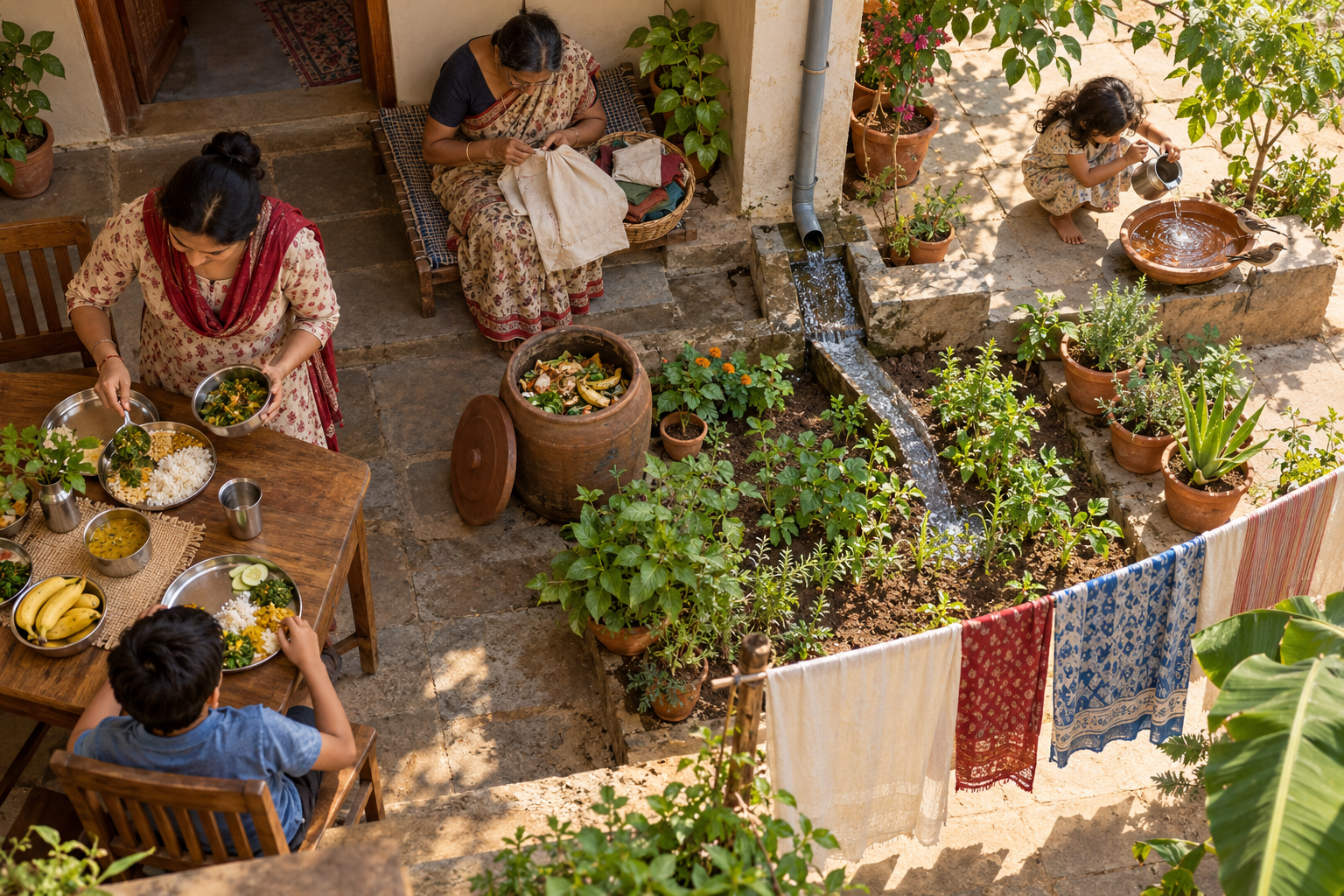
You do not have to wait for a pilgrimage, retreat, or forest visit. Nature is already present in the water you use, the food you eat, the air entering your room, and the materials surrounding you. Begin with the flows that pass through your home every day.
- Begin with water. Before opening a tap, pause long enough to remember that water has a history before it reaches you and a destination after it leaves. Then remove one recurring wasteful habit: letting water run without use, postponing a repair, or using more than the task requires.
- Make one meal visible. Look at each ingredient and identify its dependence on soil, water, sunlight, transport, and human hands. Serve a modest first portion and take more if needed. This simple change joins gratitude to the practical work of avoiding discarded food.
- Question one purchase. Before buying a nonessential item, ask what unmet function it will serve. If you cannot name the function, wait. If you can name it, check whether something you own can already perform it.
- Inspect what you throw away. Look at the recurring contents of your bin rather than making a vague promise to waste less. Choose the most avoidable repeated item and change the routine that produces it. The routine, not the feeling of remorse, is the useful target.
- Know one nearby place. Choose a courtyard, street tree, pond, park, shoreline, or patch of soil you regularly encounter. Notice changes in heat, rain, flowering, bird activity, litter, and human use. Familiarity turns an abstract environment into a place for which you can accept responsibility.
Keep the practice small enough to repeat. A dramatic weekend of ecological activity followed by unchanged daily consumption does less to reshape your relationship than one durable household rule. That rule might be using an item completely before replacing it, carrying your own container where accepted, planning meals around what must be used first, or maintaining a nearby shared space with permission.
Seasonal attention matters as well. Notice what your own locality is doing instead of treating every month as materially identical. Heat, rain, dryness, growth, and dormancy should affect how you use water, plan outdoor activity, care for plants, and understand the food before you. You are not trying to recreate an agricultural life. You are recovering the ability to notice the conditions in which you actually live.
Make ritual and community practice match their meaning

Ritual can train ecological attention because it teaches you to approach material things with care. Water is offered rather than treated as meaningless liquid. Food becomes prasada rather than a disposable commodity. Flowers, leaves, flame, fragrance, and earth remind you that worship depends on the more-than-human world.
But sacred intention does not cancel material consequences. A ceremony honoring a river becomes internally contradictory if packaging, synthetic decorations, or other waste is left on its bank. A celebration of abundance loses coherence when usable food and ritual materials are discarded carelessly.
Use these questions when planning worship at home, in a temple, or at a community event:
- Can existing vessels, cloth, decorations, and serving items be cleaned and reused?
- Does the quantity of an offering match the community’s ability to distribute, consume, compost, or otherwise handle it responsibly?
- Have plastic wrapping and other non-biodegradable materials been separated before an immersion or waterside observance?
- Do local rules permit the intended disposal method? If not, what lawful alternative preserves both reverence and ecological care?
- Who is responsible for cleaning the place after the visible ceremony ends?
Treat cleanup as seva, not as an unrelated chore delegated to unseen workers. The condition in which a sacred or public place is left forms part of the offering.
Community projects need the same discipline. Before organizing tree planting, secure permission, obtain local guidance on suitable plants, and assign continuing care. Before a cleanup, arrange lawful collection and disposal. Volunteers should not handle sharp, medical, chemical, or otherwise hazardous waste without appropriate authorities and equipment. Good intention does not remove physical risk.
Measure success by the condition of the place after attention has moved elsewhere. A maintained tree, a cleaner water edge, a reduced waste stream, or a reliably reused set of community utensils matters more than a large announcement. Ecological dharma is revealed by continuity.
Key takeaways for living Hindu ecology
- See soil, water, plants, animals, seasons, and human life as one field of dependence rather than separate subjects.
- Let Bhumi Mata mean obligation: gratitude before receiving, restraint while using, and care in what you return.
- Trace one object, meal, or waste stream until its origin and destination become visible.
- Reduce the repeated habit that creates waste instead of relying on occasional guilt or symbolic gestures.
- Judge a ritual by both its sacred intention and its physical effect on the place where it occurs.
- Choose practices you can maintain within your actual circumstances; ecological responsibility is not a competition in personal purity.
At your next meal, do not begin with a grand pledge. Pause before the first mouthful. Notice how many forms of life and labor made it possible, then choose one way to waste less of what has been given. That small act is where Bhumi Mata stops being an idea and becomes a relationship.
References

Leave a Reply
You must be logged in to post a comment.