
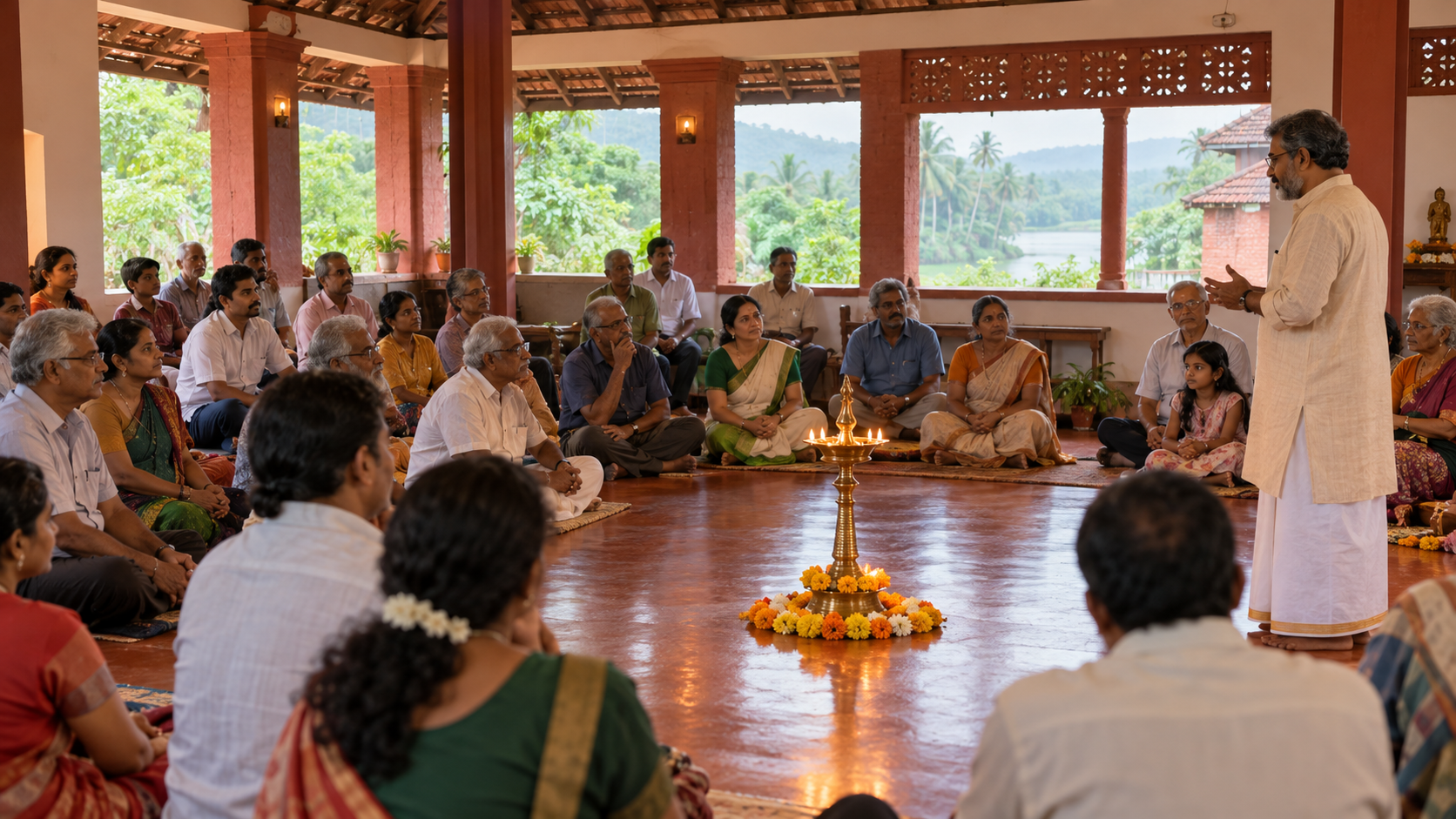
If you saw the words “Silver Jubilee” attached to the Hindu Janajagruti Samiti gathering in Chiplun, the important question is not whether the occasion was ceremonial. It is whether the milestone gives Hindu communities a clearer way to work.
The gathering points toward a practical answer. It places spiritual discipline, responsible self-defence training and Hindu unity within the same programme. For you, whether you are a volunteer, parent, temple participant or concerned Hindu, the value lies in understanding how those priorities support one another and how to carry them into local life.
Get the anniversary language right
The special gathering in Chiplun marked the Samiti’s entry into its Silver Jubilee year. In precise terms, the organisation entered its twenty-fifth year after completing twenty-four years. That is different from saying that it had already completed twenty-five years.
This distinction matters when you write a community notice, social-media caption or event introduction. “Entered its Silver Jubilee year” is the accurate wording. Avoid turning it into “completed twenty-five years” unless a later, clearly dated announcement establishes that separate milestone. Small chronological errors are easily repeated and can weaken an otherwise credible account.
The occasion also looked back at the struggle associated with the Samiti’s establishment twenty-four years earlier. An anniversary can honour that history without becoming trapped in nostalgia. The useful question is what the founding struggle requires from participants now: steadiness, preparation or better cooperation.
Three priorities form a working sequence

The programme highlighted spiritual practice, self-defence training and Hindu unity. These are not interchangeable slogans. Read as a sequence, they describe inner formation, practical capability and collective action.
Spiritual practice builds the inner foundation
Public work becomes unstable when it depends only on anger, excitement or the momentum of an event. A regular spiritual practice gives a volunteer a reason to act with restraint and consistency. It also creates a test for conduct: does the work reduce ego and deepen responsibility, or merely provide a stage for both?
You do not need to manufacture a new practice for an anniversary. Follow a discipline you understand within your tradition, and make it regular enough to shape how you speak and serve. The point is not display. It is to become harder to provoke, less careless with facts and more dependable when ordinary work has to be done.
Self-defence requires training, not bravado
Self-defence is a learned capacity. It should not be confused with seeking confrontation, issuing threats or improvising techniques after watching demonstrations. If you pursue training, choose qualified instruction, insist on controlled practice and follow the law where you live. Anyone organising a session should set clear safety rules and ensure that the activity is suitable for the participants.
The deeper benefit is disciplined awareness: noticing risk, responding proportionately and avoiding preventable escalation. Training that feeds recklessness defeats its own purpose. The standard should be greater safety and composure, not louder rhetoric.
Unity becomes real through shared work
Hindu unity does not require every participant to erase inherited customs or agree on every theological question. It requires the ability to cooperate where duties genuinely overlap. A shared task exposes the difference between symbolic unity and working unity very quickly.
When you hear an appeal for unity, ask what people are being invited to do together. Is there a defined responsibility, a responsible coordinator and a way to follow up? If none exists, the appeal may remain emotional. If those elements are present, people from different backgrounds can contribute without pretending their distinctions have disappeared.
Turn the commemoration into local practice

You do not need a large public programme before acting on the gathering’s central themes. Begin with work small enough to complete and clear enough to evaluate.
- Name the local need. Describe the actual problem rather than announcing a broad mission. It could involve volunteer reliability, community education, temple service or access to responsible safety training.
- Choose a bounded task. Decide what participants will produce, organise or improve. “Strengthen the community” is not a task; arranging a specific service activity with an identified coordinator is.
- Connect conduct with practice. Ask participants to bring the patience, truthfulness and restraint expected in spiritual life into meetings, messages and public activity.
- Use competent instruction. Where physical training is involved, work with qualified trainers and explicit safety procedures. Do not let enthusiasm substitute for skill.
- Make cooperation visible. Give people roles based on what they can reliably contribute. Unity becomes credible when responsibilities are shared and completed.
- Record the follow-through. Keep a simple account of what was promised, who accepted responsibility and when the group will review progress.
This approach also protects a community from a familiar failure: a well-attended gathering creates strong feeling, but nobody owns the next task. Before people disperse, convert intention into a named responsibility and a follow-up date.
Questions readers are likely to ask
Did the Chiplun gathering celebrate twenty-five completed years?
No. It marked entry into the Silver Jubilee year, meaning the Samiti had completed twenty-four years and begun its twenty-fifth. Preserve that wording when you share the news.
What were the gathering’s main public priorities?
The identified priorities were spiritual practice, self-defence training and Hindu unity. Do not attach additional campaigns, promises or outcomes to the occasion unless you have separate, verifiable information for them.
Does unity mean suppressing internal differences?
It need not. Practical unity can mean cooperating on a clearly shared responsibility while treating differences in custom and interpretation with discipline. The better test is whether participants can work together honestly, not whether they can produce identical language.
What should supporters look for during the jubilee year?
Look for continuity after commemorative meetings: regular spiritual discipline, responsibly conducted training, specific cooperative work and transparent follow-up. Attendance and speeches may begin a programme, but completed responsibilities show whether it has taken root.
Let the jubilee year become a test of continuity

A Silver Jubilee year is most valuable when it turns memory into discipline. If you participate in a related gathering, leave with a task you understand, a person responsible for it and a date for reviewing it. That modest habit can carry spiritual practice, preparedness and unity beyond the meeting hall and into durable community life.
References

Leave a Reply
You must be logged in to post a comment.