
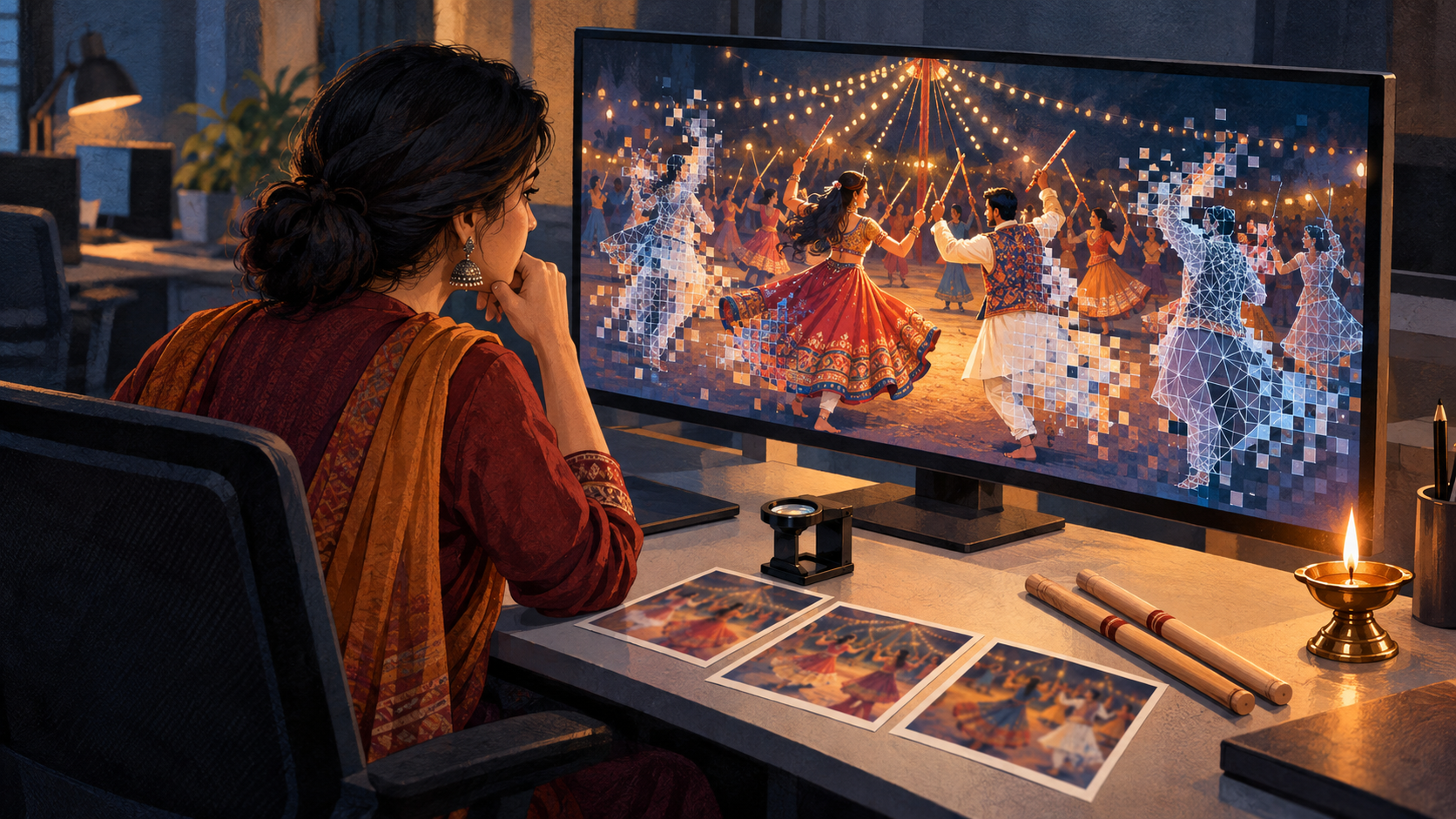
If you are approving a Navratri image for a newsroom, temple page, or community account, your hardest question is not whether it looks festive. It is whether a reader could mistake a fabricated scene for a statement about Hindu society.
An AI-made crowd can assign religion, gender, clothing, and social relationships to people who never existed. Once that image sits beside a report, it may be received as evidence. You therefore need a stricter standard than visual attractiveness: every person, identity cue, caption, and implied event must survive an editorial check before publication.
Key takeaways
- Never use a photorealistic AI scene as a substitute for documentary evidence from a Navratri event.
- Ask what a reasonable reader could infer from the image, not merely what the prompt writer intended.
- Treat clothing, religious symbols, gender, and social proximity as editorial claims when they imply communal identity.
- Label synthetic illustrations beside the image, but remember that a label cannot rescue a misleading premise.
- If an image causes harm, replace it, explain the specific error, and accept responsibility for the human decision to publish it.
The first error is confusing representation with evidence
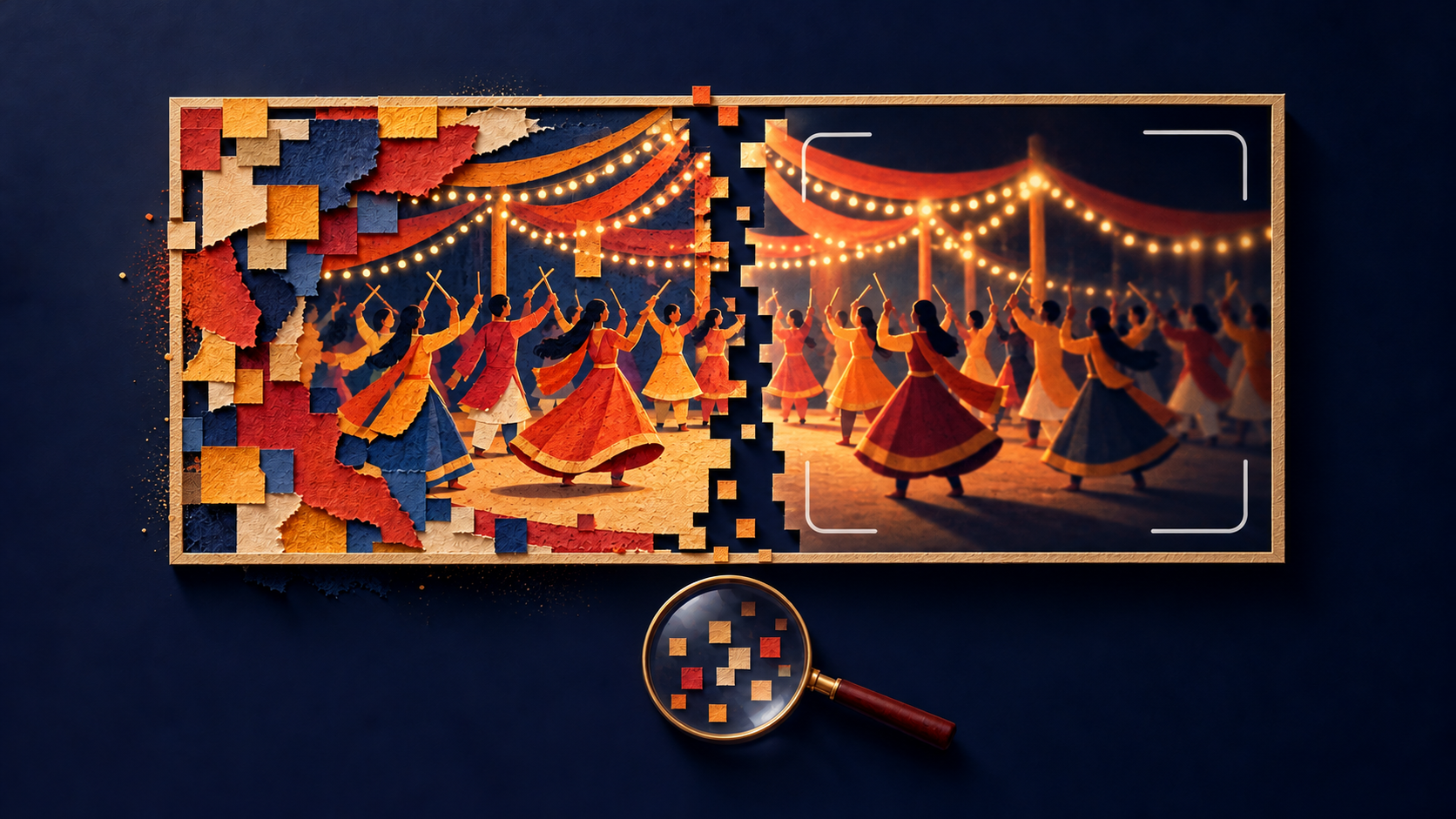
The risk became concrete when Sakal’s Pimpri-Chinchwad edition used an AI-generated image described as showing Muslim men playing dandiya with Hindu girls; Hindu criticism followed, and the newspaper attributed the error to AI-generated imagery.
The factual boundary is narrow but important. The episode does not, on its own, establish deliberate communal messaging. It also cannot establish that any real encounter depicted by the synthetic scene occurred. What it exposes is an editorial failure: an invented visual was allowed to communicate something that readers could reasonably interpret as a claim about religious communities at a Hindu festival.
A generated figure has no lived faith, family, intention, or biography. The system produces visible cues, while editors and readers supply their social meaning. If those cues are commonly read as Hindu or Muslim, the image is no longer a neutral collection of pixels. It has created a communal composition, whether or not that language appeared in the prompt.
Gender sharpens the problem. An invented scene that pairs men coded as belonging to one community with girls or women coded as belonging to another can activate fear, suspicion, or anger without documenting a single real person. Women should not become visual props in an artificial communal narrative, and religious identity should not be assigned casually through costume.
Respecting Hindu concerns does not require overstating what is known. A Dharmic response should be grounded in satya, truthfulness, and viveka, disciplined discernment. You can object firmly to misrepresentation while refusing to invent a motive, identify synthetic people as actual community members, or circulate the image as proof of an event that never happened.
Put every Navratri visual through a communal-context check
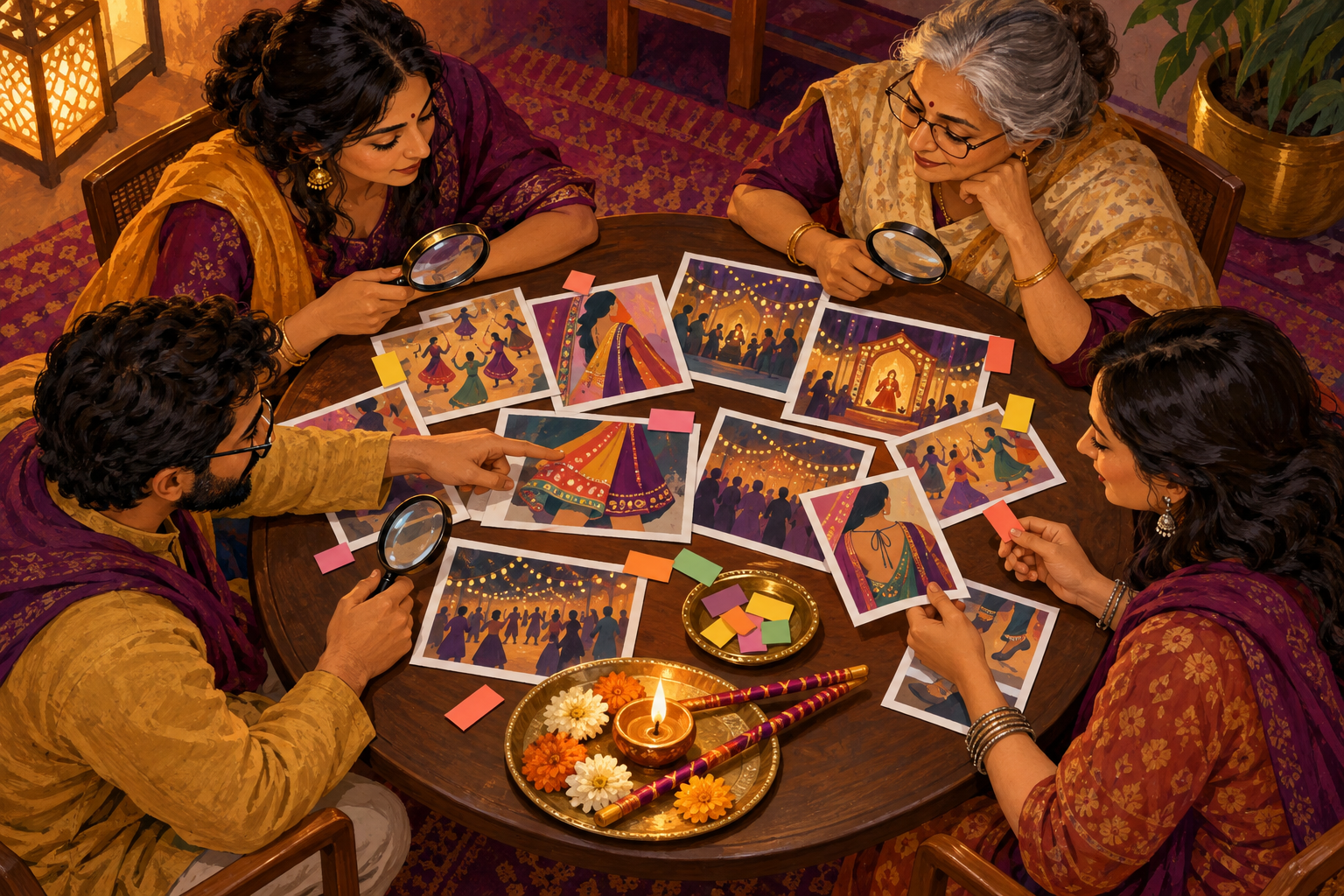
Run this check before the image enters a page template or social queue. Do not wait for objections to reveal what the approval process missed.
- Classify the asset. Record whether it is a photograph, a human-made illustration, a composite, or an AI-generated image. If its origin is uncertain, do not publish it as event coverage.
- Write down the intended claim. Complete the sentence: This image is meant to show… If the answer describes a real celebration, real participants, or real community relations, a synthetic scene is the wrong evidence.
- Run the reasonable-reader test. Ignore the prompt and inspect only the finished page. Could a reader believe the scene occurred? Could the headline or caption cause the visual to be read as reportage? If so, replace it with verified material.
- Audit communal and gender coding. Note every cue that might imply religious identity, including clothing, symbols, ritual objects, or captions. Then ask whether that identity is necessary to the story and supported by reporting. An invented person’s appearance is not verification.
- Check cultural fidelity. Navratri is not generic party scenery. Confirm that the composition respects the festival’s Hindu character and does not use sacred or cultural elements merely as decorative shorthand.
- Match the caption to the asset. A photograph needs accurate event information. A synthetic visual needs an adjacent label such as AI-generated illustration. Do not bury that disclosure in metadata or a distant note.
- Require independent approval. The person who made or selected the image should not be its only reviewer. The approving editor should examine the complete headline-image-caption combination, because meaning emerges from all of them together.
If any answer is unclear, hold the image. Deadline pressure does not turn an unverified representation into evidence.
Safer choices are readily available:
- Use a verified photograph from the event being covered, with its origin and permission recorded.
- Choose an object-led visual built around dandiya sticks, lamps, colour, or a clearly designed festival motif rather than invented people.
- Commission an illustration whose artistic form is unmistakable and whose cultural details can be reviewed deliberately.
- Use a synthetic illustration only when a conceptual image is genuinely necessary, the communal composition is relevant to the subject, and the disclosure appears beside it.
A useful house rule is simple: do not use photorealistic AI people as documentary substitutes in coverage of religious events. Label synthetic illustrations at the point of viewing. Do not assign communal identity to invented figures unless that representation is necessary to the subject and has received explicit editorial scrutiny.
The decisive red-line question is: Would we publish the same claim in the caption as plain text? If an editor would hesitate to write that Muslim men joined Hindu girls at a particular celebration without verification, the publication must not make the same suggestion through an AI image.
Correct the editorial choice, not merely the file
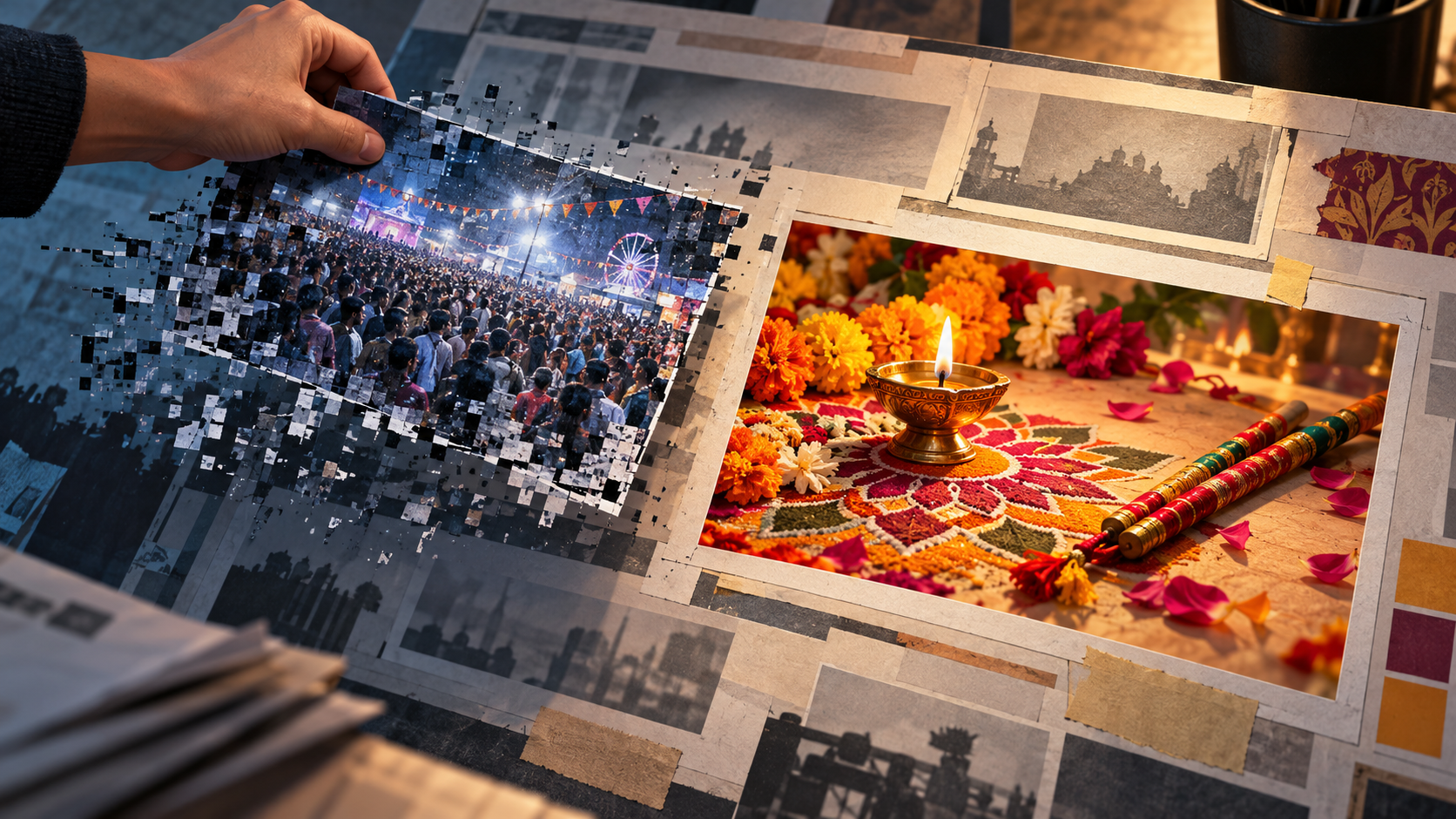
Once a misleading image is public, silently exchanging the file leaves readers uncertain about what changed and why. It also encourages the newsroom or community organisation to treat the incident as a technical glitch instead of a preventable publishing decision.
- Stop further distribution. Remove the asset from scheduled posts and replace it in the page body, thumbnail, and social previews where possible.
- Preserve an internal record. Keep the prompt, generated output, caption, approval trail, and correction decision so the workflow can be examined without leaving the harmful image in circulation.
- Publish a specific correction. State that the earlier visual was AI-generated, identify the misleading implication, and clarify that it was not documentary evidence of an actual event.
- Own the publication decision. Explain that the organisation selected and approved the image. Saying only that AI made an error transfers responsibility to a tool that cannot exercise editorial judgement.
- Repair the workflow. Determine whether the failure arose during prompting, asset selection, captioning, approval, or more than one of those stages. Add a check at the stage that allowed the image through.
If it matches the confirmed facts, a correction can say: Correction: An earlier version used an AI-generated illustration that could be read as depicting specific religious identities in a Navratri scene. It was not a photograph of an actual event. We have replaced it and reviewed our image-approval process.
That wording does more than express regret. It tells the reader what was synthetic, what inference was unsafe, what changed, and who remains accountable. Avoid vague phrases such as technical issue or image error; they conceal the editorial nature of the mistake.
AI can explain how a problematic image was produced. It cannot excuse why that image was chosen, captioned, approved, and published. The responsibility remains with the people and institution that placed it before the public.
Share criticism with the same discipline you expect from editors

If you encounter a questionable Navratri image, your response can either improve the information environment or make it worse. Pause before forwarding the screenshot with a new claim attached.
- Find the original context. Check the publication, edition, headline, caption, and any disclosure attached to the image. A cropped screenshot can remove the very information needed to evaluate it.
- Determine what kind of image it is. Ask whether it is a verified photograph, an illustration, or a synthetic visual. If that cannot be established, do not present it as proof of conduct at an actual Navratri event.
- Separate content from intent. You may be able to show that an image creates a misleading communal representation. That does not automatically establish why an editor selected it.
- Describe the exact objection. Point to the fabricated scene, the implied religious identities, the missing disclosure, or the mismatch with the report. Precision makes a correction easier to demand and harder to evade.
- Avoid assigning real identities to invented figures. Say that the image uses cues that readers may interpret communally. Do not speak about generated characters as though their religion or actions had been independently verified.
- Ask for a visible remedy. Request replacement of the image, a correction beside the affected page, and a clear synthetic-media policy. If a correction appears, circulate it with the same care given to the original criticism.
A pro-Hindu media culture should insist that Hindu festivals are represented as Hindu, with accuracy and respect. It should also refuse the temptation to turn an editorial failure into unsupported claims about an entire religious community. Those commitments reinforce each other: truthful advocacy is stronger than viral speculation.
Before your next Navratri visual leaves the publishing queue, add the red-line question to the approval form: Could this image be mistaken for evidence of people, identities, or an event we have not verified? If the answer is yes, do not publish it. Show verified events as events, illustrations as illustrations, and Hindu sacred culture with the seriousness it deserves.
References

Leave a Reply
You must be logged in to post a comment.