

If you attend, volunteer at, or help lead a Hindu temple in the United States, the Aurora allegations raise a practical question: what should change before your congregation’s next gathering? The right response is neither panic nor improvised vigilantism. It is a clear reporting path, a rehearsed safety plan, and disciplined communication.
The reported circumstances are grave. A rifle reportedly jammed, a coworker sounded the alarm, and authorities intervened in an alleged plot against a Hindu place of worship in Aurora, Illinois. Mechanical failure may have interrupted the danger, but chance is not a security plan. The part communities can reproduce is early recognition followed by prompt reporting.
What prosecutors allege, and what remains unproven

Nineteen-year-old Alexandros Paporakis, a Palatine resident, faces felony charges connected to the alleged plot. Prosecutors allege that he sent a coworker an eight-page document titled Why I fought: A.K.A. (Aurora Shooter’s Manifesto). It reportedly used dehumanizing language about Indian, Jewish, and African American people and described an intention to kill members of those communities.
The defendant also allegedly characterized himself as a white supremacist and Neo-Nazi consumed by fantasies of mass murder. Police reportedly recovered firearms, ammunition, body armor, and objects associated with Nazi symbolism during a search of his home. The FBI is assisting the investigation.
Those details support describing the suspected motive plainly, but they do not erase due process. Charges are allegations, not a conviction. The identity of the congregation, the complete sequence of events, and the evidentiary basis for every charge are not established here. Do not fill those gaps with guesses about a particular temple, possible accomplices, or additional targets.
Precision matters for another reason. This was allegedly anti-Hindu because a Hindu place of worship was selected, anti-Indian because Indians were explicitly threatened, and white supremacist because that ideology reportedly appeared in the defendant’s own writing. These descriptions can coexist. None requires pretending that every Hindu is Indian or that every Indian is Hindu.
Key takeaways
- The case concerns an alleged plot. Report the accusations accurately and do not present guilt as adjudicated.
- A coworker’s warning appears to have been a crucial point of intervention. A person who receives a violent plan should preserve it and report it, not privately investigate whether the sender is serious.
- Ideological hatred becomes especially urgent when it is joined to a named target, operational planning, access to weapons, a timeframe, or evidence of surveillance.
- A jammed weapon cannot substitute for preparation. Every temple needs named decision-makers, an escalation route, and a plan volunteers can follow under stress.
- Anti-Hindu and anti-Indian hatred should be named without overlooking the Jewish and African American communities reportedly threatened in the same document.
If a threat reaches you, preserve it and escalate it

You do not need to determine whether a threatening person is merely fantasizing, trying to shock you, or preparing to act. That assessment belongs to trained authorities. Your job is to protect yourself, retain the evidence, and get it to people who can respond.
- Move away from immediate danger. If a weapon is visible, a suspect is nearby, or the message names an imminent time and place, go to a safer location and contact local emergency services. Do not confront, follow, or attempt to disarm the person.
- Preserve the original material. Keep the message, email, file, envelope, voicemail, or social-media post in its original form. Record the account name, profile address, date, time, recipients, and exact wording. Screenshots are useful, but retain the original whenever possible.
- Separate observation from interpretation. Write down what was actually said or seen. Then list the targets, location, timeframe, weapons, routes, access claims, or preparatory acts mentioned. Do not embellish a vague statement, but do not soften an explicit one.
- Report through two channels. Notify the relevant authorities and the temple’s designated safety contact. If the temple has no contact, send the information to a board officer or senior administrator and ask for confirmation that it was received.
- Limit circulation. Do not forward a violent manifesto to a congregation-wide chat or upload it for public debate. Wide sharing can spread propaganda, strip evidence from its context, distress families, and alert a suspect to the response.
- Remain available. Keep your contact information current with investigators and the temple coordinator. A short factual timeline written while events are fresh is more useful than a later reconstruction shaped by online discussion.
Urgency rises when several indicators appear together: a named person or venue, a stated desire to kill, a proposed time, access to weapons, reconnaissance, maps or routes, attempts to learn entry procedures, or messages that shift from grievance to preparation. No single indicator proves that an attack will occur. An explicit threat still warrants reporting even when you doubt the sender’s ability to carry it out.
Pay attention to conduct rather than demographic profiling. A person’s ethnicity, nationality, age, clothing, or unfamiliarity to the congregation is not a threat assessment. A communicated plan, a named target, weapon access, surveillance, and escalating intent are relevant behaviors. The Aurora allegations are a warning about white-supremacist ideology and planned violence, not permission to treat every stranger as an enemy.
A temple needs a plan that volunteers can actually run

A binder that only one board member has read will fail when that person is absent. Build a short protocol around roles that already exist at the temple: administrators, priests, greeters, ushers, children’s-program volunteers, parking teams, and communications staff.
- Name a coordinator and a backup. Give both people authority to contact emergency services, notify leaders, pause an event, and issue internal instructions. Put their current telephone numbers on a staff-only contact sheet.
- Create one threat-intake form. It should capture the exact words, sender or witness, platform, date and time, named target, mentioned weapon, location, proposed timing, attachments, and actions already taken. Consistent intake reduces the chance that a decisive detail disappears during hurried retelling.
- Define the escalation rule in plain language. An immediate or unfolding danger goes to emergency services first. A specific but non-immediate threat goes promptly to the appropriate authorities and the temple coordinator. Offensive commentary without a threat can be documented and reviewed, but it should not clog the same urgent channel.
- Walk the site with the responsible people. Identify usable exits, areas where crowds constrict, locations where children gather, accessible routes for elders and disabled devotees, and places from which leaders can communicate. Keep required exits functional. Do not improvise locks or barriers that may violate fire and building rules.
- Assign event roles before the crowd arrives. Decide who calls for help, who guides worshippers, who checks children’s areas, who meets responders, and who sends the congregation’s message. Unassigned volunteers tend to duplicate one task while leaving another unattended.
- Use plain-language instructions. A clever code word is useless if occasional volunteers, visitors, or elders do not recognize it. Account for the languages actually spoken in the congregation and for people who cannot move quickly or hear a public announcement clearly.
- Establish a professional liaison. Ask local law enforcement or a qualified security professional for a site-specific assessment before a major gathering. Decisions about guards, cameras, access control, or armed security involve local law, training, insurance, and physical risks; they should not be improvised by a WhatsApp group.
- Rehearse and correct. Walk through the plan with the people who would carry it out. Note where contact information is missing, instructions conflict, or responsibility is unclear, then revise the protocol before the next large event.
Do not ask untrained devotees to arrive with weapons or patrol the property on their own initiative. They can be mistaken for an attacker, mishandle a confrontation, or complicate the work of responding officers. If a congregation is considering armed protection, it needs qualified professionals, explicit governance, appropriate insurance, and advice grounded in local law.
Good security should also preserve the temple’s religious purpose. A trained greeter can welcome a first-time visitor while noticing a blocked exit or suspicious package. Clear child check-in can support families without treating them as suspects. The aim is not to make darshan feel like entry into a bunker. It is to replace confusion with calm, practiced responsibility.
Name the hatred without amplifying its propaganda
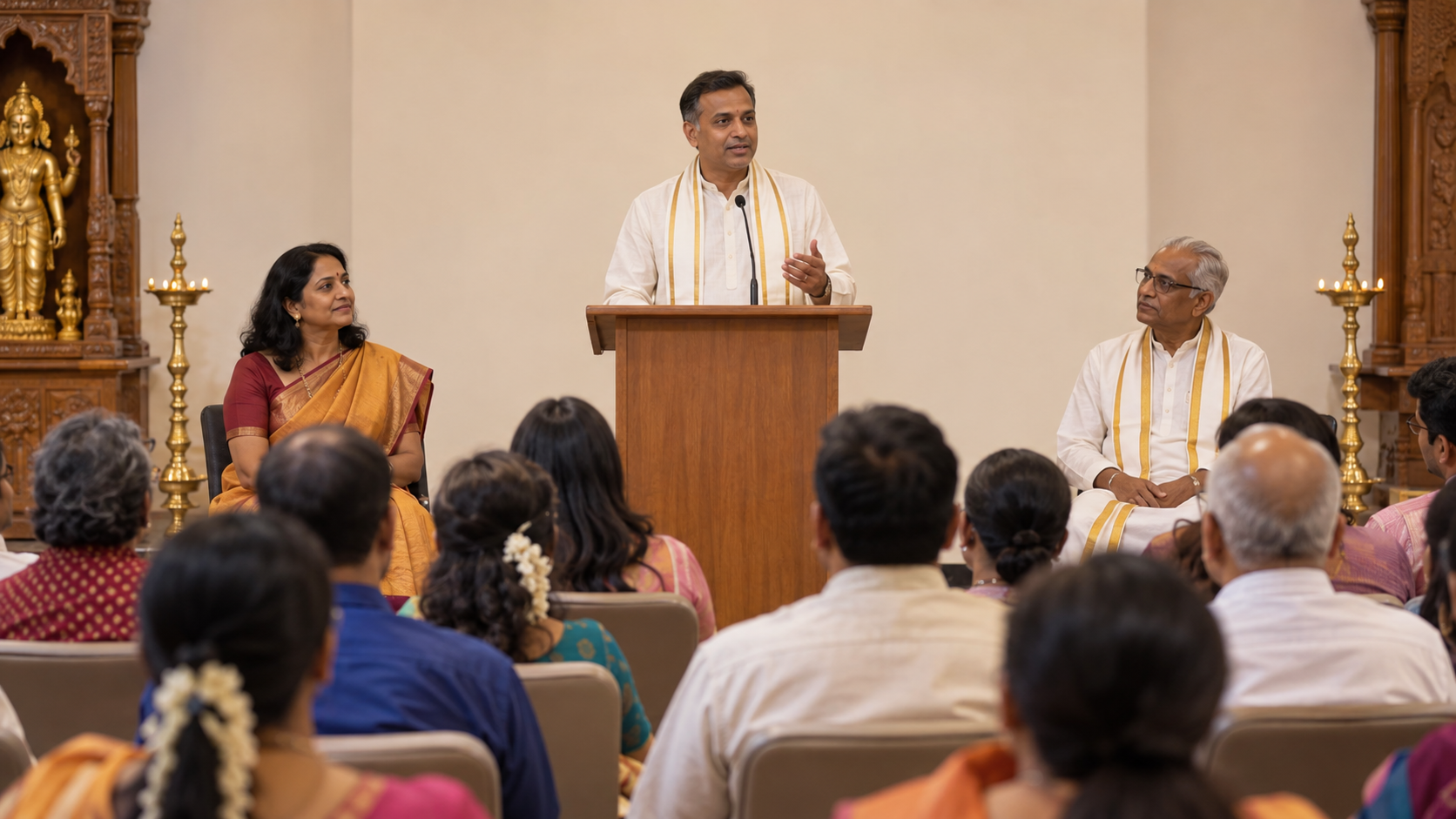
Communities often make one of two mistakes after an alleged plot. They either use language so generic that the selected Hindu target disappears, or they state unproven details so confidently that advocacy becomes rumor. You can avoid both.
Suggested public language: Authorities are investigating an alleged white-supremacist plot targeting a Hindu place of worship in Aurora. Prosecutors say the defendant’s writing threatened Indians, Jews, and African Americans. The charges have not been adjudicated. A coworker’s report helped bring the alleged danger to the attention of authorities.
That formulation identifies the temple, the alleged ideology, the communities named, the status of the case, and the value of reporting. It does not speculate about a congregation that has not been publicly identified, declare the defendant guilty, or reproduce his dehumanizing language.
White-supremacist appropriation of Aryan terminology should not be allowed to conscript Hindu concepts into a racist political mythology. The most effective answer is not a rival theory of racial purity. It is a firm rejection of racial hierarchy, accurate teaching about Dharma, and attention to the conduct at issue: dehumanization, targeting, weapon preparation, and threatened violence.
The alleged threats against Jewish and African American people also create a basis for practical solidarity. That does not require dissolving anti-Hindu hatred into a vague diversity slogan. It means Hindu, Jewish, Black, Indian American, and other civic organizations can defend one another’s right to worship and live safely while naming the form of hatred directed at each community.
When speaking with officials, ask concrete questions: Who is the congregation’s law-enforcement contact? Has a site-specific threat assessment been offered? What information should members preserve? How will leaders be notified if the risk changes? Are possible hate-related motives being investigated? Do not demand investigative details whose release could endanger the case; demand a usable channel and clear safety guidance.
Before your temple’s next major gathering, choose the coordinator and backup, complete a building walkthrough, and give volunteers a one-page reporting protocol. If you have received a threat now, skip the planning meeting: get to safety, preserve what you received, and contact the appropriate authorities. The lesson from Aurora is not that disaster will always be stopped by luck. It is that one person who takes violent intent seriously can help interrupt the path from hatred to action.
References

Leave a Reply
You must be logged in to post a comment.