
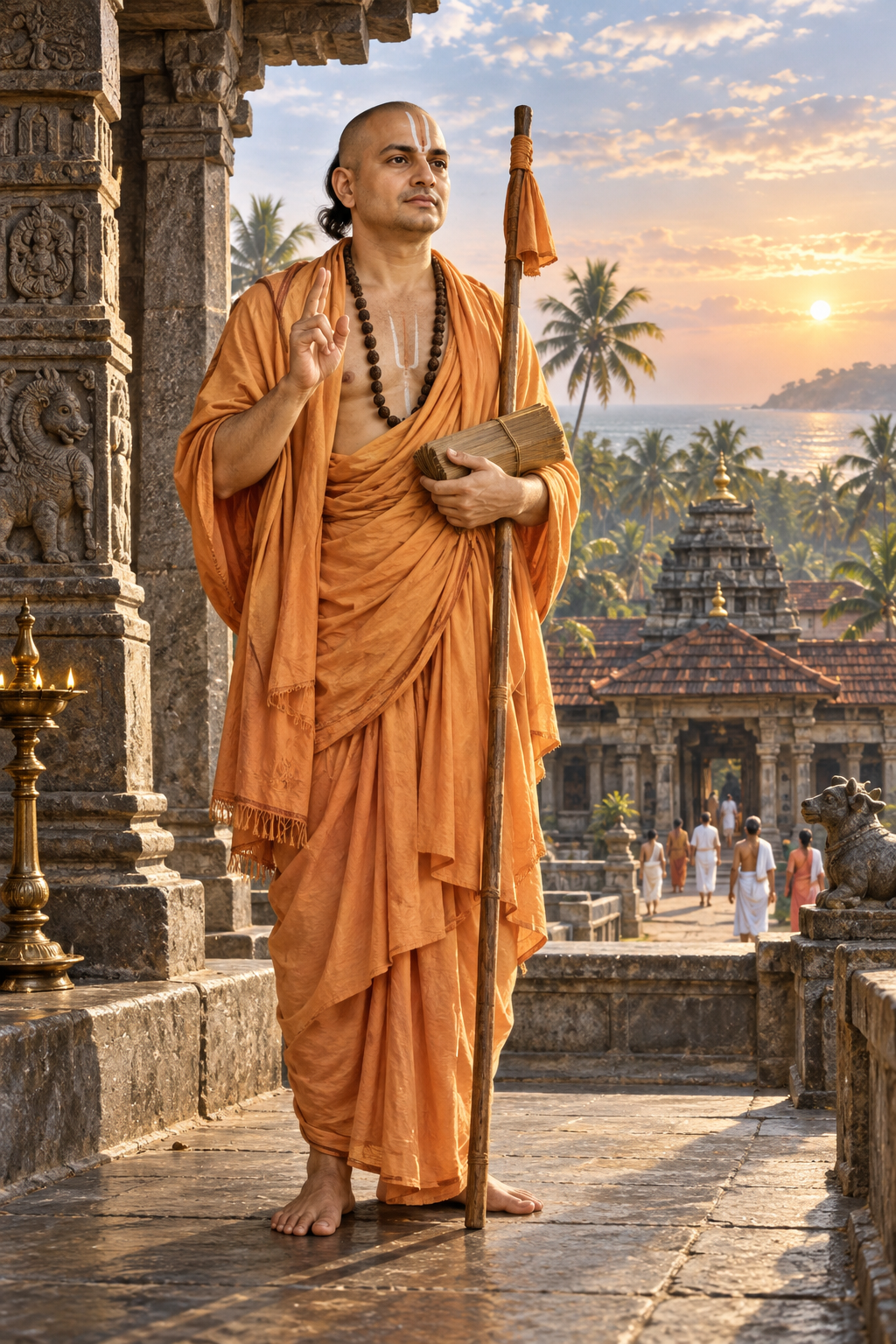
If you are observing Srila Madhvacarya’s appearance and know little beyond his name, begin with one question: what became visible through his life? His childhood directs you toward devotion and disciplined learning; his teachings direct you toward Vishnu, the reality of the world, the distinct identity of the soul, and service.
You do not need to turn Madhvacarya into either a list of wonders or a remote philosopher. Hold together the child called Vasudeva, the family austerity that preceded his birth, and the precise Vaishnava convictions associated with his mission. That gives you a practical way to remember him, study him, and honor his appearance.
Begin with the family vow, not merely a date
In devotional language, an acarya’s “appearance” means more than the beginning of a biological life. The word asks you to see a birth in relation to its spiritual purpose. It shifts attention from chronology alone to the dharma embodied and taught through that person.
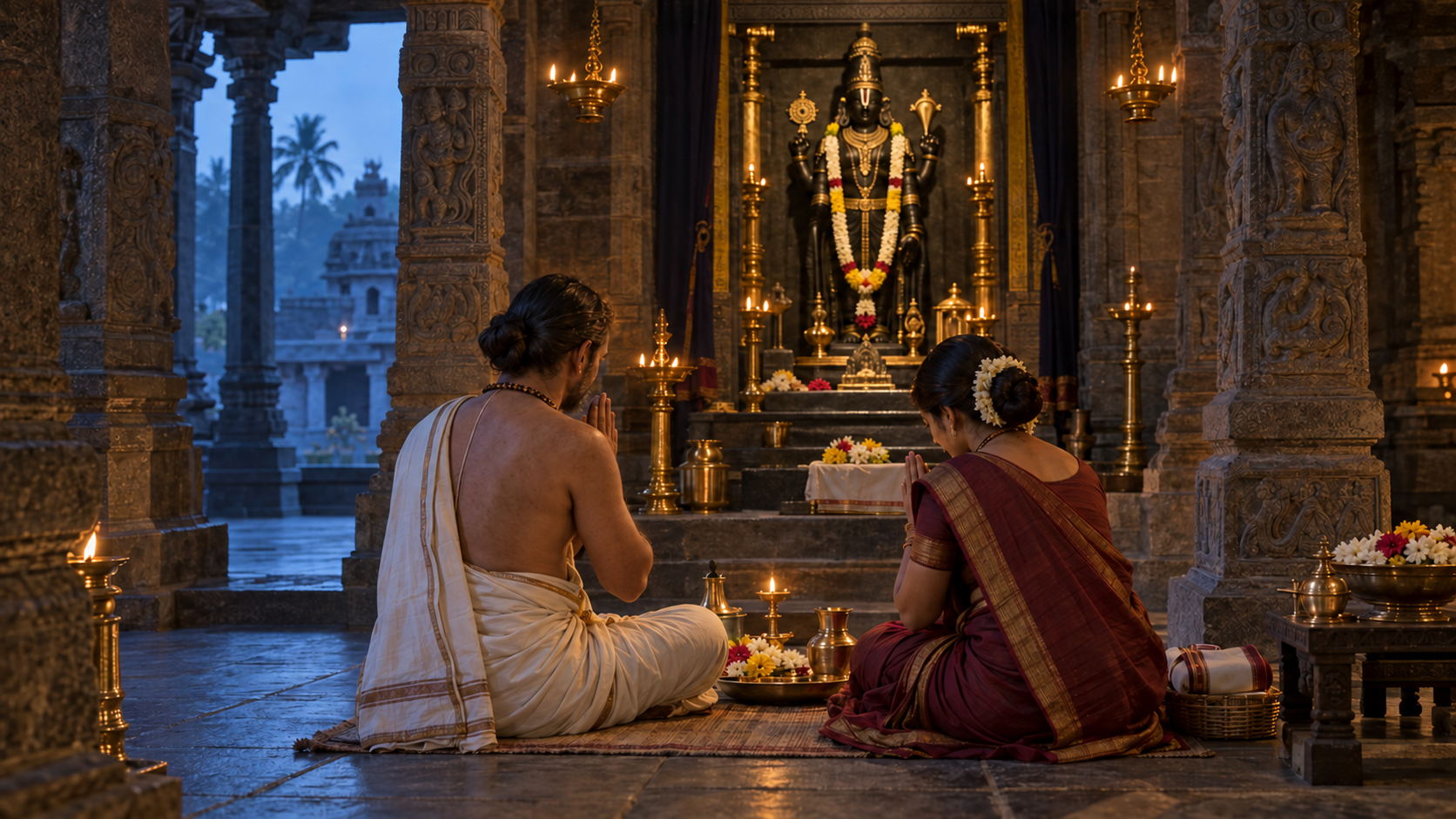
Madhvacarya appeared in a place identified as Madhyegeha. His father was Narayan Bhatta, and his mother is remembered as Vedanti, with Vedavidhya given as another form of her name. Before his birth, his parents had lost two children prematurely. Their longing for a surviving son therefore arose from grief, not ordinary family ambition.
Narayan Bhatta and Vedanti undertook prolonged tapasya for a child and sustained themselves on milk for many years. Within the received account of his life, that austerity forms the human setting for Madhvacarya’s appearance: bereaved parents carried a single prayer with unusual steadiness.
When you recount his appearance at home, in a temple gathering, or to a younger listener, do not rush past this part. The grief and tapasya prevent the story from becoming a sentimental tale about a gifted child. They place his birth within perseverance, dependence on the Divine, and the cost of a sincerely held vow.
Why the child Vasudeva matters to the mature acarya
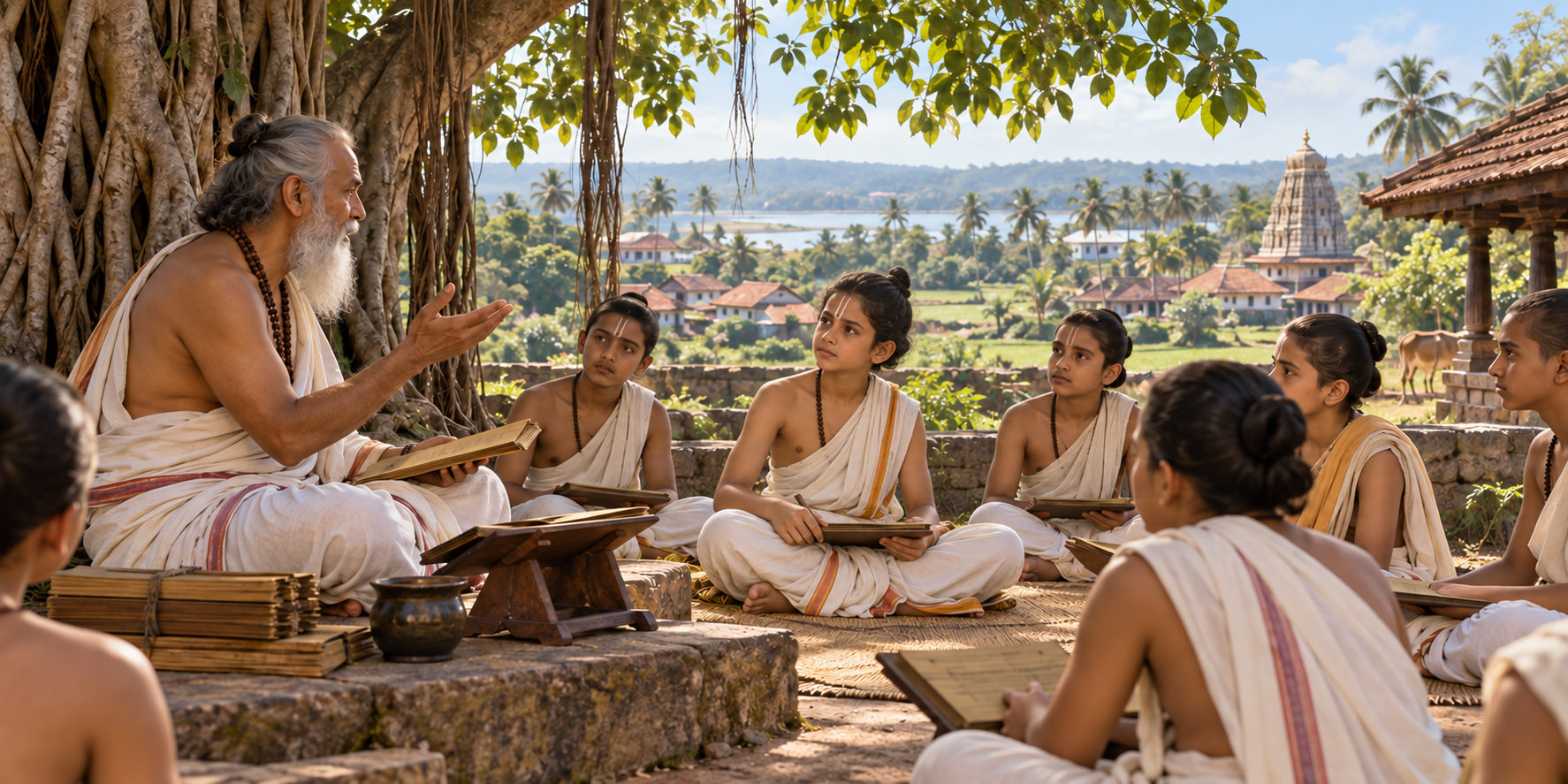
Narayan Bhatta named his son Vasudeva. That childhood name should not be treated as an incidental biographical detail. It helps you remember that Madhvacarya’s public teaching emerged from an early life already oriented toward Vishnu.
Vasudeva would recite and enact the Lord’s pastimes, astonishing his companions. This combination is worth noticing: he did not only retain sacred narratives as information; he gave them voice and form. His learning was joined to devotional imagination.
His formal development was equally striking. He completed his primary education in a short period, received the Brahminical thread at the age of five, and became known for extraordinary command and memorization of Vedic literature. The thread ceremony and mastery of sacred learning belong together here: responsibility toward Vedic knowledge accompanied intellectual ability.
Do not turn these childhood accomplishments into a standard by which ordinary children are judged. Their purpose in his life story is not to shame anyone whose memory or education develops differently. They show the continuity between Vasudeva’s early attraction to the Lord and Madhvacarya’s later work as an acarya.
You can apply that insight when teaching his life. Read or recite one divine pastime aloud, then ask each listener to retell its central movement in plain language. The aim is not theatrical polish. It is to join hearing, memory, expression, and devotion instead of leaving sacred learning as silent information.
Read Madhvacarya’s nine teachings as one vision
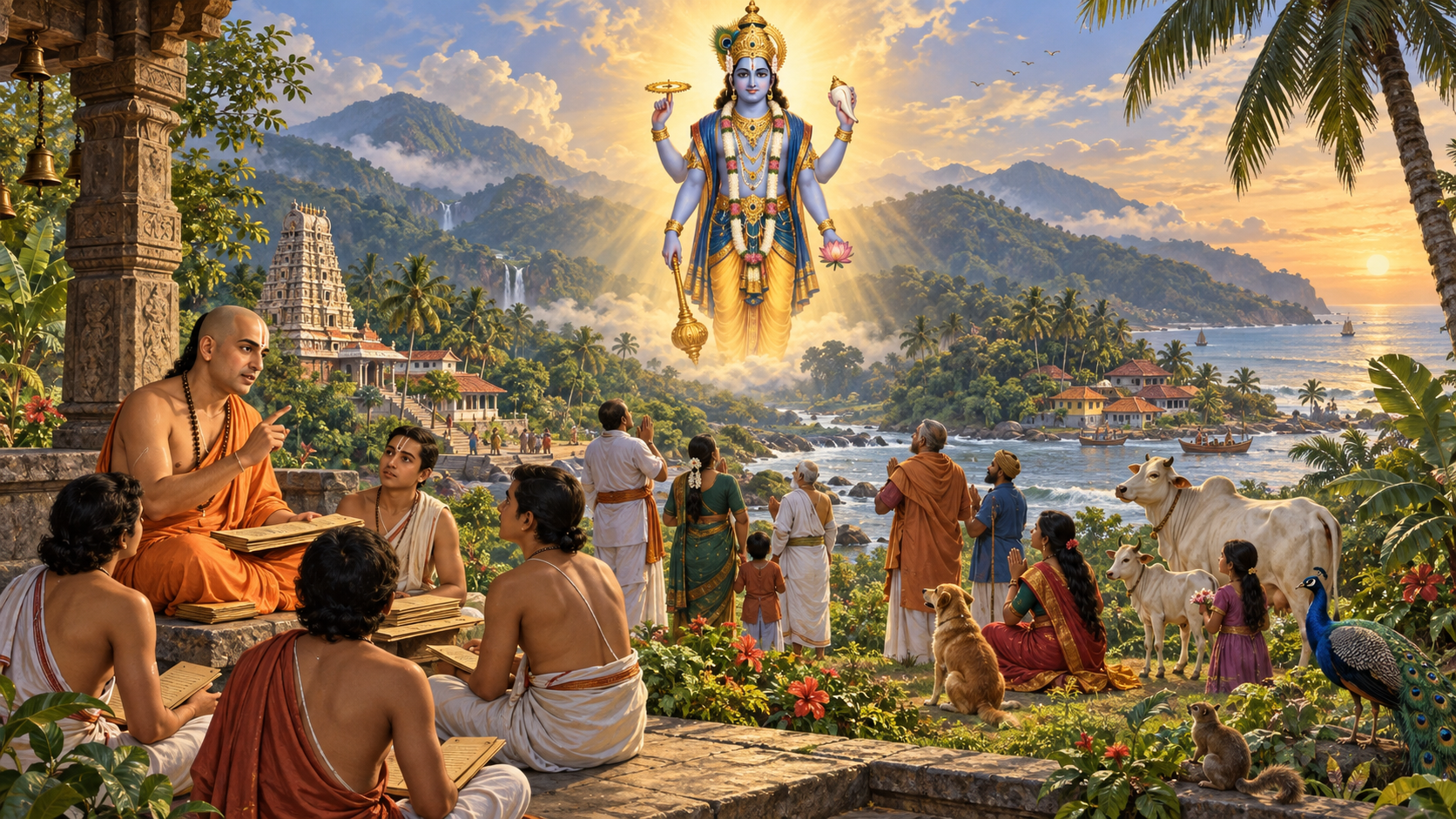
Sri Baladeva Vidhyabhushana is credited with a concise nine-point presentation of Madhvacarya’s siddhanta. Read the points in sequence. They are not nine disconnected slogans; each helps explain the place of Vishnu, the world, the living being, liberation, worship, and knowledge.
- Vishnu alone is the Supreme Absolute Truth. Madhvacarya’s system begins with a definite Supreme, not an undefined religious ideal.
- Vishnu is the object of Vedic knowledge. Vedic study is therefore read through a Vishnu-centered theological orientation.
- The material world is real. The field in which you act, worship, learn, and accept responsibility is not dismissed as sheer nonexistence.
- Living entities are distinct from Vishnu. Devotion requires a real relation between the worshipper and the worshipped; it does not erase their distinction.
- Living entities are servants of Hari’s lotus feet. The soul’s identity is expressed through service, not merely through intellectual description.
- Living entities may be liberated or conditioned. This distinction explains why freedom cannot simply be assumed while bondage continues.
- Reaching Vishnu’s lotus feet brings liberation to the conditioned soul. Liberation is directed toward the Lord rather than treated as an impersonal achievement.
- Pure worship of Vishnu is the conditioned soul’s highest perfection. Philosophical clarity is meant to culminate in worship.
- Truth is known through pratyaksha, anumana, and shabda. Direct perception, reasoned inference, and Vedic authority each belong to the pursuit of knowledge.
Three movements hold this vision together. Vishnu has unsurpassed supremacy. The world and living entities possess reality and distinction. The conditioned soul’s fulfillment lies in liberation and pure service at the Lord’s feet. If you detach any one movement from the others, Madhvacarya’s position becomes easier to misrepresent.
The affirmation that the world is real deserves particular attention. It corrects the loose claim that every Vedantic school simply declares the world unreal in the same sense. Madhvacarya’s position, usually associated with Dvaita Vedanta, preserves difference rather than dissolving Vishnu, the soul, and the world into an undifferentiated formula.
That distinction also matters in a broad Dharmic conversation. These are Madhvacarya’s Vaishnava conclusions, not a neutral creed shared in identical form by every Hindu, Buddhist, Jain, or Sikh tradition. Respect between traditions begins by representing each one accurately. Do not make Madhva easier to accept by removing the very distinctions he defended.
Use the three pramanas as a study discipline
The final principle gives you a method for examining what you hear. Keep three headings in your notes and ask a different question under each:
- Pratyaksha, direct perception: What has actually been observed, and what has merely been assumed?
- Anumana, inference or logic: What conclusion is being drawn, and do the stated reasons support it?
- Shabda, Vedic authority: What sacred authority is being invoked, and is its meaning being represented carefully?
This simple discipline will not replace a full study of Madhva’s epistemology. It will, however, stop three common errors: treating personal impression as proof, calling speculation logic, and using the prestige of scripture without establishing what the cited authority teaches.
A practical way to observe Madhvacarya’s appearance

No single household exercise should be mistaken for a universally mandatory ritual. The following sequence is a study-centered observance you can adapt to the established practice of your family, guru, or temple.
- Tell the family setting honestly. Include the loss of the two earlier children, the parents’ austerity, and their hope for a son who would live. Do not reduce the account to the child’s brilliance.
- Say both names. Remember Vasudeva as the gifted and devotional child, and Madhvacarya as the teacher whose mature identity is inseparable from siddhanta.
- Read the nine principles aloud. After each one, restate it in ordinary language without weakening its meaning. If you cannot paraphrase a proposition accurately, mark it for further study rather than pretending to understand it.
- Examine one claim through the three pramanas. Separate what you perceive, what you infer, and what you accept through Vedic authority. This makes the epistemological teaching an actual practice rather than a Sanskrit vocabulary test.
- Let study culminate in worship and service. Offer worship to Vishnu according to your tradition, then perform a concrete act of seva appropriate to your home or temple. This reflects the teaching that the living being is a servant of Hari.
This sequence protects against two opposite reductions. Madhvacarya should not be remembered only as a formidable thinker whose importance lies in argument. His stated culmination is pure worship of Vishnu. Yet he should not be flattened into a generic saint whose doctrines do not matter. His devotion possesses a precise theological structure.
When disagreement arises, return to the same discipline. First state Madhvacarya’s position accurately. Then distinguish perception, reasoning, and scriptural authority. Only after that should you evaluate the claim. Accuracy is a form of respect even when the listener belongs to another sampradaya.
Key takeaways
- Madhvacarya was named Vasudeva by his father, Narayan Bhatta; his mother is remembered as Vedanti or Vedavidhya.
- His appearance followed profound family loss and years of austerity undertaken by his parents for a surviving son.
- His childhood joined rapid Vedic learning and memorization with recitation and enactment of the Lord’s pastimes.
- His siddhanta centers Vishnu as Supreme, affirms the reality of the world and the soul’s distinction, and directs the conditioned soul toward liberation through pure worship.
- Pratyaksha, anumana, and shabda give you a practical framework for separating observation, inference, and Vedic authority.
- The most fitting observance joins accurate remembrance, careful study, Vishnu worship, and service.
At your next observance, choose one of the nine principles and carry it beyond the gathering. Write it in your own words, test your understanding through the three pramanas, and let it shape one act of worship or service. That is how an appearance day becomes part of your practice rather than another date that passes.
References

Leave a Reply
You must be logged in to post a comment.