
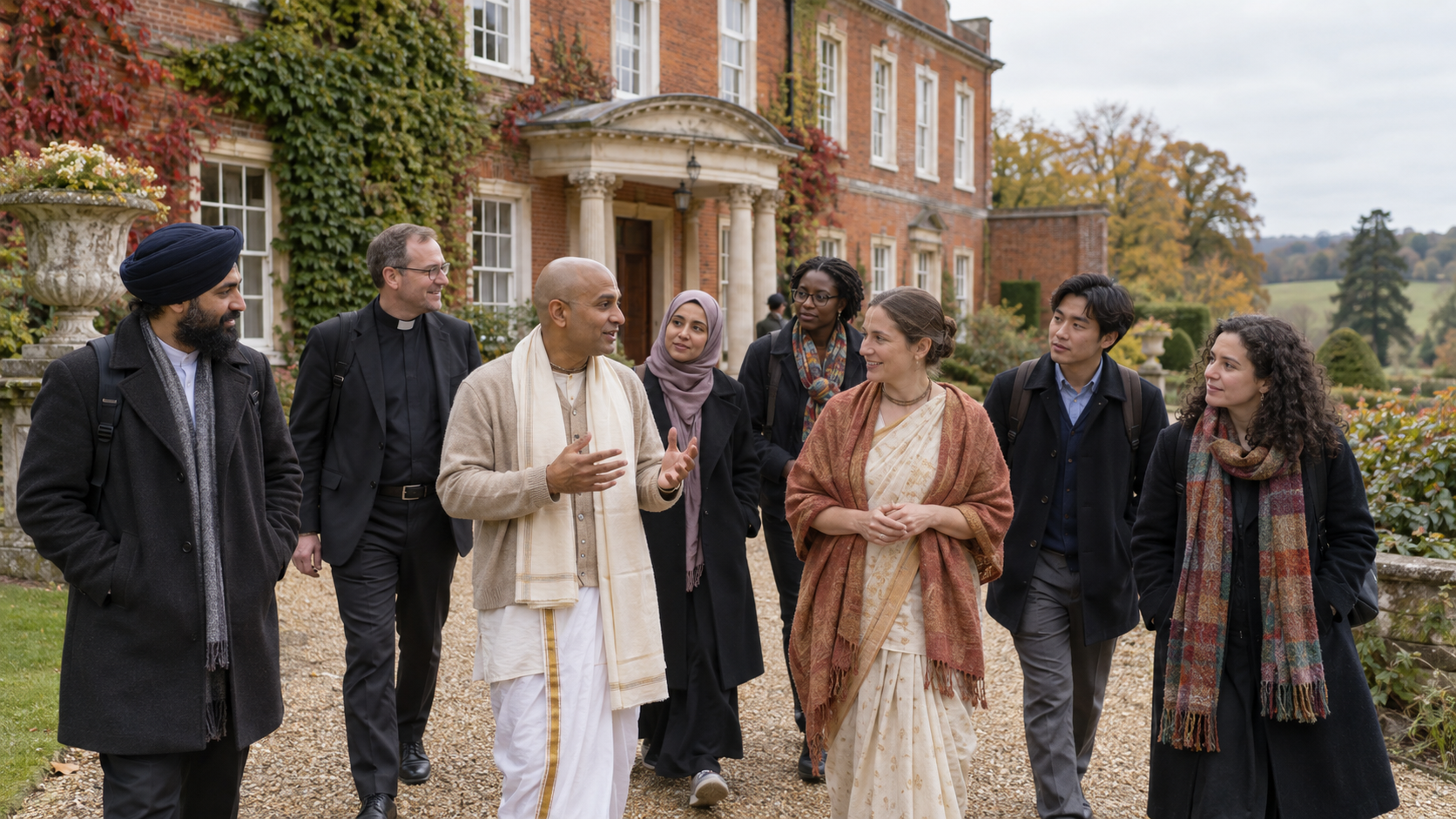
If you are arranging interfaith education for clergy, teachers or students, the difficult question is not how many facts to include. It is how to introduce a living religious community without reducing its worship to a spectacle or treating polite agreement as understanding.
Bhaktivedanta Manor offers a practical answer. Let visitors encounter a particular community in its own setting, give them enough language to interpret what they see, make the boundaries around participation clear, and create time for ordinary human conversation. That combination can turn an unfamiliar tradition into a relationship people want to continue.
Start with a particular community, not generic Hinduism
An interfaith visit becomes confused when it promises to explain Hinduism as though Hindu traditions formed a single denomination with one theology and one pattern of worship. Bhaktivedanta Manor is a specific Krishna-conscious community. Its devotees should be allowed to explain their own convictions clearly, without being asked to represent every Hindu school.
That clarity was especially important when the Manor’s ISKCON Educational Services welcomed Church of England vicars-in-training from the Eastern Region Ministry Course. People preparing for Christian ministry did not need a blurred catalogue of beliefs. They needed an intelligible encounter with a community they may meet in their future public and pastoral work.
Before your own visit, give participants a three-part scope note:
- Who is hosting: name the institution and community rather than using Hindu as the only identifier.
- What the visit covers: identify Krishna consciousness, its devotional life and the practices guests will encounter.
- What the visit does not claim: state plainly that one community cannot stand for every Hindu philosophy, lineage or regional tradition.
This protects everyone involved. Visitors know what they are learning, while devotees are free to speak from within their tradition rather than supplying an artificial survey of all Hindu life.
Build the encounter around five different ways of learning
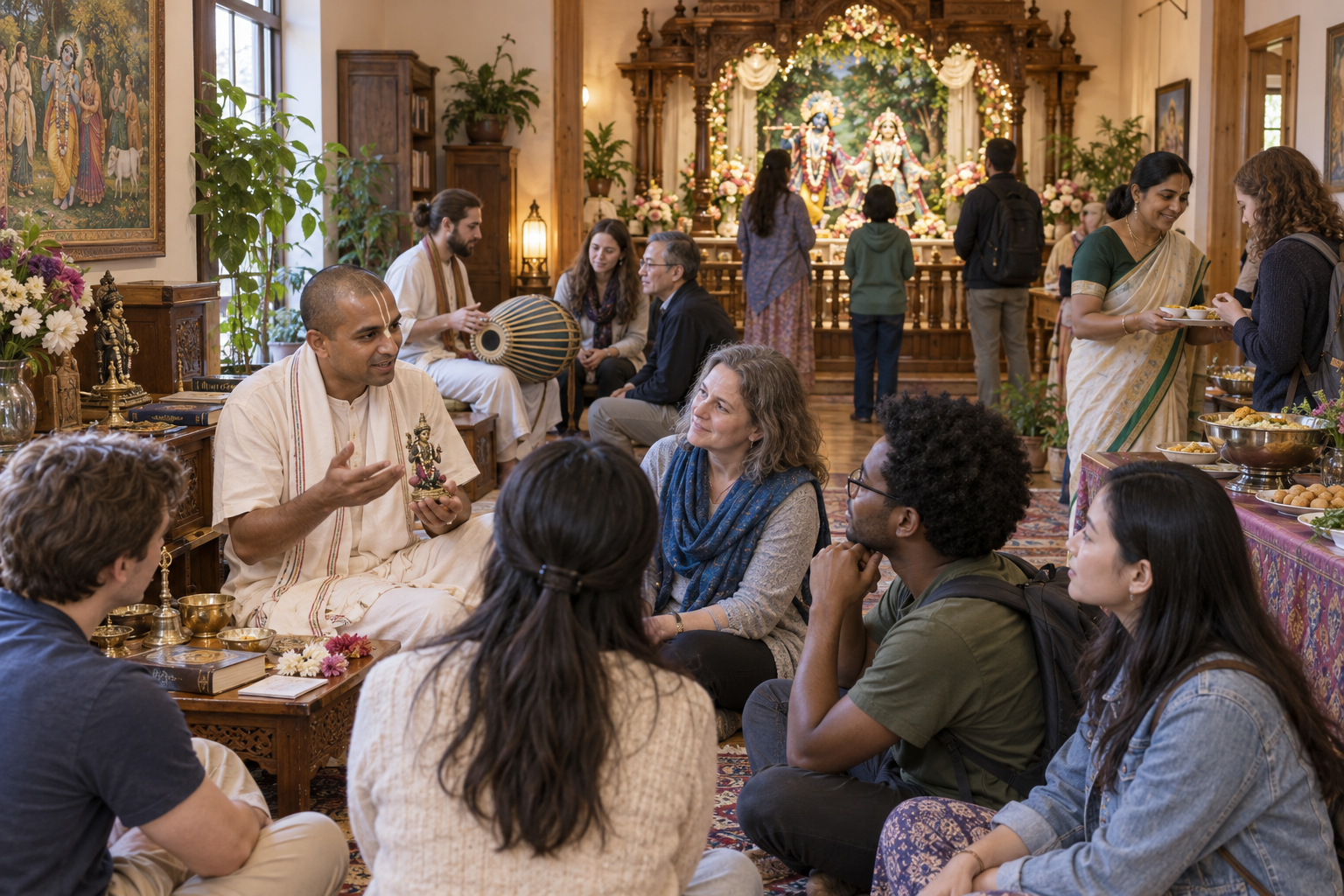
A classroom lecture can define unfamiliar terms, but it cannot reproduce the experience of entering a place of devotion. The Manor programme brought together a tour of the grounds, introductory books, midday arati, a shared lunch and conversation with Krsna Ksetra Swami in Srila Prabhupada’s room. Each element answered a different kind of question.
- Begin with place and people. A guided tour lets visitors notice that a religious community is not merely a set of propositions. Show them where worship, teaching, hospitality and daily community life happen, and explain what each space is for.
- Supply a usable vocabulary. Give guests a short introduction they can revisit afterward. Define Krishna consciousness, devotion, guru and arati in the community’s own terms. A small number of well-explained words is more useful than a long glossary delivered too quickly.
- Encounter worship as worship. Arati is a devotional offering of light before the deity, not a performance inserted for visitors. Explain its purpose before it begins so that guests can understand the ceremony as an act of devotion.
- Eat together. A shared meal changes the social texture of the visit. People who hesitate to ask a formal question may speak more naturally at the table, while hosts and guests meet one another as people rather than representatives of competing systems.
- Make room for a practitioner conversation. Books give structure, but a conversation allows visitors to test what they think they understood. Ask a rooted practitioner how a teaching is lived, not only what it means in the abstract.
You do not need to imitate every feature mechanically. Preserve the educational movement: orientation, explanation, encounter, hospitality and reflection. If time is limited, reduce the number of topics rather than removing the opportunity for questions.
Make the boundary between participation and agreement explicit
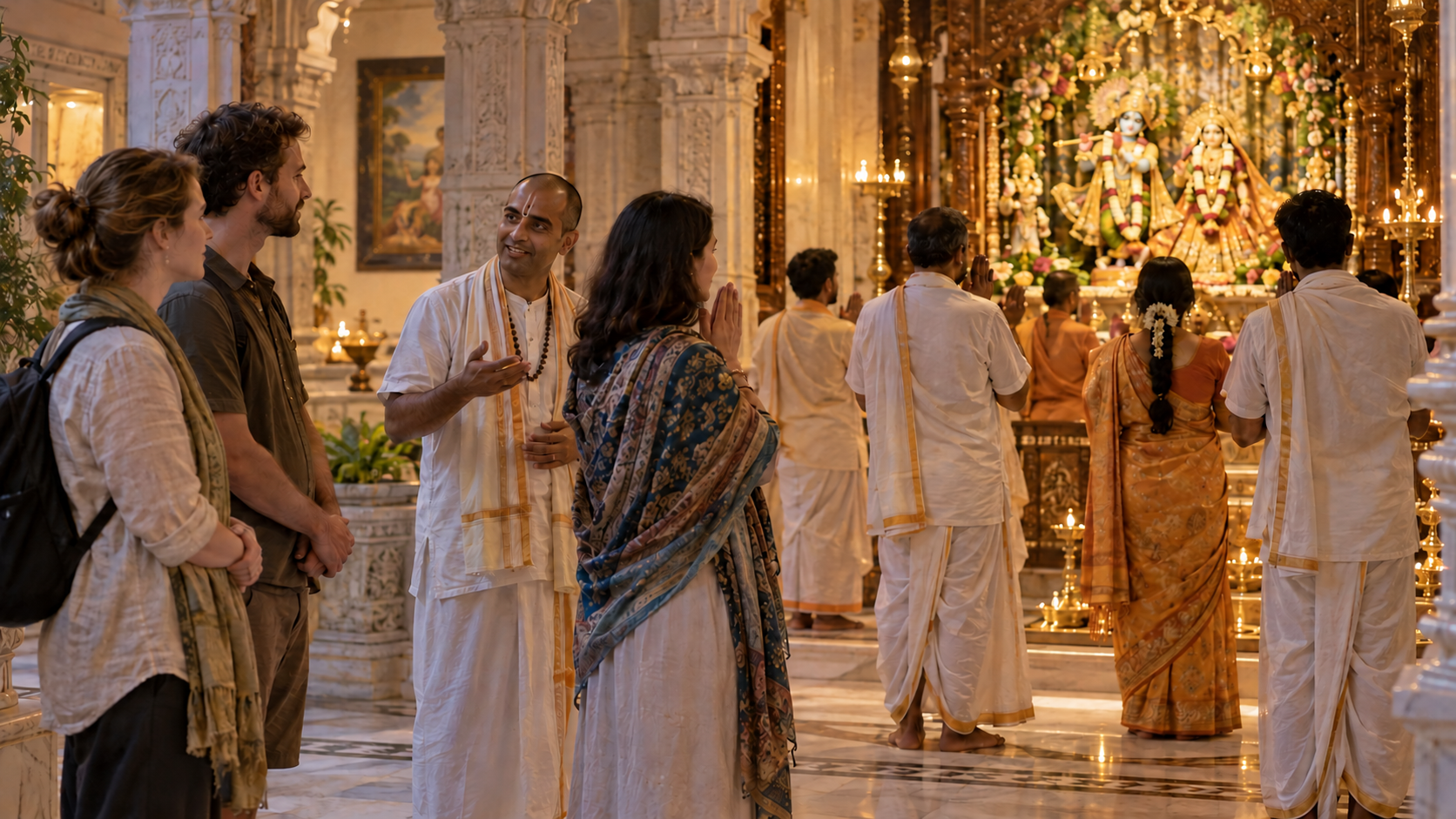
Worship presents the most sensitive part of many interfaith visits. A visitor may be interested in joining a gesture yet uncertain about its theological meaning. Another may prefer to observe. Neither response should be treated as a test of openness.
The visiting vicars-in-training joined the midday arati with enthusiasm. That response shows that respectful participation can be possible across religious boundaries. It does not establish a rule that every future guest should participate in the same way.
Hosts can prevent confusion by addressing four points before worship starts:
- Explain what the community believes is happening in the ritual.
- Distinguish observing, following along and actively participating.
- Say clearly that quiet observation is welcome and requires no apology.
- Describe any practical expectations before guests enter the worship space, rather than correcting them publicly afterward.
The debrief matters just as much. Begin by asking what participants noticed and how the host community explained it. Only then move to similarities and differences. Starting with comparison too early encourages people to translate an unfamiliar practice into their own religious categories before they have understood it on its own terms.
Good interfaith education does not require Christians to become less Christian or Vaishnavas to become less Vaishnava. It asks both sides to listen accurately, describe differences without hostility and resist the temptation to manufacture agreement.
Turn hospitality into a relationship that can continue
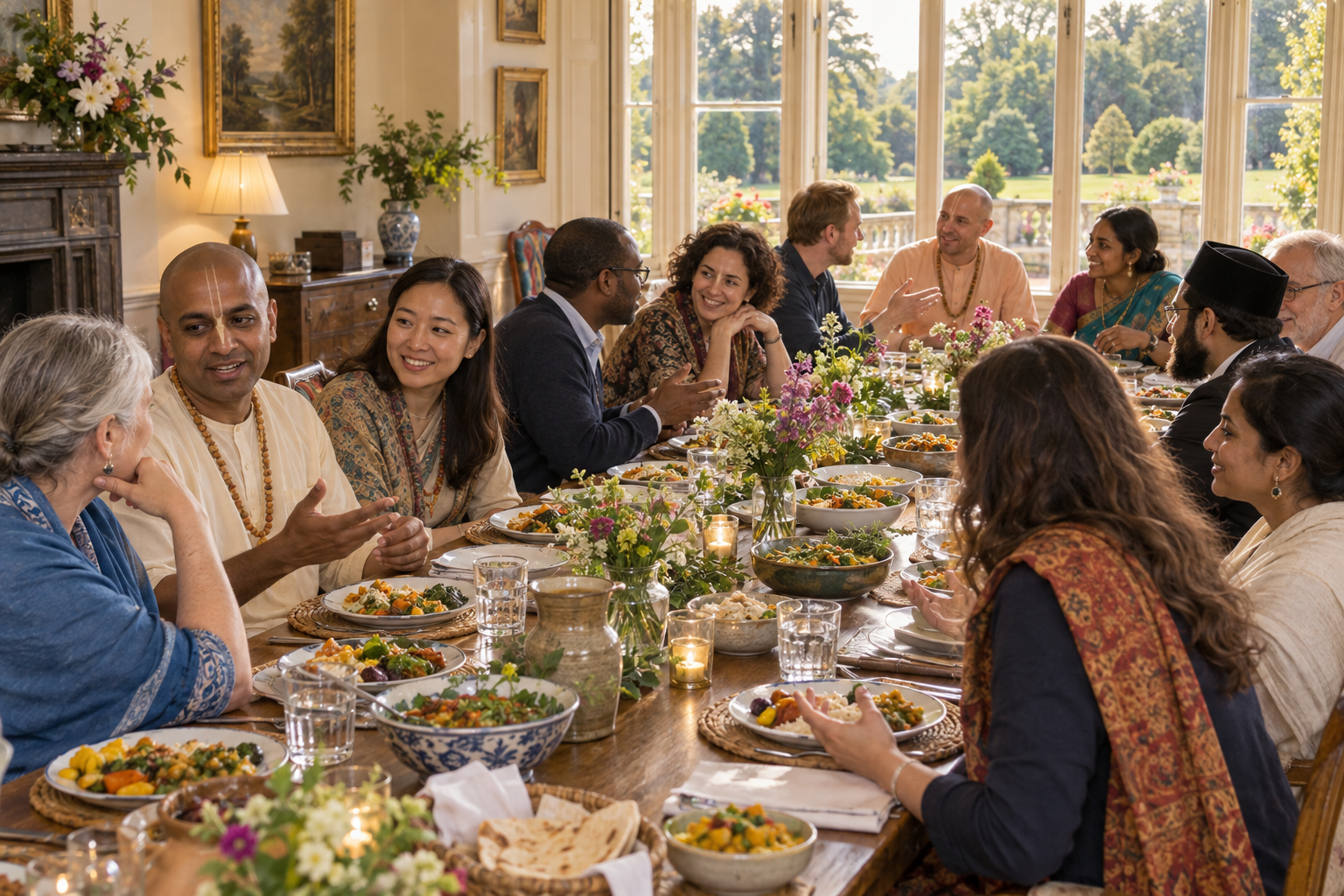
Hospitality is not the decorative part of the curriculum. A tour and ceremony can leave guests impressed but still distant. Eating together and speaking informally create the conditions in which careful questions become possible.
The Eastern Region Ministry Course organiser already had a longstanding regard for the Manor community and its welcoming atmosphere. After this visit, the group expressed a wish to return annually. That does not prove that the same format will work for every audience, but it does show that this particular encounter was valuable enough for its participants to seek continuity.
If you want that continuity, do not let the relationship end with departure. Use a simple three-part follow-up:
- Ask every participant to record one point they can now explain more accurately.
- Collect the questions that remain unresolved, especially questions people did not feel ready to ask during worship.
- Send the hosts a concise response that includes thanks, what the group learned and one realistic proposal for continued contact.
A return visit is not the only useful next step. A reciprocal visit, a focused discussion on one theological question or a conversation between trainees and practitioners can deepen the relationship. Choose one next action with a named organiser; otherwise goodwill usually remains only an intention.
Key takeaways: four outcomes worth checking
Do not judge an interfaith visit only by whether everyone enjoyed it. Before participants leave, check whether they can do four concrete things:
- Name the hosts accurately. They should be able to identify Bhaktivedanta Manor and its Krishna-conscious community, not merely say that they visited a Hindu place.
- Explain one practice in the hosts’ terms. A visitor should be able to describe what arati means to devotees before offering a personal comparison or judgement.
- State the limits of the encounter. Participants should understand that this visit introduced one community and did not make them experts on every Hindu tradition.
- Carry one good question forward. A thoughtful unresolved question is often a better result than a superficial claim that all religions are essentially the same.
If you are planning a visit, write the scope statement, participation note and debrief questions before you settle the rest of the programme. Once those three elements are clear, the tour, worship, meal and conversation can serve genuine understanding rather than becoming a sequence of interesting but disconnected activities.
References

Leave a Reply
You must be logged in to post a comment.