

You can understand every word in a Bhagavad Gita translation and still struggle to see how self, action, nature, time and the Supreme fit together. If you think in systems, a block diagram can make those relationships easier to examine. It can also mislead you if a metaphor is mistaken for a physical measurement.
The useful question is not whether thermodynamics proves Krishna. It does not. The useful question is whether engineering habits—defining boundaries, distinguishing a controller from a process, tracing feedback and locating an identification error—can help you read the Gita more carefully and act with greater clarity.
Begin with the system boundary, not an equation

An engineer first asks what belongs in the model. One proposed Supreme Absolute Truth, or SAT, schematic identifies five entities: Ishvara or God, the individual souls, material nature, time and karma as activity. It draws upon a presentation associated with A.C. Bhaktivedanta Swami Prabhupada, so you should understand it as a particular pedagogical reading rather than a substitute for the Sanskrit text or every Hindu commentary.
| Element in the model | Engineering question | Question for your life |
|---|---|---|
| Ishvara | What is the ultimate source and governing context? | Which part of reality exceeds your ownership and control? |
| Jiva, the individual soul | Who is the conscious agent or observer? | Are you identifying with awareness itself or only with a temporary role? |
| Prakriti, material nature | What is the operating field? | Which bodily, mental and environmental conditions are shaping the choice? |
| Kala, time | How does the system change? | What is temporary, maturing or becoming harder to reverse? |
| Karma, activity and consequence | Where is feedback retained? | How will this action condition the next situation and the next choice? |
This five-part boundary is useful because each omission produces a characteristic blind spot. Leave out time and you treat a changing life as a static snapshot. Leave out karma and action appears to have no feedback. Leave out the jiva and the human being becomes an elaborate machine. Leave out Ishvara and the model cannot represent devotion, surrender or a reality beyond personal control.
The model does not prove that its five elements exist. It helps you notice which relationships a strictly material or psychological diagram cannot express. That distinction—between describing a worldview and experimentally establishing it—must remain visible throughout the exercise.
Read the arrows as dependence, not measurable energy flow

The SAT arrangement places God at the infinite end of a vertical energy axis, with souls, nature, time and karma at lower levels. Arrows indicate an ordered dependence upon the Supreme. In an engineering drawing, however, the word energy normally demands a unit, a measurement procedure, a defined system boundary and equations that can be tested.
No such measurement turns Ishvara into a reservoir of joules. Infinite energy in this spiritual model means inexhaustible source, supremacy and subtlety. Physical energy in thermodynamics is a quantitatively defined property. Using one word in both settings can stimulate thought, but it does not make the two meanings identical.
A good way to prevent category errors is to replace each unlabeled arrow with a verb. Ask whether one element conditions, constrains, governs, reveals, results from or depends upon another. If you cannot name the relationship without saying only that energy flows, the diagram has not yet clarified your thought.
- A physical claim specifies quantities and can be tested against observations.
- A systems analogy transfers a pattern from one domain to another so that relationships become easier to inspect.
- A metaphysical claim concerns the nature of reality and requires philosophical, scriptural or contemplative reasoning appropriate to that claim.
The SAT framework places the interaction of material nature and time in the domain of science, and the relation between soul and God in the domain of religion. It then proposes a physics–psychology–parapsychology bridge associated with Bhagavad Gita 3.42. That division can remind you that every method has a scope. It does not authorize you to insert God as an undefined term in a physics equation or to call a spiritual conviction an experimental result.
What the heat-engine analogy reveals—and where it stops
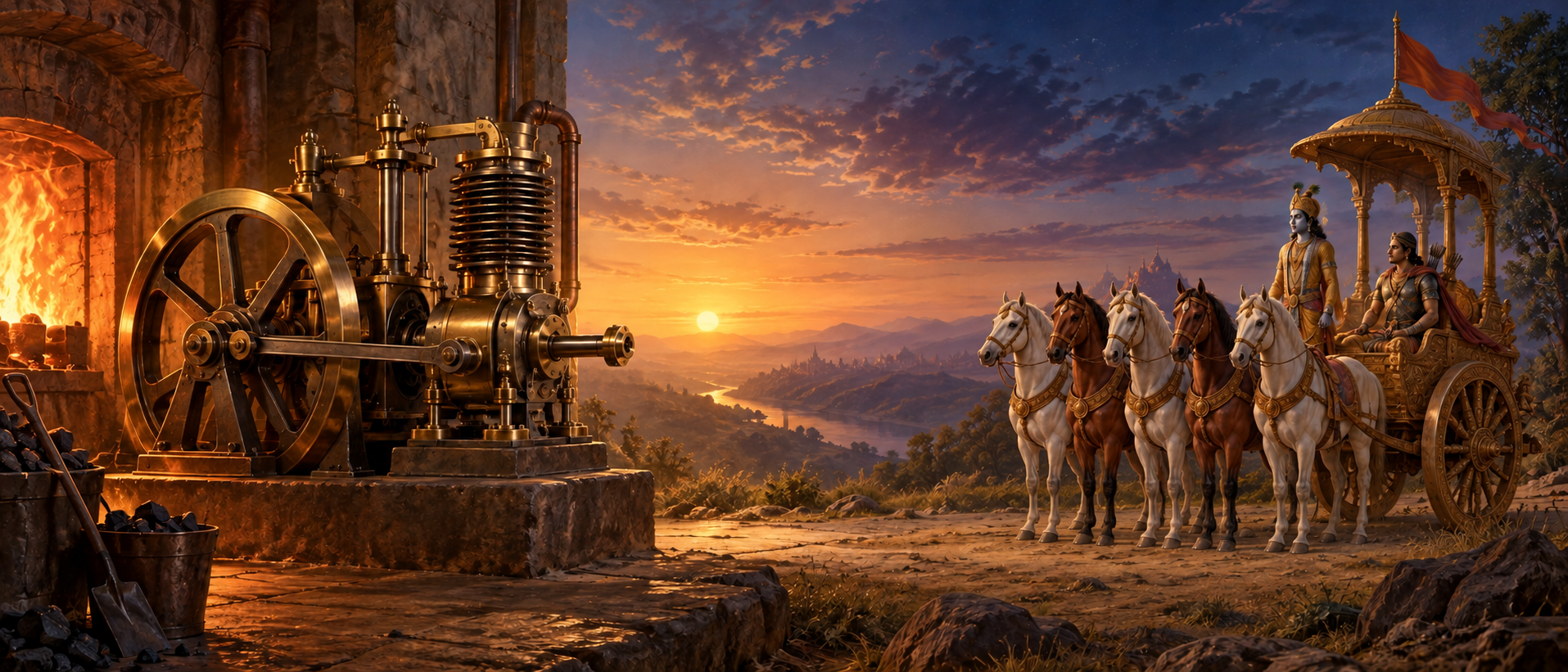
A conventional heat engine takes energy from a hotter reservoir, produces work and rejects heat to a cooler sink. The total entropy of the complete process does not decrease. In the proposed spiritual analogy, a living entity consists of the soul operating through body, mind, intelligence and false ego. When that being identifies exclusively with the material apparatus, it resembles a heat engine running from an infinite source toward a finite reservoir of accumulated karma.
The strongest insight here concerns direction. Attention continually moves outward through appetite, fear, status, possession and bodily identity. Action produces consequences; those consequences shape later circumstances and tendencies; those tendencies influence further action. False ego acts like an incorrectly drawn system boundary: you mistake the instrument, role or output for the whole self.
The contrasting refrigerator metaphor represents deliberate inward discipline. A refrigerator does not passively follow the easiest thermal direction; it requires work to move heat against a local gradient. Likewise, yoga requires sustained effort to prevent impulse from functioning as the automatic controller. Attention is redirected through discrimination, self-knowledge, devotion and surrender toward the Supreme.
The analogy becomes unreliable when its terms are treated literally. Thermodynamic entropy is defined for physical states; it is not a numerical measure of greed, confusion or sin. Karma is not a tank with a capacity stated in energy units. Enlightenment cannot be calculated as a low-entropy state. A refrigerator also does not repeal the second law: it consumes work and increases total entropy while producing a local change. Its spiritual value is therefore modest but useful—transformation requires directed effort rather than wishful thinking.
Labels such as inward and outward are clearer than attaching the two modes to biological sex or treating Yin and Yang as engineering variables. Nor should nirvana, moksha, enlightenment and communion be collapsed into perfect synonyms. Hindu and Buddhist traditions give these terms distinct doctrinal settings. When a schematic groups them together, read that grouping as the model’s broad indication of transcendence, not as proof that the traditions make identical claims.
Most importantly, inwardness does not mean refusing worldly duty. The Gita addresses a crisis of action, not a search for an excuse to avoid action. The engineering question is therefore not whether you can shut the system down. It is whether bodily impulse, social approval and fear are controlling the action, or whether a steadier intelligence is directing it toward dharma.
Use Bhagavad Gita 3.42 as a debugging hierarchy

Bhagavad Gita 3.42 orders the human interior from the senses to the mind, from the mind to intelligence, and from intelligence to the self. An engineer can read this as a hierarchy without reducing consciousness to software. Sensory contact supplies signals. The mind gathers reactions and preferences. Buddhi, or intelligence, discriminates and decides. The self is not exhausted by any one signal, reaction or temporary identity.
Suppose you learn that a project will miss its promised date. The debugging hierarchy changes how you handle the moment:
- Separate the event from the reaction. The delay, test result or unfinished work is the condition in prakriti. Embarrassment and fear are responses to it, not additional facts.
- Inspect the mind’s automatic command. It may urge you to hide the delay, blame someone else or make another promise that the evidence cannot support.
- Bring buddhi into the control loop. Ask what your duty requires, what the known facts permit you to say and which action avoids transferring the cost of your discomfort to someone else.
- Correct the identity boundary. A failed estimate is not the whole self. Neither is a job title, praise from a manager or the wish to appear infallible.
- Act and accept feedback. Report the condition accurately, propose the responsible next action and allow the result to unfold without rewriting the facts merely to protect an image.
This sequence is not emotional suppression. A signal can be acknowledged without being promoted into control policy. Fear may tell you that something matters; it does not automatically know what dharma requires. The practical movement is from reaction to discrimination, and then from discrimination to responsible action.
Run the five-part model on a decision you actually face
Do not begin by trying to diagram the cosmos. Begin with one decision in which attachment is making your duty difficult to see. Write the decision as plainly as you can, then complete the following sequence:
- Prakriti: list the material facts, bodily pressures, habits and external constraints. Keep facts separate from predictions and self-judgements.
- Kala: identify what changes if you act now, postpone the choice or continue the current pattern. Time is part of the system, not an empty background.
- Karma: trace the feedback. Ask what tendency this action strengthens in you, what consequence it hands to others and what kind of next decision it makes more likely.
- Jiva: name the identity you are defending. Then ask whether that role—professional, parent, winner, victim, expert or outsider—is being mistaken for the whole self.
- Ishvara: mark what does not belong to your control. This is where devotion and surrender enter without cancelling effort: you remain responsible for the action, but you do not claim ownership of the entire field or every result.
- Dharma: choose the action that remains defensible after fear, appetite and reputation have been removed from the controller’s seat.
After acting, review the decision by asking whether intelligence governed impulse, whether the system boundary became less ego-centred and whether the action made the next dharmic choice easier. Winning, receiving praise or obtaining the desired outcome is not a sufficient test; those outputs can occur even when the controlling intention is confused.
Key takeaways
- Use Ishvara, jiva, prakriti, kala and karma as a completeness check for your reasoning, not as parts of a physical machine.
- Treat energy, reservoir and entropy as analogies unless measurable variables and testable relationships have been defined.
- Read false ego as a boundary error: a temporary body, role or outcome is mistaken for the whole self.
- Use the hierarchy of senses, mind, intelligence and self to find which layer is controlling a difficult decision.
- Let surrender limit your claim over results, not weaken your responsibility for truthful and dharmic action.
Take the decision you have been postponing and draw the five boxes. If the model exposes an attachment, clarifies a duty or reveals feedback you had ignored, it has done useful work. If it tempts you to claim that thermodynamics has proved Krishna, stop at that boundary and return to the Gita’s verses, commentarial traditions and disciplined practice.
References

Leave a Reply
You must be logged in to post a comment.