
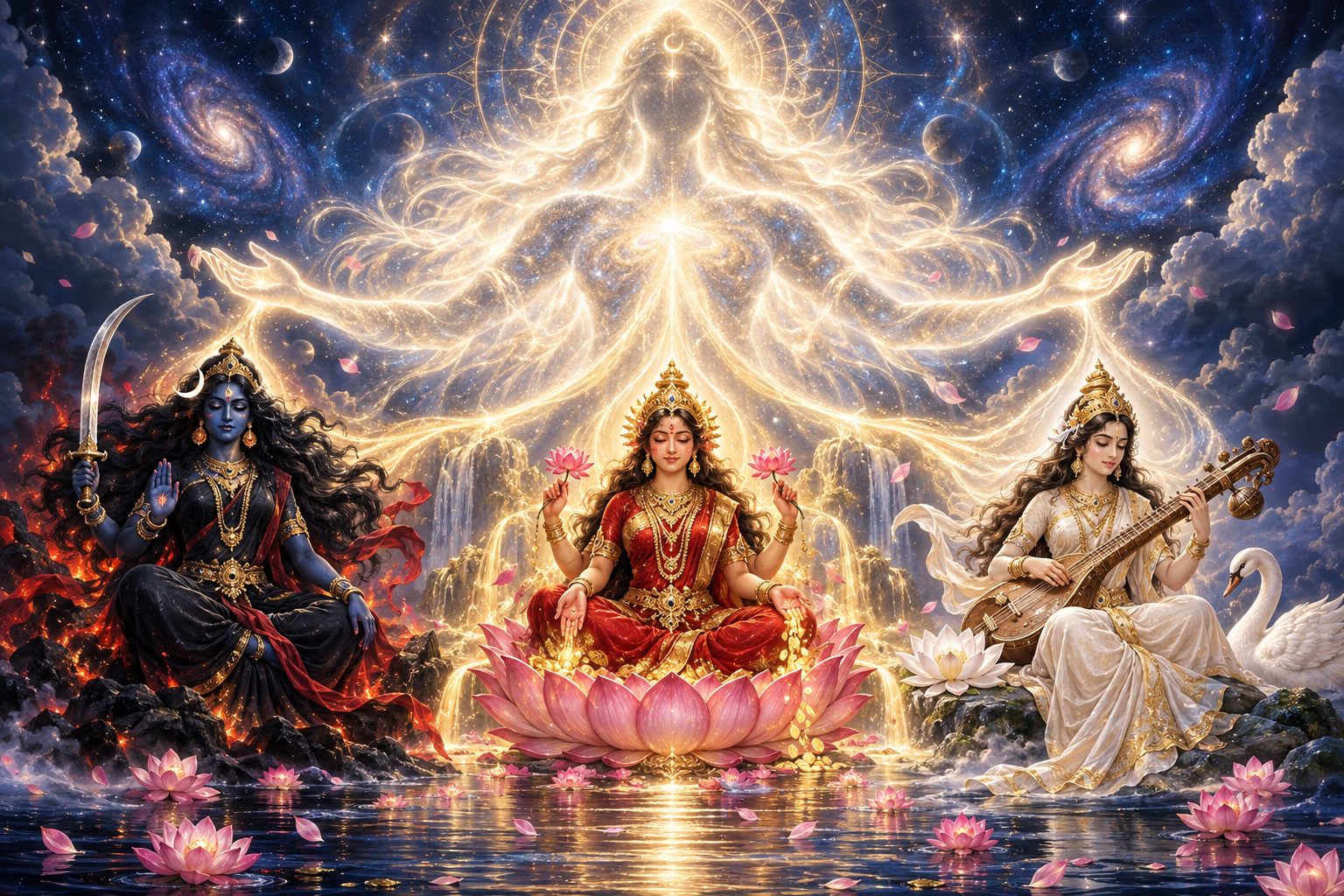
If you have encountered Adi Shakti beside Mahakali, Mahalakshmi, and Mahasaraswati, the obvious question is whether Hindu tradition is presenting four separate goddesses, one supreme goddess with three subordinates, or several names for the same reality. The clearest answer begins by refusing that arithmetic.
Adi Shakti is the primordial divine power. The Tridevi are that one power made intelligible through three distinguishable expressions. Once you hold unity and distinction together, the theology becomes coherent and the three forms become useful guides for spiritual discernment rather than entries in a divine hierarchy.
Begin with one Shakti, not four competing deities
Adi means primordial or original. Shakti is power: not merely physical force, but the capacity through which reality becomes active, manifest, ordered, and transformative. Adi Shakti therefore names divine power at its most fundamental level, before you divide its activity into separate functions.
The cosmological account begins with an infinite void and primordial energy in an undifferentiated condition. Adi Shakti is identified with this original feminine power and with the motherhood of the universe. Mahakali, Mahalakshmi, and Mahasaraswati emerge when that undivided reality is understood through the different work it performs.
This matters because a manifestation is not necessarily a separate source. One flame may give light, warmth, and the power to transform what it touches without becoming three unrelated fires. In the same way, the Tridevi allow you to recognize distinct divine activities without abandoning their common ground in Adi Shakti.
When you see an image or hear a narrative centred on one member of the Tridevi, do not assume that the other forms have been denied. A devotional tradition may bring one form to the foreground while still treating divine power as inexhaustibly one.
The three forms reveal a complete cycle of divine action
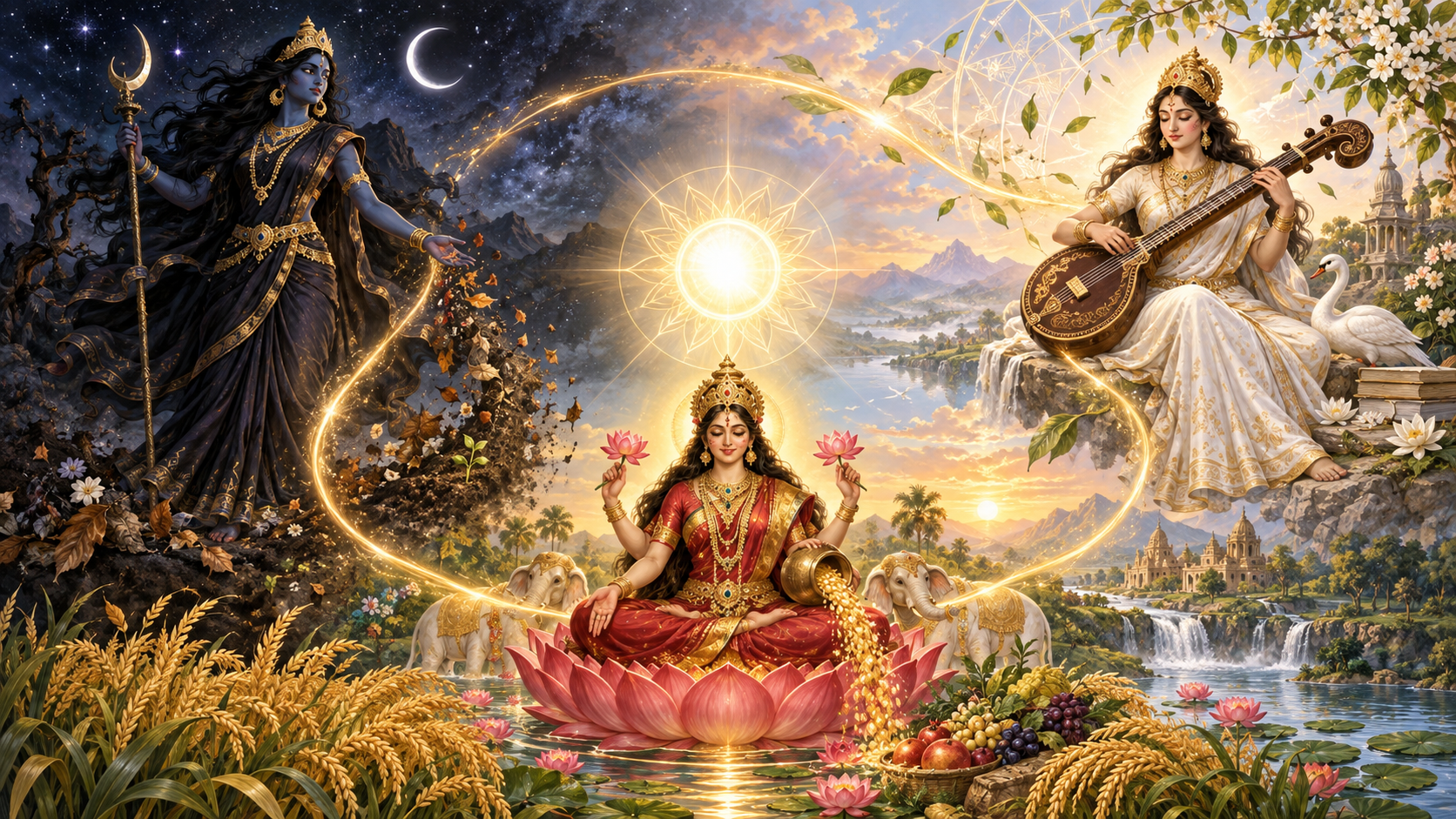
The names Mahakali, Mahalakshmi, and Mahasaraswati do more than divide responsibility among three goddesses. Together they disclose a pattern: reality must be transformed, sustained, and made intelligible. None of those movements is sufficient by itself.
Mahakali expresses the power that confronts limitation and brings an exhausted form to its end. Her fierceness should not be confused with evil or uncontrolled anger. Destruction, in this frame, clears what can no longer carry dharma. If nothing could end, error, decay, and obstruction would become permanent.
Mahalakshmi expresses the power that nourishes, harmonizes, and sustains. Prosperity is part of her field, but reducing Lakshmi to money misses the larger principle. Resources become auspicious when they support order, generosity, beauty, responsibility, and continuity. Acquisition without right use is not the fullness of Lakshmi.
Mahasaraswati expresses the power of knowledge, articulation, discernment, and meaningful formation. Learning is not an ornament added after life has been organized. Understanding is what enables a person to distinguish a worthy form from an unworthy one and to give a clear expression to what ought to emerge.
A common misreading isolates whichever form feels most attractive. You may want Lakshmi’s abundance without Kali’s demand to relinquish what is corrupt, or Saraswati’s learning without the discipline needed to sustain it. The Tridevi correct that imbalance. Sound creation requires insight, support, and the removal of obstruction.
Emergence is differentiation, not a biological family tree

Words such as birth and creation can mislead if you read a cosmic narrative as ordinary chronology. Adi Shakti does not have to disappear so that the Tridevi can take her place. The movement is from undifferentiated potency to recognizable activity: the one becomes perceptible through the many while remaining their ground.
Think of the story as answering a theological question: how can ultimate reality be one while the world displays different powers? The answer is manifestation. Unity is not sameness, and plurality is not necessarily separation. Mahakali, Mahalakshmi, and Mahasaraswati can possess distinct names, forms, moods, and devotional relationships while expressing the same primordial Shakti.
This distinction also prevents a second mistake: treating Adi Shakti as merely the first member of a sequence. She is not simply an older goddess placed before three younger ones. She is the underlying power by which their functions are possible. The Tridevi make that power approachable without exhausting it.
You should not expect every temple, lineage, or devotional telling to organize these relationships with identical language. Hindu traditions often approach divine unity through the form most central to their worship. Use the one-and-three pattern as an interpretive key, not as a demand that every sacred narrative behave like a standardized chart.
Use the Tridevi as a discipline of discernment

You do not need to invent a new ritual to make this theology practical. Before prayer, study, or a significant undertaking, examine the situation through three questions.
- What must be released or confronted? This is the Mahakali question. Name the attachment, confusion, obstruction, or spent form that you keep protecting simply because it is familiar.
- What must be nourished and sustained? This is the Mahalakshmi question. Identify the relationships, resources, habits, and responsibilities that will keep the worthy part of the undertaking alive.
- What must be learned or expressed clearly? This is the Mahasaraswati question. Find the missing knowledge, unasked question, unclear teaching, or poorly formed intention.
- Are all three answers serving dharma? Power is not made sacred merely by being forceful, productive, or clever. Test transformation, prosperity, and knowledge by the order they create and the responsibilities they uphold.
Consider a community trying to revive a neglected programme of dharmic education. Mahasaraswati is present in deciding what should be taught and how it can be communicated truthfully. Mahalakshmi is present in sustaining teachers, materials, space, and mutual goodwill. Mahakali is present when ineffective habits, needless conflict, or confused priorities must be ended. Leaving out any one movement weakens the whole effort.
The same test can clarify personal sadhana. Collecting teachings without relinquishing distraction produces information rather than transformation. Renunciation without nourishment becomes barren. Seeking comfort without discernment lets comfort become attachment. The three forms teach you to see spiritual life as a living cycle rather than a search for one permanent mood.
Key takeaways
- Adi Shakti names primordial divine power; the Tridevi reveal distinct expressions of that one power.
- Mahakali transforms and removes what cannot rightly continue.
- Mahalakshmi nourishes the order, resources, and harmony through which life can flourish.
- Mahasaraswati gives knowledge, discernment, articulation, and meaningful form.
- The emergence of the Tridevi is best read as differentiation within divine unity, not as a competition among four goddesses.
- A balanced undertaking asks what must end, what must be sustained, and what must be understood.
The next time you approach Adi Shakti or any member of the Tridevi, resist the urge to reduce her to a single benefit you want. Ask which divine work the form is revealing, where that work is absent in your life, and how it must cooperate with the other two. That question turns a theological diagram into a practice of dharmic attention.
References

Leave a Reply
You must be logged in to post a comment.