

You may still chant, visit the temple, hear discourses, and keep the forms of devotion while feeling that the sacred has somehow receded. The altar is familiar. The words come easily. Yet they no longer seem to disclose a world alive with divine presence.
If that describes your situation, you do not need to manufacture a devotional mood. You need to discover what has interrupted attention, inquiry, relationship, or conduct. Rukmini Devi Dasi’s engagement with Srila Prabhupada points toward a practical response: bring a real question to the lineage, receive the answer as guidance, and let that guidance alter how you practise.
First diagnose what has actually gone flat

Spiritual dryness is not a single problem. If you treat every form of it as weak faith, you may prescribe more activity when what you need is more attention, clearer understanding, honest company, or repaired conduct.
- An attention problem: You complete the practice while mentally rehearsing work, checking a device, or rushing toward the next obligation. Keep the practice, but remove the competing activity. Hear the name you are chanting. Look at the murti before beginning your requests.
- An understanding problem: Familiar theological language has become opaque. You can repeat it but cannot explain what it asks of you. Choose the exact phrase that has gone dead and turn it into a question.
- A belonging problem: You are trying to sustain bhakti almost entirely alone. Seek satsanga in which people practise, question, serve, and hold one another accountable, not merely exchange devotional content.
- An integrity problem: Your outward practice and ordinary behaviour are moving in different directions. Identify the unresolved apology, neglected duty, contemptuous habit, or self-serving choice. Re-enchantment without ethical repair easily becomes spiritual entertainment.
This diagnosis matters because the remedies are not interchangeable. Another lecture may help a question of understanding, but it will not necessarily repair a fractured relationship. A larger festival may create intensity, but it cannot substitute for undistracted daily remembrance. Begin with the obstruction you can actually name.
Rukmini’s question shows how wonder returns
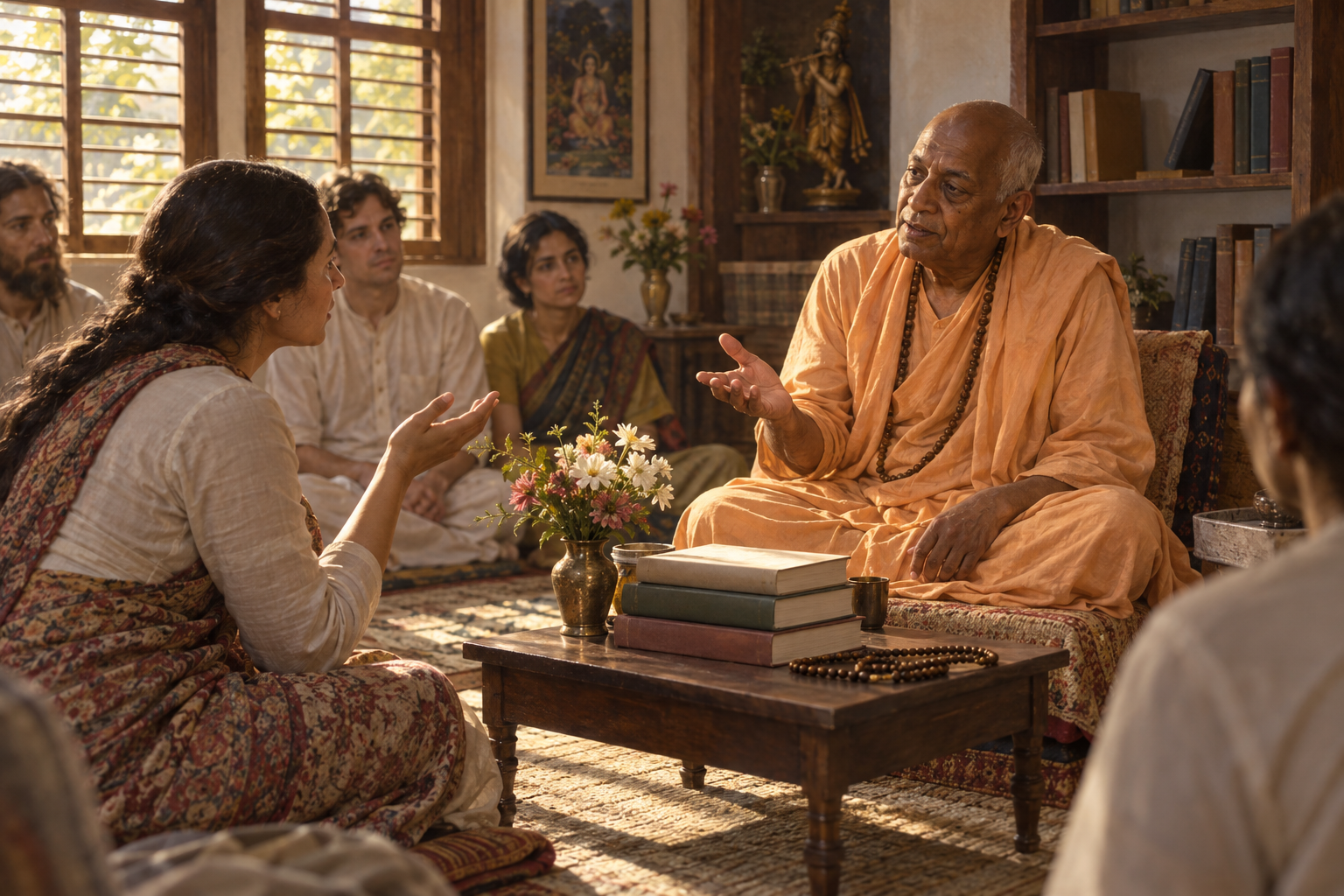
When Rukmini Devi Dasi asked Srila Prabhupada about Lord Caitanya, she enacted a vital feature of living tradition. She did not leave the question suspended between private speculation and vague admiration. She brought it into a relationship of inquiry and instruction.
That movement is itself a lesson. A sincere question is not the enemy of devotion. It can be the point at which inherited language becomes personally intelligible. Srila Prabhupada’s role also shows why lineage matters: a seeker does not have to invent the path afresh, but neither must the seeker pretend to understand what remains unclear.
Use the same pattern with your own difficulty:
- Name the gap. Write down what you affirm intellectually but are failing to perceive or live. Avoid a question as broad as how to become spiritual. Ask why a particular teaching, name, form, or duty has ceased to reach you.
- Make the question honest. Do not disguise resistance as philosophy or suppress a genuine theological difficulty to appear faithful. State what you do not understand without dramatizing it into a rejection of the whole tradition.
- Take it to an accountable place. Look first to the teachings of guru, sadhu, and shastra as received within your sampradaya. When speaking with a practitioner, choose someone whose conduct gives weight to the explanation, not merely someone with a quick answer.
- Convert the answer into practice. Ask what the teaching changes in your chanting, worship, relationships, or service. An answer that remains only in your notes may inform you without re-forming your attention.
- Return with the next precise question. Inquiry in a living tradition is not a demand for instant total certainty. It is a disciplined conversation in which understanding and practice deepen together.
Lord Caitanya should not become only a historical figure whom you know facts about. Within Gaudiya Vaishnava life, remembrance of him directs the seeker toward divine love, the holy name, humility, and shared devotion. Your useful question is therefore not only, What do I know about Lord Caitanya? It is also, What should become different in the way I hear, serve, and regard another person?
Build an ecology of sacred attention

Re-enchantment is often mistaken for an extraordinary feeling. That makes the seeker dependent on novelty: a different speaker, a larger gathering, a new pilgrimage, or a more dramatic presentation. Such experiences can be valuable, but novelty cannot bear the full weight of spiritual life.
A more durable approach is to arrange ordinary life so that attention repeatedly meets the sacred. In Gaudiya Vaishnava practice, the divine name is approached as an encounter, not merely as religious vocabulary. The same relational attention can shape reading, darshan, offering, service, and satsanga.
- Meet the sacred before the algorithm. Place your mala, prayer book, or worship materials where the practice begins. Keep the phone beyond reach until that practice is complete. This is not a war against technology; it is a decision about which presence receives your freshest attention.
- Hear rather than merely finish. During japa or kirtana, return to the sound whenever the mind runs ahead. Do not measure the entire period by whether it felt elevated. The immediate task is to hear the name you are speaking.
- Read for an encounter with instruction. Take a short passage connected to Lord Caitanya or the bhakti tradition. Ask what it reveals about the Divine, what it exposes in you, and what response it requires. Reading becomes formative when it reaches conduct.
- Offer something concrete. Prepare and offer food according to your household or temple discipline, bring a flower, or give time to an overlooked duty. An offering interrupts the assumption that everything exists primarily for consumption.
- Choose service that does not advertise you. Clean, prepare, carry, listen, or assist where credit is unlikely. Hidden service is a sharp test of whether devotion is becoming relationship or remaining self-image.
- Leave a trace of attention. After practice, write a single sentence about where you noticed gratitude, resistance, distraction, or grace. This is not a performance score. It helps you see the recurring place where your practice is opening or closing.
Keep the structure stable enough for its demands to become visible. If you redesign the practice every time familiarity appears, you may train yourself to seek stimulation rather than depth. Repetition is not automatically mechanical. It becomes mechanical when the body repeats while attention is permitted to live elsewhere.
Let satsanga challenge cynicism and credulity
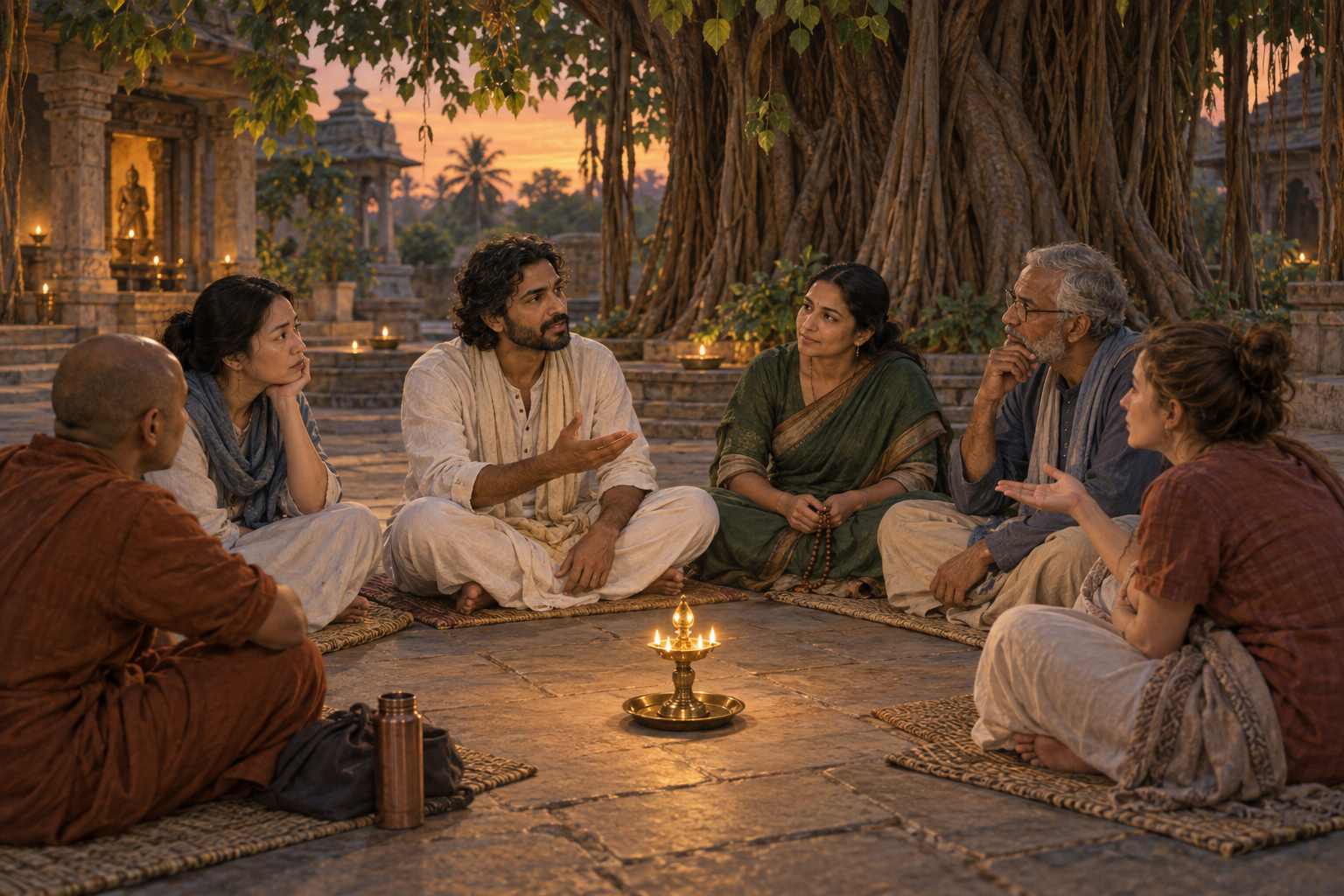
Rukmini Devi Dasi and Anuttama Dasa brought the theme of re-enchantment into a student program at Boston University. The setting makes an important possibility visible: rigorous questioning and devotional receptivity do not have to be enemies. A Dharmic response to disenchantment need not abandon intelligence. It asks intelligence to examine its own habits as carefully as it examines religious claims.
Good satsanga protects you from two opposite errors. Cynicism assumes that nothing can be sacred because every claim can be analysed. Credulity assumes that analysis itself is disloyal. A mature devotional community refuses both. It permits difficult questions while asking whether the questioner is also willing to practise, observe, serve, and be corrected.
When choosing a gathering, class, or study circle, look for these signs:
- Questions are received without ridicule, and uncertainty is not treated as moral failure.
- Answers are rooted in the lineage and its teachings rather than the charisma of the speaker.
- Participants do something together: chant, study, worship, serve, or care for others.
- No one is pressured to display an emotion as proof of spiritual advancement.
- The gathering sends you back to daily responsibilities with a clearer practice, not merely admiration for the event.
You can apply the same standard after any spiritual program. Ask what you will hear more carefully, what you will stop doing, whom you will serve, or which question you will pursue. If nothing becomes more concrete, the gathering may have inspired you without yet forming you.
You can also make a small satsanga more fruitful without turning it into a production. Begin with a shared devotional practice. Bring one clearly stated question. Read a relevant teaching slowly. Allow different participants to distinguish what they know from what they assume. End by naming a practical response. This structure gives both reverence and inquiry a proper place.
Key takeaways for a spiritually flat season
- Do not demand a feeling before you practise. Begin by restoring undivided attention to the practice already in front of you.
- Distinguish problems of attention, understanding, belonging, and integrity. Each requires a different response.
- Follow Rukmini Devi Dasi’s example of directed inquiry: bring a precise question into relationship with guru, sadhu, and shastra.
- Judge an answer by what it clarifies and what it asks you to live, not only by how impressive it sounds.
- Use stable practices of chanting, reading, offering, and service to move beyond dependence on novelty.
- Choose satsanga that welcomes questions, remains accountable to lineage, and leads to concrete devotional action.
At your next period of practice, do not try to recover every spiritual feeling you once had. Remove the nearest distraction, bring one honest question, and give full attention to the name, teaching, form, or service before you. Let that encounter make one demand on your conduct.
Re-enchantment can begin quietly: not as escape from the ordinary world, but as the recovery of your capacity to meet it as a place of divine relationship. The next step is not to wait for wonder. It is to become available to what your habits have taught you not to notice.
References
- Dandavats – From the Archives: Srila Prabhupada Answering Rukmini’s Question about Lord Caitanya
- Dandavats – Today’s Featured Video: Becoming Re-enchanted with Rukmini Devi Dasi (ACBSP) & Anuttama Dasa (ACBSP)

Leave a Reply
You must be logged in to post a comment.