
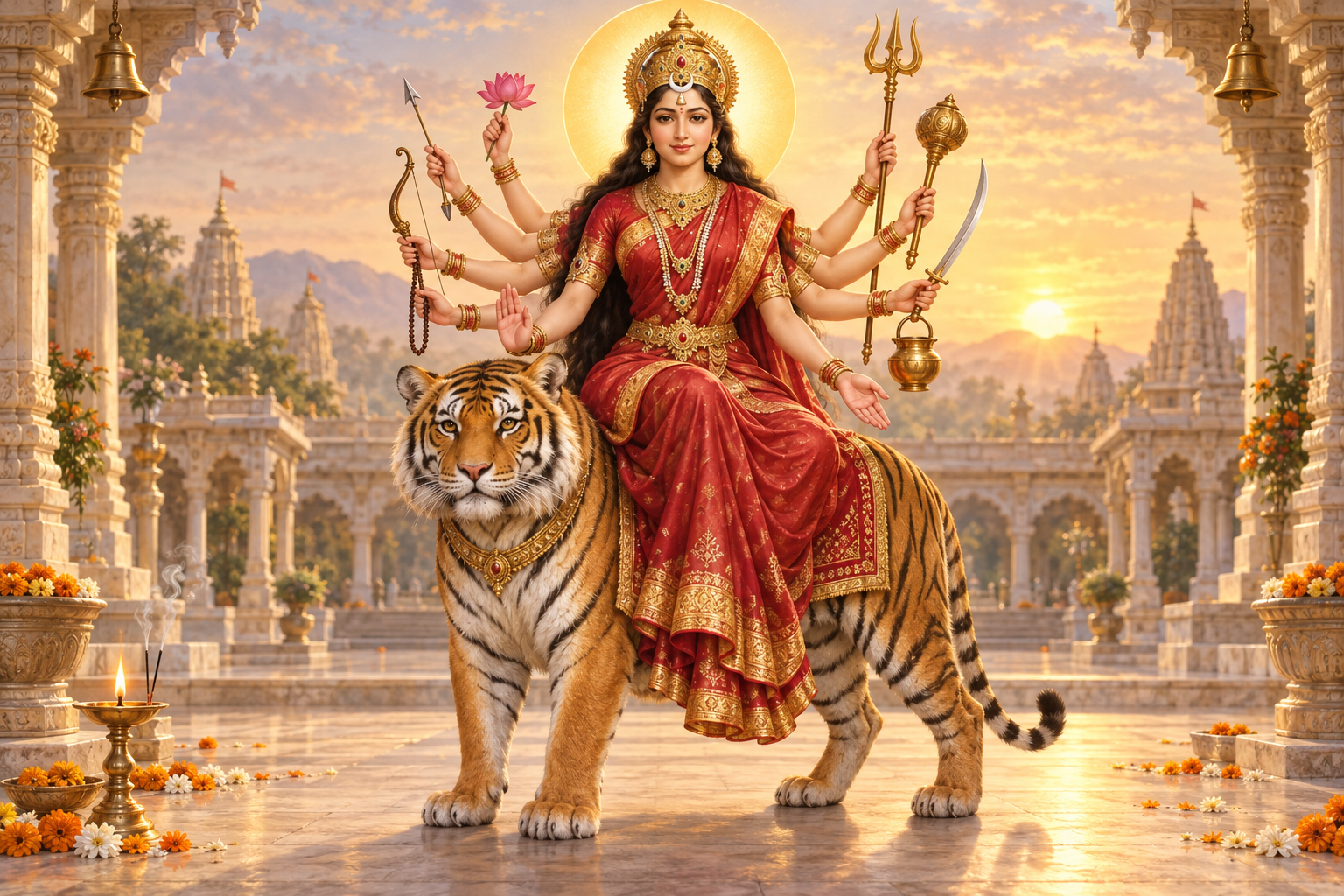
If you are trying to plan Maa Chandraghanta worship in 2026, begin with the distinction that prevents most calendar confusion: she is worshipped on the third day of Navratri, and 2026 has both a Chaitra observance and an Ashwin observance. The listed dates are 21 March 2026 and 13 October 2026.
You do not need an elaborate altar or a long Sanskrit recitation to approach the day seriously. You do need the correct date for the Navratri cycle you follow, a clean and deliberate sequence, and an understanding of why Chandraghanta combines serenity with readiness. That combination is the heart of the worship.
Key takeaways for Chandraghanta Puja in 2026
- Maa Chandraghanta is the third form of Navadurga and is worshipped on Navratri’s third day.
- Her Chaitra Navratri date in 2026 is 21 March; her Ashwin Navratri date is 13 October.
- Both observances fall in relation to Shukla Paksha Tritiya, but the exact local puja window should be checked against your city’s panchang or your temple’s schedule.
- Her name joins chandra, the moon, with ghanta, the bell. The crescent and bell point toward a mind that is calm, awake and responsive.
- A practical home puja can include water, a kalash, turmeric, kumkum, rice, camphor, a lamp, flowers, mantra or stotra recitation, and aarti.
- Chandraghanta’s association with Shukra, or Venus, belongs to a devotional astrological tradition. Treat it as a spiritual framework, not a guaranteed method of changing external circumstances.
What Chandraghanta’s form asks you to notice
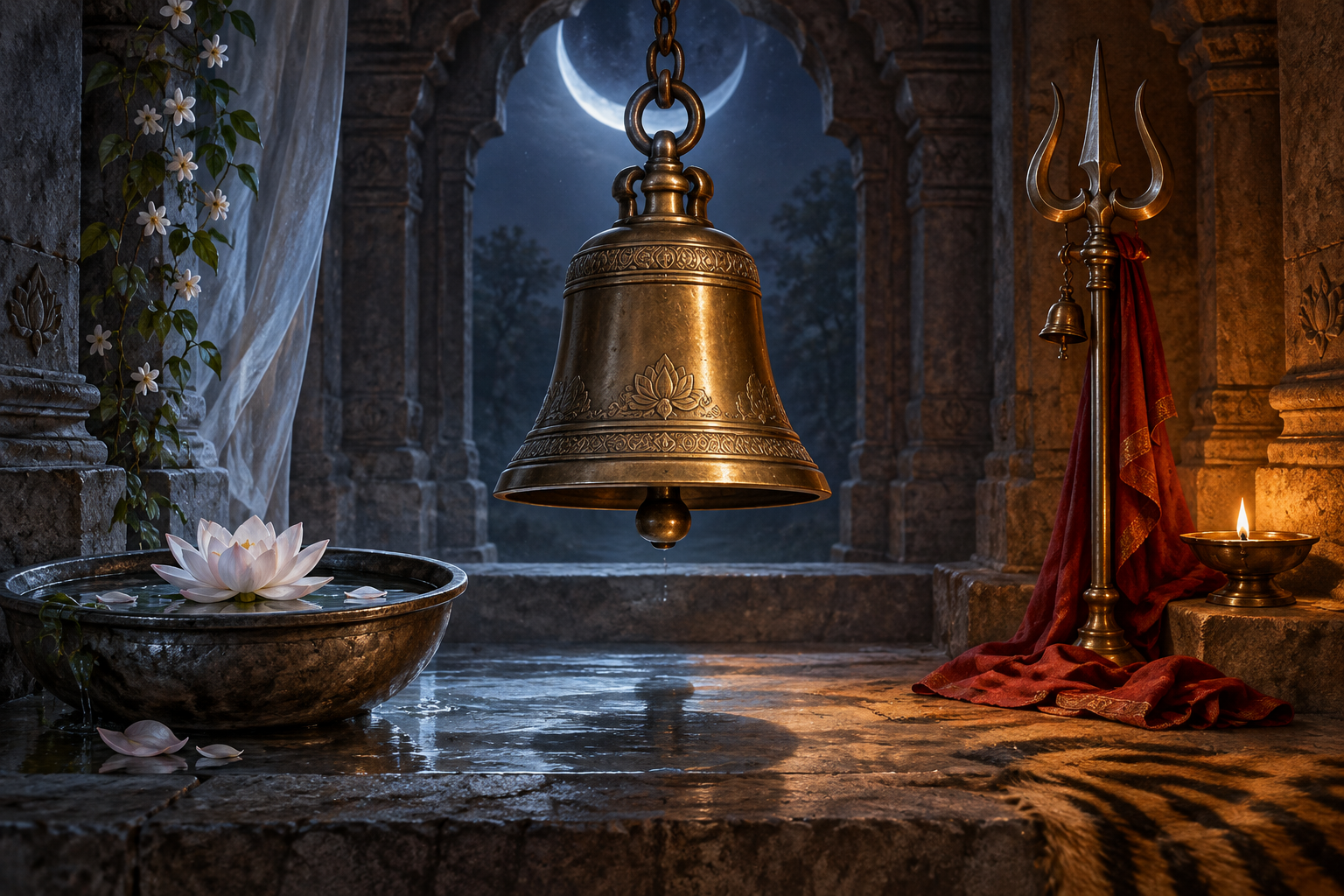
The name Chandraghanta joins two clear images: chandra means moon, while ghanta means bell. In her widely recognised Navadurga iconography, a crescent appears on her forehead and she is represented with ten arms. The image is not merely decorative. It holds together qualities that people often separate: inward composure and outward strength.
The moon can be contemplated as coolness, rhythm and the changing mind. The bell has another function. It gathers scattered attention and marks a transition from ordinary activity to sacred presence. Read together, they offer a disciplined ideal: do not confuse calmness with passivity, and do not confuse readiness with aggression.
Her many arms can be understood as divine capacity operating in several directions at once. For your own contemplation, the useful question is not whether you can imitate that power. Ask where your attention has become fragmented and whether fear is deciding your conduct. Chandraghanta worship invites you to recover one-pointed awareness before you act.
This makes her form especially relevant when you face conflict, uncertainty or an obligation you would rather avoid. The devotional response is neither panic nor withdrawal. First steady the mind. Then meet the duty in front of you. If the ritual ends without affecting how you speak, decide or uphold dharma, its symbolism has remained outside your life.
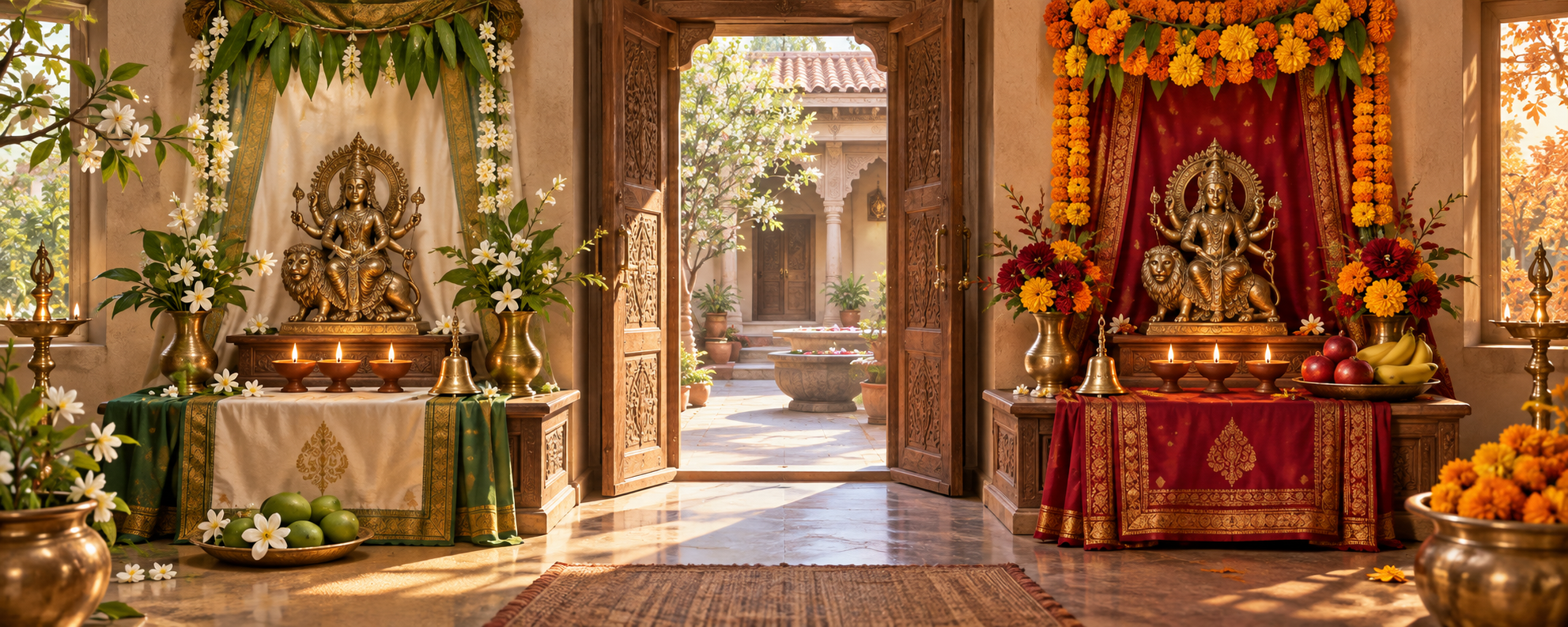
Chandraghanta Puja dates for both 2026 Navratris
| Navratri cycle | Chandraghanta Puja date | Calendar basis | What you should verify locally |
|---|---|---|---|
| Chaitra Navratri | 21 March 2026 | Third Navadurga observance associated with Shukla Paksha Tritiya in Chaitra | Local tithi boundaries and the puja time followed by your household or temple |
| Ashwin Navratri | 13 October 2026 | Third Navadurga observance associated with Shukla Paksha Tritiya in Ashwin | Local tithi boundaries and the puja time followed by your household or temple |
These dates tell you which civil day to reserve. They do not create one universal clock time for every location. A Hindu tithi does not necessarily begin at midnight, and its local timing can cross parts of two civil dates. That is why a muhurat copied without a city or time zone can mislead you even when the festival date itself is correct.
Use your local panchang, temple notice or family acharya to settle the exact window. If two calendars seem to disagree, compare their location and the tithi start and end times before assuming that one is wrong. For a temple observance, follow the temple’s announced programme. For a household observance, keep the convention your family normally uses unless a qualified guide gives you a reason to change it.
Chaitra and Ashwin Navratri are two distinct annual settings for the same third form of Navadurga. You are not required to perform both merely because both appear on the 2026 calendar. Observe the cycle maintained by your sampradaya, family or temple; observe both only if that is already part of your practice or a commitment you consciously choose.
A clear Chandraghanta Puja sequence for the home
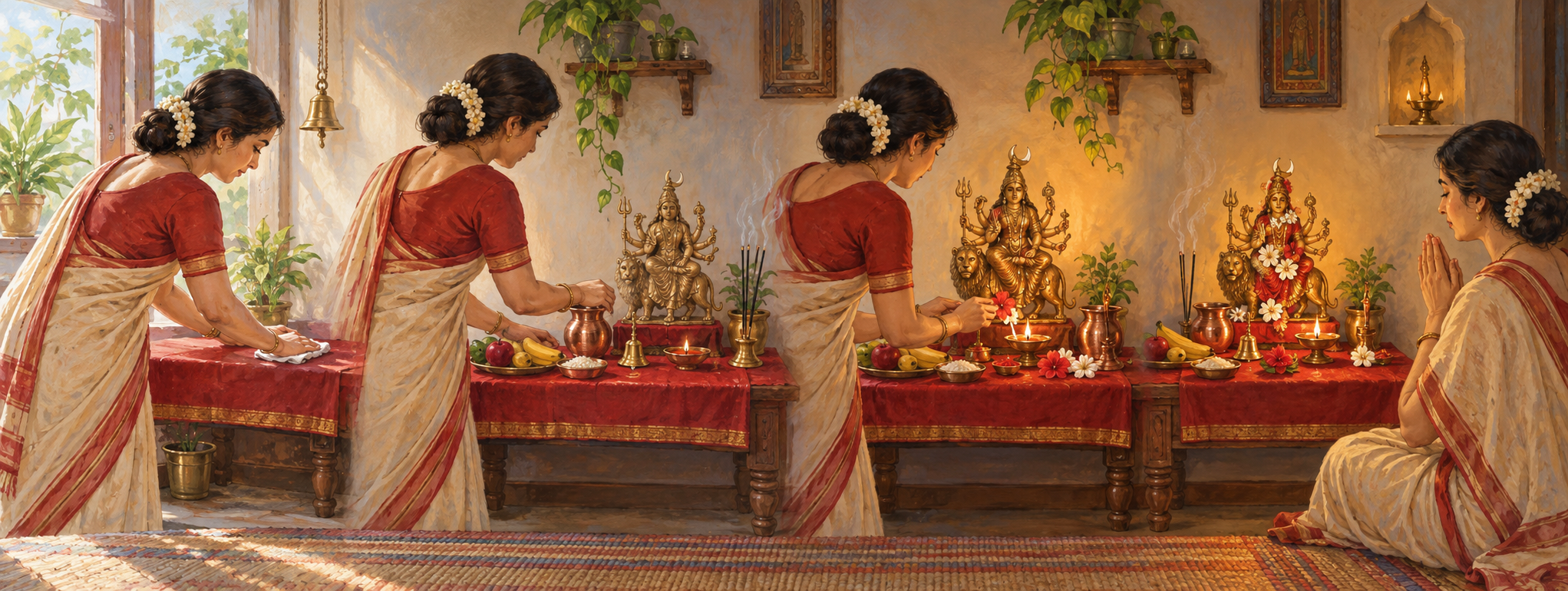
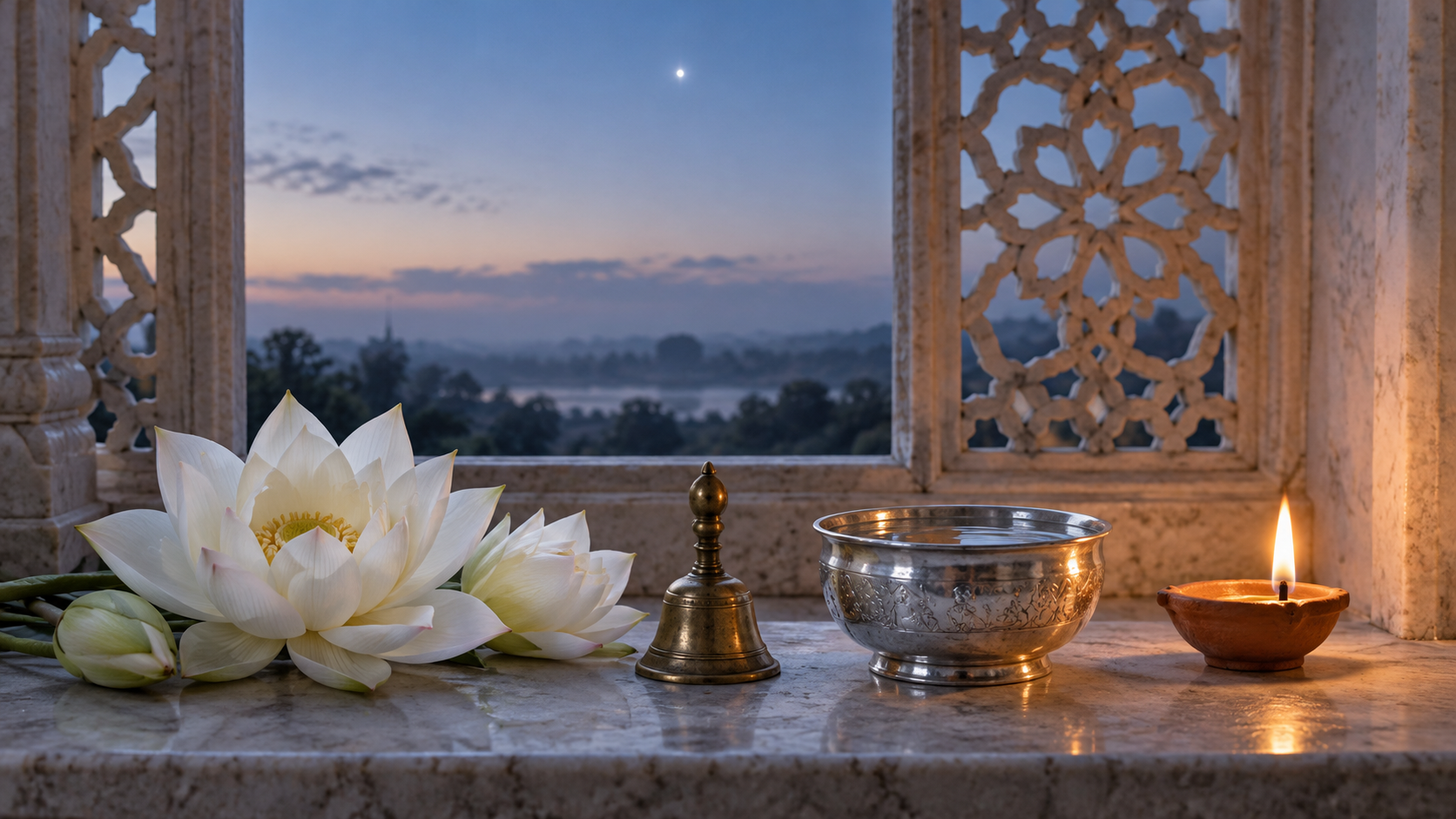
A traditional Chandraghanta puja arrangement uses familiar materials such as turmeric, kumkum, camphor, rice, a kalash and water, including Gangajal where that is your custom. A lamp, flowers and the materials used for your household aarti can complete the arrangement. Gather everything before you sit down; repeatedly leaving the altar breaks the attention the ritual is meant to establish.
- Prepare yourself and the space. Bathe or wash, wear clean clothes and clean the place of worship. Set the murti or image securely, place the offerings within reach and keep the lamp or camphor on a stable, heat-safe surface.
- Make a simple sankalpa. State that you are worshipping Maa Chandraghanta on the third day of Navratri. Name the quality you are trying to cultivate, such as courage without anger, vigilance without fear, or steadiness under pressure. If your household uses a formal Sanskrit sankalpa, follow that inherited form.
- Enter dhyana before making requests. Bring the crescent on her forehead and her ten-armed form to mind. Let the image collect your attention. This prevents the puja from becoming a hurried list of desired outcomes.
- Offer the puja materials in your customary order. Present water, turmeric, kumkum, rice and flowers with care. Establish the kalash if it belongs to your Navratri practice. The meaning lies in attentive offering, not in displaying the largest possible collection of items.
- Recite what you can recite responsibly. Chandraghanta worship includes a mool mantra, dhyana shloka and stotra. Use the text and pronunciation maintained by your family, temple or teacher. If you have not learned a longer text, repeat Maa Chandraghanta’s name reverently instead of racing through unfamiliar syllables.
- Perform aarti and close deliberately. Offer the flame, bow and sit quietly before ending the worship. Let the sankalpa return to mind. Extinguish any camphor or open flame completely before leaving the space.
If you are away from home or cannot assemble the full tray, keep the structure rather than abandoning the observance. Clean the place available to you, remember her form, offer water or a flower if possible, repeat her name, and sit in quiet prayer. A reduced observance should still be deliberate. Simplicity is not carelessness.
Avoid turning the materials into a pass-or-fail checklist. A kalash and traditional substances support the ritual, but merely possessing them does not create attention. Conversely, do not casually discard a procedure that your family or sampradaya treats as essential. The sound rule is simple: preserve inherited practice where you have it; where you do not, use a modest sequence you can perform sincerely and consistently.
How to approach the Shukra association without making promises
In one devotional astrological understanding, Chandraghanta is associated with Shukra, or Venus. Shukra is linked in that framework with love, beauty, harmony, prosperity and emotional balance. Her worship is therefore believed to help with the difficult or malefic influence attributed to Venus.
That belief should shape your intention without becoming a guarantee. Puja is not a mechanical exchange in which the correct materials force a particular relationship, financial result or emotional state to appear. Astrology can identify the field of reflection; it does not remove your responsibility to make sound decisions within that field.
If harmony is your sankalpa, choose one concrete act that expresses it after worship. Speak without the cutting remark you have been rehearsing. Correct an unfair demand. Repair a neglected obligation. Bring order to spending driven only by appearance. The act need not be dramatic. It should be specific enough that you can tell whether your prayer changed your conduct.
The same discipline applies when you approach Chandraghanta because an astrologer has raised a concern about Shukra. Follow the spiritual remedy if it belongs to your faith, but do not let fear produce compulsive repetition or expensive display. The deity’s symbolism points toward collected courage. A remedy pursued in panic contradicts the quality you are invoking.
For whichever 2026 Navratri cycle you observe, put the correct date on your calendar now, verify the local tithi before the day arrives, select the mantra or stotra you will actually use, and arrange the puja materials in advance. Then let the observance do more than occupy a morning: carry Chandraghanta’s alert calm into the next decision that tests you.
References
- Hindu Pad – Astrological Significance of Chandraghanta Pooja
- Hindu Pad – Chandraghanta Puja Vidhi | Maa Chandraghanta Pooja Method
- Hindu Pad – Chandraghanta Mantras – Mool Mantra, Dhyana Sloka, Stotra
- Hindu Pad – Aspects of Chandraghanta Navadurga
- Hindu Pad – Muhurat of Chandraghanta Devi Pooja 2026

Leave a Reply
You must be logged in to post a comment.