

If a mosque loudspeaker is waking you, interrupting study, or repeatedly carrying amplified sound into your Kolhapur home, you do not have to choose between suffering quietly and starting a communal quarrel. Take the narrower and stronger position: ask the competent authority to verify the loudspeaker’s authorisation, examine how it is being operated, and record its action in writing.
A delegation of Hindu organisations in Kolhapur has sought the permanent removal of unauthorised mosque loudspeakers, grounding its demand in Supreme Court directions on noise pollution and the fundamental right to peaceful sleep. That is a legitimate civic demand to place before the administration. It is not, by itself, proof that every loudspeaker under complaint is unauthorised; determining that status is the authority’s responsibility.
Make the complaint precise enough to enforce
Prayer and electronic amplification are not the same issue. A request to verify a loudspeaker does not require you to argue against anyone’s worship. It asks whether particular equipment has the required permission and whether its use complies with the conditions that apply to it.
Keep three questions separate. This prevents a genuine disturbance from being weakened by a claim you cannot yet prove.
- What did you observe? Identify the location, dates, times, recurrence and effect of the amplified sound.
- Is the equipment authorised? Ask the responsible authority to verify this from its records. Do not present your suspicion as an established fact.
- What remedy follows? If the loudspeaker is unauthorised, request its removal. If it is authorised but operated contrary to applicable conditions, request enforcement of those conditions.
This distinction also answers a common objection. The demand is not for an indiscriminate ban on Muslim prayer. It is for official action against amplification that lacks lawful authorisation. The same principle should govern comparable loudspeakers used by temples, political gatherings, weddings and commercial events. Equal enforcement makes the case more credible, not less Hindu.
Turn recurring disturbance into an actionable record
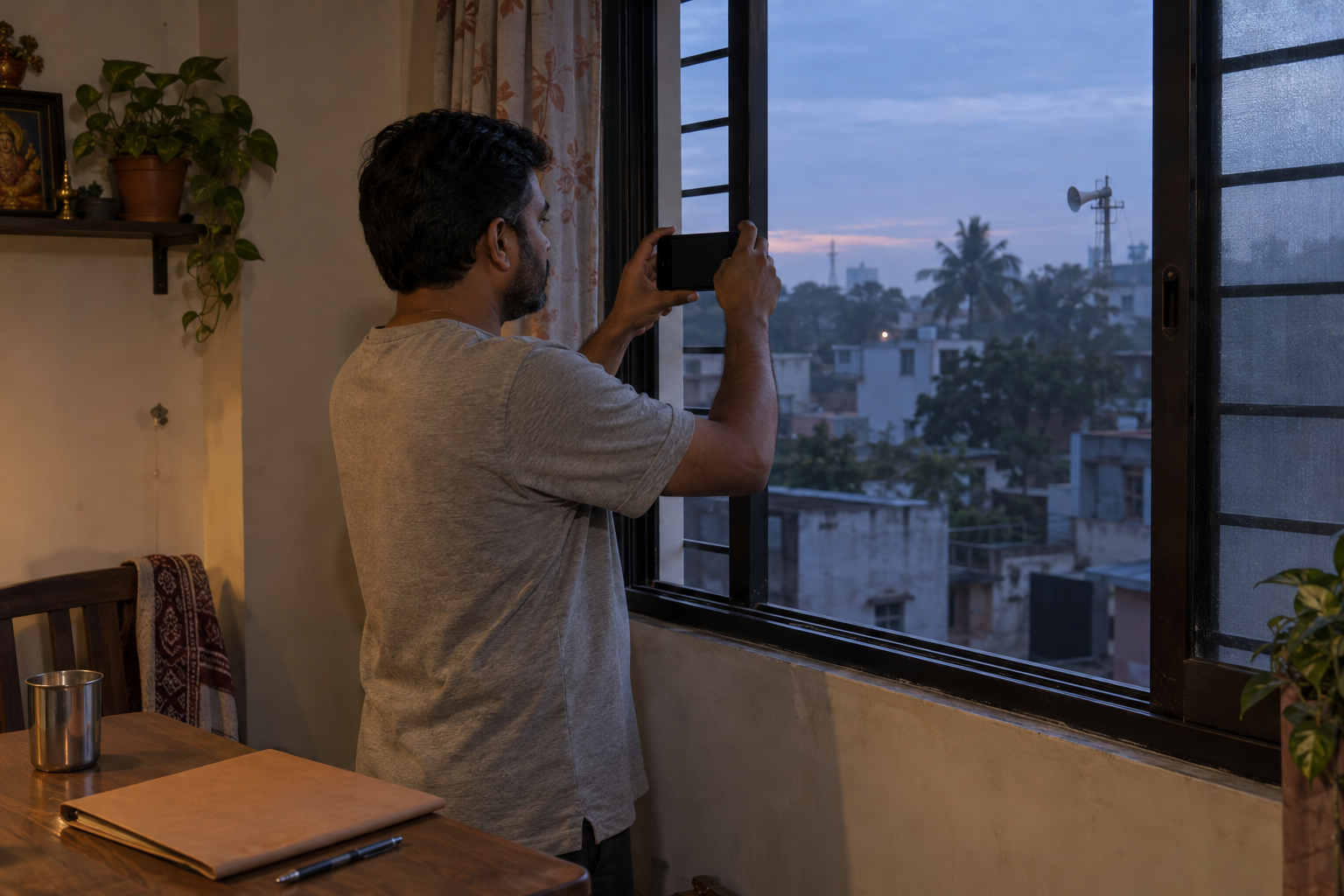
An angry complaint says that the noise is intolerable. An actionable complaint tells an officer what happened, where to inspect, which record to check and what response is being requested. Build that record before memories blur or the dispute becomes personal.
- Identify the installation accurately. Note the mosque’s name if you know it, its location and the apparent position of the loudspeaker. Do not guess the names of operators or office-bearers.
- Keep a contemporaneous log. For every occurrence, write down the date, approximate start and end times, whether the sound recurred, and where you heard it. A sequence of entries is more useful than a general claim that it happens regularly.
- Describe the effect without exaggeration. Record concrete consequences such as being awakened, a child’s study being interrupted, or amplified speech remaining clearly audible inside the home. Do not add medical or technical conclusions you cannot support.
- Preserve lawful supporting material. If lawful in your circumstances, retain recordings made from your property or a public place. Do not trespass, provoke an exchange, point a camera into private areas, or treat a phone application as official noise-measurement evidence.
- Submit a short written representation. Address the police or administrative office responsible for permissions and noise enforcement. If you are unsure which office has jurisdiction, ask the receiving office to transfer or route the complaint and tell you where it was sent.
- Ask for an acknowledgement. Keep the receiving stamp, grievance number, email confirmation or other proof of submission. Preserve the exact version you submitted and every attachment.
- Follow up in writing. Refer to the acknowledgement and ask what verification or inspection occurred. Repeated emotional messages are less useful than one clear follow-up tied to the original record.
A practical structure for your representation
You do not need elaborate legal language. A one-page representation can use the following structure, adapted to your circumstances:
- Subject: Request to verify authorisation and operation of a loudspeaker at a precisely identified mosque.
- Resident details: Your name, contact information and locality.
- Observed facts: A short description supported by your dated log.
- Requested checks: Verification of the loudspeaker’s authorisation, its applicable conditions and whether its observed use complies with them.
- Requested action: Removal if it is unauthorised, or enforcement of the applicable conditions if it is authorised.
- Requested response: Written acknowledgement and written information about the action taken.
- Attachments: Copies of the log and any lawfully collected supporting material.
Several affected residents may sign a joint representation or submit their own truthful accounts. Independent statements should reflect what each person actually experienced; copied allegations can make a campaign look coordinated without adding evidence.
Ask for the remedy that the verified facts support

Permanent removal is the clearest remedy when the administration confirms that a loudspeaker is unauthorised. Until that verification occurs, frame removal as the action you are requesting if the equipment lacks permission, not as a punishment you have already decided to impose.
- If no authorisation exists: Ask the authority to remove the unauthorised equipment or prevent its continued use, and request written confirmation of the action.
- If authorisation exists: Ask what conditions govern the loudspeaker and whether the documented operation complied with them. Request enforcement where a breach is found.
- If the status remains unclear: Ask for a reasoned written response identifying what was checked. Use the established grievance or escalation route rather than repeating the same unsupported allegation.
- If no response arrives: Preserve your submission record and seek advice from a local lawyer or qualified legal-aid service about the next lawful remedy. Procedures and competent offices can depend on the facts of the location.
Do not climb onto the premises, disconnect equipment, threaten an operator or organise a crowd to remove it. Those actions can create safety risks, damage your legal position and expose participants to legal consequences. Inspection, seizure, disconnection or removal must be left to the competent authorities.
Keep a pro-Hindu campaign disciplined and non-communal

A civic demand becomes easier to dismiss when it is wrapped in collective accusations against Muslims. Keep every public statement tied to the narrow issue: a named installation, an observed disturbance, verification of authorisation, equal application of noise rules and a lawful administrative remedy.
That discipline requires more than polite language. Do not circulate private phone numbers, publish unverified names, edit recordings deceptively, encourage abusive calls, or claim that all mosques are violating the law. Do not turn a request for enforcement into a demand to obstruct prayer itself. Each of those moves shifts attention away from the loudspeaker and onto the conduct of the complainants.
A Dharmic public position should protect the peace of Hindu residents while insisting that every community remains subject to the same civic standards. Restraint here is not surrender. It keeps the demand focused, verifiable and difficult for officials to evade through communal rhetoric.
Key takeaways and your next move
- Challenge the authorisation and operation of the loudspeaker, not the community’s right to worship.
- Record the exact location, dates, times, recurrence and concrete effect of the amplified sound.
- Ask the competent authority to verify permission, inspect the installation and answer in writing.
- Request permanent removal when the equipment is confirmed to be unauthorised; request enforcement of conditions when authorisation exists.
- Never trespass, threaten anyone or attempt to remove equipment yourself.
- Keep the demand equally applicable to religious, political, social and commercial amplification.
If you are affected, begin with one clean page: your observation log, a precise representation and a request for acknowledgement. That record gives the administration something it can verify and gives you a lawful basis for the next step if it fails to act.
References

Leave a Reply
You must be logged in to post a comment.