
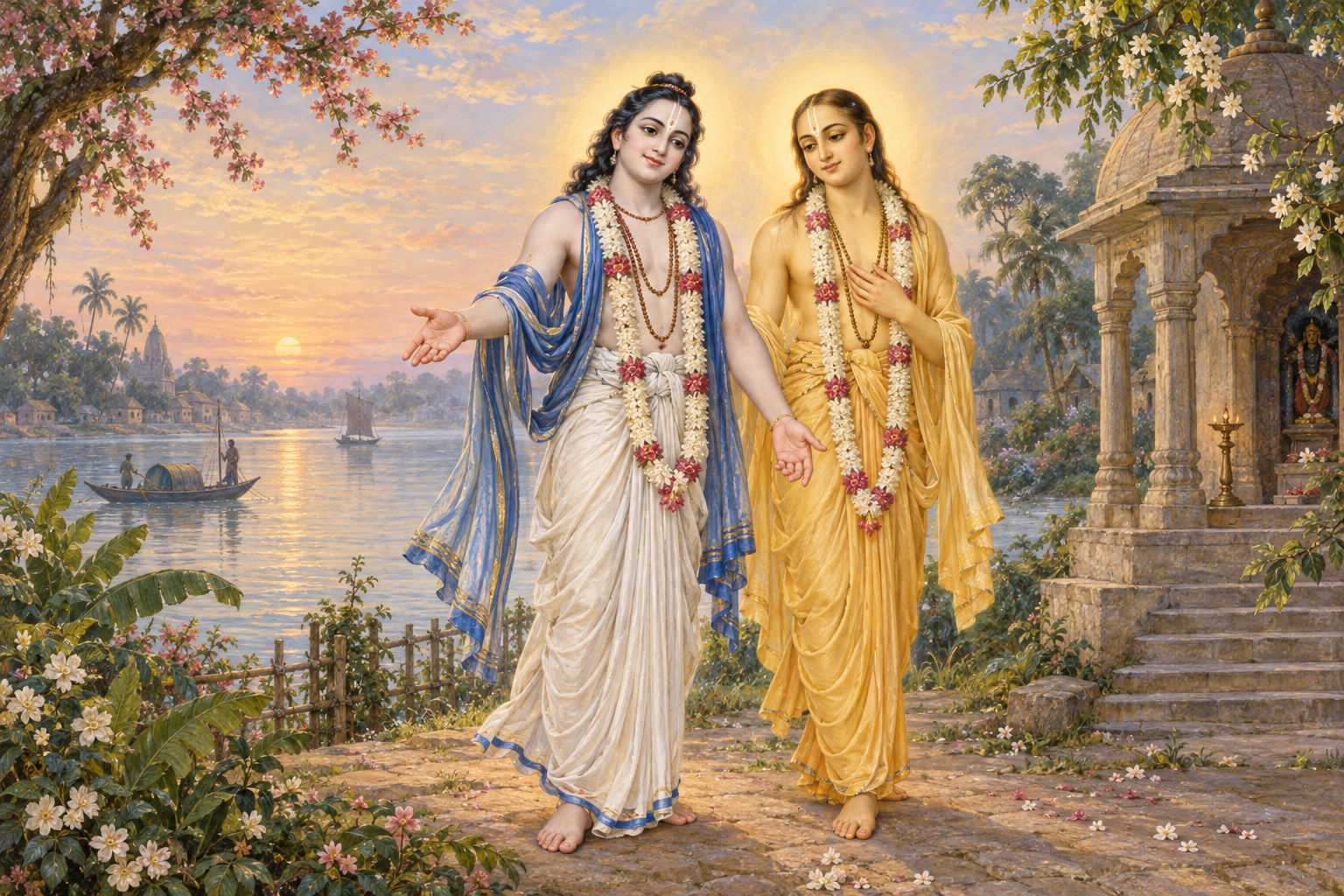
You open Adi-lila Chapter 5 looking for the life of Sri Chaitanya and suddenly meet a dense succession of divine names, forms, realms, and cosmic functions. It can feel like a genealogy that must be memorized before you are allowed to reach the devotional heart of the text.
That is the wrong burden to place on yourself. The chapter’s central question is relational: Who is Sri Nityananda, how is he related to Krishna and Chaitanya, and why does that relationship make service fundamental to spiritual life? Once you follow those questions, the cosmology becomes a map rather than an obstacle.
Read the hierarchy as a map of dependence

In the Gaudiya Vaishnava understanding presented here, Krishna is the original source of the divine expansions. Balarama is his first personal expansion: fully divine, not a created being, yet distinct in form, role, and serving disposition. Nityananda is Balarama appearing in Sri Chaitanya’s lila.
The chapter then traces an ordered movement from that first expansion through further divine manifestations, including the Vishnu forms associated with material creation and the form of Ananta Sesha. This is not a sequence in which one independent god replaces another. Each change of name marks a particular relationship, realm, or function while preserving dependence on the original source.
| Divine form | What to notice | Mistake to avoid |
|---|---|---|
| Krishna | The original source in the chapter’s Gaudiya theology | Treating him as merely one interchangeable form in the sequence |
| Balarama and Nityananda | The first expansion and the divine disposition of service | Reducing Nityananda to a secondary historical personality |
| Maha-Vishnu | Divine agency in relation to the total material manifestation | Imagining creation as independent of its spiritual source |
| Garbhodakasayi Vishnu | The Lord’s relation to each universe | Assuming transcendence means complete absence from creation |
| Ksirodakasayi Vishnu | The indwelling divine presence, or Paramatma | Confusing divine nearness with the conditioned individual self |
| Ananta Sesha | Support and service expressed as a divine function | Thinking that a supporting role must be spiritually inferior |
When a new name appears, pause and write four things in the margin: identity, relationship, function, and realm. Ask, “Who is this? From whom does this form expand? What service does this form perform? Where is that function expressed?” Those questions prevent the names from collapsing into a blur.
The three Vishnu forms are especially easy to confuse. Keep their scale in view. Maha-Vishnu concerns the material manifestation at its most comprehensive level. Garbhodakasayi Vishnu concerns the divine presence within each universe. Ksirodakasayi Vishnu concerns the indwelling presence within creation and the hearts of living beings. The movement is from cosmic causality toward intimate presence, not from a greater deity to unrelated lesser gods.
Hold unity and difference together

Adi-lila Chapter 5 trains you to avoid two opposite errors. The first is fragmentation: treating Krishna, Balarama, Nityananda, and the Vishnu forms as competing divine beings with separate ultimate sources. The second is flattening: saying that every form is identical in every respect, so names, relationships, and services have no real meaning.
The doctrine of acintya-bheda-abheda, inconceivable simultaneous oneness and difference, gives you a reliable guardrail. Divine expansions are one with their source in spiritual nature and potency, yet their distinctions of form, relationship, mood, and function remain meaningful. “One” does not mean featureless, and “different” does not mean independent.
- If sameness makes every relationship interchangeable, you have erased the lila the text is asking you to contemplate.
- If difference turns divine forms into rivals, you have separated what the text presents as an ordered unity.
- If service sounds like evidence of lesser spiritual worth, you have imported a worldly status system into a divine relationship.
Balarama’s serving disposition is therefore not a defect that must be explained away. It reveals that loving service belongs within divine life itself. Nityananda’s identity carries the same lesson into Chaitanya-lila: service is not merely an obligation imposed on conditioned souls. It is an expression of spiritual fullness.
Use a simple test when an explanation of the chapter becomes confusing. Does it preserve the source, the expansion’s real identity, the distinction of role, and the purpose of service? If it preserves only unity or only difference, return to the passage and rebuild the relationship more carefully.
Nityananda makes service the center, not the margin
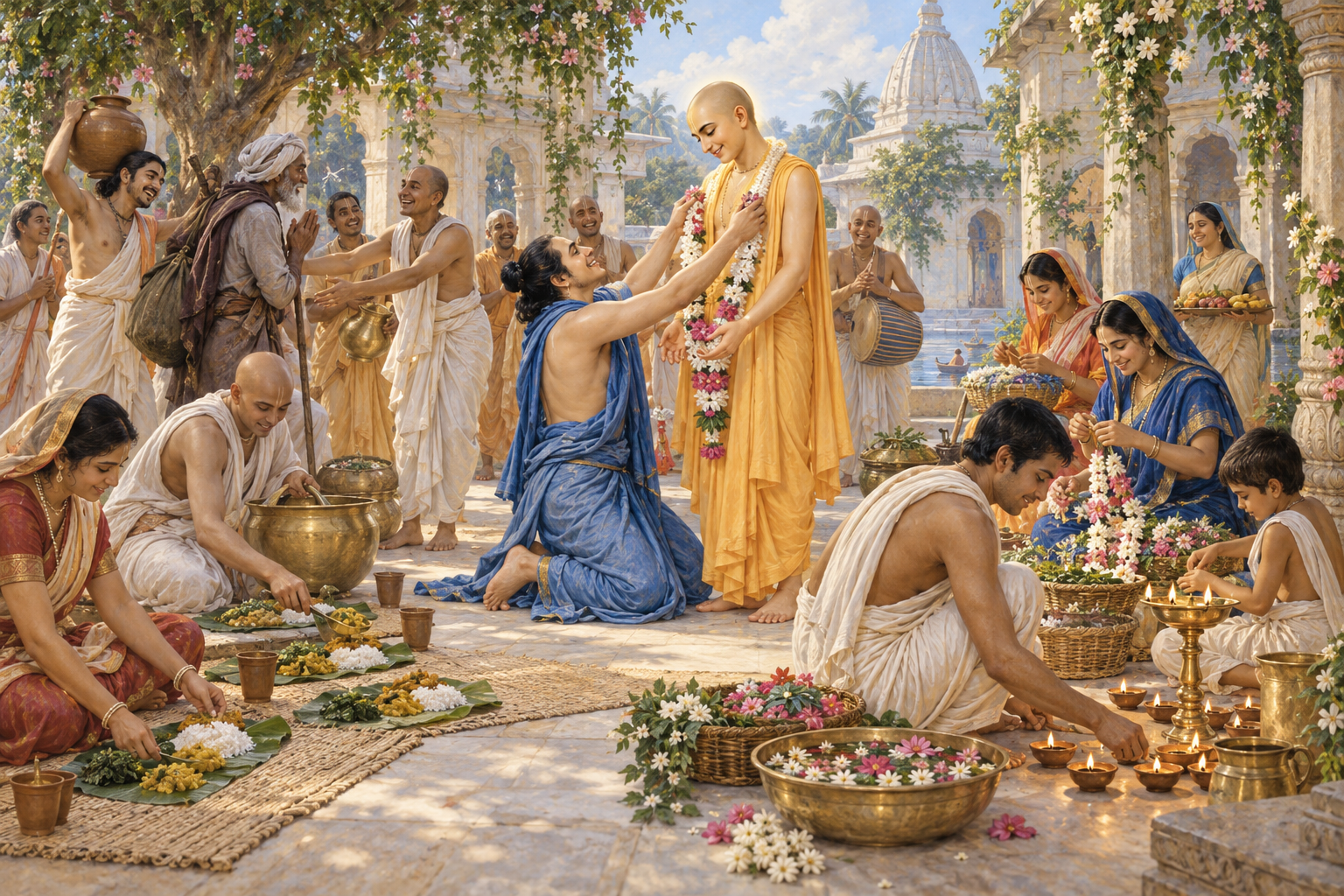
The chapter does more than identify Nityananda with Balarama. It presents a theology in which divine power repeatedly becomes support for Krishna’s purposes. Balarama’s serving identity extends through the personalities, abodes, and paraphernalia that sustain divine lila. What appears outwardly to be a supporting position is revealed as an intimate exercise of spiritual potency.
This reverses a common worldly assumption. We usually treat the visible leader as important and the person who prepares, carries, teaches, reconciles, or maintains as secondary. Chapter 5 asks you to judge importance by loving contribution rather than prominence.
- In worship: do one necessary task that receives no public recognition. Preparing the space, cleaning after worship, or helping another person participate can express the supporting mood the chapter honors.
- In study: help a newcomer understand one relationship in the text instead of displaying how many Sanskrit names you know. Knowledge has become service when it makes another person’s approach clearer.
- In community: ask what will protect both truth and relationship before entering a disagreement. Winning a devotional argument while humiliating a devotee contradicts the serving disposition you are studying.
- In leadership: measure responsibility by what you enable others to offer, not by how much attention gathers around you.
- In private practice: notice the task you resist because it feels beneath you. That resistance may show exactly where worldly status has entered your understanding of seva.
Gaudiya Vaishnavas consequently approach Nityananda as the original spiritual guide. That principle should sharpen discernment, not suspend it. Authentic spiritual guidance directs attention toward Krishna, disciplined practice, humility, and service; it does not make the teacher’s personal prestige the final object of devotion. A title alone cannot turn control or manipulation into guru-seva.
The practical question is not simply, “Do I accept that Nityananda is Balarama?” Ask, “What changes in my behavior if divine greatness expresses itself through support?” Your answer should be visible in how you carry responsibility, receive correction, treat less experienced practitioners, and perform unnoticed work.
Use a relation-and-function method for close study
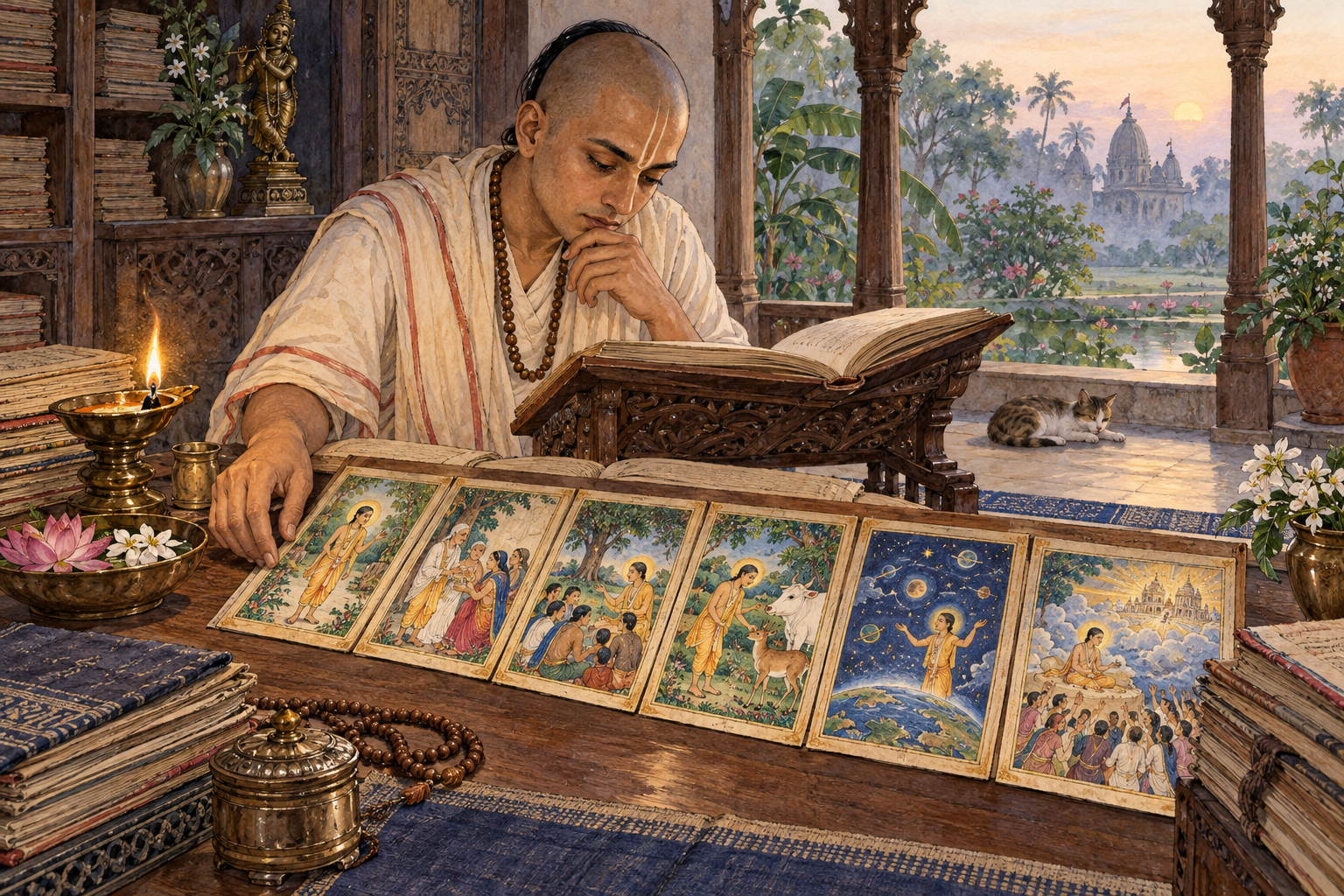
Reading the chapter straight through can give you the overall movement, but close study works better when you separate recognition from interpretation. Use the following method with any short passage.
- Read the passage without stopping at every unfamiliar term. First identify its main action: expansion, entry, support, creation, guidance, or service.
- Mark every divine name and every relational verb. Words such as “expands,” “appears,” “enters,” “supports,” and “serves” often carry more interpretive weight than the names alone.
- Draw directional arrows. Write the source at the left and the manifested form at the right. Do not use a loose equals sign when the passage is describing both identity and a real distinction of function.
- Label the kind of difference. Is the passage distinguishing form, realm, function, devotional mood, or participation in creation? This keeps real distinction from becoming imagined separation.
- State the teaching in one sentence. A useful sentence names both sides of the relationship, such as: “Nityananda is Balarama, fully divine, while his distinct role reveals the primacy of service in Chaitanya-lila.”
- Choose a corresponding act. If the passage concerns support, support someone’s sincere practice. If it concerns divine presence, become more accountable for conduct that you usually treat as unseen. If it concerns spiritual guidance, receive one sound instruction without turning it into a debate about your status.
A recorded class is most useful after this first pass. You can then compare your map with focused discussions of Adi-lila 5.52 and Adi-lila 5.89. Listen for the relationship or function the speaker emphasizes, add it to your notes, and then return to the verse. This keeps oral commentary connected to the text instead of letting passive listening replace study.
Do not make the diagram the final result. A perfect expansion chart can coexist with pride, impatience, or indifference. The chart has done its work only when it helps you see ordered divine relationship and then practice service with greater intelligence.
Key takeaways for your next reading
- Chapter 5 establishes Nityananda’s theological identity; it does not treat him as a peripheral companion of Sri Chaitanya.
- Balarama is presented as Krishna’s first expansion, united with Krishna in divinity while distinct in form, role, and serving disposition.
- The successive manifestations are an ordered account of divine relationship and function, not a collection of competing gods.
- The Vishnu forms show divine agency at different levels of material creation, from the cosmic manifestation to indwelling presence.
- Service is not evidence of spiritual inferiority. The chapter places support, guidance, and service within the expression of divine fullness.
- The soundest reading preserves unity, difference, function, and devotional response at the same time.
On your next reading, stop at the first change of divine name. Mark the source, relationship, function, and realm before moving forward. Then finish the session with one act that supports another person’s bhakti. That small movement from map to seva is where Chapter 5 begins to become lived theology.
References
- Dandavats – C.C Class Adi-Lila 5.52 | By H.G Mukund Datta Prabhu | 12th Oct 2026
- Dandavats – His Grace Braja Bihari Prabhu (from ISKCON Resolve) || CC Adi Lila 05.89 || 12-10-2026

Leave a Reply
You must be logged in to post a comment.