
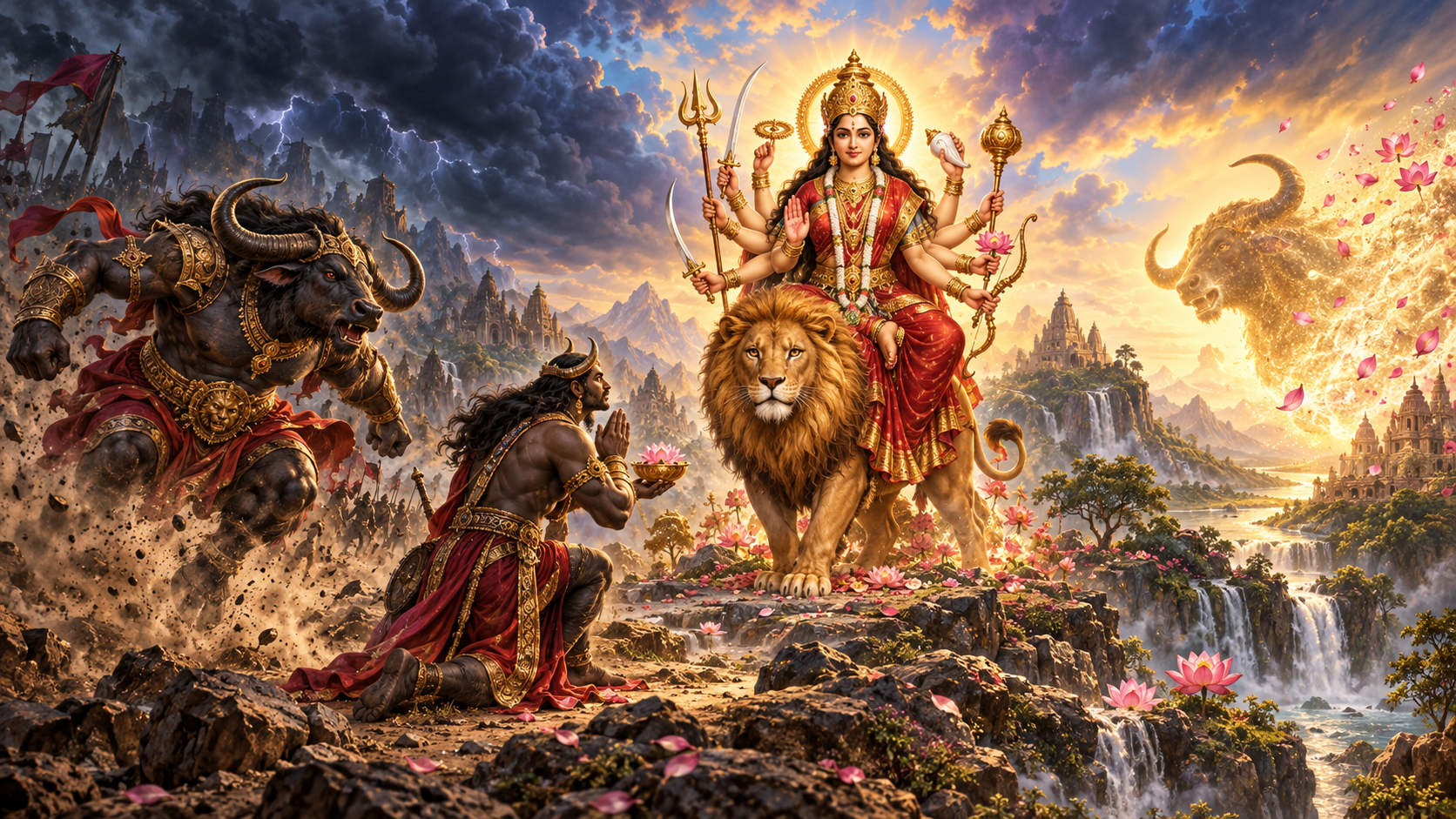
If you know Mahishasura only as the buffalo demon slain by Devi, the claim that he passed through three births raises an immediate question: why did one decisive victory not end his story?
The answer lies in what changes between the encounters. The three-birth cycle moves through ignorance, devotion, and salvation. Read that sequence carefully and it becomes more than a repeated battle. It becomes a map of how a soul can remain bound, begin turning toward the Divine, and finally be released from the identity that kept it in conflict.
Why one defeat does not finish Mahishasura’s journey
A simple good-versus-evil reading focuses on the battlefield: Mahishasura threatens dharma, the Divine Mother confronts him, and divine power defeats asuric power. That level matters. Devi does not merely offer private consolation; she restores an order that destructive force has violated.
Yet the three births direct your attention from the outcome of a battle to the condition of the being who fought it. Destruction of a body is not automatically destruction of ignorance. A forceful correction can stop harmful action without removing the attachment, pride, or confusion from which that action arose.
This is why recurrence matters. Mahishasura’s return should not be treated as a narrative reset, as though the first encounter had been forgotten. Each birth belongs to one movement. What remains unresolved reappears, but it does not necessarily reappear unchanged.
You can recognize the same mechanism in ordinary spiritual life. A painful consequence may end one episode without ending the habit behind it. You can lose an argument yet preserve the vanity that caused it. You can abandon one object of attachment while immediately finding another. Until insight reaches the root, changing circumstances only gives the old tendency a new field in which to operate.
That does not reduce the sacred narrative to psychology. It shows why the outer and inner readings belong together: Devi defeats a threat to dharma, while repeated contact with her gradually changes the destiny of the being who opposes her.
The three births form an inner map

The progression can be read through three familiar Dharmic ideas: ignorance, devotion, and liberation. These terms describe the theological movement of the story; they are not an invitation to force every person’s life into exactly three stages.
First birth: ignorance turns power into bondage
In the first movement, ignorance is not a lack of information. It is a false understanding of self. The asuric mind takes temporary strength, status, or capacity to dominate as proof that it is independent and entitled to rule. Power then ceases to be a responsibility exercised within dharma. It becomes an identity.
Once power becomes identity, correction feels like annihilation. The person does not hear, “This action is wrong”; the ego hears, “Your very existence is under attack.” Resistance therefore hardens even when the corrective force is unmistakable.
When you read the first birth, notice that the deepest bondage is not strength itself. Dharma does not condemn strength. Bondage begins when strength is severed from right order and used to make the self answerable to nothing beyond its own appetite.
Second birth: devotion begins before surrender is complete
The movement toward devotion is the most easily misunderstood part of the cycle. We often imagine that a devotee must already be morally purified, inwardly peaceful, and free of self-interest. Actual spiritual movement is rarely so neat. Recognition of the Divine can arise while pride, ambition, and possessiveness are still active.
That mixed condition is not mature bhakti, but neither is it spiritually meaningless. The center of attention has begun to shift. The being who once encountered Devi only as an obstacle now encounters her as the ultimate reality around which his destiny turns.
The useful distinction is between attraction to divine power and surrender to divine order. You may admire the Divine because you want protection, victory, recognition, or extraordinary ability. Surrender begins when devotion changes what you are willing to obey, relinquish, and become.
Use that distinction when examining your own practice. Do not ask only whether you pray, visit a temple, recite a name, or feel reverence. Ask what your devotion is permitted to correct. If every preference remains beyond challenge, the ego may have incorporated worship without yielding its throne.
Third birth: defeat becomes release
Salvation changes the meaning of the final encounter. Outwardly, Devi still overcomes Mahishasura. Inwardly, however, the end of the asuric form can be read as the end of the identity that made separation and resistance seem absolute.
This does not mean evil conduct earns liberation, nor that wrongdoing becomes holy because the wrongdoer eventually receives grace. Mahishasura’s conduct and his ultimate spiritual destiny answer different questions. Dharma requires destructive action to be stopped. Divine grace concerns whether any soul must remain eternally confined to its worst orientation.
The final victory therefore holds justice and compassion together. The Mother does not preserve adharma in order to appear merciful. She destroys what cannot be reconciled with dharma, yet her victory is not limited by hatred of the being trapped within that opposition.
Devotion is tested by transformation, not proximity

Mahishasura repeatedly comes into the presence of the Divine, but proximity alone does not settle his condition. This is one of the story’s most practical lessons. Sacred surroundings, religious vocabulary, ritual participation, and emotional intensity can bring you close to forms of worship without necessarily changing the habits that govern you.
A better test of devotion is concrete. Does worship make you more truthful when dishonesty would benefit you? Does it restrain the desire to humiliate an opponent? Does it make power more accountable? Can correction enter your life without immediately being treated as hostility?
These questions prevent two opposite errors. The first is complacency: assuming that religious identification is itself spiritual completion. The second is despair: assuming that mixed motives make every act of devotion fraudulent. The three-birth movement leaves room for an imperfect beginning while insisting that genuine devotion must eventually alter the devotee.
This is also why repetition need not mean that nothing is happening. You may face the same anger, craving, fear, or pride more than once. Look for a change in your relationship to it. In the first encounter you may defend it. In the next you may recognize it but still bargain with it. Later you may finally consent to let it go. The recurring struggle is not identical when awareness and surrender have deepened.
Devi’s terrible form is protective and liberating
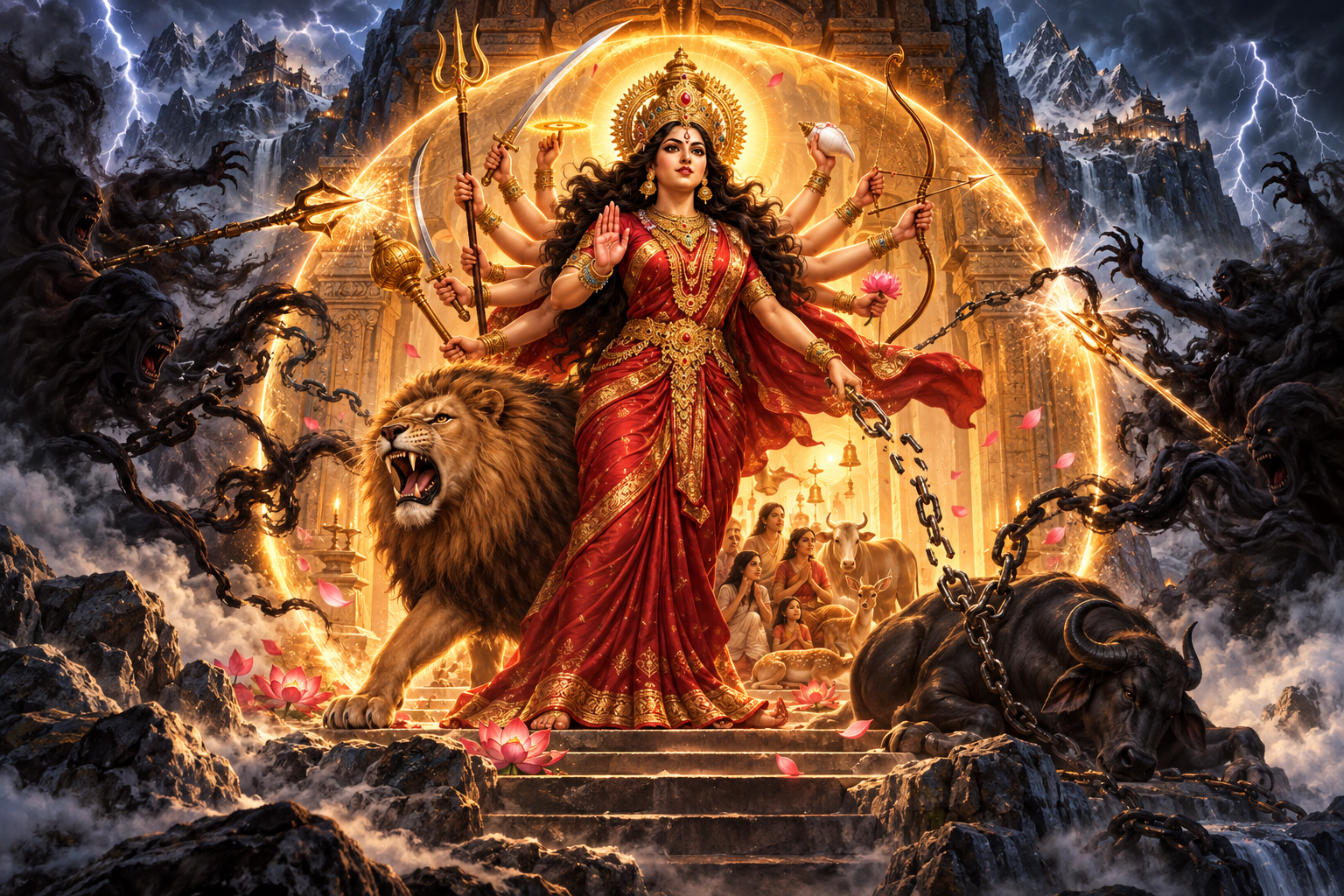
The slaying of Mahishasura can trouble a reader who approaches the Divine Mother only through gentleness. Shakta vision does not confine motherhood to softness. A mother who nourishes life must also oppose what devours it. Protection sometimes appears terrible from the standpoint of the force being restrained.
At the cosmic level, Devi’s weapon-bearing form establishes a boundary that adharma cannot cross indefinitely. At the spiritual level, the same power cuts through false identity. What feels like destruction to the ego can be liberation for the deeper self.
Keep the two levels distinct. The myth does not authorize a human being to label an opponent “asuric” and imitate divine violence. Devi’s cosmic function is not a licence for anger, vigilantism, self-harm, or harm to another person. In human conduct, the actionable lesson is to stop enabling adharma, accept necessary correction, and relinquish the inner tendencies that repeatedly place you in conflict with truth.
This distinction also protects the story from being reduced to a slogan about destroying your “inner demons.” Mahishasura is an antagonist within a sacred narrative, not merely a modern psychological metaphor. The inward application becomes fruitful when it grows from the theological meaning rather than replacing it.
Key takeaways for reading and practice
- Read the births as one arc. The sequence is not three disconnected battles but a movement from ignorance through emerging devotion to salvation.
- Distinguish correction from transformation. An outward defeat can stop an act while leaving its inner cause intact; watch what returns after consequences have passed.
- Test devotion by what it changes. Religious feeling matures into bhakti when it makes pride, appetite, and self-will answerable to dharma.
- Do not confuse grace with approval. Mahishasura’s ultimate release does not excuse adharma. Devi both ends the destructive condition and refuses to reduce a soul to that condition forever.
- Let recurrence sharpen your attention. When the same fault returns, identify the defended identity beneath it instead of merely changing the circumstances around it.
The next time you contemplate Mahishasura beneath Devi’s power, ask more than who won the battle. Ask what in him had to return, what began to turn toward the Mother, and what finally came to an end. Then bring the same questions to one pattern in your own life that consequences have interrupted but not yet transformed.
References

Leave a Reply
You must be logged in to post a comment.