
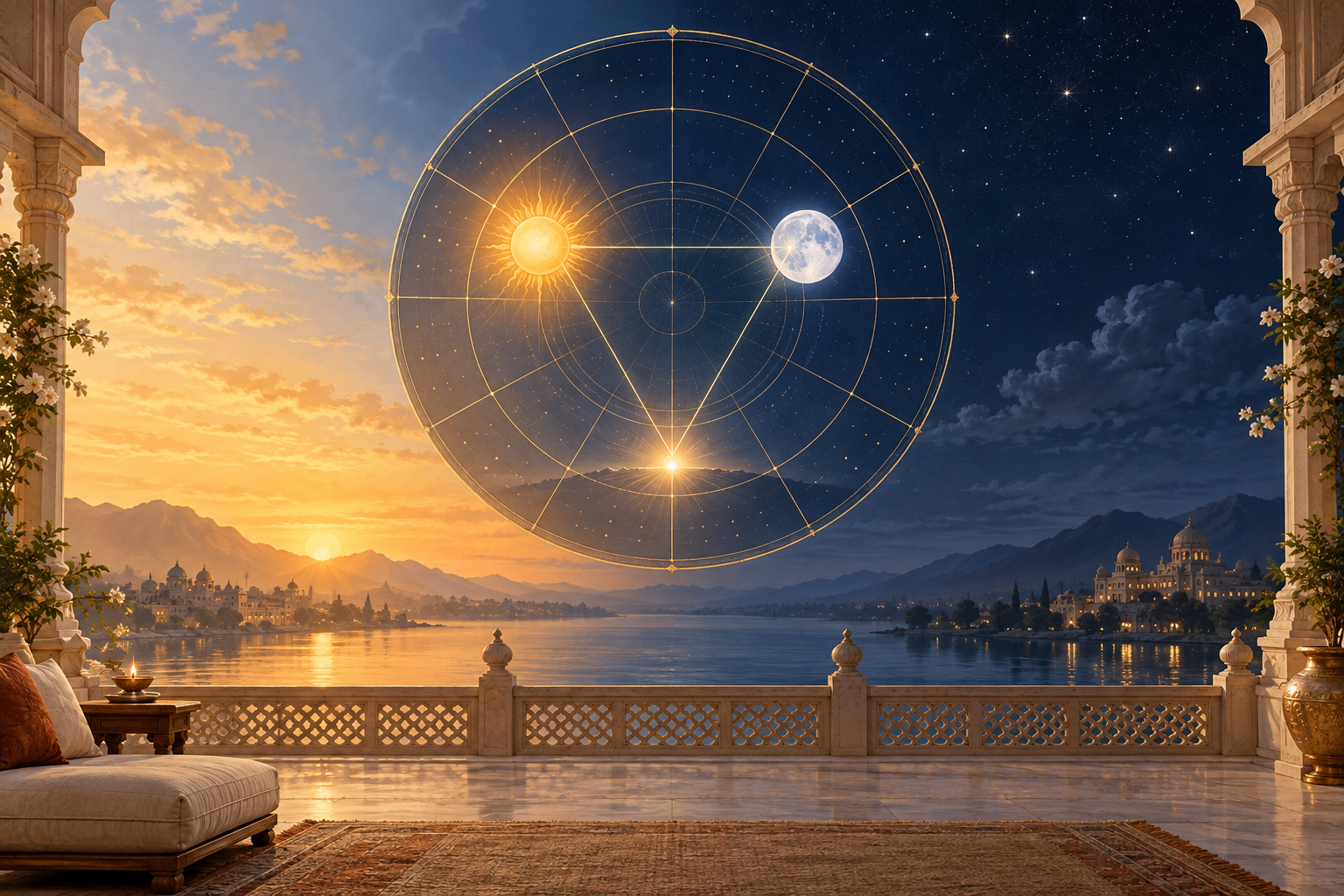
If an astrologer has told you that you have Mahabhagya Yoga, the first question is not, “How rich will I become?” It is, “Was the combination tested correctly?” One favorable placement is not enough, and the rule is different for male and female births.
You can check the basic formation yourself. You need the local day-or-night status of the birth and three chart placements: the Lagna, the Sun, and the Moon. Once those facts are on the page, the test is simple. Interpreting what it promises requires more restraint.
The exact combination you are checking
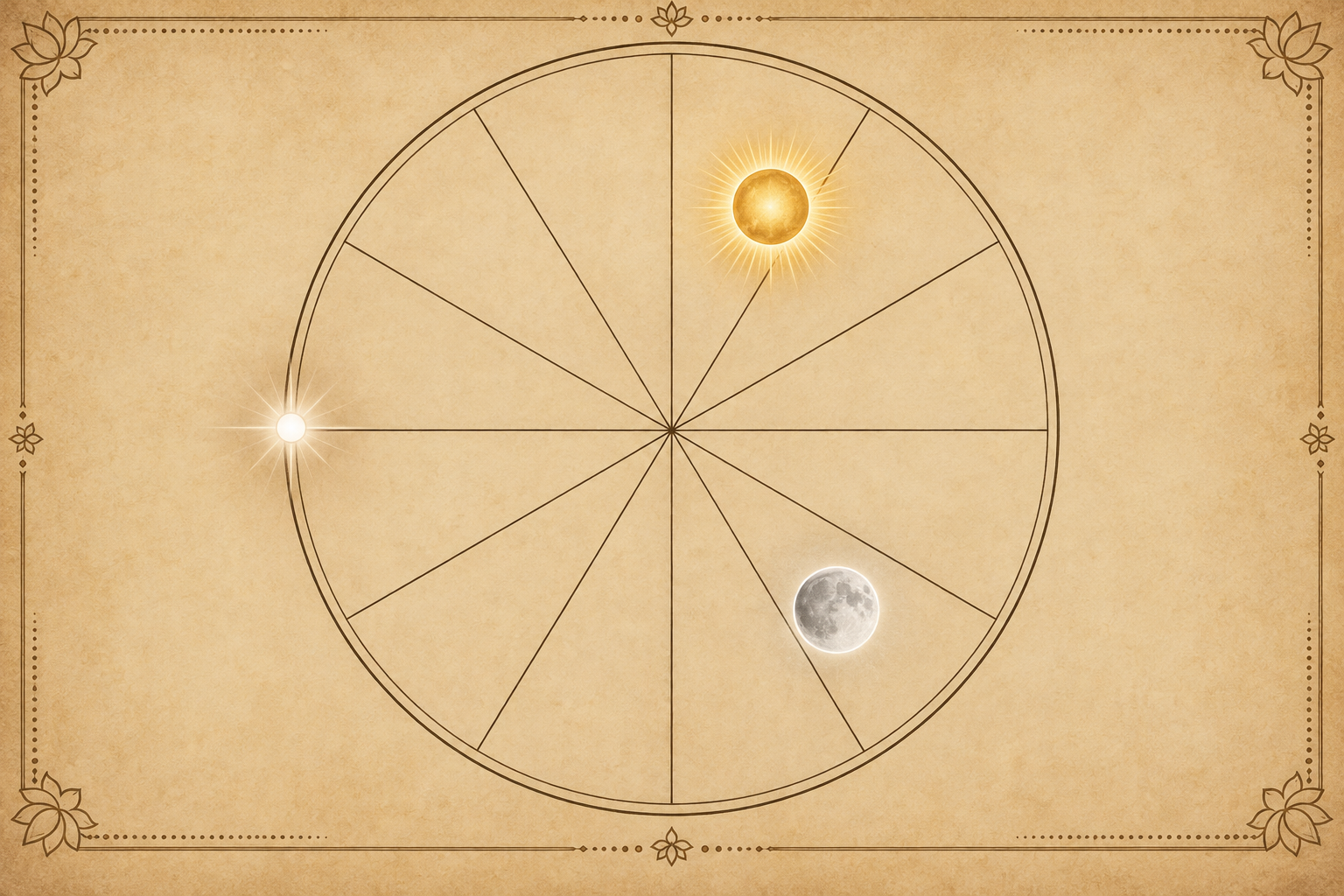
Mahabhagya Yoga, a name commonly rendered as “great fortune yoga,” is treated as a rare Vedic astrology combination associated with wealth, happiness, and success. Its traditional formation depends on the native’s sex, whether the birth occurred during the day or night, and the odd-or-even signs occupied by the Lagna, Sun, and Moon.
| Traditional case | Birth condition | Required chart placements |
|---|---|---|
| Male native | Day birth | Lagna, Sun, and Moon must all occupy odd-numbered signs |
| Female native | Night birth | Lagna, Sun, and Moon must all occupy even-numbered signs |
The odd-numbered signs are Aries, Gemini, Leo, Libra, Sagittarius, and Aquarius. The even-numbered signs are Taurus, Cancer, Virgo, Scorpio, Capricorn, and Pisces. Number the zodiac from Aries as the first sign and the pattern becomes easy to see.
- Odd signs: Aries, Gemini, Leo, Libra, Sagittarius, Aquarius.
- Even signs: Taurus, Cancer, Virgo, Scorpio, Capricorn, Pisces.
Every condition in the relevant row must be satisfied. A man born during the day with an odd-sign Lagna and Sun but an even-sign Moon does not have the yoga under the strict rule. Nor does the odd-sign pattern form Mahabhagya Yoga for a man born at night. The birth condition and all three placements belong to one test.
“Planetary combination” is convenient shorthand, but it is not completely literal. The Sun and Moon are grahas in Jyotisha, while the Lagna is the ascendant: the sign rising on the eastern horizon at birth. That distinction matters because the Lagna is highly sensitive to birth time.
How to verify Mahabhagya Yoga without a false positive
Use this sequence rather than searching a chart report for the yoga’s name. Automated reports can hide the assumptions behind a result; the placements let you see the logic.
- Confirm the birth data. You need the birth date, recorded time, and location. An uncertain time can make the Lagna uncertain, especially when it is close to changing signs.
- Generate one consistent Jyotisha chart. Record the calculation settings used by the astrologer or software. Do not copy the Sun from one chart, the Moon from another, and the Lagna from a third chart calculated under different conventions.
- Determine whether the birth was during the day or night. Use local sunrise and sunset for the birth date and place. “AM” does not automatically mean night, and “PM” does not automatically mean day.
- Write down the three signs. Make a one-line record: Lagna sign, Sun sign, and Moon sign. Do not substitute the Lagna lord, Moon’s nakshatra, or the Sun’s house for the required sign placements.
- Classify all three signs as odd or even. For a male day birth, all three must be odd. For a female night birth, all three must be even.
- Mark boundary cases as uncertain. If the birth occurred close to sunrise or sunset, or the Lagna is close to a sign boundary, verify the data before declaring the yoga present.
Consider a hypothetical man born during daylight with Leo rising, the Sun in Gemini, and the Moon in Sagittarius. All three are odd-numbered signs, so the basic combination is present. Change only the Moon to Capricorn, an even-numbered sign, and the strict formation fails.
For a hypothetical woman born at night, Taurus rising with the Sun in Virgo and Moon in Pisces satisfies the even-sign requirement. If the same chart belonged to a daytime birth, it would not satisfy the complete rule. These examples show why checking placements without checking the birth condition produces false positives.
The commonly stated rule is explicitly sex-specific. If the traditional male-or-female classification does not describe how you want your chart read, ask the practitioner to state the convention being used. Adapting the rule may be a considered interpretive choice, but it should not be presented as though no choice was made.
What the yoga can and cannot tell you

The traditional promise is favorable: wealth, happiness, and success. It is better to understand those words as areas of potential than as guaranteed events. The yoga’s presence answers one question—whether a particular configuration exists. It does not, by itself, settle how strongly the promise operates, when results may become visible, or what form success will take in a particular life.
A responsible interpretation separates four layers:
- Formation: Are the day-or-night condition and all three sign conditions actually met?
- Condition: What is the broader state of the Lagna, its lord, the Sun, and the Moon? A formally present yoga still belongs to the rest of the horoscope.
- Timing: Which planetary periods and other timing factors are relevant? A chart promise is not the same thing as a continuous result operating at equal strength throughout life.
- Expression: What do wealth, happiness, and success mean in this native’s circumstances and dharma? Material resources, social standing, family wellbeing, useful responsibility, and freedom to pursue worthy work are not interchangeable outcomes.
This distinction prevents two opposite errors. The first is fatalism: “The yoga is present, so success will arrive without effort.” The second is needless pessimism: “The yoga is absent, so good fortune is impossible.” Neither conclusion follows. The absence of one favorable configuration is not a negative yoga, and no single yoga exhausts a horoscope.
From a Dharmic perspective, bhagya does not cancel purushartha, or purposeful human effort. A fortunate configuration can be read as supportive potential; it is not permission to neglect discipline, ethics, education, or sound judgement. What you do with favorable circumstances remains part of the reading.
Because this yoga is associated with wealth and success, keep financial consequences outside the reach of astrological certainty. Do not borrow money, abandon secure income, make a concentrated investment, or promise a future windfall solely because the yoga appears in a chart. Test financial decisions against income, obligations, risk, and qualified advice. Astrology may supply a symbolic frame; it does not make losses impossible.
Questions that make an astrological reading more precise
If someone identifies Mahabhagya Yoga in your horoscope, ask for the reasoning in a form you can inspect. A careful practitioner should be able to answer these questions plainly:
- What are my Lagna, Sun, and Moon signs in the chart being used?
- Which of those signs are odd-numbered or even-numbered?
- Was my birth classified as a day birth or a night birth, and what local sunrise or sunset time supports that classification?
- Do all the required conditions match, or is the interpretation using a looser variant?
- How reliable is my recorded birth time, and could a small correction change the Lagna?
- Which features of the wider horoscope support, weaken, or redirect the yoga’s promised results?
- Is a statement being offered as a chart potential, a timing judgement, or a guaranteed event?
Be cautious when the answers remain vague while the prediction becomes increasingly specific. Claims about an exact amount of money, a guaranteed promotion, or an unavoidable life outcome require more certainty than the basic formation provides. Precision in tone is not a substitute for precision in the chart.
Key takeaways
- For a traditional male chart, Mahabhagya Yoga requires a day birth with the Lagna, Sun, and Moon all in odd-numbered signs.
- For a traditional female chart, it requires a night birth with the Lagna, Sun, and Moon all in even-numbered signs.
- All conditions must be present simultaneously; one mismatched sign or birth condition breaks the strict formation.
- Local sunrise and sunset matter more than the casual labels “AM” and “PM.”
- A reliable birth time is essential because the Lagna can change and alter the result.
- The yoga traditionally indicates favorable potential, not guaranteed wealth or effortless success.
Before accepting any prediction, ask the astrologer to write down the day-or-night classification and the three required placements. The basic test should fit on one line. Once it is verified, let the full horoscope—and your own disciplined action—determine how much weight the yoga deserves.
References

Leave a Reply
You must be logged in to post a comment.