
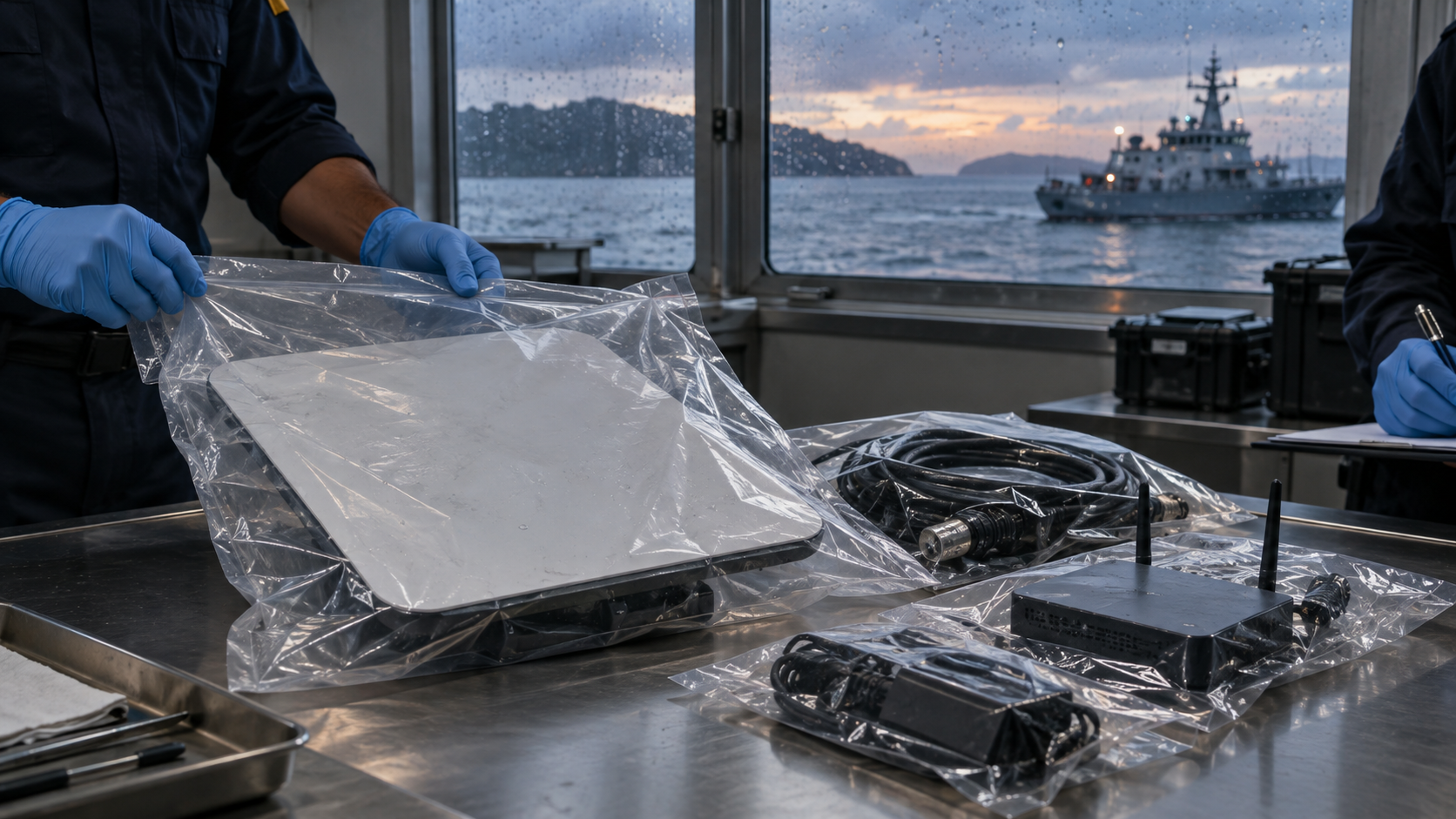
You may have seen a photograph of a seized Starlink terminal presented as proof of a sweeping national-security failure. That conclusion moves too quickly. A recovered terminal is important evidence, but it doesn’t by itself prove that the device was active, that it carried criminal communications, or that Starlink knowingly enabled the people who possessed it.
The distinction matters because Bharat has to make two decisions at once. Investigators must determine how satellite equipment entered a criminal operation, while regulators must decide whether a commercial network can satisfy India’s security requirements. You can judge both questions more clearly by separating possession, connectivity, criminal use and provider responsibility.
What the Andaman Sea seizure actually establishes
In November 2024, Indian authorities reportedly intercepted a Myanmar fishing vessel in the Andaman Sea. The vessel carried more than 6,000 kg of methamphetamine, valued at approximately ₹36,000 crore. The items recovered reportedly included foreign currency, satellite phones and a Starlink Mini terminal.
That establishes three material facts: Starlink-branded hardware was physically present; it was found with a very large narcotics consignment and other communications equipment; and the operation had a cross-border maritime dimension. The combination is serious enough to justify a full communications and financial investigation.
Those facts alone don’t establish whether the terminal was provisioned, connected during the voyage or used to coordinate the consignment. They also don’t identify its subscriber, purchaser, payment method, country of activation or route into the vessel’s possession. Nor do they prove that Starlink knew about, approved or assisted the alleged conduct.
This is the first discipline to apply whenever you encounter a similar claim: don’t turn the presence of an object into a complete account of how it was used. Investigators should treat the terminal as a potentially valuable evidentiary gateway. Readers should treat it as a confirmed recovery whose operational role still has to be demonstrated.
Four evidence levels separate a recovery from culpability
The phrase “Starlink was used” can conceal several different claims. Each requires its own evidence. If a report doesn’t tell you which level has been established, its conclusion is probably stronger than its disclosed facts.
| Evidence level | What investigators need | What it would establish |
|---|---|---|
| Hardware recovery | Device identification, serial number, photographs and an intact chain of custody | A particular terminal was present at the location |
| Active connectivity | Provisioning status, relevant session records and timestamps matched to the operation | The terminal connected to the network during a material period |
| Criminal or insurgent use | Forensic artefacts, communications, location evidence or operational links to named participants | The connection supported planning, coordination or another part of the unlawful activity |
| Provider or regulatory failure | A defined legal obligation, a documented request or control requirement, and evidence that it was not met | A compliance failure attributable to the provider rather than merely to the device holder |
A clear image of a terminal may satisfy the first level and nothing more. An active subscription may satisfy part of the second without proving what travelled over the connection. Even verified criminal use doesn’t automatically prove provider complicity; ordinary communications systems are routinely misused without their operators sharing the user’s intent.
The reverse is also true. A provider cannot dismiss a recovery as irrelevant merely because its corporate intent hasn’t been implicated. Serial-number mapping, subscriber verification, preservation of relevant records and timely responses to lawful orders may determine whether Indian authorities can identify a trafficking network. That is why compliance capability has to be tested before a crisis, not improvised after a seizure.
Why equipment can surface before a service is fully licensed
A licensing boundary isn’t a physical wall. It governs lawful sale and operation inside a jurisdiction, but a portable terminal can still be purchased elsewhere, transferred between users or carried across a land or maritime border. Its presence in India therefore doesn’t prove that it entered through an authorised Indian retail channel.
It doesn’t prove that it connected successfully either. Satellite internet still requires compatible hardware, power, an adequate view of the sky and service authorisation from the network. A terminal that is deactivated, damaged or outside its permitted service area may be little more than cargo. Investigators have to verify its state rather than infer it from the logo.
When the system does work, its operational appeal is easy to understand. A mobile telephone depends on terrestrial coverage. Satellite connectivity can reduce dependence on nearby towers, making it potentially useful on remote sea routes, in border terrain or in sparsely connected areas. Smugglers may value it for continuity of communication. An insurgent group may value the same characteristic for resilient command and logistics. These are risk scenarios, not proof that any particular seized device served those purposes.
This also explains why simply prohibiting lawful domestic sales cannot be the whole security strategy. If equipment can arrive from outside the licensed market, India needs border enforcement, device-level traceability and cross-border cooperation alongside telecom regulation. Otherwise, legitimate customers face restrictions while illicit operators continue searching for foreign or black-market access.
India’s licensing test should begin with hostile-use scenarios
Commercial demand, competitive pricing and connectivity for remote communities all belong in a licensing decision. None answers the security question. Before granting operational permission, Indian authorities need verifiable answers about how the network behaves when a terminal is stolen, imported unofficially, registered through false credentials or recovered from a trafficking or insurgency operation.
The unresolved debate includes whether Starlink can meet India’s conditions for lawful access and monitoring of satellite communications. A company’s objection to regulatory delay doesn’t settle that issue. Equally, the recovery of branded hardware doesn’t settle it against the company. The proper test is documented, auditable compliance.
At minimum, a security-ready licensing review should require clear answers to these questions:
- Can every authorised terminal be mapped promptly to a verified subscriber, account history and payment trail?
- What controls govern activation, roaming and use by a terminal carried across an international boundary?
- How quickly can a reported stolen, diverted or illegally operated terminal be suspended after lawful verification?
- Can relevant records be preserved when an authorised Indian agency presents a legally valid request?
- Can the provider support lawful access and monitoring requirements without creating an unrestricted surveillance system?
- Are resellers, importers and account transfers subject to controls strong enough to prevent anonymous chains of possession?
- Will compliance failures be logged, independently auditable and tied to enforceable consequences?
The fifth question is especially important. National security doesn’t require a choice between investigative capability and civil liberty. Security powers should have a defined legal basis, limited scope, recorded authorisation and meaningful audit. From a Dharmic perspective, this is part of rajadharma: the state must protect the innocent from predatory networks while restraining arbitrary power over the innocent.
India should also judge performance over the whole incident lifecycle. Subscriber checks before activation matter, but so do emergency preservation, lawful disclosure, suspension, post-incident review and remediation. A provider that performs only the onboarding step hasn’t solved the security problem.
Key takeaways
- A seized terminal proves physical possession, not active connectivity or criminal use.
- The November 2024 Andaman Sea interception is significant because a Starlink Mini was reportedly recovered with more than 6,000 kg of methamphetamine and other communications equipment.
- Serial numbers, subscriber records, timestamps and device forensics are needed to move from recovery to operational attribution.
- The absence of full domestic permission doesn’t make cross-border possession physically impossible.
- Criminal misuse doesn’t by itself prove provider complicity, but it does make traceability and timely lawful cooperation essential licensing questions.
- India should demand auditable security controls while keeping access powers specific, lawful and proportionate.
When the next seizure claim appears, look for four things before accepting its conclusion: the terminal’s identity, its activation status, its connection records and its link to the alleged operation. If those elements are missing, say plainly that the case remains unresolved. Bharat need not approve a strategic communications network under commercial pressure, and it need not rely on guilt by association to reject one. It can insist on the harder and sounder standard: demonstrated security compliance backed by evidence.


References

Leave a Reply
You must be logged in to post a comment.