

If you are planning to attend a Dandiya event in Goa, do not assume that a social-media message, campaign demand or rule at one venue applies everywhere. The useful question is narrower: what has the mandal running your event actually announced, and what will its volunteers ask you to do at the entrance?
The known development is that the Hindu Rashtra Samanvay Samiti asked Goa’s Navratri mandals to check identity cards and apply tilak at entry, while denying admission to people who do not believe in murti puja, do not apply tilak or do not chant “Vande Mataram”. Those are proposed conditions for mandals to adopt. The request does not, by itself, establish a uniform rule across Goa, a government order or actual enforcement at every Dandiya venue.
Key takeaways
- The proposal contains four distinct checks: identity verification, tilak, chanting “Vande Mataram” and belief in murti puja.
- A request addressed to Navratri mandals becomes a venue rule only when the responsible organizer adopts and communicates it.
- Before leaving home, ask your specific venue which conditions are mandatory and whether a ticket holder who declines them will be refused entry.
- If you organize a Dandiya, publish the conditions before registration or ticket sales rather than introducing them at the gate.
- The accompanying demand for an anti-conversion law is a separate political and legislative demand. It is not proof that the proposed entry checks are required by an existing law.
A campaign request is not yet a venue rule
Four stages must be kept separate when you assess a claim about Dandiya admission:
- An organization asks mandals to adopt specified conditions.
- An individual mandal decides whether to adopt some or all of them.
- The mandal tells prospective guests what will be required.
- Entrance staff apply the announced conditions at the venue.
The public information establishes the first stage. It does not supply a venue-by-venue adoption list. If a forwarded message says that “Goa Dandiya events” have one common policy, ask for the official notice from the named organizer before changing your plans.
The four proposed checks also work differently. An identity card is a document. Applying tilak and chanting are observable acts. Belief in murti puja is inward and cannot be reliably established from a person’s name, clothing or appearance. A mandal considering the proposal therefore has to answer more than a yes-or-no question: it must decide what each condition means, who applies it and how disagreements will be handled.
Do not treat publicity about a proposal as confirmation of enforcement. Look for a notice naming the mandal, venue and event. If the wording is vague, contact the organizer through the number or account printed on its own event page or ticket.
What to confirm before you attend

Ask one direct question in writing: Does this event require photo identification, tilak, chanting “Vande Mataram” or a declaration of belief in murti puja, and will a person who declines any of these be refused entry? That wording prevents a general answer such as “normal checks apply” from hiding the part that affects your decision.
- Check the organizer’s official ticket, registration page or announcement. Confirm that it names the same venue and date as your booking.
- Ask which identity document will be accepted and whether staff merely inspect it or retain any details. Do not send an identity-card image to an unverified account.
- Ask whether tilak and chanting are mandatory admission conditions, part of an optional devotional observance, or simply encouraged.
- If you have already paid, ask what happens when a guest will not meet a condition that was not disclosed during booking.
- Keep the ticket, the published conditions and the organizer’s written answer together so that you are not relying on a forwarded screenshot at the gate.
If admission is refused, do not turn the entrance queue into a confrontation. Ask the responsible staff member to identify the condition, whether it was published in advance and how to request a refund or review. Preserve your own ticket and correspondence, along with the venue, time and exact explanation given. If you intend to challenge an exclusion on legal grounds, take those records to a lawyer familiar with Goa law; the campaign demand alone does not settle your rights or the organizer’s obligations.
How a mandal can protect sanctity without gate confusion
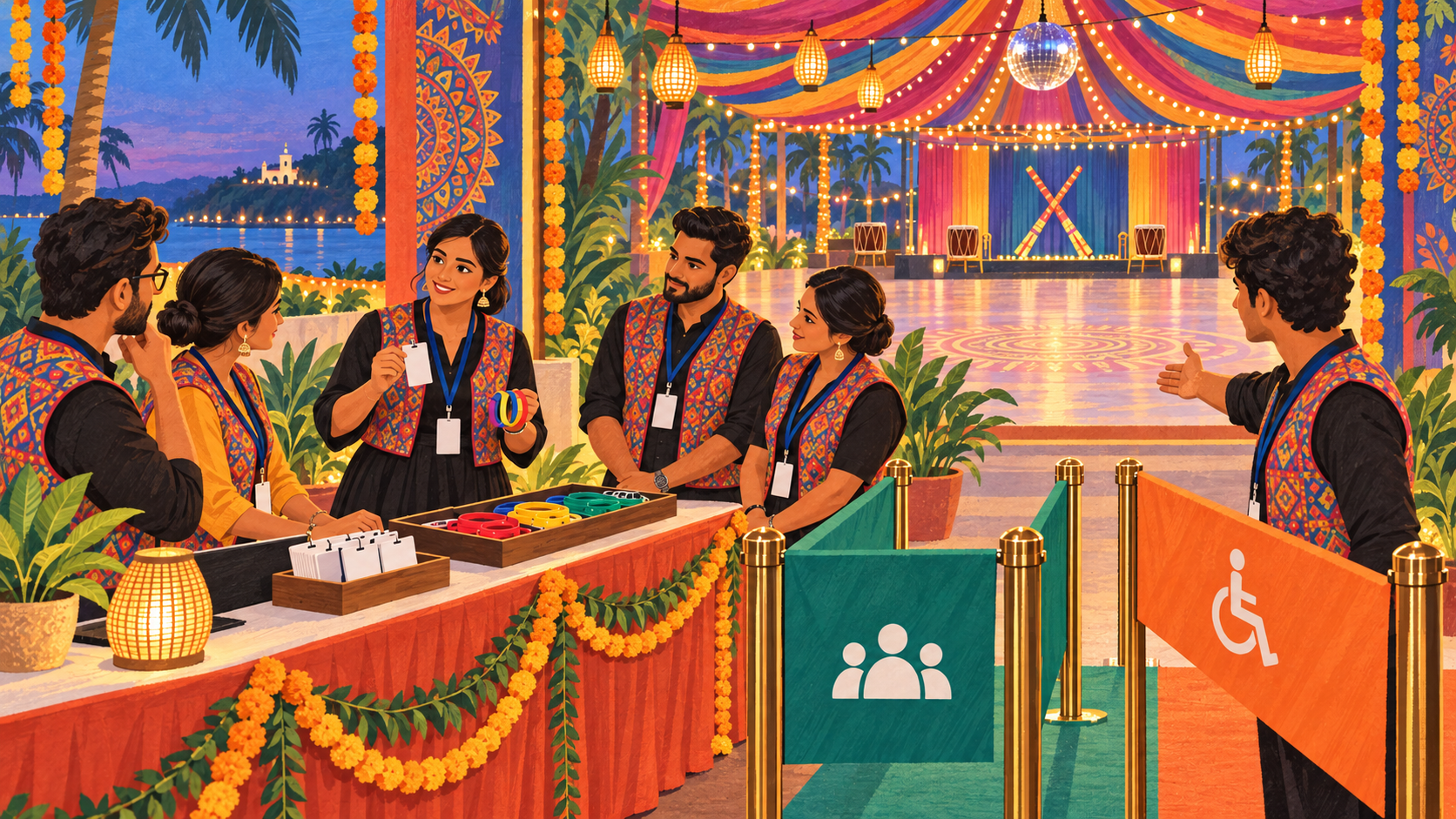
A Navratri mandal has a legitimate interest in preserving the devotional character and decorum of its celebration. That purpose is served most credibly by clear stewardship. Guests should know before they register whether they are entering a religious observance with required practices, a public cultural dance with devotional elements, or an invitation-only community gathering.
If your mandal is considering the proposed checks, settle these operational questions before volunteers take their places:
- State the event’s religious character, expected conduct and mandatory admission conditions in the same place where registration occurs.
- Explain why identification is checked, which documents qualify, who may inspect them and whether any information is recorded.
- Say plainly whether tilak is applied by the mandal, applied by the guest or optional. Do not leave volunteers to invent different standards.
- Define whether chanting “Vande Mataram” is a scheduled collective observance or an individual entrance test.
- Do not ask gate staff to infer belief in murti puja from names, accents, dress or appearance. If belief is made a condition, obtain legal advice on the wording and method before publishing it.
- Give volunteers one escalation contact for disputed admissions. The queue is not the place for an improvised theological examination.
- Provide a visible contact and refund process for people who bought access before a condition was disclosed.
Security screening and religious participation should not be blurred. A pass or identity check answers who is entering. A tilak, chant or profession of belief addresses participation in the event’s religious culture. If both are required, label them accurately. Clear language lets sympathetic guests prepare, lets unwilling guests opt out before travelling and prevents volunteers from carrying the entire dispute at the door.
Any exclusion tied to religion or belief can raise questions that depend on the event’s structure and applicable law. A mandal should obtain advice from a qualified local lawyer before announcing such a policy. It should never tell guests that a condition is legally required unless it can identify the official legal text and the authority that issued it.
Do not confuse the anti-conversion demand with entry policy
The Hindu Rashtra Samanvay Samiti also called for an anti-conversion law in Goa. That is a demand for legislative action, distinct from its requested Dandiya entry conditions. A call for a law cannot by itself be cited as present legal authority for identity, tilak, chant or belief checks.
If someone claims that a Dandiya condition is mandated by law, ask for the exact name of the legal instrument, the issuing authority, the relevant provision and its effective date. Without that information, treat the statement as an organizer’s policy or an advocacy position rather than a verified legal requirement.
Before attending, get the rule from your own venue and decide whether you are willing to follow it. Before organizing, publish one precise policy, have it legally reviewed where belief-based exclusion is contemplated, and train every entrance volunteer to apply the same announced standard. That preparation protects the dignity of the celebration far better than a surprise argument at the gate.
References

Leave a Reply
You must be logged in to post a comment.